


Learn Catalan: Pronunciation, Culture and Resources

Full disclosure: This post contains affiliate links. ?
Catalan is spoken by millions of people across several territories. Learning it gives you direct access to local conversations, media and culture in Catalonia, Valencia, the Balearic Islands, Andorra, parts of southern France and Alghero in Sardinia.
Want to hear how Catalan fits into a real language-learning project? Follow @languagehacking on Instagram and have a look at this update from the Balearic Islands.
A note from the Fluent in 3 Months team before we get started: You can chat away with a native speaker for at least 15 minutes with the “Fluent in 3 Months” method. All it takes is 90 days. Tap this link to find out more.
Table of contents
- Why Learn the Catalan Language
- Catalan and Its Modern History
- How Familiar Will Catalan Feel?
- Catalan Sounds You May Recognise from Spanish
- Unique Letters and Sounds in Catalan Pronunciation
- Current Catalan Courses and Resources
- Catalan Courses in Catalonia
- Practise Catalan with Native Speakers
- Begin Your Catalan Adventure
Why Learn the Catalan Language
First, you’ll be introduced to some beautiful places. The majority of Catalan speakers are found in Catalunya (often referred to as “Catalonia” in English), in the northeastern corner of Spain, a place where you can both laze on idyllic beaches and climb dramatic mountains.
Catalan is also spoken in the Mediterranean paradises of the Balearic Islands and the city of Alghero in Sardinia, Italy. A variant is also spoken in Valencia, Spain, home of the world-famous paella.
There are Catalan speakers in southern France along the border with Catalunya. Catalan is also the national language of Andorra, a tiny country tucked high into the breathtaking Pyrenees mountains.
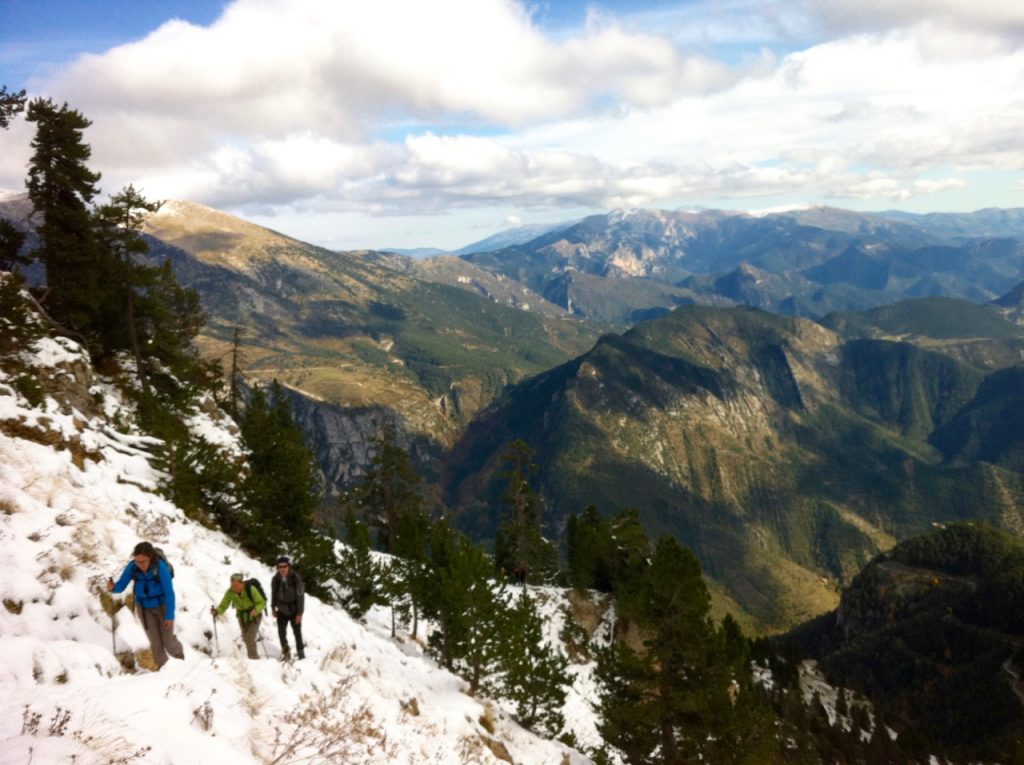
When you learn the Catalan language, you get greater access to the Pyrenees – full of climbing, trekking, paragliding and skiing routes. You will also be able to navigate magnificent Mediterranean islands and beaches, lovely countryside, and vibrant cities.
You’ll be able to fully appreciate many historic sites leftover from the Greeks, Romans, Moors, and the many other peoples who invaded these historically sought-after lands.
You’ll meet some great people, get to know their rich cultural history, and desirable way of life.
Famous Catalans include artists Salvador Dalí and Joan Miró, cellist Pablo Casals, architect Antoni Gaudí, and chef Ferran Adrià.

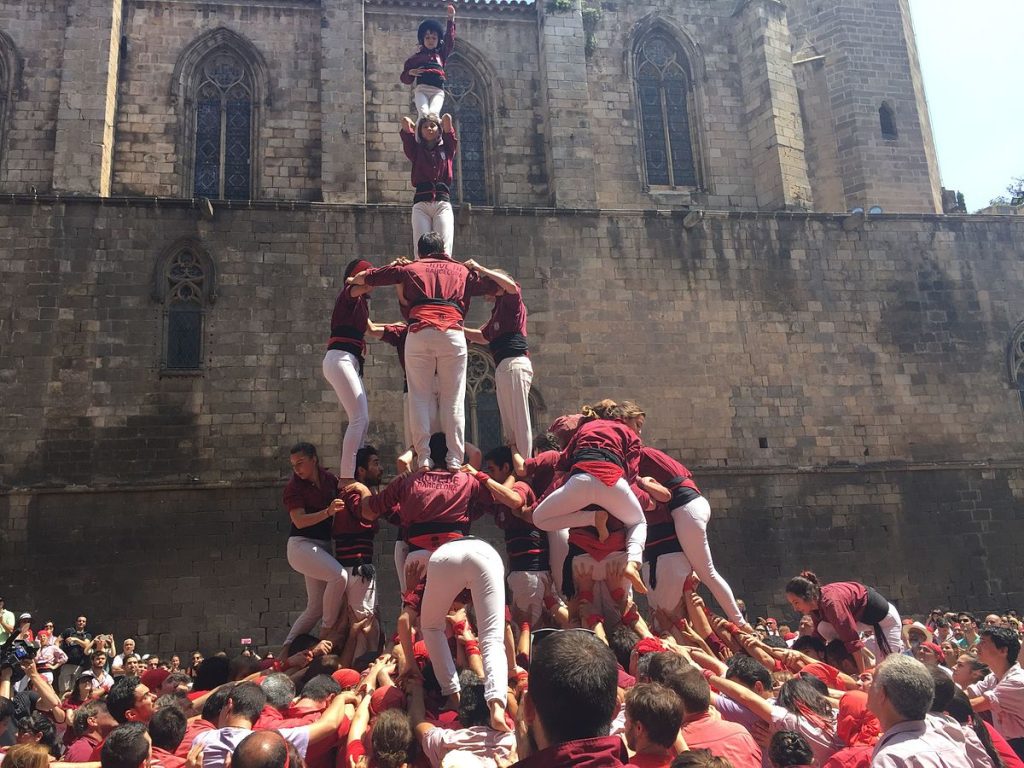
Spain. Photo credit: Georges Jansoone
The gorgeous, friendly and culturally vibrant seaside city of Barcelona is the capital of Catalunya. It has great architecture, fabulous restaurants and lively festivals, such as La Mercè, a city-wide, multi-day party every September featuring free cultural and music events.
Catalans are known for their delicious Mediterranean cuisine. (Many say that, in Spain, their only rival in regional cuisine are the Basques). The recipes are simple; what makes them so outstanding are the tasty and fresh ingredients, including delectable olive oil, seafood, tomatoes, cheeses and charcuterie.
The wine and cava (Catalan sparkling wine) also excellent – and very affordable. This is a place to savour your food and drink in the sunshine.
Finally, they have an awesome soccer team!
Catalan and Its Modern History
If you’re going to learn Catalan, there is some important cultural and political background that you should know.
Catalunya is officially considered an “autonomous community” within Spain. It has its own government which includes, for example, its own president, parliament and police force.
This democratic political set-up has been in place since 1978, three years after Spanish dictator Francisco Franco died.
A couple of important notes about this:
During Franco’s dictatorship, the state restricted public and official use of Catalan, although many families continued speaking it. Since Spain’s transition to democracy, Catalan has returned to schools, media and public institutions.
Language use still varies by place, age and situation, so do not assume that everyone outside Barcelona speaks only Catalan or has weak Spanish.
Catalonia’s relationship with Spain remains politically contested. Catalan language and culture matter to people across a range of political views, so speaking Catalan or joining a cultural activity does not by itself identify someone’s position on independence.
How Familiar Will Catalan Feel?
Catalan can feel familiar if you already speak another Romance language, but its pronunciation, grammar and regional varieties still take practice.
Many people mistake Catalan for a dialect of Spanish. It is a distinct Romance language with its own history, standard forms and regional varieties.
Catalan is a Romance language, so Spanish, French, Italian or Portuguese can give you useful vocabulary and grammar connections. It is not simply closer to French than Spanish in every respect: the similarities depend on the feature and the word.
That being said, however, many people – like me – come to Catalan by way of wanting to learn Spanish. I know I am not the first person to land on Barcelona’s sunny shores ignorantly expecting to practise my Spanish – only to learn that the dominant language here is Catalan.
Like many people who visit Catalunya, I fell in love with the culture and lifestyle and ended up staying. (In my case, I literally fell in love with a Catalan farmer, and married him!)
Spanish is my strongest second language. Japanese is the language of my father’s family, so I also grew up exposed to it. I’ve taken beginner courses in Japanese, French, and Arabic.
I know, especially from trying to learn Arabic, that when picking up a new language it helps to link new vocabulary and grammar rules with what you already know. Arabic was very difficult because I felt like I had nothing to “hook” the words to in my brain.
No similarities or associations to help me remember.
By contrast, thanks to having lots of Spanish and a little French, I had plenty of “hooks” for Catalan. It was very “sticky” – plus I really like the way Catalan sounds. It’s not as musically effusive as Spanish. It’s more emphatic like French.
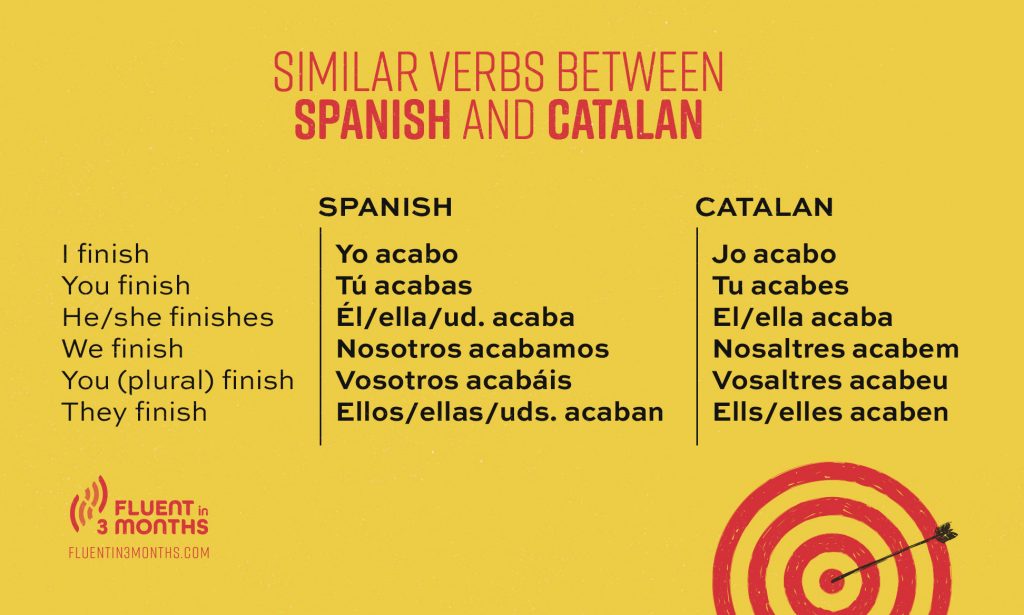
There are plenty of examples of verbs that are similar or the same in Spanish and Catalan, and in French and Catalan.
Here are a few for Spanish:
- Acabar – to end, to finish
- Cantar – to sing
- Caminar – to walk
- Estar – to be
- Poder – to be able to
- Saber – to know
- Ser – to be
Yet the verb conjugations are quite different. See with example of the verb “acabar”:
And here are some of the similar verbs between French and Catalan:
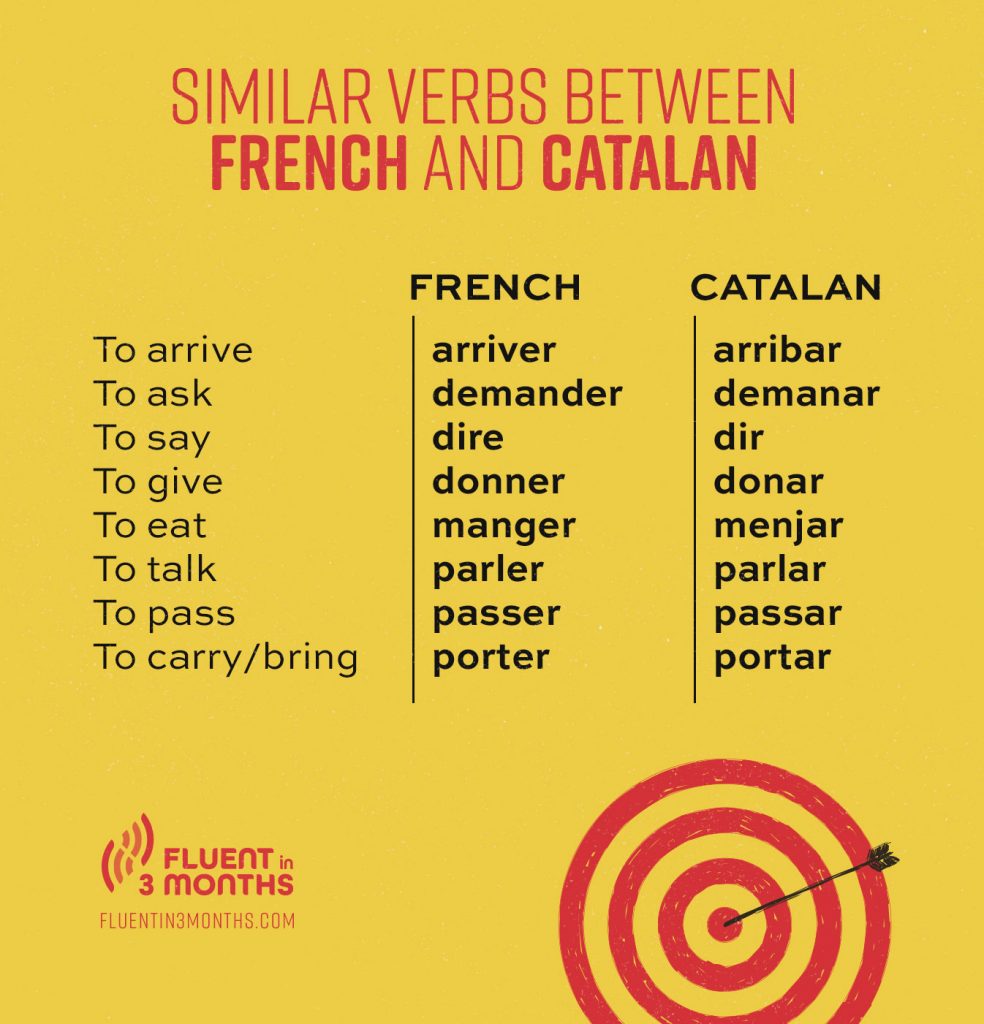
See how many similarities you’ll find if you speak another Romance language? Easy!
Catalan Sounds You May Recognise from Spanish
Before we dive into the unique letters and sounds found in Catalan, it’s worth mentioning a few that you’ll already know if you speak Spanish.
The Rolled “R”
Like the Spanish, the Catalans roll their “R”’s.
The Sounds of “V” and “B”
In most Catalan speech, the letters “V” and “B” are pronounced the same, but some varieties distinguish them.
“NY” and Spanish “Ñ”
Catalan does not use ñ. It writes the same palatal nasal sound with ny, as in Catalunya and acompanyar.
For example, Catalans would spell their home, Catalunya – whereas the Spanish would spell it as Cataluña.
Another example: The word “to accompany” in Spanish is acompañar, whereas in Catalan it’s acompanyar.
Unique Letters and Sounds in Catalan Pronunciation
Maybe because I’m a writer and avid reader, I enjoy learning how to spell words in a new language. I love how Catalan introduced me to some totally new combinations of letters and sounds.
The Different Sounds of “X”
The letter x has several pronunciations in Catalan. At the start of xai, xocolata, Xile and Xina, it is commonly pronounced like English “sh”, not “ch”. Other positions can produce different sounds, so check a recording when you meet a new word.
How “G”, “J” and “-IG” Sound
The spellings g and j can represent a sound like the “s” in English “measure”. Final -ig in words such as Puig and vaig is commonly pronounced like “tch”. Exact pronunciation varies by dialect.
The Cedilla “Ç”
The “C” with the cedilla (the little tail underneath the “C”) is a Latin script letter. In Catalan, it’s a hissing “S” (as in “snake”).
For example, the verb “to begin” is començar, pronounced “comenssar.”
Or, take the word for “effort”, which is esforç, pronounced “esforss.”
This letter doesn’t occur very often in Catalan.
How to Pronounce “LL”
Catalan ll represents the palatal lateral /ʎ/ in the standard model, although many speakers use other pronunciations. English has no exact equivalent, so audio is more useful than spelling it as “yeuh”.
Put the middle of your tongue against the hard palate, keep the sides in contact and let the air pass around the tongue. Treat this as a starting point, then copy recordings from the dialect you are learning. An imperfect attempt does not make communication impossible.
If it makes you feel any better, some of my Catalan friends say that they had to practise making this sound over and over when they were kids. One even suggested sticking the tip of a pencil vertically inside my front teeth to properly train my tongue.
(Hey, that kind of works!)
How to Pronounce “NY”
Catalan ny represents /ɲ/, the same consonant written ñ in Spanish. It can appear before a vowel, as in Catalunya, or at the end of a word, as in bany. Say bany as one syllable without adding an extra vowel.
Current Catalan Courses and Resources
With the movement afoot to encourage more Catalan usage and speakers, you can benefit from some really great resources in learning the language – especially from the Generalitat de Catalunya (local government).
A useful starting point is Parla.cat, which offers online Catalan courses developed with support from the Generalitat de Catalunya.
Parla.cat offers self-study Catalan courses. Its current enrolment and tutoring options can change, so check the course page before registering.
The website’s design and functionality feels a little dated, but the materials and lesson plans are top-notch.
Catalan is also available through Duolingo for Spanish speakers. If you use that course, you will practise Spanish and Catalan together.
Catalan Courses in Catalonia
If you are able to actually spend some time in Catalunya, you can also take advantage of highly subsidized in-person classes offered by the Consorci per a la Normalització Lingüística.
CPNL offers courses across Catalonia. Course formats and prices change by level and location, so check the CPNL course finder for the current schedule, fee and any available discount.
These classes are an interesting sociological immersion as well, where you will meet fellow immigrants to Catalunya. In my classes there were people from other parts of Spain, China, Morocco, Dominican Republic, Ecuador and Venezuela.
Practise Catalan with Native Speakers
Catalans are accustomed to foreigners speaking Spanish or English, so if you strike up a conversation in Catalan, they will likely be both surprised and pleased.
Many people in Catalunya are also eager to learn English, so you should have no problem finding partners for language exchanges in person.
If you cannot travel to Catalonia, you can practise with a tutor through Preply; our Preply review explains how the platform works.
They’re platforms where you can find online tutors to have conversations wherever you are, whenever you can.
Begin Your Catalan Adventure
Are you learning the Catalan language?
Continue your adventures into català, and you’re likely to meet new people along the way. If you want a practical system for organising and reviewing vocabulary, Vocab Vault can help you turn useful Catalan words into regular retrieval practice.
Original article by Lisa Hoashi, updated by the Fluent in 3 Months team.

Social