


Chinese Numbers: Count from 0 to 1 Billion in Mandarin

Full disclosure: This post contains affiliate links. ?
Chinese numbers follow a reusable pattern. Learn the words from zero to ten, then add a few place-value words, and you can build numbers into the billions.
This guide covers Standard Mandarin, using simplified Chinese characters and Hanyu Pinyin. “Chinese numbers” is 中文数字 (zhōngwén shùzì).
I’ll start with the basic Chinese numbers, then show you the patterns for larger numbers, ordinals, dates and measure words.

A note from the Fluent in 3 Months team before we get started: You can chat away in Chinese for at least 15 minutes with the “Fluent in 3 Months” method. All it takes is 90 days. Tap this link to find out more.
Chinese Numbers 1–10
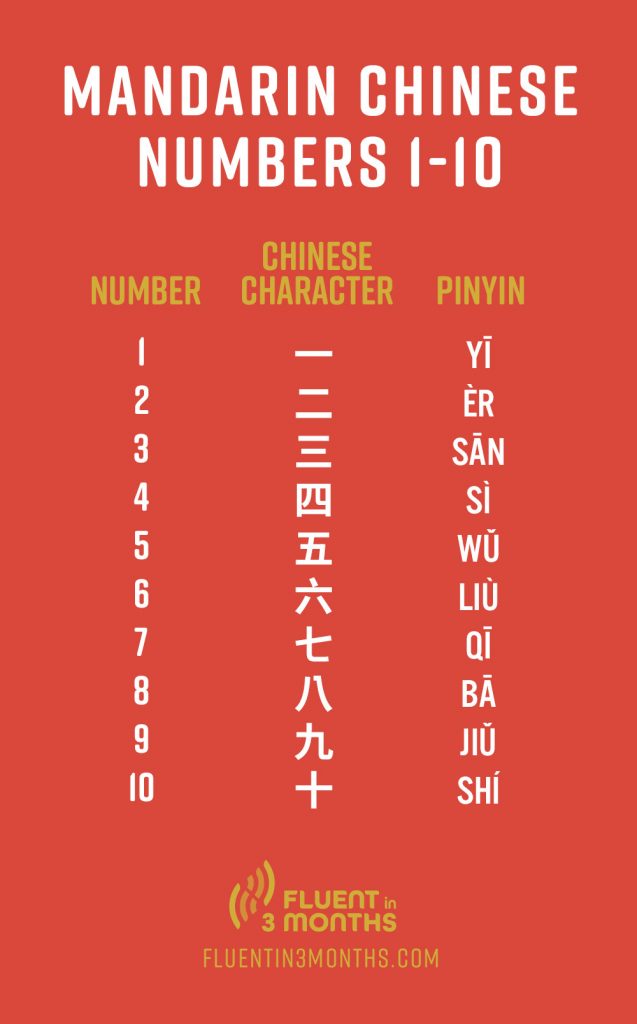
Here are the building blocks. You’ll see both Arabic numerals and Chinese characters in everyday life, so it’s useful to recognise both.
| Number | Chinese | Pinyin |
|---|---|---|
| 0 | 零 | líng |
| 1 | 一 | yī |
| 2 | 二 | èr |
| 3 | 三 | sān |
| 4 | 四 | sì |
| 5 | 五 | wǔ |
| 6 | 六 | liù |
| 7 | 七 | qī |
| 8 | 八 | bā |
| 9 | 九 | jiǔ |
| 10 | 十 | shí |
The pinyin in the tables follows standard spelling practice and shows the original tones. In connected speech, 一 (yī) generally changes to yí before a fourth-tone syllable and to yì before a first-, second- or third-tone syllable. It stays yī when said alone, as a final digit and in ordinals such as 第一 (dì-yī). Long number names have some position-dependent variation, so treat the table forms as spelling rather than a phonetic transcript. If tone changes are new to you, review this guide to Mandarin tones.
二 or 两 for “two”?
Mandarin has two common words for “two”. Use 二 (èr) for the number itself, in counting and in numbers such as 22. 两 (liǎng) is common before a measure word: 两个人 (liǎng ge rén), “two people”. You’ll also often hear 两百 (liǎngbǎi), “two hundred”, and 两千 (liǎngqiān), “two thousand”.
When people read a string of digits aloud, such as a phone, room or bus number, they may pronounce 1 as 幺 (yāo) so it is easier to distinguish from 7, 七 (qī). Keep 一 (yī) for ordinary counting and quantities.
You may also notice that 四 (sì), “four”, sounds similar to 死 (sǐ), “death”. Some Chinese-speaking communities therefore avoid 4 in certain settings, but the custom varies. It doesn’t change how you form or use the number.
Chinese Numbers 11–99
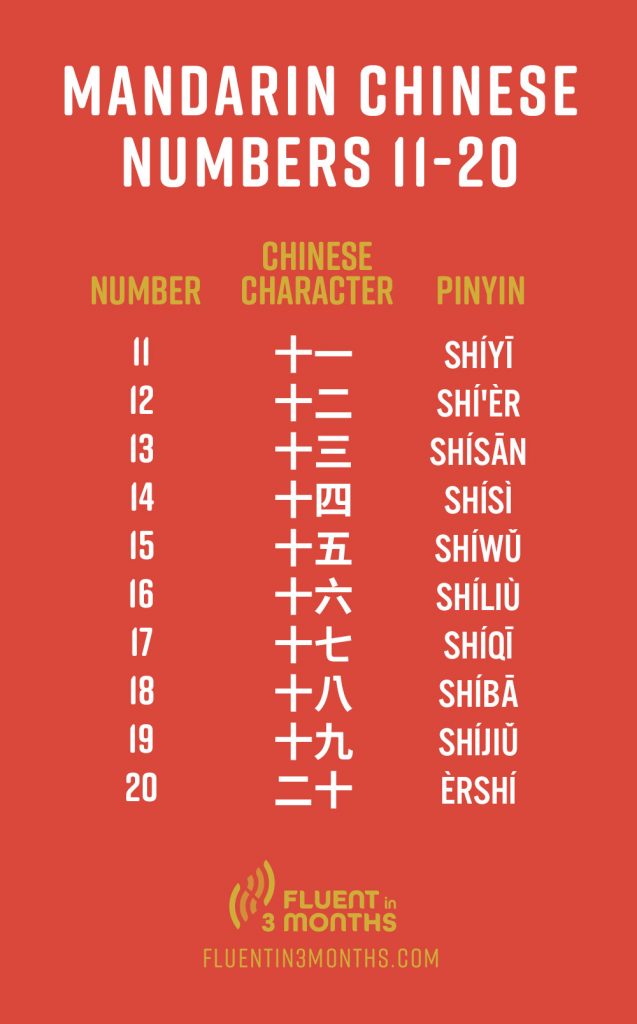
The pattern from 11 to 19 is “ten + digit”. So 11 is 十一 (shíyī), literally “ten-one”, and 19 is 十九 (shíjiǔ), “ten-nine”.
| Number | Chinese | Pinyin |
|---|---|---|
| 11 | 十一 | shíyī |
| 12 | 十二 | shí'èr |
| 13 | 十三 | shísān |
| 14 | 十四 | shísì |
| 15 | 十五 | shíwǔ |
| 16 | 十六 | shíliù |
| 17 | 十七 | shíqī |
| 18 | 十八 | shíbā |
| 19 | 十九 | shíjiǔ |
| 20 | 二十 | èrshí |
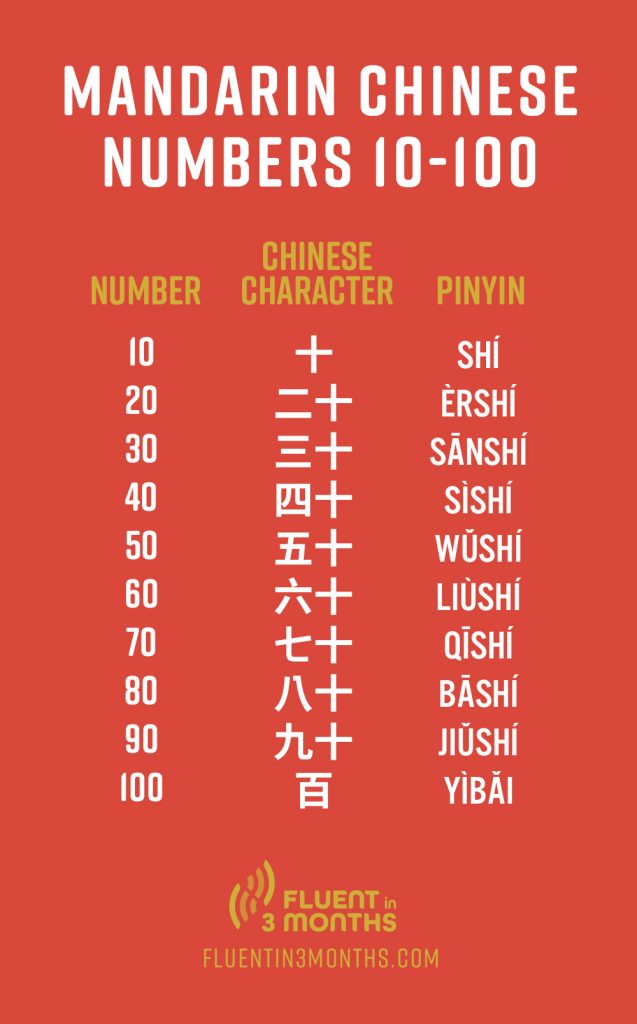
For the other tens, put the multiplier before 十 (shí): 二十 (èrshí) is 20, 三十 (sānshí) is 30 and 九十 (jiǔshí) is 90. Add the final digit when you need one:
- 21: 二十一 (èrshíyī)
- 33: 三十三 (sānshísān)
- 58: 五十八 (wǔshíbā)
- 96: 九十六 (jiǔshíliù)
This regular pattern is one reason I include numbers in my short guide, Why Chinese Is Easy.
Chinese Numbers 100–999
The word for 100 is 百 (bǎi). Build hundreds in the same order: multiplier + 百 + tens + units.
| Number | Chinese | Pinyin |
|---|---|---|
| 100 | 一百 | yībǎi |
| 110 | 一百一十 | yībǎi yīshí |
| 135 | 一百三十五 | yībǎi sānshíwǔ |
| 200 | 两百 | liǎngbǎi |
| 468 | 四百六十八 | sìbǎi liùshíbā |
| 999 | 九百九十九 | jiǔbǎi jiǔshíjiǔ |
Use 零 (líng) when a place in the middle is empty. For example, 101 is 一百零一 (yībǎi líng yī) and 105 is 一百零五 (yībǎi líng wǔ). For clear beginner speech, say every place-value word in numbers such as 110 and 130: 一百一十 (yībǎi yīshí) and 一百三十 (yībǎi sānshí).
One useful warning: 250 as a complete number is 二百五十 (èrbǎi wǔshí). The shortened expression 二百五 (èrbǎi wǔ) is also an informal insult for a foolish or reckless person, so don’t use it as a casual shortcut for the number.
Chinese Numbers 1,000 and Above
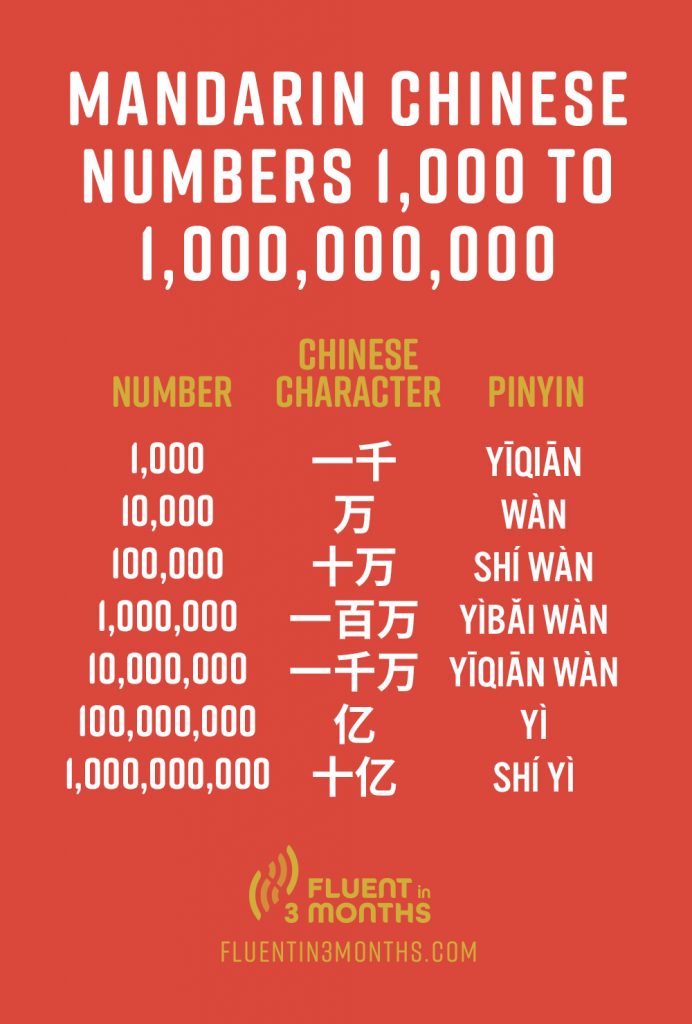
Now add 千 (qiān), “thousand”, 万 (wàn), “ten thousand”, and 亿 (yì), “hundred million”.
The big shift for English speakers is that Mandarin groups large numbers around units of four digits. One 万 is 10,000, and one 亿 is 100,000,000.
| Number | Chinese | Pinyin |
|---|---|---|
| 1,000 | 一千 | yīqiān |
| 10,000 | 一万 | yīwàn |
| 100,000 | 十万 | shíwàn |
| 1,000,000 | 一百万 | yībǎi wàn |
| 10,000,000 | 一千万 | yīqiān wàn |
| 100,000,000 | 一亿 | yīyì |
| 1,000,000,000 | 十亿 | shíyì |
The same zero rule applies across these groups. For example, 20,309 is 两万零三百零九 (liǎngwàn líng sānbǎi líng jiǔ). And 1,300,025 is 一百三十万零二十五 (yībǎi sānshí wàn líng èrshíwǔ).
Chinese Ordinal Numbers and Frequency
To turn a number into an ordinal such as “first” or “second”, put 第 (dì) before it:
- first: 第一 (dì-yī)
- second: 第二 (dì-èr)
- third: 第三 (dì-sān)
- 54th: 第五十四 (dì-wǔshísì)
To say how many times something happens, use 次 (cì), “time” or “occurrence”, after the number. 一次 is pronounced yí cì, “once”; 两次 (liǎng cì) is “twice”; and 三次 (sān cì) is “three times”.
Chinese Days of the Week and Months
Weekdays use 星期 (xīngqī) plus a number from one to six:
- Monday: 星期一 (xīngqīyī)
- Tuesday: 星期二 (xīngqī'èr)
- Wednesday: 星期三 (xīngqīsān)
- Thursday: 星期四 (xīngqīsì)
- Friday: 星期五 (xīngqīwǔ)
- Saturday: 星期六 (xīngqīliù)
Sunday is usually 星期日 (xīngqīrì) or 星期天 (xīngqītiān), rather than a numbered weekday.
Months are even more direct: put the month number before 月 (yuè), “month”. 一月 (yīyuè; usually pronounced yíyuè in connected speech) is January, 四月 (sìyuè) is April and 十二月 (shí'èryuè) is December.
Chinese Measure Words
When a number modifies a countable noun in Mandarin, you will usually put a measure word, also called a classifier, between them. It’s similar to saying “two cups of tea” in English, but Mandarin classifiers are used much more widely.
You don’t need a unique classifier for every noun. Learn common noun-and-classifier combinations as chunks, and use 个 (gè, often neutral ge in speech) as a useful general classifier when it is idiomatic.
| Measure word | Pinyin | Common use |
|---|---|---|
| 个 | gè | General classifier, including many people and objects |
| 本 | běn | Books and bound volumes |
| 张 | zhāng | Sheets and flat objects, including many tickets |
| 位 | wèi | Polite classifier for people |
| 杯 | bēi | Cupfuls or glassfuls of drinks |
| 双 | shuāng | Pairs |
| 把 | bǎ | Objects with handles, such as knives and umbrellas |
| 件 | jiàn | Items, matters and many pieces of clothing |
| 条 | tiáo | Long or flexible things, including rivers and trousers |
| 家 | jiā | Families, businesses and institutions |
| 辆 | liàng | Wheeled vehicles |
Here are four useful combinations: 一个人 (yí ge rén), “one person”; 两本书 (liǎng běn shū), “two books”; 三张票 (sān zhāng piào), “three tickets”; and 两辆车 (liǎng liàng chē), “two vehicles”.
Practise Chinese Numbers
Start by memorising zero to ten. Then practise building a few random two-digit numbers, followed by hundreds and numbers containing zero. Finally, read prices, dates, room numbers and quantities aloud so you meet the patterns in different contexts.
For your next step, learn a few basic Chinese words and combine them with the numbers and classifiers above. If you want a complete beginner course built around speaking from day one, take a look at Language Hacking Mandarin.
And if you want to compare number systems, try the Spanish numbers or Japanese numbers next.

Social