



How to Order Food in Mandarin: 40+ Chinese Restaurant Phrases

Full disclosure: This post contains affiliate links. ?
Ordering food in Mandarin gets much easier once you can recognise a few common dishes and make a clear request.
Menus vary by restaurant and region. Some include English or pictures; others are mainly in Chinese characters.
You may not see pinyin on the menu, so it helps to know the characters for the food you want. Our guide to Chinese characters can help you get started.
Below you’ll find more than 40 restaurant words and phrases in Simplified Chinese, with Mandarin pinyin and practical English meanings.
You can practise them wherever Mandarin is useful, whether that’s in China or at a local restaurant. Our Mandarin practice guide has more ideas.
Etiquette varies by region, restaurant and dining group, so use the cultural notes here as prompts to observe and ask rather than fixed rules.
A note from the Fluent in 3 Months team before we get started: You can chat away in Chinese for at least 15 minutes with the “Fluent in 3 Months” method. All it takes is 90 days. Tap this link to find out more.
Mandarin Phrases for Booking a Restaurant Table
Use these phrases when you call or visit a restaurant to reserve a table:
- 我想订一张五人桌 (wǒ xiǎng dìng yī zhāng wǔ rén zhuō) – “I’d like to book a table for five.”
- 有什么特殊的场合吗?(yǒu shénme tèshū de chǎnghé ma?) – “Is it for a special occasion?”
- 是我朋友的生日 (shì wǒ péngyǒu de shēngrì) – “It’s my friend’s birthday.”
- 您想订几点的位子?(nín xiǎng dìng jǐ diǎn de wèizi?) – “What time would you like to reserve?” 您 (nín) is a respectful form of “you”; the choice between 您 and 你 varies by relationship and service setting.
- 我想订六点的位子 (wǒ xiǎng dìng liù diǎn de wèizi) – “I’d like to reserve for six o’clock.”
- 好的,都给您订好了 (hǎo de, dōu gěi nín dìng hǎo le) – “Okay, it’s all booked for you.”
- 谢谢 (xièxie) – “Thank you.”
Reading a Chinese Menu: Common Dishes
Chinese cuisine covers many regional traditions, so a short list cannot represent every menu.
The cooking style, ingredients, portion size and serving format depend on the dish and restaurant.
These names give you a useful starting point:
- 水饺 (shuǐjiǎo) or 饺子 (jiǎozi) – “Chinese dumplings”. 饺子 is the general term; 水饺 are boiled dumplings, while steamed dumplings are 蒸饺 (zhēngjiǎo) and pan-fried dumplings are 煎饺 (jiānjiǎo). You’re more likely to see 饺子.
- 春卷 (chūnjuǎn) – “spring rolls”. These have thin wrappers around savoury fillings; recipes and cooking methods vary.
- 火锅 (huǒguō) – “hotpot”. Diners cook ingredients in simmering broth at the table. Broths and ingredients vary widely.
- 北京烤鸭 (Běijīng kǎoyā) – “Peking duck”. This Beijing roast-duck dish is often served with thin pancakes, spring onion, cucumber and sauce.
- 宫保鸡丁 (gōngbǎo jīdīng) – “kung pao chicken”. This Sichuan dish commonly combines diced chicken, chillies and peanuts; recipes inside and outside China vary.
- 麻婆豆腐 (mápó dòufu) – “mapo tofu”. Tofu is cooked in a spicy, savoury sauce, often with fermented bean paste and Sichuan pepper; some versions include minced meat.
- 炒面 (chǎomiàn) – “stir-fried noodles”. 汤面 (tāngmiàn) means “noodles in broth”. The noodles, broth and toppings vary by region and restaurant.
These common food and ingredient words can help you scan a menu:
猪肉 (zhūròu) – “pork”
牛肉 (niúròu) – “beef”
鸭肉 (yāròu) – “duck”
鸡肉 (jīròu) – “chicken”
豆腐 (dòufu) – “tofu”
虾 (xiā) – “shrimp”
米饭 (mǐfàn) – “cooked rice”
炒饭 (chǎofàn) – “fried rice”
米粉 (mǐfěn) – “rice noodles”
面条 (miàntiáo) – “noodles”
蔬菜 (shūcài) – “vegetables”
白菜 (báicài) – “Chinese cabbage”
酱油 (jiàngyóu) – “soy sauce”
大蒜 (dàsuàn) – “garlic”
花生 (huāshēng) – “peanuts”
Ordering Food in Mandarin
Many group meals use shared dishes, but individual portions and other serving styles are common too. Check with the people at your table before assuming everyone is sharing.
Keep these expressions handy for when you are ready to order:
- 请给我一副刀叉 (qǐng gěi wǒ yī fù dāochā) – “Could I have a knife and fork, please?” Availability varies, so ask rather than assume.
- 有筷子吗?(yǒu kuàizi ma?) – “Do you have chopsticks?”
- 有勺子吗?(yǒu sháozi ma?) – “Do you have a spoon?”
- 我不吃… (wǒ bù chī…) – “I don’t eat…” for a dietary preference. For an allergy, be explicit: 我对…过敏,请不要加… (wǒ duì… guòmǐn, qǐng bù yào jiā…) – “I’m allergic to… Please don’t add…”
- 请给我们一份菜单 (qǐng gěi wǒmen yī fèn càidān) – “Could we have a menu, please?”
- 请给我们三碗米饭 (qǐng gěi wǒmen sān wǎn mǐfàn) – “Can we please have three bowls of rice?”
- 请给我们六杯水 (qǐng gěi wǒmen liù bēi shuǐ) – “Can we please have six glasses of water?”
At a hosted or formal meal, follow the host’s lead on ordering and when to begin. At an informal meal, simply ask if you’re unsure. Age alone does not tell you how a particular table will handle the meal.
Chinese Restaurant Etiquette: Follow the Table
Restaurant etiquette is not one fixed national rulebook. It changes with the region, venue, occasion and people at the table.
Watch what your host and other diners do, especially at a formal or hosted meal, and ask a quiet question if you’re uncertain.
Slurping may be unremarkable in some noodle settings, but it is not required to show that you enjoyed your food. Eat at a comfortable volume for the setting.
Leaving food is not a universal sign of appreciation either. Order a suitable amount and follow the restaurant’s approach to leftovers.
When serving chopsticks or spoons are provided for shared dishes, use them rather than your personal utensils.
The useful rule is simple: pay attention to the table in front of you, not a list of stereotypes.
Paying at a Chinese Restaurant
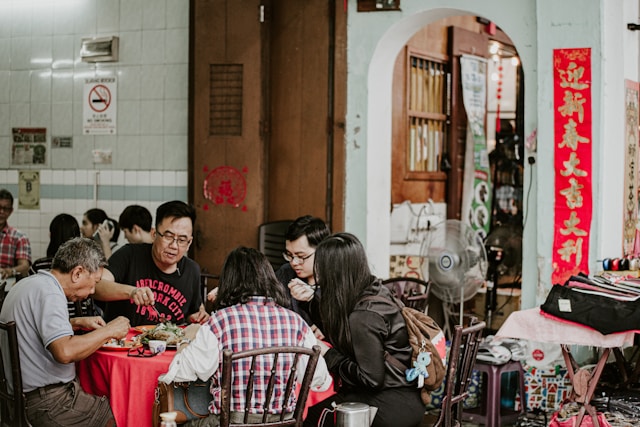
Who pays depends on the invitation, relationship and occasion.
If someone clearly invited the group, they may expect to pay. Friends may take turns, split the bill or use another arrangement.
If you want to pay, offer clearly. If your host declines, you do not need to turn the exchange into a performance.
At a formal or business meal, follow the organiser’s lead.
At an informal meal, ask how the group would like to handle the bill.
Payment methods also vary. Mobile payment is widespread in mainland China, but card and cash acceptance depend on the venue.
If payment access matters, check before you order.
None of this requires arguing or physical jostling over the bill.
Gender and age do not give you a reliable rule for every date, family or friendship.
The invitation and the people involved are better guides.
A short question is more useful than guessing what the group expects.
These phrases will help you ask for the bill, offer to pay and thank someone:
- 服务员,麻烦结一下账 (fúwùyuán, máfan jié yīxià zhàng) – “Excuse me, could we have the bill?” 服务员 means “server”, and 麻烦 softens the request.
- 请给我账单 (qǐng gěi wǒ zhàngdān) – “Could I have the bill, please?”
- 可以刷卡吗?(kěyǐ shuākǎ ma?) – “Can I pay by card?”
- 今天我来买单 (jīntiān wǒ lái mǎidān) – “I’ll get the bill today.”
- 下次你来买单 (xià cì nǐ lái mǎidān) – “You can get the bill next time.”
- 谢谢你,你太客气了 (xièxie nǐ, nǐ tài kèqi le) – “Thank you, you’re too kind.”
- 下次一定让我来买单 (xià cì yīdìng ràng wǒ lái mǎidān) – “You have to let me pay next time.”
Tipping in mainland Chinese restaurants is not widespread, while some venues may list a service charge. Check the bill and local practice rather than assuming there is never an extra fee.
- 小费 (xiǎofèi) – “tip”. Literal meaning: “small fee”.
Ready for a Chinese Restaurant?
You do not need to memorise every phrase before your next meal. Start with the words for the food you want, one clear ordering sentence and a way to ask for the bill.
Chinese-speaking communities and restaurants are varied, so there is no single set of “Chinese rules” you must perform perfectly.
Menus, serving styles and payment methods change from one venue to the next. Pay attention to the people and information in front of you.
If you’re unsure, ask politely or show the written phrase on your phone. That is a useful restaurant skill in any language.

Social