


Days of the Week in Japanese: A Simple Guide

Full disclosure: This post contains affiliate links. ?
On today’s Japanese language agenda, we’re learning how to talk about the days of the week in Japanese. They are:
- Sunday: 日曜日, nichiyoubi
- Monday: 月曜日, getsuyoubi
- Tuesday: 火曜日, kayoubi
- Wednesday: 水曜日, suiyoubi
- Thursday: 木曜日, mokuyoubi
- Friday: 金曜日, kin’youbi
- Saturday: 土曜日, doyoubi
In this simple guide, you’ll learn how to write the days of the week in Japanese and easy ways to remember them. I’ll also share the origin of the words and their kanji meaning.
But the week is only one part of the calendar and talking about time, right? So I’ll share other related words you need to know so you can start planning your schedule in Japanese.
Editor's note: Before we get started, if you’re looking for an online Japanese course, here’s the course we recommend: Japanese Uncovered – Learn Japanese Through the Power of Story, a course with a fascinating new method by Olly Richards. You can try it for free for 7 days!
Table of contents
Days of the Week in Japanese
First, here’s an image you can save to help you remember and review the days of the week in Japanese hiragana:
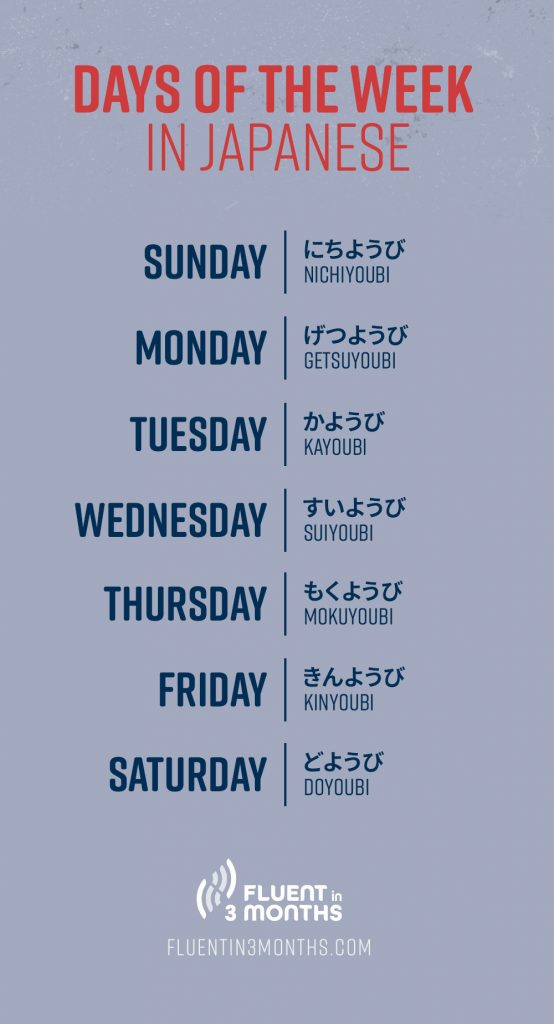
If you only know how to read kana, here are the days of the week in Japanese hiragana:
- Sunday: にちようび, nichiyoubi
- Monday: げつようび, getsuyoubi
- Tuesday: かようび, kayoubi
- Wednesday: すいようび, suiyoubi
- Thursday: もくようび, mokuyoubi
- Friday: きんようび, kin’youbi
- Saturday: どようび, doyoubi
But, the kanji are your friends here.
See, once you know how the kanji’s meaning ties into our English words for days of the week, it becomes a lot simpler.
But also, the days of the week are often abbreviated (like in English) to just 日, 月, 火, 水, 木, 金, and 土. That’s because the kanji 曜日 (youbi) means “day of the week” and it’s the same ending for every day.
So I’ll share with you how mythology and astronomy origins help tie the Japanese and English words together. But, if that’s not your thing, don’t worry, I’ll share some other (fun!) mnemonic tips at the end.
“Sunday” in Japanese: 日曜日
Look at the kanji breakdown of 日曜日 (nichiyoubi):
日: nichi, “sun” 曜: you, “day of the week” 日: bi, “day”
The kanji 日 means both “sun” and “day”, and it has different readings depending on its use. But what’s important here is that these kanji literally mean: Sun Day. Sunday.
In many languages, the words for the days of the week come from mythology and astronomy. So if you remember 日 means “sun”, then you can remember 日曜日 means “Sunday” like English.
“Monday” in Japanese: 月曜日
月曜日 (getsuyoubi) starts with the character 月 (getsu, tsuki, among other readings). It means “moon”.
So 月曜日 means “Moon Day”, the same as English: Monday is also derived from “moon”.
“Tuesday” in Japanese: 火曜日
The 火 in 火曜日 (kayoubi) means “fire”. But it’s also associated with the planet Mars, 火星 (kasei).
English “Tuesday” comes from Old English Tiw’s day. Tiw is the Germanic war god known as Tyr in Norse mythology, and his name took the place of Mars in the Roman weekday naming pattern.
This one is a bit harder to connect because you have to think Tuesday → Tyr → Mars → 火星 (kasei) → 火曜日 (kayoubi).
But you can create a mnemonic to remember it, like: “Mars, the god of war, rained fire 火 on Tuesday.”
“Wednesday” in Japanese: 水曜日
水曜日 (suiyoubi) uses the character 水 (sui, mizu) which means “water”. It’s tied to the planet Mercury, 水星 (suisei).
English Wednesday comes from Old English Woden’s day. Woden is the Germanic god known as Odin in Norse mythology; his name corresponds to Mercury in the weekday naming pattern.
“Thursday” in Japanese: 木曜日
木 in 木曜日 (mokuyoubi) means “wood” and is connected to the planet Jupiter, 木星 (mokusei).
The Roman god Jupiter is the god of thunder. “Thursday” in English is named after Thor, who, as I’m sure you know from the Marvel movies, is also the god of thunder.
“Friday” in Japanese: 金曜日
金曜日 uses 金 (kin), which means “gold” and also “money.” If Friday is your payday, that gives you a handy connection!
This one should be easy enough to remember. But if you want to know the origins like with the other days, then here it is:
金星 (kinsei) is the planet Venus. The Roman goddess Venus is associated with love and beauty, and the Roman name for Friday was Venus’s day.
English Friday comes through Old English Frig’s day, named for the Germanic goddess known as Frigg in Norse mythology, where she is Odin’s wife.
“Saturday” in Japanese: 土曜日
Last up is 土曜日 (doyoubi). 土 (do, tsuchi) means “soil” or “ground”. It’s tied to the planet Saturn, 土星 (dosei).
This is exactly the same as English, because Saturday also stems from Saturn, the god of harvest and abundance.

Other Ways to Remember the Days of the Week in Japanese: Elements, Anime, Avatar!
Okay, look. I know not everyone cares about the etymology of words or has any interest or knowledge of Roman or Nordic mythology.
So maybe those ways to remember the days of the week in Japanese don't work for you.
That’s okay!
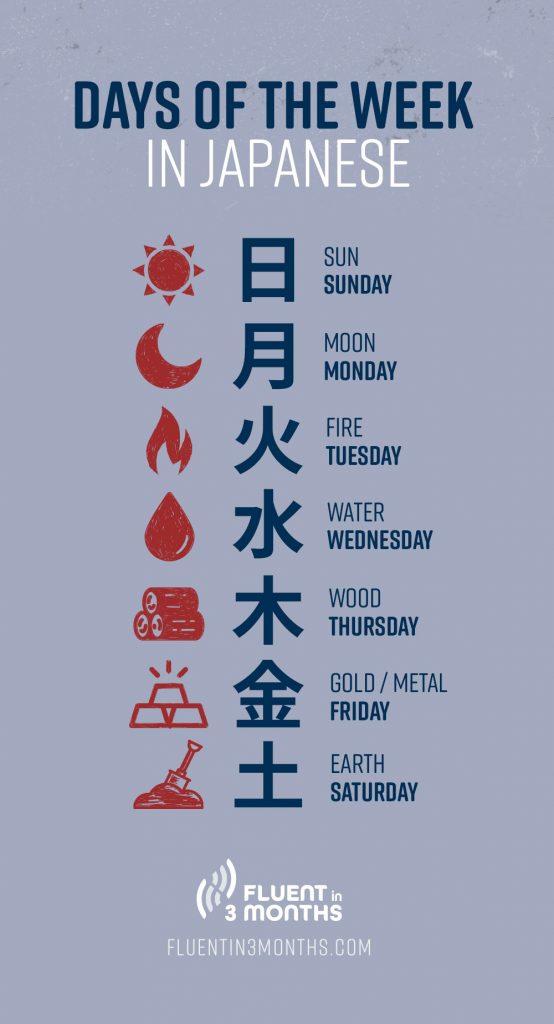
The first characters give you a set of images to remember: the Sun and Moon, followed by the five traditional elements associated with the planets.
- 日: sun
- 月: moon
- 火: fire
- 水: water
- 木: wood
- 金: gold/metal
- 土: earth
Maybe a visual connection is all you need. These are memory aids, so your personal associations don't have to be literal explanations of astronomy or a story's world. Like this:
But honestly? How do I remember them? I connect the planets and elements aspect to my love of Sailor Moon.
- Monday is Sailor Moon (obvious).
- Tuesday is Sailor Mars, who wields fire 火.
- Sailor Mercury controls water 水 for Wednesday.
- Sailor Jupiter uses thunder (Thor), and also really loved flowers and cherry blossom trees 木.
- Venus wields love and beauty, and uses her golden 金 love-me chain.
- Saturday is for Sailor Saturn, 土星, who was reborn on earth 土.
- Sunday doesn’t really need one, but I think of it as Tuxedo Mask who (deep cut reference) was protector of the golden (sun) crystal.
You could associate them with the elemental Clow Cards from CardCaptor Sakura.
- 日: sun, Sozin’s Comet
- 月: moon, Yue
- 火: fire, Fire Benders
- 水: water, Water Benders
- 木: wood, Aang (see the arrow?)
- 金: gold/metal, Metal Benders
- 土: earth, Earth Benders
Seriously. It’s fun to play around with these and make connections to things you love. Obviously, I got nerdy about it. But find what works for you!
Days of the Week Song in Japanese: 一週間の歌
Here’s another tool you can use to memorise the days of the week in Japanese: music!
Try singing along and checking which day names you can remember without looking at the list.
This song on YouTube, called 一週間の歌 (isshuukan no uta, “One Week Song”) will help you keep it straight.
Other Vocab Related to the Week in Japanese
Nearly everything in this section is a number with a counter stuck on the end, so if your Japanese numbers are a bit shaky, this video will make the rest of it way easier:
Now that the days are out of the way, let’s learn some other important words when talking about days, dates, and spans of time.
Months in Japanese
The months in Japanese are:
- January: 一月 (ichigatsu)
- February: 二月 (nigatsu)
- March: 三月 (sangatsu)
- April: 四月 (shigatsu)
- May: 五月 (gogatsu)
- June: 六月 (rokugatsu)
- July: 七月 (shichigatsu)
- August: 八月 (hachigatsu)
- September: 九月 (kugatsu)
- October: 十月 (juugatsu)
- November: 十一月 (juuichigatsu)
- December: 十二月 (juunigatsu)
If you know your Japanese numbers then this is super simple to remember! It’s just the number of the month + the kanji for month: 月 (gatsu).
I’ve written the numbers in kanji here, but you’ll often see the digits 1–12 followed by 月, such as 12月 for December. Both forms are valid; the choice also depends on the layout and type of text.
Days of the Month in Japanese
As for the days of the month in Japanese, there are some inconsistencies. Although many follow the same pattern as months, where it’s the number + 日 (nichi) for “day”.
Keep an eye out for the first 10 days of the month, which sound closer to the Native Japanese numbers than the Sino-Japanese numbers. The 14th, 17th, 19th, 20th, 24th, 27th and 29th are irregular too.
- 1st: 一日 (tsuitachi)
- 2nd: 二日 (futsuka)
- 3rd: 三日 (mikka)
- 4th: 四日 (yokka)
- 5th: 五日 (itsuka)
- 6th: 六日 (muika)
- 7th: 七日 (nanoka)
- 8th: 八日 (youka)
- 9th: 九日 (kokonoka)
- 10th: 十日 (tooka)
- 11th: 十一日 (juuichinichi)
- 12th: 十二日 (juuninichi)
- 13th: 十三日 (juusannichi)
- 14th: 十四日 (juuyokka)
- 15th: 十五日 (juugonichi)
- 16th: 十六日 (juurokunichi)
- 17th: 十七日 (juushichinichi)
- 18th: 十八日 (juuhachinichi)
- 19th: 十九日 (juukunichi)
- 20th: 二十日 (hatsuka)
- 21st: 二十一日 (nijuuichinichi)
- 22nd: 二十二日 (nijuuninichi)
- 23rd: 二十三日 (nijuusannichi)
- 24th: 二十四日 (nijuuyokka)
- 25th: 二十五日 (nijuugonichi)
- 26th: 二十六日 (nijuurokunichi)
- 27th: 二十七日 (nijuushichinichi)
- 28th: 二十八日 (nijuuhachinichi)
- 29th: 二十九日 (nijuukunichi)
- 30th: 三十日 (sanjuunichi)
- 31st: 三十一日 (sanjuuichinichi)
Like with months, I’ve used kanji here, but you’ll find it’s more common to write the days like 21日 for the 21st.
Next Week, Last Week, and This Week in Japanese
There will be times when you’ll need to know how to say “last week” or “next month” or “two years ago.” So here’s the vocab you need to know:
General:
- Day: 日 (hi)
- Days: 日々 (hibi)
- Week: 週 (shuu); use 週間 (shuukan) when counting weeks, as in 一週間 (isshuukan), “one week”
- Weekend: 週末 (shuumatsu)
- Month: 月 (tsuki)
- Year: 年 (toshi, nen)
Days:
- Today: 今日 (kyou)
- Tomorrow: 明日 (ashita)
- Yesterday: 昨日 (kinou)
- The day before yesterday: 一昨日 (ototoi)
- The day after tomorrow: 明後日 (asatte)
- Every day: 毎日 (mainichi)
- Three days ago: 三日前 (mikka mae)
- The other day: 先日 (senjitsu)
Weeks:
- This week: 今週 (konshuu)
- Last week: 先週 (senshuu)
- Next week: 来週 (raishuu)
- The week after next: 再来週 (saraishuu)
- Every week: 毎週 (maishuu)
- Every weekend: 毎週末 (maishuumatsu)
- A week ago: 一週間前 (isshuukan mae)
- 3 weeks later: 三週間後 (sanshuukan go)
Months:
- This month: 今月 (kongetsu)
- Last month: 先月 (sengetsu)
- Next month: 来月 (raigetsu)
- Every month: 毎月 (maitsuki)
- A few months: 数ヶ月 (suukagetsu)
- End of the month: 月末 (getsumatsu)
- Two months ago: 二ヶ月前 (nikagetsu mae)
- A few months later: 数ヶ月後 (suukagetsu go)
Years:
- This year: 今年 (kotoshi)
- Last year: 去年 (kyonen)
- Next year: 来年 (rainen)
- The year before last: 一昨年 (ototoshi)
- The year after next: 再来年 (sarainen)
- Every year: 毎年 (maitoshi)
- A few years before / years ago: 数年前 (suunen mae)
- A few years later: 数年後 (suunen go)
As you can tell, there are some patterns here! For example:
- 先 (sen or saki) means “previous” in words such as 先週, but can also mean “ahead” or “first” in other contexts
- 今 (ima or kon) means “now” or “current”
- 来 (rai) means “coming”
- 後 (ato or go) means “after”
- 前 (mae) means “before”
So knowing these kanji can help you make various measurements of current, past, and future time.
By the way, “days” in Japanese, 日々, is more poetic and has a nuance of “day after day” rather than “days”. Otherwise, you would usually only use “day” in Japanese, 日, and mark it with the number of days as needed.
Bonus: Telling Time in Japanese
You can’t plan your schedule in Japanese without knowing how to tell time! Thankfully, it’s pretty simple if you already know your Japanese numbers.
- 1 o’clock: 1時 (ichiji)
- 2 o’clock: 2時 (niji)
- 3 o’clock: 3時 (sanji)
- 4 o’clock: 4時 (yoji)
- 5 o’clock: 5時 (goji)
- 6 o’clock: 6時 (rokuji)
- 7 o’clock: 7時 (shichiji)
- 8 o’clock: 8時 (hachiji)
- 9 o’clock: 9時 (kuji)
- 10 o’clock: 10時 (juuji)
- 11 o’clock: 11時 (juuichiji)
- 12 o’clock: 12時 (juuniji)
For minutes, you use the number + 分 (fun or pun), such as 12:15 is じゅうにじじゅうごふん (juuniji juugofun). Or for “half past 12” it’s じゅうにじはん (juuniji han). 半 (han) means “half.”
Plan Tomorrow’s Agenda in Japanese!
Now you’ve got the essentials for planning out your schedule or calendar. And in fact, that’s a great way to practise what you’ve learned today!
Try writing out your weekly schedule using the days of the week in Japanese. Practise reading the time and calendar using the Japanese words. Date your journal entries with Japanese. And if you’ve got an online tutor, you can schedule your next meeting with them using the vocabulary you’ve learned in the post!
The more you practise, the easier it gets. So don’t waste any more time, go use your new Japanese skills!
If you want to go further with times and dates, the full guide to telling time in Japanese picks up where the bonus section above leaves off. To hear these words from native speakers, sign up for JapanesePod101 for hours of audio, and check our JapanesePod101 review to see what you get for your money.
When you’re ready to stop studying Japanese and start speaking it, the Fluent in 3 Months Bootcamp gives you 90 days to reach a 15-minute conversation with a native speaker.

Social