



How to Say “Good Afternoon” in French

Full disclosure: This post contains affiliate links. ?
The most useful French translation of “good afternoon” depends on whether you are arriving or leaving. To greet someone during the afternoon, say bonjour. When you leave, bon après-midi means “have a good afternoon”.
You may also come across bonne après-midi. Both genders are grammatically accepted, although bon après-midi is the safer and more common choice. With friends, you can shorten it to bon aprèm.
As a fluent French speaker who has lived in France and Belgium, I have heard plenty of regional variation, even in something as basic as French numbers. This guide explains the forms, pronunciation, register and regional differences so you can choose a phrase that suits the conversation.
Editor's note: Before we get started, if you’re looking for an online French course, here’s the course we recommend: French Uncovered – Learn French Through the Power of Story, a course with a fascinating new method by Olly Richards. You can try it for free for 7 days!
Table of contents
- Good Afternoon in French
- Bon après-midi vs. Bonne après-midi: What’s the Difference?
- How to Say Good Afternoon as a Greeting in French
- How to Say Good Afternoon as a Parting in French
- Formal vs Informal Good Afternoon in French
- Good Afternoon in Canadian French
- Other French Greetings and Partings for the Afternoon
- Example Phrases with Good Afternoon in French
- You Took One More Step in Becoming Fluent in French
Good Afternoon in French
These are the main phrases to know. The distinction between a greeting and a wish when leaving matters more than a word-for-word translation.
| English | French | Audio |
|---|---|---|
| “Have a good afternoon” | Bon après-midi | |
| “Have a good afternoon” (accepted feminine form) | Bonne après-midi | |
| “Have a good afternoon” (informal) | Bon aprèm | |
| “Hello” (the usual afternoon greeting) | Bonjour | |
| “Have a good afternoon” (informal singular) | Passe un bon après-midi | |
| “Have a good afternoon” (formal or plural) | Passez un bon après-midi |
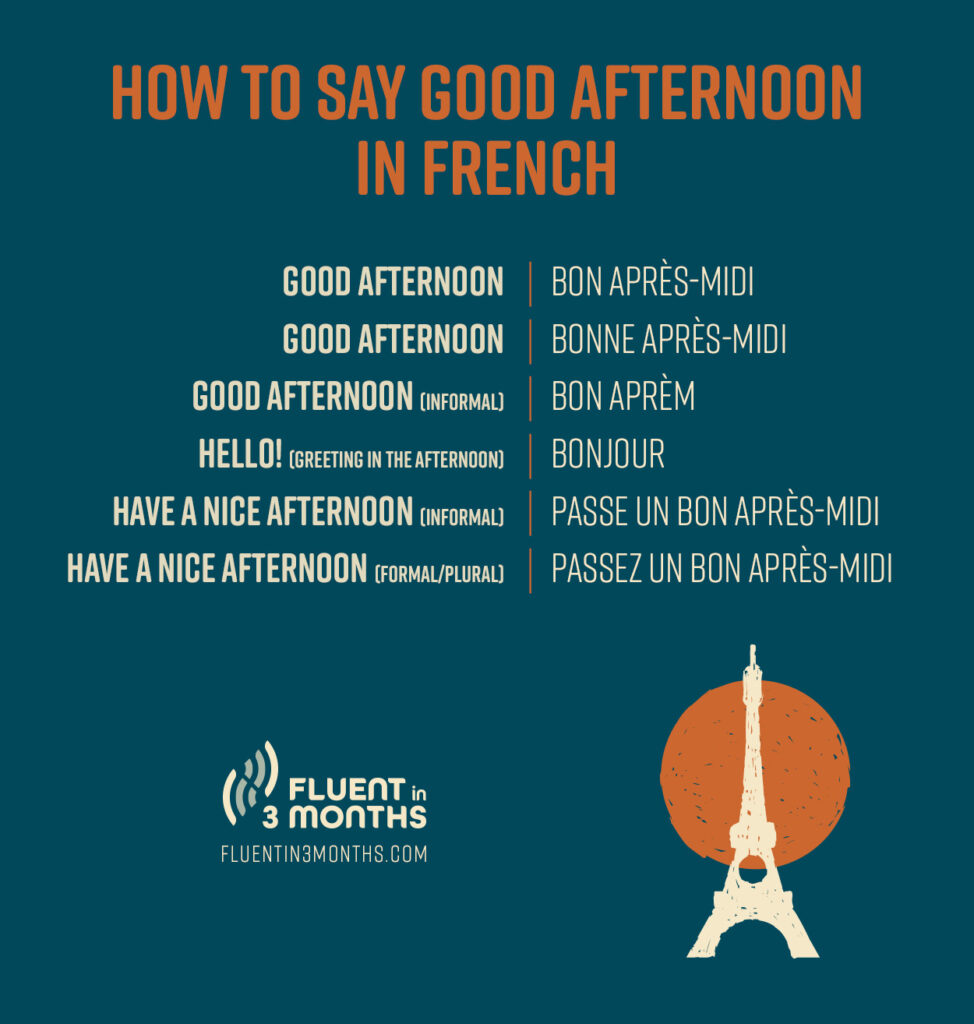
The audio above is the best way to copy the rhythm. The CNRTL gives après-midi as /a.pʁɛ.mi.di/: the s in après is silent. In bon après-midi, you hear the final n before the following vowel, so the full phrase is /bɔ.n‿a.pʁɛ.mi.di/, roughly “bo-na-preh mee-dee”.
Bon après-midi vs. Bonne après-midi: What’s the Difference?
Bon après-midi and bonne après-midi have the same meaning, but they are not equally useful defaults. The noun après-midi can be masculine or feminine, so both agreements are grammatical. The Académie française accepts both genders but says to prefer the masculine, while the Office québécois de la langue française notes that usage varies and both are accepted.
For a learner, bon après-midi is the straightforward choice in speech and writing. If someone says bonne après-midi, they are using an accepted feminine form rather than making a mistake.
How to Say Good Afternoon as a Greeting in French
Use bonjour when you meet someone during the daytime, including the afternoon. At 14:00 or 16:00, it works with friends, colleagues, shop staff and strangers. Salut is a more informal option with people you would normally address casually.
This Fi3M video gives you ten ways to say hello in French, with the register differences that decide when each one fits:
Later in the day, bonsoir gradually takes over. There is no universal clock cut-off shared by every speaker, so context matters more than memorising “18:00” as a rule. If the people around you have switched to bonsoir, follow their lead.
If you specifically want to mention the afternoon after greeting someone, you can say Bonjour, j’espère que vous passez un bon après-midi. (“Hello, I hope you’re having a good afternoon.”)
How to Say Good Afternoon as a Parting in French
Bon après-midi most often works as a wish when you leave, much like “have a good afternoon”. It belongs with expressions such as bonne journée and bonne soirée, rather than with greetings that open a conversation.
With a friend, you can shorten it to bon aprèm. Here is a natural informal exchange:
Laura: Bonjour, Thomas ! Ça va ? (“Hi, Thomas! How are you?”)
Thomas: Salut ! Ça va, et toi ? (“I’m good, and you?”)
Laura: Ça va. Je viens de sortir du travail. (“I’m good. I just got off work.”)
Thomas: Tu as des plans pour le reste de ton après-midi ? (“Do you have plans for the rest of your afternoon?”)
Laura: Je vais juste rentrer chez moi et me détendre. Et toi ? (“I’m just going to go home and relax. And you?”)
Thomas: Pareil. Bon après-midi, Laura ! (“Same here. Have a good afternoon, Laura!”)
Laura: Passe un bon aprèm ! (“Have a good afternoon!”)
The friends greet each other with bonjour and salut, then use bon après-midi and bon aprèm as they say goodbye in French.
Formal vs Informal Good Afternoon in French
Bon après-midi itself is neutral enough for formal and informal settings. In a restaurant or shop, you may hear Bon après-midi, monsieur. (“Have a good afternoon, sir.”) or Bon après-midi, madame. (“Have a good afternoon, ma’am.”)
The verb makes the relationship clearer. Use Passe un bon après-midi with one person you address as tu. Use Passez un bon après-midi with one person you address as vous, or with several people. Bon aprèm is familiar and suits friends or relaxed colleagues, but not a formal email or a polished customer interaction.
Good Afternoon in Canadian French
In Québec as elsewhere, bonjour is the safest standard greeting during the day. The Office québécois de la langue française distinguishes greetings from wishes and lists bon après-midi among the expressions used when leaving someone.
You will also hear bon matin from some Québec speakers. The Office describes it as established in spontaneous, informal speech among part of the Québec population, but not as a neutral equivalent of bonjour. It recommends bonjour in writing, professional communication and more formal speech.
That makes bonjour the useful default for a learner in Montréal as well as Paris, Brussels or Geneva. Local speakers may use other formulas, but a regional habit should not be taught as a rule for all Canadian French.
Other French Greetings and Partings for the Afternoon
These phrases let you open or close an afternoon conversation without forcing an English expression into French.
| English | French | Audio |
|---|---|---|
| “Hi!” (informal greeting or goodbye) | Salut ! | |
| “How are you?” (formal or plural) | Comment allez-vous ? | |
| “How are you?” (informal) | Ça va ? | |
| “Have a good evening” (a wish when leaving) | Bonne soirée | |
| “See you later” | À plus tard | |
| “See you tomorrow” | À demain | |
| “Goodbye” | Au revoir | |
| “Have a good day” (formal or plural) | Passez une bonne journée | |
| “Have a good day” (informal singular) | Passe une bonne journée | |
| “Have a good afternoon” (formal or plural) | Passez un bon après-midi | |
| “Have a good afternoon” (informal singular) | Passe un bon après-midi |
Example Phrases with Good Afternoon in French
These examples keep the greeting, parting and level of formality clear.
| English | French | Audio |
|---|---|---|
| “Hello, I hope you’re having a good afternoon.” (formal or plural) | Bonjour, j'espère que vous passez un bon après-midi. | |
| “Have a good afternoon, see you tomorrow!” (informal) | Bon aprèm, à demain ! | |
| “Have a good afternoon, rest well!” (informal) | Bon aprèm, repose-toi bien ! | |
| “Hi, how is your afternoon going?” (informal) | Salut, comment se passe ton après-midi ? | |
| “I’m having a very good afternoon, thanks.” | Je passe un très bon après-midi, merci. | |
| “Enjoy your afternoon at the park!” (informal) | Profite de ton après-midi au parc ! | |
| “Have a good afternoon with your parents.” (informal) | Passe un bon après-midi avec tes parents. |
You Took One More Step in Becoming Fluent in French
One practical distinction covers most situations: open a daytime conversation with bonjour, and wish someone bon après-midi as you leave. Use passe with one person you address as tu, passez with vous or a group, and save bon aprèm for informal conversation.
You can build from there with these core French words and phrases, different ways to ask “how are you?” in French, and the vocabulary for talking about family and friends. Bonne chance et bon après-midi !

Social