


10+ Ways to Say “Hello” in Arabic and Other Arabic Greetings

Full disclosure: This post contains affiliate links. ?
How do you say “hello” in Arabic?
Are you planning a trip to the Middle East or North Africa, or would you simply like to greet Arabic-speaking friends in their language?
Either way, you’re in the right place.
These 10+ greetings come from more than one variety of Arabic. Modern Standard Arabic (MSA) is used across the Arabic-speaking world in writing and formal settings, while everyday greetings often come from regional dialects. This guide includes both MSA and colloquial Levantine forms, with regional expressions labelled so you can choose them in context.
Here are the greetings you’ll learn:
Table of contents
- 1. مرحبا (Marḥaban) – “Hello/Hi”
- 2. Salamo Alaykom – “Peace be Upon You”
- 3. Awefe (Levantine Arabic) – a wish for health
- 4. Ya’teek el ‘afye (Levantine Arabic) – “[May God] give you health”
- 5. Marahib – “Hellos”
- 6. Salam – “Peace”
- 7. Sabaho, Sabah el Kheir, Sabah el Noor – morning greetings
- 8. Kifak – “How are you?”
- 9. Naharak sa’eed – “Good day”
- 10. Sho el Akhbar (Levantine Arabic) – “What’s new?”
- A Note on Regional Arabic Greetings
- Say “Hello” in Arabic!
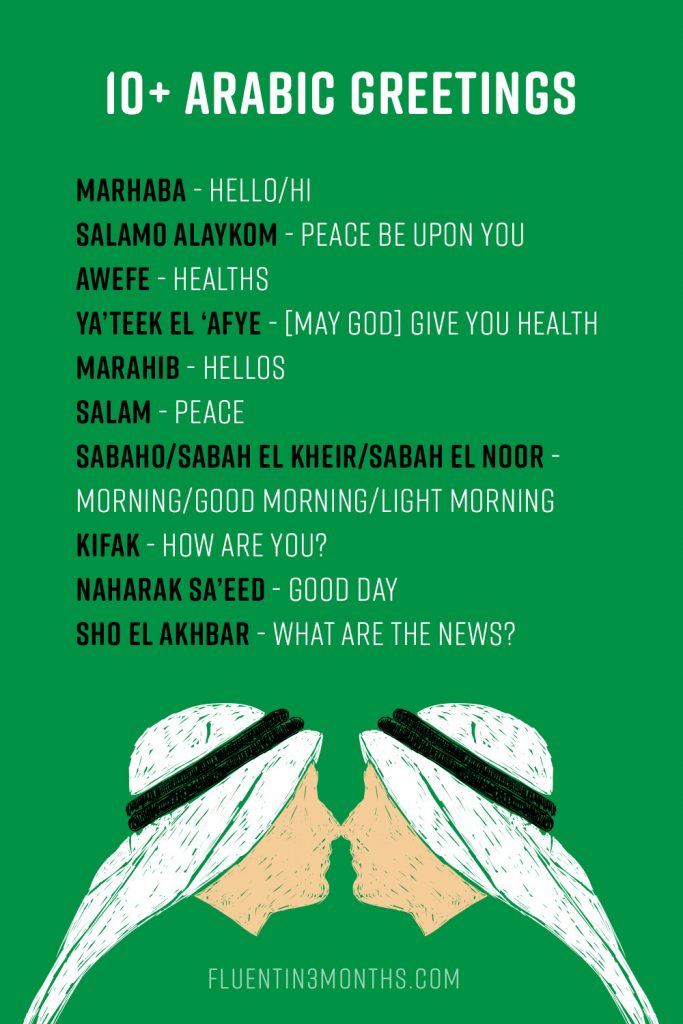
And here’s an infographic you can download for quick reference:
Before choosing what to study, this video explains the difference between Modern Standard Arabic and a spoken dialect:
A note from the Fluent in 3 Months team before we get started: You can chat away with a native speaker for at least 15 minutes with the “Fluent in 3 Months” method. All it takes is 90 days. Tap this link to find out more.
Let’s get started!
1. مرحبا (Marḥaban) – “Hello/Hi”
How do you say “hello” in Arabic? One answer is مرحبا (Marḥaban), often written Marhaba in informal transliteration.
Marḥaban is an MSA greeting that is widely understood across the Arabic-speaking world, although pronunciation and everyday usage vary by region.
It is a polite, neutral choice in many situations, but local greetings may sound more natural in everyday conversation.
2. Salamo Alaykom – “Peace be Upon You”
Salamo Alaykom has Islamic roots and is widely used among Muslims.
It means “peace be upon you”. Its use varies by community and setting.
Wa Alaykom el Salam is a common response. It means “and upon you peace”, or “peace be upon you too”.
Salamo Alaykom is used when speaking to groups of people. Although it is in plural form, it can be used with both a single person or a group.
If you want to be precise though, here are the variations of Salamo Alaykom depending on whom you’re addressing.
- Salamo Alayka – Singular Masculine
- Salamo Alayki – Singular Feminine
- Salamo Alaykoma – Dual (Feminine, masculine or mixed)
- Salamo Alaykonna – Plural Feminine
- Salamo Alaykom – Plural (Can be masculine or mixed)
Because this greeting has a religious association, pay attention to how people around you use it rather than assuming the same convention everywhere.
Arabic greetings can be longer than short informal greetings such as German Na, but length alone tells you nothing about how formal or friendly a greeting is.
3. Awefe (Levantine Arabic) – a wish for health
Awefe is a colloquial expression used in parts of the Levant. It is not a universal Arabic greeting, so use it where you have heard local speakers use it.
The expression conveys a wish for health. In natural English, that idea does not need the plural “healths”.
4. Ya’teek el ‘afye (Levantine Arabic) – “[May God] give you health”
Ya’teek el ‘afye is a Levantine expression often glossed as “[May God] give you health”. Depending on the context, it can express thanks, encouragement or a good wish. It is not a neutral greeting used in exactly the same way as Marḥaban.
5. Marahib – “Hellos”
Marahib is a colloquial plural-style greeting used in some varieties of Arabic. As with other regional greetings, follow local usage.
6. Salam – “Peace”
Salam means “peace” and can be used as a greeting in many Arabic-speaking communities. Its use varies by region and setting.
7. Sabaho, Sabah el Kheir, Sabah el Noor – morning greetings
Sabaho is a colloquial morning greeting used in parts of the Levant. It is not a universal Arabic form.
- Sabah el Kheir is “good morning”, plain and simple
- Sabah el Noor is the answer for Sabah el Kheir, and literally means “morning of light”.
A typical conversation with these phrases:
- “Good morning”
- “Light morning”
- And then you move on with your day.
Bonus point: Yis’idle Sabahak/ik/kon. This means “May your morning be happy!” How sweet is that? The “ak”, “ik” and “kon” is the difference between masculine, feminine and plural forms. “Ak” is for masculine, “ik” is for feminine and “kon” is for plural.
8. Kifak – “How are you?”
Kifak and Kifik are colloquial Levantine ways to ask “How are you?”, with the form changing according to whom you’re addressing.
You can also say Kif Halak? which means “How are you?” or, literally, “How is your condition?” Sometimes it comes directly after the Marhaba. So to say it all in Arabic it would be Marhaba, kifak?/Kif halak?
When someone says this to you, you can reply with Lhamdella or Mnih.
Lhamdella is “Praise be to God” or “Thank God”, as in thanking Him for being in good health. Mnih is “well” or “good” for a masculine speaker; a feminine speaker says mniha.
If you’re feeling down or not quite yourself that day, one possible reply is meshe lhal. Its literal sense is “the situation is walking”, and a natural English equivalent is “it’s okay”.
9. Naharak sa’eed – “Good day”
Although this is often translated as “good day”, the more literal sense is “happy day”. It is a warm wish to offer when you meet someone.
This expression belongs to Fusha, or Modern Standard Arabic, rather than to one particular spoken dialect.
10. Sho el Akhbar (Levantine Arabic) – “What’s new?”
Sho el Akhbar is a colloquial Levantine expression meaning “What’s new?”
You may also hear Sho fi ma fi, another colloquial way to ask “What’s new?”
I wouldn’t use it as the first greeting. It works more naturally after Marḥaban or another greeting.
A Note on Regional Arabic Greetings
Arabic has many spoken varieties, and everyday greetings differ by region. Even a widely understood greeting such as Marḥaban may have local alternatives.
In Tunisia, for example, aslema is a common greeting and bislema is used for goodbye. Marḥaban may still be understood, so don’t treat a regional preference as an absolute rule.
Say “Hello” in Arabic!
You now have several ways to start a conversation in Arabic. Practising one or two greetings in the right context can be a useful first step towards the Fluent in 3 Months Bootcamp goal of a 15-minute conversation in Arabic in 90 days.
If that’s a goal you’d like to work towards, keep building from these greetings.
For more practice options, see this guide to 33 free online Arabic classes.
For a broader collection, see Benny’s Top Resources for Learning Arabic. You can also watch Benny speaking Arabic.
Original article by Ali Matar, updated by the Fluent in 3 Months team.

Social