



A 5-Step Method to Improve Your Listening Skills

Full disclosure: This post contains affiliate links. ?
Do you remember how it felt the first time you heard someone speak your target language at a natural pace?
Bamboozled?
I’ve often found listening the most difficult language-learning skill. Maybe you feel the same way.
This article gives you the five-step method I use to practise listening with short audio and a transcript.
One reason I used to struggle was that I didn’t know how to practise. Should I read while listening or listen without text? What should I choose? Did I need to translate every word?
I tried several approaches while learning Spanish before I found a routine that helped me.
The need became obvious when I moved to Argentina. Before arriving in Buenos Aires, I thought my Spanish was pretty good. Then I landed and struggled to understand ordinary interactions on buses and in supermarkets. I often found myself smiling and nodding while trying to work out what people had said.

Over the following weeks and months, my listening improved. The practical lesson was simple: background exposure was not enough for the details I needed to understand. I had to give speech my attention, check what I heard and listen again.
Living in Argentina gave me plenty of reasons to listen closely, but you can use the same deliberate practice at home. Background audio can add contact with the language; focused listening is the part of this routine that lets you test and correct your understanding.
A note from the Fluent in 3 Months team before we get started: You can chat away with a native speaker for at least 15 minutes with the “Fluent in 3 Months” method. All it takes is 90 days. Tap this link to find out more.
Passive vs. Active Listening: What’s the Difference?
Why Passive Listening Isn’t Enough
Here, passive listening means playing audio without giving it your full attention: French radio while you work, for example, or Spanish music when you are not following the lyrics.
Background listening is not the same as listening practice. It may familiarise you with voices, rhythms or an occasional phrase, but it gives you no reliable check on what you understood.
Think about having the radio on while cooking. You may notice a favourite song or an important news item, but much of the programme passes without detailed attention. That is fine for company or extra exposure; it is a weak way to measure comprehension.
The same limitation applies in a language you are learning. Hearing more of it can be useful, but simply logging hours of background audio does not show which sounds, words or ideas you can follow.
If background audio is the foundation of your listening plan, add a short session in which you have one task and check the result.
You do not need to stop playing music or radio while you cook, travel or read. Treat that as optional exposure, then protect a smaller amount of time for focused work. Ten attentive minutes can tell you more about a problem than an hour you barely notice.
Why Listening Needs to be Active
Focused practice asks you to notice something specific and compare your first impression with the recording or transcript.
Repeating a manageable clip gives you another chance to identify words, sound patterns, intonation and phrasing. The transcript then shows where your interpretation matched and where it did not. Repetition is useful when each pass has a purpose, rather than becoming an endurance test.
Focused listening also helps you notice connected speech. Words can link, shorten or change quality when people speak naturally. In American English, “what’s up?” may sound closer to “wassup?”. In Hiberno-English, “how’s it going?” can sound more like “howsagoin?”.
These patterns are familiar in languages we already understand. In a new language, the gap between a word’s careful form and its connected form can make a known word hard to recognise.
That is why a vocabulary item on a page may not be immediately available to your ear. You need examples of how words sound in phrases and sentences. Background exposure may help with familiarity, but focused comparison makes a specific mismatch easier to find.
So what should you listen to, and how can you turn it into a focused session?
The Tools You Need to Improve Your Listening Skills
Choose a resource with audio and an accurate transcript or same-language captions. The text lets you check your first interpretation, locate missed words and connect written forms with the sounds you heard. My routine starts without the text, but beginners can reveal it sooner if repeated listening turns into guessing.
Possible materials include:
- A short scene from a film or TV programme with same-language subtitles
- A podcast segment with a transcript
- A short report from Euronews or another news service
- A YouTube video with an interactive transcript
- A print book with its audiobook
- Recorded dialogues with matching text
- An Assimil course
- LingQ
- Textbook audio with its written dialogue
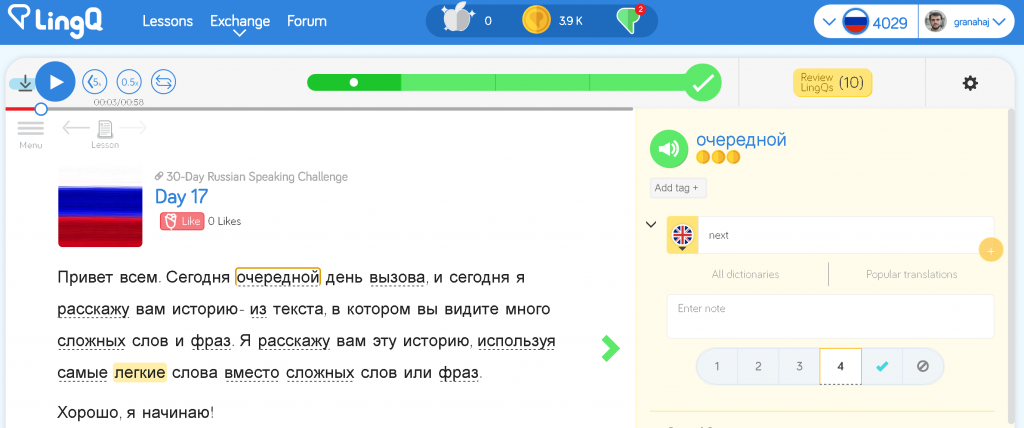
Start with a clip you can repeat without losing concentration. Three or four minutes works for many learners, but it is not a rule. A beginner may get more from 30 seconds; an advanced learner may choose a longer passage. Short clips make it easier to replay the same material and compare details.
In a 30-minute session, a three-minute clip leaves time to listen more than once, inspect the transcript and return to the difficult sections. A 15-minute clip leaves less time for that depth. Both extensive listening and close study can have a place; choose the format that matches your goal for this session.
Choose topics that matter to you. You do not need every word in a dictionary to hold useful conversations, so material related to your life can make the vocabulary more relevant. Difficulty matters too: if almost every sentence is opaque, shorten the clip, slow it down if the tool allows, or choose easier material.
Here is the five-step routine. The number of repeats is a guide, not a test you must pass.
A 5-Step Method to Improve Your Listening Skills
Step 1: Listen to the Audio – No Reading!
Listen once without reading the transcript. The aim is to get a baseline for what your ears can recover from this clip, not to prove that you can understand it unaided.
Do not chase every word. Listen for the gist: who is speaking, what the situation is and what seems to happen.
Write down a few words or phrases you recognise, plus one or two places where you lost the thread. That gives your next listen a purpose.
Step 2: Repeat!
Listen again before opening the transcript. This time, test one question from your notes or listen for the words around a difficult section.
You may hear a word or idea you missed on the first pass because you now know the context. Note what changed, but do not fill gaps with guesses and then treat them as facts.
I often repeat this stage up to three times. Stop sooner if you are no longer noticing anything new. If the clip still feels like an uninterrupted blur, move to the transcript, reduce the playback speed or work with a shorter section.
Step 3: Get Reading
Now read the transcript and compare it with your notes. Did you catch the gist? Which words did you hear correctly, and which boundaries or sounds misled you?
Look up words that block the meaning or seem useful for your own conversations. You do not need to turn every unfamiliar word into a vocabulary card.
Also mark words you already knew in writing but failed to recognise in the recording. Those are especially useful targets because the problem is the sound-to-meaning connection, not a missing dictionary definition.
Step 4: Listen With the Text
Listen while following the transcript. You should now understand the overall meaning, even if a few details remain unclear.
Connect the written words with the sounds. Pay attention to phrases rather than isolated spelling, especially where words link or shorten.
If the clip contains many difficult sections, divide it into smaller chunks. Replay one sentence or exchange instead of restarting the whole recording.
I usually make two passes with the text, but accuracy and attention matter more than reaching a fixed count.
Step 5: Listen Again Without the Text
Hide the transcript and listen once more. Compare this pass with your first one. You should understand more of this specific clip, though you may still miss parts.
Return to the clip after a day or two and see what remains available without the text. Repetition can make this recording feel easier; transfer to new speakers and topics requires practice with varied material too. When this clip is comfortable, choose another rather than polishing one recording forever.
In Conclusion: There’s no Quick Fix for Listening Skills
Listening improves through repeated contact with understandable speech, not one perfect resource or one fixed number of repetitions.
Choose one short clip today. Listen once, write down the gist, check the transcript and listen again. That gives you a concrete comparison and a routine you can repeat with new material.

Social