


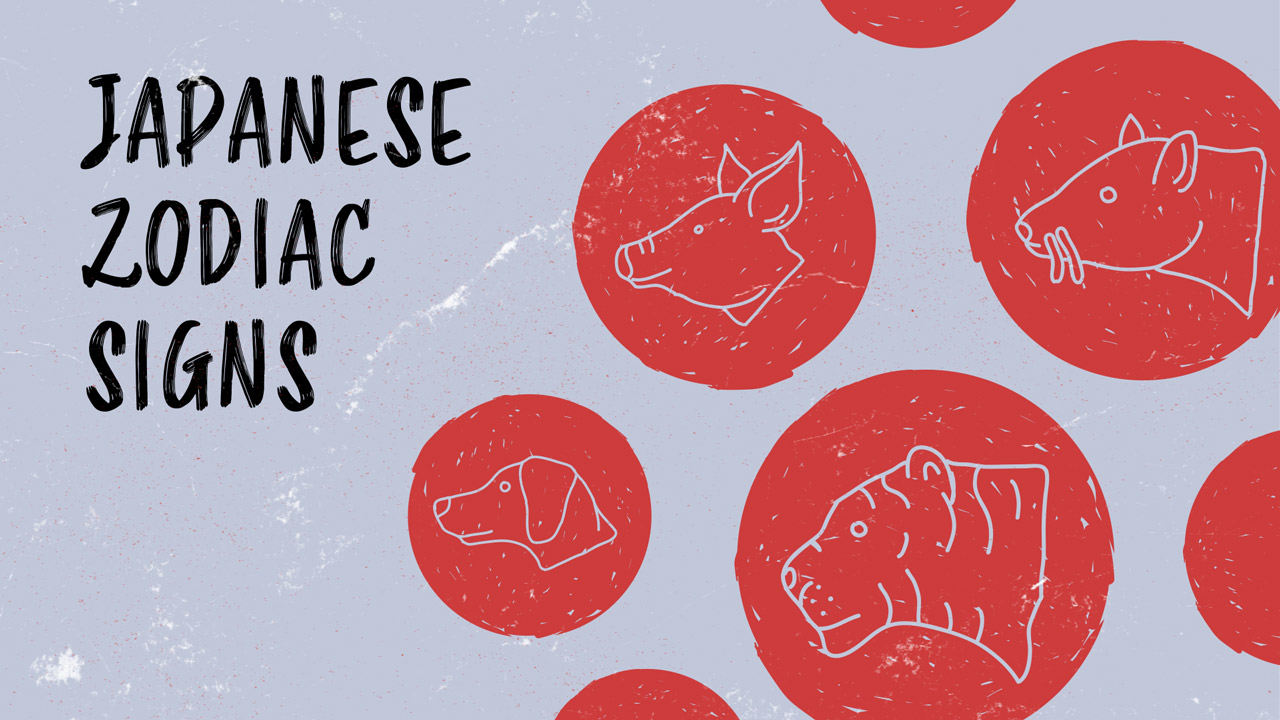
Japanese Zodiac Signs: Animals, Years and Useful Vocabulary

Full disclosure: This post contains affiliate links. ?
The Japanese zodiac can come up on New Year cards, shrine souvenirs and in casual conversations about birth years. It is useful to know the language without treating a sign as a fact about anyone's personality.
Start with two short exchanges:
- 干支は何ですか? (eto wa nan desu ka?): “What is your Japanese zodiac sign?”
午年です。 (uma-doshi desu.): “I'm a Horse.” - 何座ですか? (nani-za desu ka?): “What is your Western zodiac sign?”
蠍座です。 (sasori-za desu.): “I'm a Scorpio.”
Those questions refer to different systems. 干支 commonly refers to the 12-year animal cycle, while 星座 means a constellation or a Western zodiac sign. This guide separates those systems, New Year customs, blood-type fortune-telling and Japanese era dates so that each term has a clear use.
Editor's note: Before we get started, if you’re looking for an online Japanese course, here’s the course we recommend: Japanese Uncovered – Learn Japanese Through the Power of Story, a course with a fascinating new method by Olly Richards. You can try it for free for 7 days!
Table of contents
- Japanese Zodiac Signs
- Rat
- Ox
- Tiger
- Rabbit
- Dragon
- Snake
- Horse
- Sheep
- Monkey
- Rooster
- Dog
- Boar
- Japanese New Year Zodiac Traditions
- Japanese Horoscopes
- Aries
- Taurus
- Gemini
- Cancer
- Leo
- Virgo
- Libra
- Scorpio
- Sagittarius
- Capricorn
- Aquarius
- Pisces
- Japanese Blood Types
- What is My Japanese Birth Year? Eras in Japan
- Related Japanese Fortune-Telling Vocab
- What's Your Fortune?
Japanese Zodiac Signs
The system was transmitted from China and adapted in Japan. In modern everyday Japanese, 干支 (eto) often means the 12 animal signs. 十二支 (jūnishi) refers to the 12 Earthly Branches represented by those animals.
Historically, 干支 also refers to a fuller 60-year cycle. Ten Heavenly Stems, 十干 (jikkan), combine the five phases (wood, fire, earth, metal and water) with yin and yang. They pair with the 12 Earthly Branches. The five phases are therefore not themselves the Heavenly Stems.
Modern Japanese zodiac years change on 1 January. Chinese New Year follows a lunisolar calendar, so someone born in January or February may receive a different animal under the two conventions. Japanese convention also usually calls 亥 a boar; English labels for animals such as 未 vary between sheep, goat and ram.
Each entry below distinguishes the everyday animal word from the branch kanji used in zodiac-year expressions. The years repeat every 12 years. Any personality associations attached to them belong to folklore and entertainment, not evidence about a person.
Rat
Animal: ネズミ (nezumi)
Zodiac branch: 子 (ne)
Year form: 子年 (ne-doshi or nezumi-doshi)
Recent years: 1960, 1972, 1984, 1996, 2008, 2020
Ox
Animal: 牛 (ushi)
Zodiac branch: 丑 (ushi)
Year form: 丑年 (ushi-doshi)
Recent years: 1961, 1973, 1985, 1997, 2009, 2021
Tiger
Animal: 虎 (tora)
Zodiac branch: 寅 (tora)
Year form: 寅年 (tora-doshi)
Recent years: 1962, 1974, 1986, 1998, 2010, 2022
Rabbit
Animal: 兎 or うさぎ (usagi)
Zodiac branch: 卯 (u)
Year form: 卯年 (u-doshi)
Recent years: 1963, 1975, 1987, 1999, 2011, 2023
Dragon
Animal: 竜 or 龍 (ryū)
Zodiac branch: 辰 (tatsu)
Year form: 辰年 (tatsu-doshi)
Recent years: 1964, 1976, 1988, 2000, 2012, 2024
Snake
Animal: 蛇 (hebi)
Zodiac branch: 巳 (mi)
Year form: 巳年 (mi-doshi)
Recent years: 1965, 1977, 1989, 2001, 2013, 2025
Horse
Animal: 馬 (uma)
Zodiac branch: 午 (uma)
Year form: 午年 (uma-doshi)
Recent years: 1966, 1978, 1990, 2002, 2014, 2026
Sheep
Animal: 羊 (hitsuji)
Zodiac branch: 未 (hitsuji)
Year form: 未年 (hitsuji-doshi)
Recent years: 1967, 1979, 1991, 2003, 2015, 2027
Monkey
Animal: 猿 (saru)
Zodiac branch: 申 (saru)
Year form: 申年 (saru-doshi)
Recent years: 1968, 1980, 1992, 2004, 2016, 2028
Rooster
Animal: 鶏 (niwatori)
Zodiac branch: 酉 (tori)
Year form: 酉年 (tori-doshi)
Recent years: 1969, 1981, 1993, 2005, 2017, 2029
Dog
Animal: 犬 (inu)
Zodiac branch: 戌 (inu)
Year form: 戌年 (inu-doshi)
Recent years: 1970, 1982, 1994, 2006, 2018, 2030
Boar
Animal: 猪 (inoshishi)
Zodiac branch: 亥 (i)
Year form: 亥年 (i-doshi)
Recent years: 1971, 1983, 1995, 2007, 2019, 2031
Japanese New Year Zodiac Traditions
Japan's mainstream national New Year begins on 1 January, although Lunar New Year is still observed in some communities and regions. The year's zodiac animal often appears on 年賀状 (nengajō), traditional New Year greeting cards. Cards posted by the designated deadline may be delivered on 1 January, but customs and participation vary.
The first shrine or temple visit of the year is 初詣 (hatsumōde). At some sites, visitors write wishes on wooden votive plaques called 絵馬 (ema) or receive a paper fortune called おみくじ (omikuji). Some fortunes and souvenirs use the year's zodiac animal.
Practices for keeping or tying an omikuji vary. Follow the site's instructions and use its designated rack rather than assuming that a tree branch is appropriate.
Japanese Horoscopes
星座 (seiza) means “constellation” and, in this context, a Western zodiac sign. A horoscope based on those signs can be called 星座占い (seiza-uranai) or 星占い (hoshi-uranai).
The 12 sign names below are useful vocabulary. Date boundaries can vary slightly between horoscope sources, and personality claims are entertainment rather than evidence about an individual.
Aries
牡羊座 (ohitsuji-za): Aries, the ram, ♈
Taurus
牡牛座 (ōshi-za): Taurus, the bull, ♉
Gemini
双子座 (futago-za): Gemini, the twins, ♊
Cancer
蟹座 (kani-za): Cancer, the crab, ♋
Leo
獅子座 (shishi-za): Leo, the lion, ♌
Virgo
乙女座 (otome-za): Virgo, the maiden, ♍
Libra
天秤座 (tenbin-za): Libra, the scales, ♎
Scorpio
蠍座 (sasori-za): Scorpio, the scorpion, ♏
Sagittarius
射手座 (ite-za): Sagittarius, the archer, ♐
Capricorn
山羊座 (yagi-za): Capricorn, the goat, ♑
Aquarius
水瓶座 (mizugame-za): Aquarius, the water bearer, ♒
Pisces
魚座 (uo-za): Pisces, the fish, ♓
Japanese Blood Types
血液型占い (ketsuekigata-uranai) assigns personality stereotypes or compatibility claims to blood types. It appears in some Japanese popular culture, but it is pseudoscientific and not an evidence-based way to judge someone. Interest and belief vary.
Blood type is medical information and can be personal, so it is not a default question for a new acquaintance. If the subject comes up willingly, 血液型は何型ですか? (ketsuekigata wa nani-gata desu ka?) asks “What is your blood type?” One answer is A型です。 (A-gata desu.), “I'm type A.”
What is My Japanese Birth Year? Eras in Japan
Japanese era dates are a calendar convention, not fortune-telling. Japan uses Gregorian years alongside an era-year system called 和暦 (wareki). Each era has a 元号 (gengō), or era name.
The Reiwa era began on 1 May 2019. Dates from that day through 31 December 2019 are 令和元年 (Reiwa gannen), the first year of Reiwa. The preceding Heisei era began on 8 January 1989 and ended on 30 April 2019. That means both 1989 and 2019 cross an era boundary, so subtracting a number from the Gregorian year without checking the date can give the wrong answer.
When reading a date, identify the era name and year before converting it. The Japanese numbers guide can help with the number readings.
Related Japanese Fortune-Telling Vocab
- Astrology: 占星術 (senseijutsu)
- Horoscope or astrology forecast: 星占い (hoshi-uranai)
- Constellation or zodiac sign: 星座 (seiza)
- Fortune-telling: 占い (uranai)
- Fortune-teller: 占い師 (uranaishi)
- North Star: 北極星 (hokkyokusei)
- Ursa Minor: こぐま座 (koguma-za)
- Ursa Major: おおぐま座 (ōguma-za)
- Sun: 太陽 (taiyō)
- Moon: 月 (tsuki)
- Mercury: 水星 (suisei)
- Venus: 金星 (kinsei)
- Earth: 地球 (chikyū)
- Mars: 火星 (kasei)
- Jupiter: 木星 (mokusei)
- Saturn: 土星 (dosei)
- Uranus: 天王星 (tennōsei)
- Neptune: 海王星 (kaiōsei)
- Pluto: 冥王星 (meiōsei)
Four reusable sentence patterns are:
- 干支は何ですか? (eto wa nan desu ka?): “What is your Japanese zodiac sign?”
- 午年です。 (uma-doshi desu.): “I'm a Horse.”
- 午年に生まれました。 (uma-doshi ni umaremashita.): “I was born in the Year of the Horse.”
- 何座ですか? (nani-za desu ka?): “What is your Western zodiac sign?”
What's Your Fortune?
Practise this topic as language, not as a personality test. First, find your birth-year animal using the modern Japanese 1 January convention. Match its everyday animal word to its branch kanji and year reading, such as 兎 (usagi) → 卯 (u) → 卯年 (u-doshi).
Then say the two questions and your answers aloud. Substitute another animal and sign, check the script and reading, and retrieve all four lines again the next day. If era dates interest you, identify whether a sample date is Gregorian or wareki before converting it.
For a broader next step, use the guide to learning Japanese to place this vocabulary inside a speaking and review routine.

Social