


How to Use Instagram for Language Learning: A 6-Step Method

Full disclosure: This post contains affiliate links. ?
Instagram can be more than a place to scroll. I used a separate French-focused account to practise writing, find material about my hobbies and have small conversations with other French speakers.
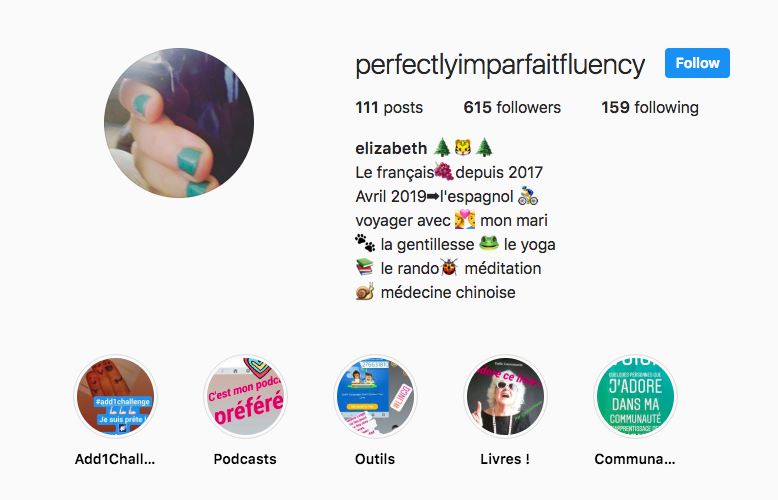
This is a case study from 2018 and 2019, when my account was called @perfectlyimparfaitfluency. Instagram, account names and hashtags change, so treat the examples as a method you can adapt rather than a directory guaranteed to stay current.
By the time I first wrote this article, I had published 111 posts in French. The useful number was not my follower count. It was the number of times I had sat down, composed a message and responded to another person in my target language.
Editor's note: Before we get started, if you’re looking for an online French course, here’s the course we recommend: French Uncovered – Learn French Through the Power of Story, a course with a fascinating new method by Olly Richards. You can try it for free for 7 days!
Why I Joined Instagram
I struggled for years to learn a new language and tried ten of them before I found the strategy that worked for me: use the language for something I already want to do.
I first put this into practice with the Speak From Day One approach. Using my new language to chat with French speakers gave all that vocabulary a purpose.
“Facebook? I Will Never Join That”
I remember the first time someone described Facebook to me as a website where people shared what they had eaten for lunch. My response was immediate: “You have got to be kidding me. I will never join.”
Never Say Never
I did join Facebook, of course, and I spent more time on social media than I wanted. At a Women in Language conference, Elfin Waters of @allaboutitalian showed me that I could turn some of that time into language practice.
It All Started in Paris
I joined Instagram in March 2018 and shared a photo from a trip to Paris. It was my first post on a new account dedicated to French.

How I Turned Social Media into a Language-Learning Resource
I kept the account focused on French and separate from my personal feed. That made every visit a cue to read or write in French. If you make a learning account of your own, decide how public you want it to be and avoid sharing a location, routine or personal detail you would not give to a stranger.
Here are the six choices that made the account useful for me.
1. Give Your Target Language Most of the Space
I posted and commented in French. Keeping one account mostly in my target language helped me resist the habit of switching back to English.
For example, here is a post about my favourite book for learning French:
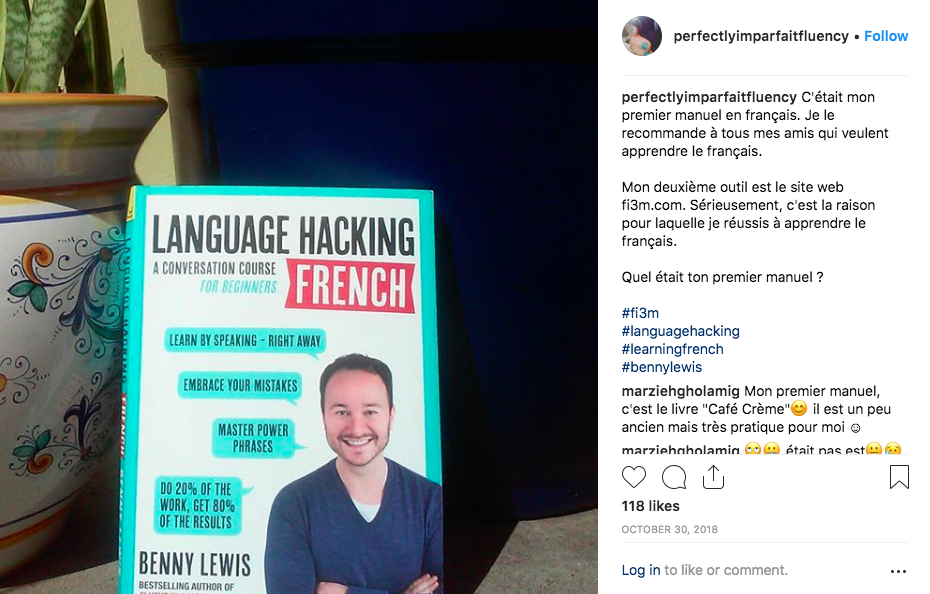
You do not have to copy my rule. A beginner might start with one word, a short caption or a sentence frame. The point is to make producing your target language the default, at a level you can sustain.
2. Decide When a Translation Helps
I usually left out an English translation because I wanted French-speaking readers and learners to be my audience. That kept the exercise quick and stopped me from polishing the English version instead of practising French.

A translation can still be useful when you are asking for feedback or want friends to follow the story. Choose deliberately. There is no language-learning prize for making a post harder to understand.
3. Use Search Terms and Hashtags to Find Your People
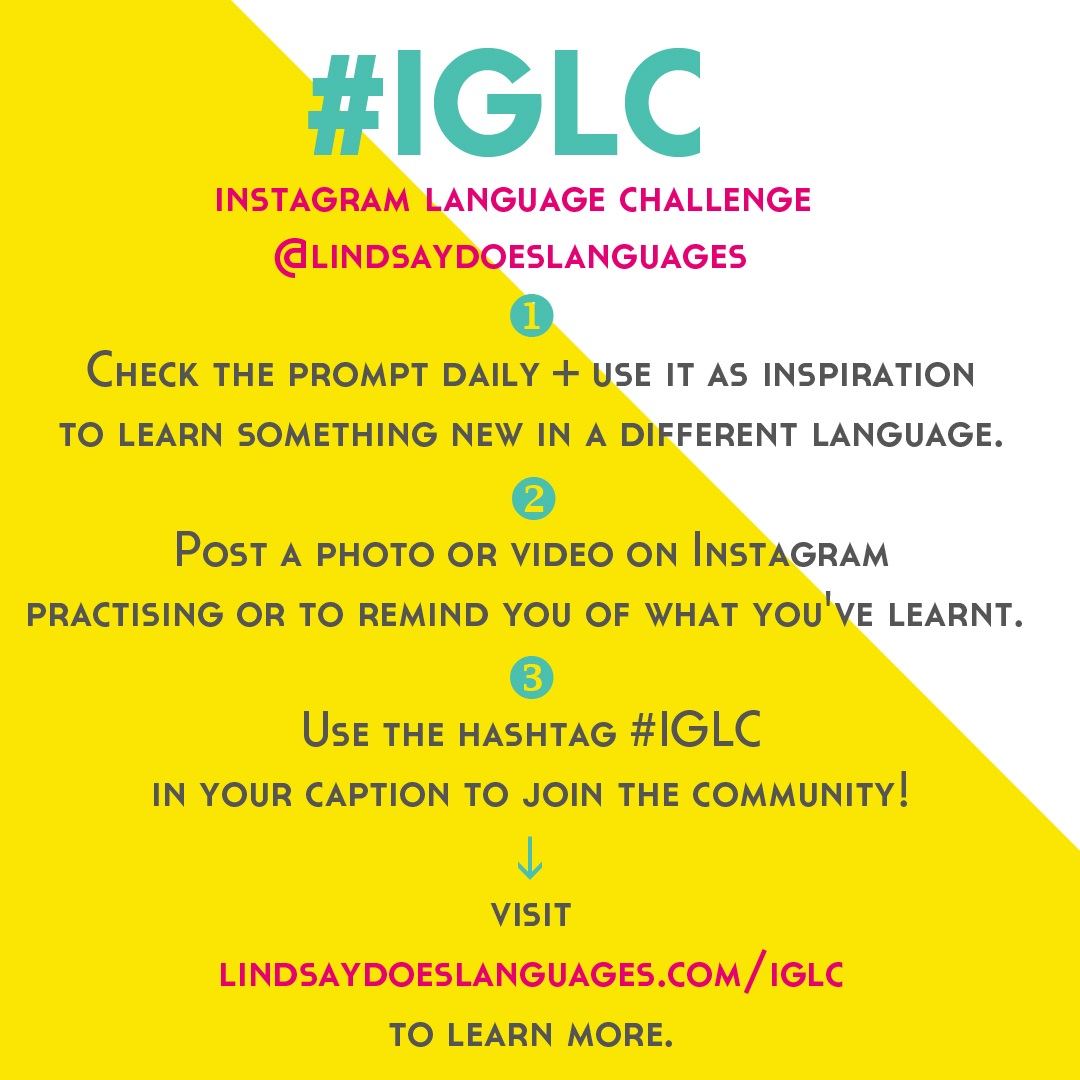
In 2018, challenge hashtags helped people find my first posts. Today, start by searching for your language plus a hobby, then check whether the results are recent and relevant before you follow an account or use a tag.
My Original Language-Learning Challenge Tags
These are historical examples from my first year. Some campaigns may no longer be active, but they show the kind of specific community term worth searching for:
- #iglc
- #languagediarychallenge
- #30dayspeakingchallenge
- #fi3mchallenge
French Search Terms and Hashtags for Hobbies
Look up words for things you genuinely enjoy. I used French terms such as:
- #apprendrelefrançais (“learn French”)
- #forêt (“forest”)
- #livre (“book”)
- #rando (informal shorthand related to hiking)
- #ratdebibliothèque (“library rat”, similar to “bookworm”)
Do not worry about finding one perfect tag. Try a few current terms, inspect the results and keep the ones that lead to conversations or material you want to understand.
4. Join Conversations, Not Just Feeds
Reading captions is useful, but writing a relevant comment turns passive scrolling into retrieval practice. Start with a sentence you can reuse and adapt. Avoid copying the same generic comment across many posts; respond to what the person actually shared.
I read comments to notice short reactions such as mignon (“cute”). When I found French posts about Harry Potter, I could write: J’ai lu le premier tome de Harry Potter. C’était chouette. (“I read the first Harry Potter book. It was great.”)

Here is one of those comments in context:
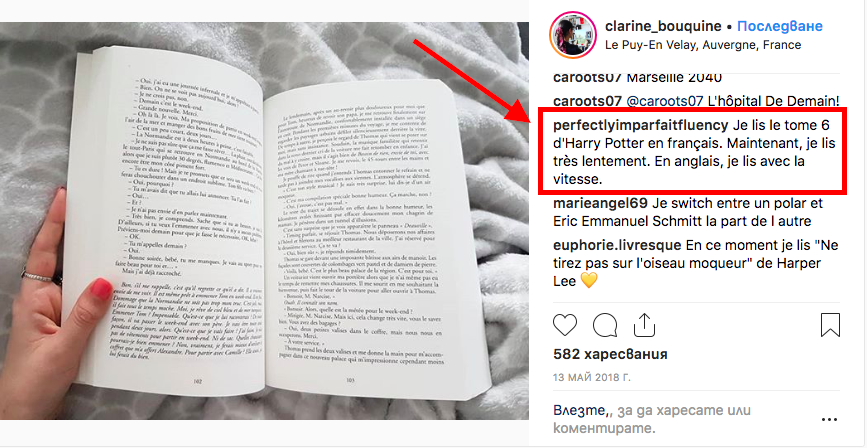
Those small exchanges helped me meet encouraging French speakers and other learners. A reply is never guaranteed, so make the comment itself your practice rather than treating attention as the reward.
Two accounts from my original story still have independently verifiable public identities: Elfin Waters at @allaboutitalian and Carrie Anne James at @frenchisbeautiful. Account names and posting habits can still change after this update.

5. Dare to Be Perfectly Imperfect
I learned from Benny to treat mistakes as part of practice. My goal was one imperfect French post each week, not a flawless performance.
I wrote sentences I knew how to construct, then checked anything uncertain. A translation tool can help you investigate a phrase, but do not assume its first output is correct. Compare it with a dictionary, a trusted example or feedback from someone who knows the language.
One post showed my dog on the grass while I wrote about kindness. Another showed the notebook where I organised my study routine into 12-week phases.
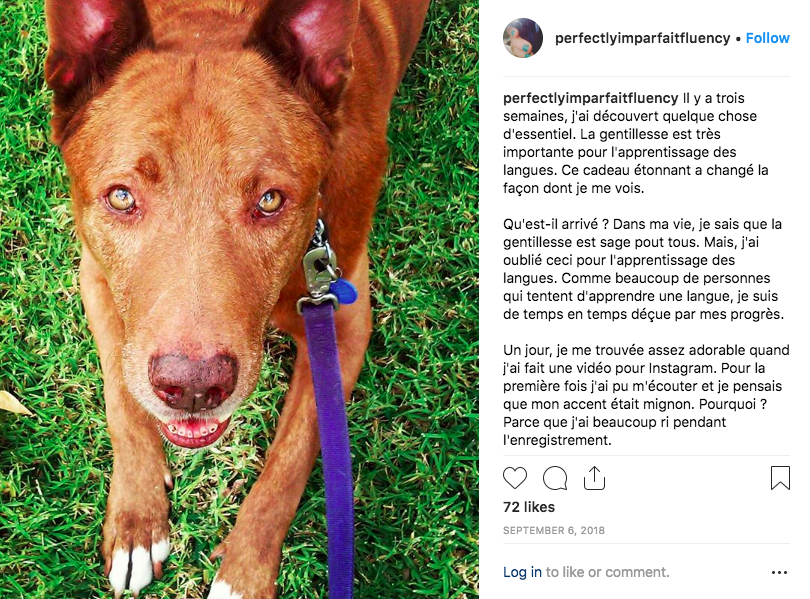
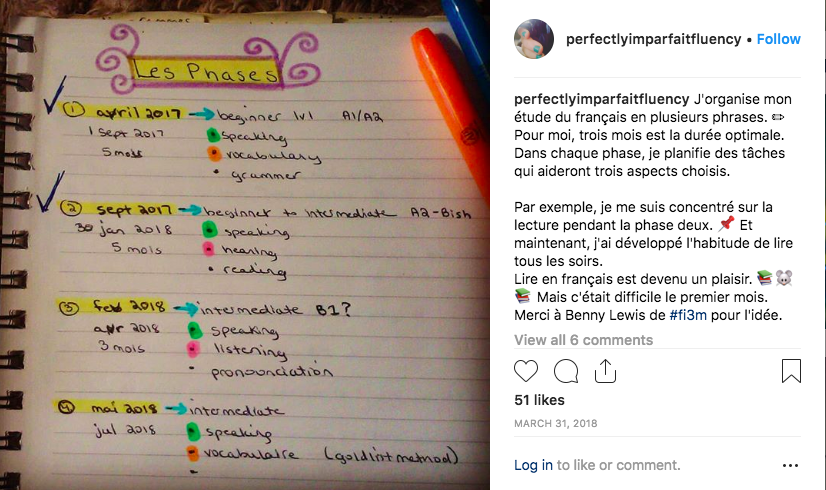
Your post does not need to be fancy. It needs to give you a manageable reason to use your target language.
I Did Challenges Imperfectly, Too
For my first month, I aimed to post every day. After 30 days, I changed the goal to once a week because I did not want to use Instagram daily. Two completed posts are still two genuine pieces of practice; a missed streak does not erase them.
6. Be Selective about Who You Follow
Your goal does not have to be a large following. Mine was to practise French without turning a hobby into another source of pressure.
Follow accounts that make you want to read, listen or comment in your target language. They do not all need to teach the language. At the time, I enjoyed French posts about cats and the novel Mémémoires because they connected French with something I already liked.
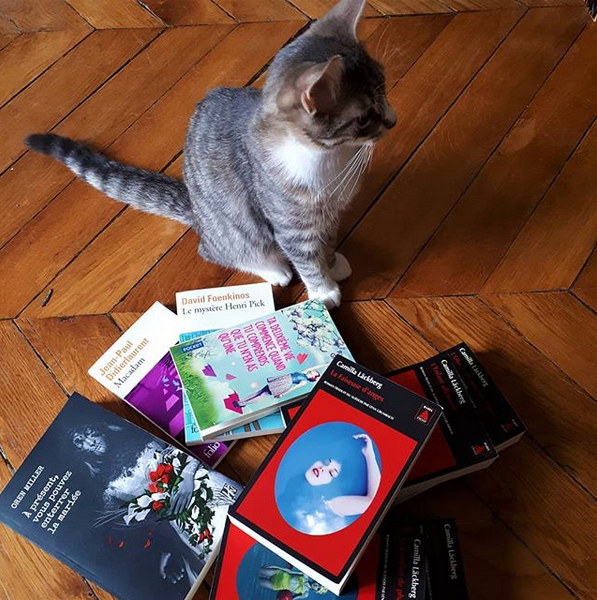

Review the feed from time to time. Unfollow or mute accounts that distract, annoy or pull you back into your native language. A useful learning feed is deliberately small enough that you still want to open it.
Easy Does It
Pick one action for this week: write a short caption, search for a hobby in your target language or leave one thoughtful comment. Keep the account enjoyable, protect your privacy and measure the practice you did rather than the likes you received.

Social