



EnglishClass101 Review: Is It the Best Way to Learn English?

Full disclosure: This post contains affiliate links. ?
What is EnglishClass101?
EnglishClass101 is part of the Innovative Language family, built to get you understanding and speaking English from the very first lesson. Audio and video lessons taught by native speakers are its main feature.
- what it’s for:
- First contact with English, listening practice, vocabulary, pronunciation (the stress, rhythm and "th" sounds), phrasal verbs, and choosing between British and American English
- languages:
- English
- level:
- Absolute Beginner to Advanced
+ PROS
- Loads of native-speaker audio, exactly what English’s spelling-versus-sound gap needs
- A pronunciation voice-recorder tool for English’s tricky stress and “th” sounds
- British and American English offered as full parallel tracks, so you choose your accent
- A guided, CEFR-aligned learning pathway, so there’s no guessing where to begin
- Excellent for vocabulary and phrasal verbs, learned in context
- Genuinely affordable, with a free tier and a 60-day guarantee
- CONS
- All instruction is in English, so true beginners with no English will want first-language support
- Grammar isn’t drilled in sequence, so articles and the tense system need a companion resource
- Speaking and writing practice is light below the top tier
- Upsell banners and marketing emails
- The mobile app doesn’t have all the best features
Quick Fire Review
A brilliant audio-and-vocabulary engine for English that trains your ear for its chaotic spelling and stress and lets you choose British or American; pair it with a grammar resource for articles and tenses. 4.5/5.
English has a reputation as an “easy” language, and in some ways it earns it: no cases, no grammatical gender, a familiar Latin alphabet for most learners. But anyone who’s actually sat in front of a class of English learners knows the truth is messier: the spelling barely relates to the sound, the stress lands in unpredictable places, and there are enough phrasal verbs and articles and present-perfect traps to keep a learner stumbling long after they can order a coffee. So when you pick your main English resource, you want one that deals with the things that really make English hard, not a generic app that drills you on “the cat sat on the mat”.
I’ve reviewed the Innovative Language “101” courses across more than a dozen languages now (you might have seen my SpanishPod101 and JapanesePod101 reviews), and most of the Fluent in 3 Months team have leaned on these podcasts for their own language missions. But EnglishClass101 is a slightly different review for me to write, because English is the one language on this list I’ve taught. Before I was doing this, I spent years as an English teacher, watching learners from every kind of language background hit exactly the same walls, in the same order. So I’m coming at this one from both sides: as a language learner who knows what a good course feels like, and as a former English teacher who knows exactly where students get stuck.
So the question I really want to answer is a specific one: does EnglishClass101 handle the bits of English that trip everyone up?
What Makes English So Hard to Learn (and Where a Course Has to Earn Its Keep)
Before we get to the platform, let’s look at what an English learner is actually up against. These are the challenges I watched trip up learner after learner, and they’re the yardstick I’ll measure EnglishClass101 against.
One quick decision comes first, though: which English? British or American spelling, pronunciation and vocabulary differ enough that you want to pick a lane and train your ear on it (is it a “flat” or an “apartment”, is that a hard “t” or a flapped one in “water”?). EnglishClass101 is unusual here, and I’ll come back to it, but keep the question in mind.
1. Spelling that ignores the pronunciation. This is the single biggest wall, and every teacher watches students hit it in week one. English spelling was more or less frozen by the printing press five centuries ago, and then the pronunciation kept moving without it. Pile on French scribes, silent letters added to fake a Latin pedigree (the “b” in “debt” was never spoken), and you get a language where “through”, “though”, “tough”, “thought”, “plough” and “cough” all share the letters “ough” and not one of them rhymes with another. There’s no rule to fall back on; you simply have to hear each word, which means whatever course you pick needs audio at its core.
2. Pronunciation, word stress and rhythm. English is stress-timed: the stressed syllables land at roughly even intervals and everything else squashes down around them. That creates three problems at once. Word stress moves for no visible reason (“PHO-to”, “pho-TOG-raphy”, “photo-GRAPH-ic”). Unstressed vowels collapse into a lazy “uh” sound (say “banana” and notice only the middle vowel is really pronounced). And native speakers run words together, so “what are you doing” becomes “whaddaya doin'”. Add the “th” sounds, which most languages don’t have, and minimal pairs like “ship” and “sheep” that many learners can’t hear apart, and you get the classic complaint: “I understand English fine when it’s slow, and not a word at full speed.”
3. Phrasal verbs. “Get up”, “get over”, “get by”, “get around”, “get away with”. Same little verb, wildly different meanings, and almost nothing a learner can reason out. Most languages have no equivalent structure, so there’s nothing to map them onto; each one has to be learned as its own idiom, and plenty carry three or four unrelated meanings (“take off” your coat, the plane takes off, her career took off). This is the wall between textbook-fluent and actually following a conversation, because native speakers lean on phrasal verbs constantly.
4. Articles and countable nouns. If your first language is Russian, Polish, Mandarin, Korean or Japanese, English articles (“a”, “an”, “the”) are brutal, because the concept itself is missing from your language. It’s one of the very last things even fluent, advanced speakers get consistently right. Countability makes it worse: “advice”, “information”, “furniture” and “news” are uncountable in English but countable in plenty of other languages, so a learner’s own instinct actively misleads them. There’s no tidy rule here; native speakers “just know”, which is the hardest kind of thing to teach.
5. Tenses and aspect. English has a big tense system relative to many languages, and the notorious sticking point is present perfect versus past simple. “I have lived here for ten years” (still true now) versus “I lived here for ten years” (finished) is a distinction that plenty of languages simply don’t draw, so learners flatten the two together and lose the “still relevant now” signal that English speakers rely on. Layer the continuous (“I am eating” versus “I eat”) on top of every tense and you have loads of scaffolding to build.
Keep those in mind. Here’s how EnglishClass101 stacks up.
Getting Started with EnglishClass101
Like the rest of the 101 family, EnglishClass101 is built around short audio and video lessons taught by real native speakers, organised into level-based pathways: Absolute Beginner, Beginner, Intermediate, Upper Intermediate and Advanced.
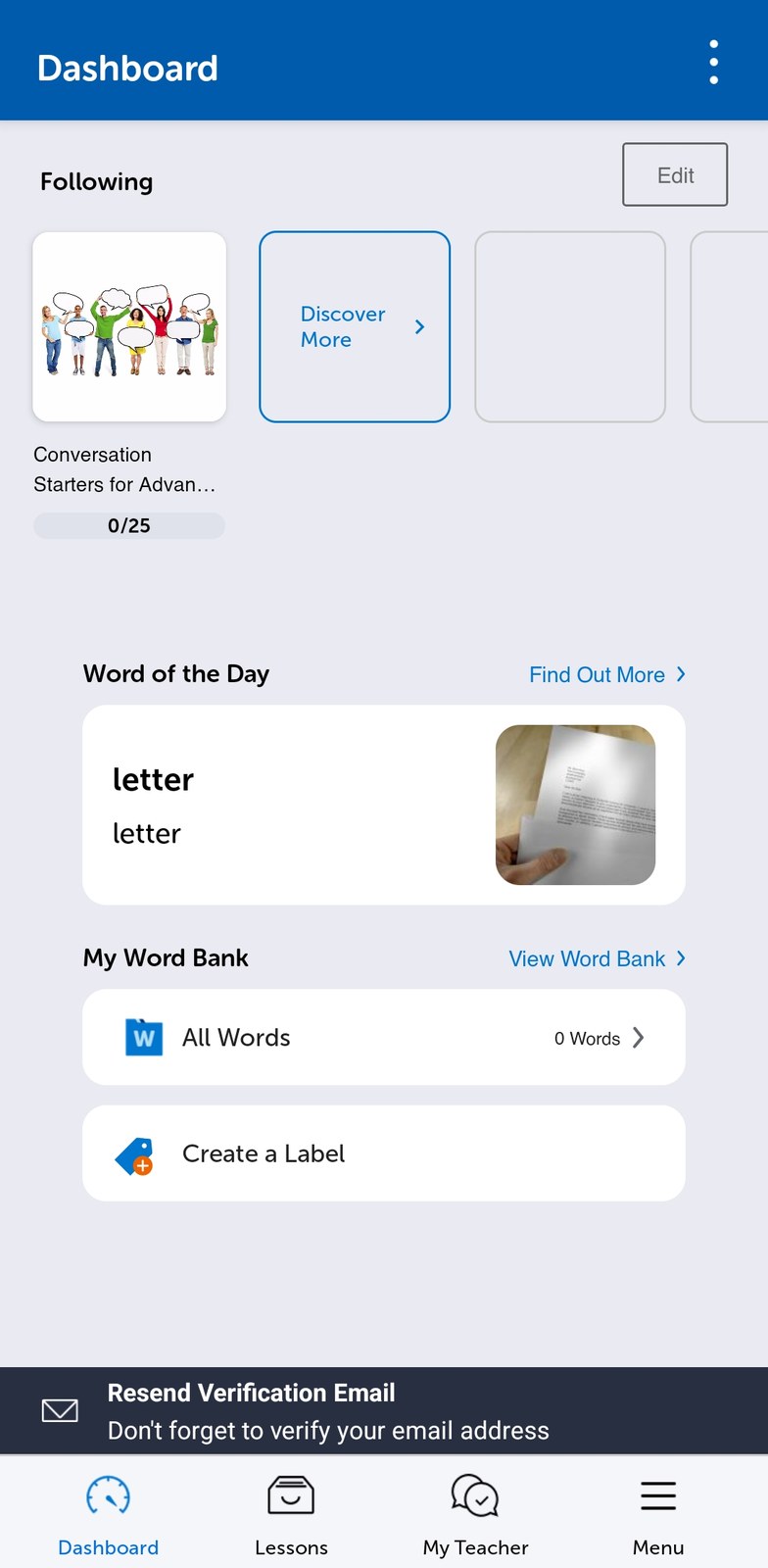
Signing up is painless. You create a free lifetime account with just an email (no card needed) and pick your level. Not sure where you sit? Start at Absolute Beginner and move up later. New accounts also get a 7-day Premium trial, so you can try the paid features before committing to anything.
Once you’re in, your dashboard hands you a learning pathway for your level, so you’re not left staring at thousands of lessons wondering where to start. Helpfully, the core pathways are mapped to the CEFR levels employers and exams actually use: the Level 1 tracks line up with CEFR A1, with parallel American and British versions. There are dozens of themed pathways beyond the core route too, from Survival Phrases to a full Business English strand.
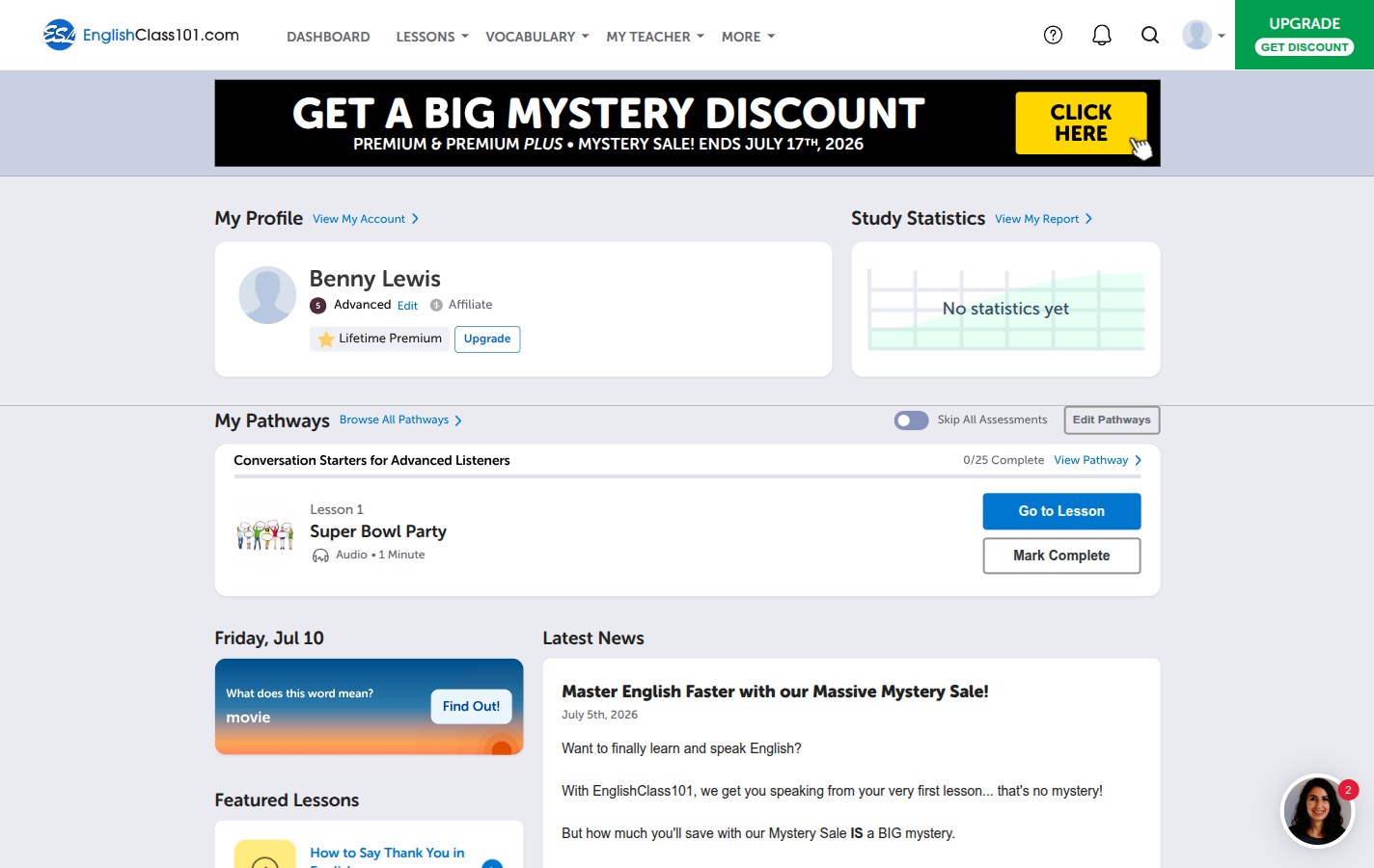
Which English, and Does It Handle the Pronunciation?
EnglishClass101 does something most of its sister sites don’t: rather than picking one national standard, it runs American and British English as parallel tracks. The core pathways come in both flavours, Survival Phrases has a US season and a UK season, and there are separate pronunciation series and “3-Minute” video courses for each accent, each with its own host. American is clearly the flagship, and it’s the default the site nudges you towards, but the British option is a proper, built-out alternative rather than a token toggle. For a learner, that’s a real plus: you get to consciously choose the accent you’re training your ear on, instead of absorbing whichever one a course happens to default to.
And the pronunciation side is exactly where the audio format pays off. Because every lesson is built on native-speaker recordings, with slowed-down, line-by-line playback on the paid tiers, you learn “through” and “though” by ear, sidestepping the spelling trap entirely. On Premium there’s also a voice-recorder tool that records you and plays your attempt back against the native audio, which is spot-on for English’s moving word stress and the “th” sounds. Of all the challenges on my list, this is the one EnglishClass101 is best built to solve.
Inside an EnglishClass101 Lesson
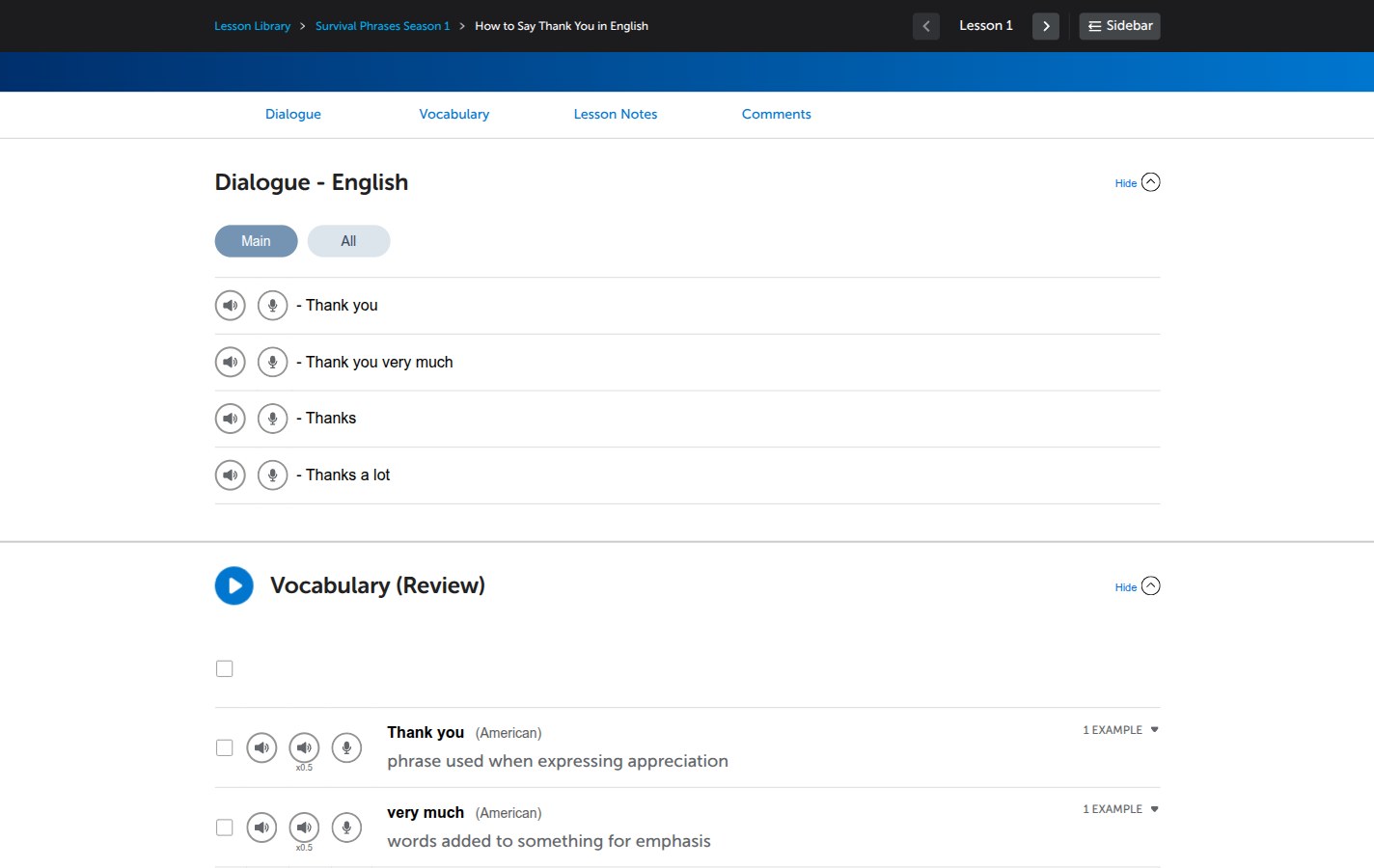
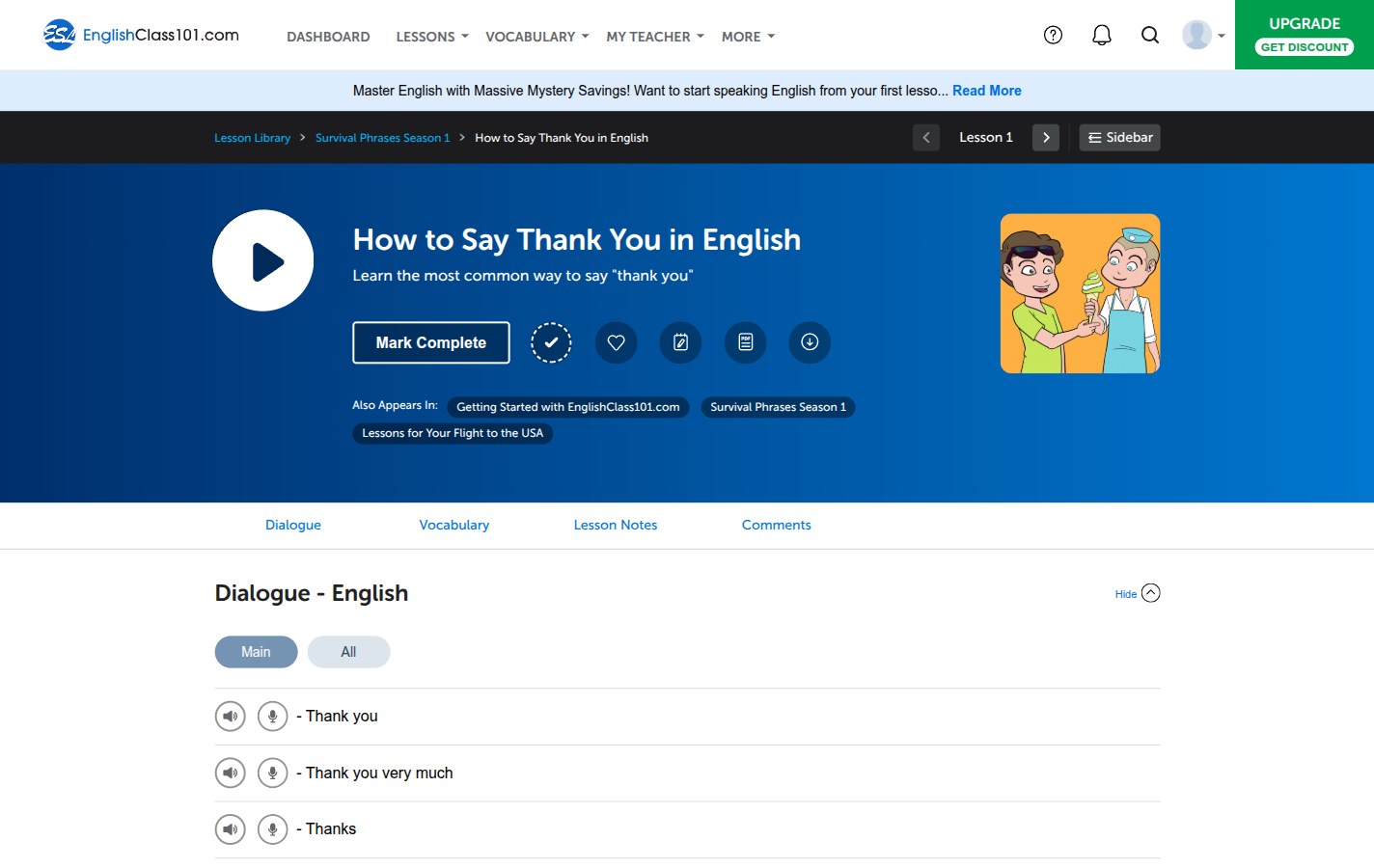
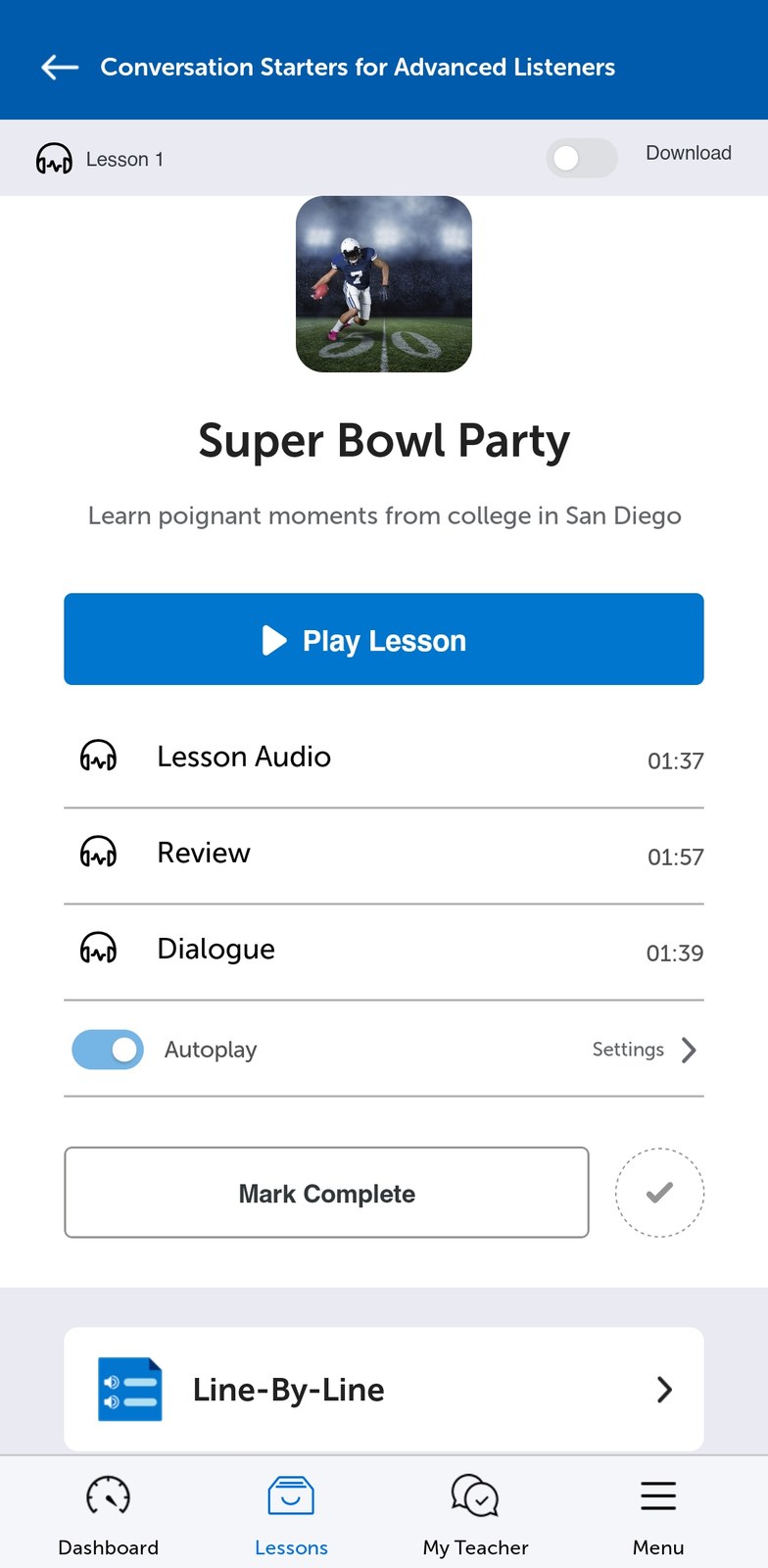
A typical lesson is short (most run 3 to 15 minutes) and follows a consistent shape: a native dialogue, a slow line-by-line breakdown, vocabulary with natural-then-slow pronunciation, a grammar point, and a cultural note. You get the audio, the full scripted dialogue, a vocab list, and downloadable lesson notes (a PDF) that unpack the grammar and context.
This dialogue-first format suits some of English’s quirks well. Phrasal verbs are best absorbed in context rather than drilled from a list, and hearing “get over it” or “take off” land naturally in a conversation, then saving it as a chunk in your word bank, is much closer to how anyone actually picks them up. The same goes for prepositions (“good at”, “afraid of”, “depend on”), which sink in through repeated exposure.
Where the format is weaker is the rule-based grammar. Articles, countability and the present-perfect-versus-past-simple distinction are taught as they happen to come up inside a dialogue, not built up as a deliberate, sequenced syllabus. You’ll hear the correct forms used many times, which helps your instinct over the long run, but if your first language doesn’t have articles or that tense distinction, passive exposure alone rarely fixes the habit. This is the standard, honest caveat for the whole 101 family, and it holds for English too: brilliant for input, lighter on systematic grammar.
The Study Tools
On a Premium plan, the lessons are wrapped in a solid set of study tools:
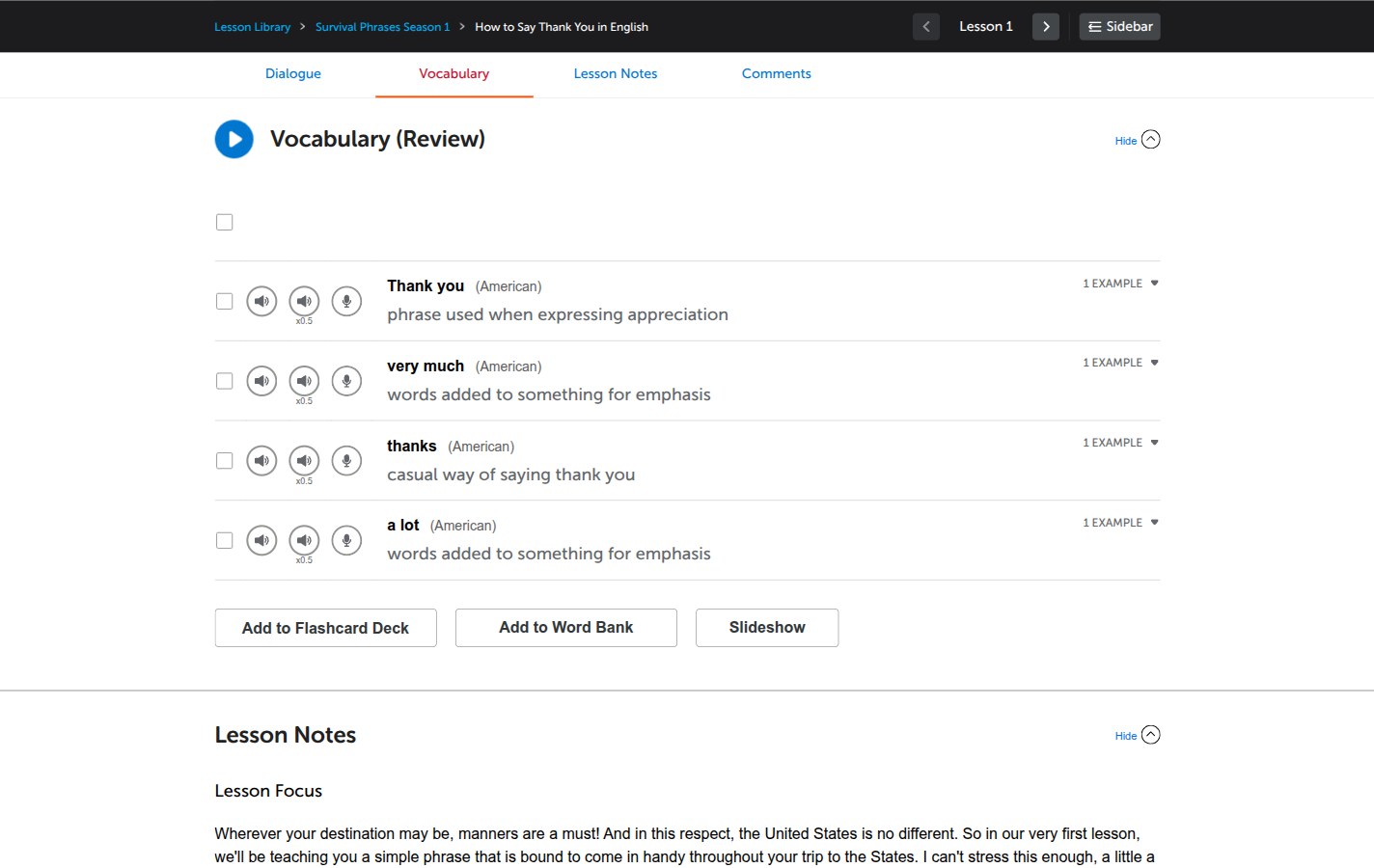
- Spaced-repetition flashcards and a personal word bank, where you save words straight from any lesson, ideal for hammering home vocabulary and those phrasal-verb chunks.
- A Grammar Bank collecting the course’s grammar points (hundreds of them) in one place.
- Multiple-choice assessments to check a section has actually gone in.
- A pronunciation tool that records you and compares against the native audio, the standout feature for English.
- 2,000 core words and phrases as a ready-made vocabulary backbone (the free and Basic tiers get a smaller 100-word list).
The Mobile App
EnglishClass101 shares one app with the whole Innovative Language family (it’s called “Innovative Language Learning”; you choose English after installing). It syncs with your account, so a lesson you finish on your laptop shows as done on your phone, and you can download lessons for offline listening on the commute. It’s well rated too, at well over 4 stars on both app stores.
The usual family caveat applies: the app is gated by your subscription tier just like the website, and a few of the best study features live more comfortably in the browser. The workaround is the same one I use elsewhere: pull the site up in your phone’s browser when you want the full experience.
What Other English Learners Say
I dug through a stack of independent reviews and learner forums to test my own take against other people’s. A few clear patterns came up.
The praise is consistent. Learners love that the lessons use real native speakers rather than robotic text-to-speech, that the library is so deep you could never exhaust it, and that the content is modern and practical (the way people actually talk day to day). The dual British/American design gets singled out as a genuine differentiator, and the study tools (the PDF notes, transcripts and pronunciation recorder) get plenty of praise too.
The criticism clusters around a few points. The big one, and it’s specific to an English course, is that the instruction is entirely in English. That’s fine once you have some footing, but for an absolute beginner with no English at all, being taught English through English (with no support in your own language) can be genuinely frustrating, and it’s the one thing rival beginner apps handle better. Beyond that: the lessons can over-explain rather than just immerse you; the library is easy to get lost in unless you stick to a pathway; there are the familiar upsell banners and marketing emails; and hands-on speaking and writing practice is thin (most in-lesson practice is multiple-choice) unless you pay for the top tier and its 1-on-1 teacher, which some learners feel overpromises. None of that sinks the platform, but it’s the full picture.
Pricing and Plans
EnglishClass101 runs the same four-tier structure as the rest of the family:
| Plan | Roughly… | What you get |
|---|---|---|
| Free | Free forever | Survival Phrases, plus the first 3 lessons of every pathway, Word of the Day, 100+ vocab lists, the app, and a 7-day Premium trial |
| Basic | ~$4/mo | Everything free + access to all lessons and in-depth PDF lesson notes |
| Premium | ~$5–10/mo | Everything in Basic + line-by-line audio, flashcards, word bank, the Grammar Bank, assessments, the pronunciation tool, and the 2,000 core words |
| Premium PLUS | ~$13–23/mo | Everything in Premium + your own teacher, hand-graded assessments and a personalised study plan |
A few notes on the pricing: the headline per-month figures are based on the longest (24-month) plan, so the real price depends on the billing period you pick. Innovative also runs a standing discount most of the time, applied automatically through our link at checkout; the exact amount varies, so the checkout price is the one to trust. There’s a 60-day money-back guarantee, which takes the risk out of trying Premium, and if you know you’re in this for the long haul, there’s also a one-off Lifetime option worth a look. Expect the usual upsell banners nudging you up the tiers; mildly annoying, easy to ignore.
For most people, Premium is the sweet spot: that’s the tier with the flashcards, the pronunciation recorder and the full lesson features. Premium PLUS only makes sense if you specifically want a teacher checking your work.
Pros and Cons
Pros
- Loads of native-speaker audio, which is exactly what English’s spelling-versus-sound gap demands.
- A pronunciation voice-recorder tool that compares you against a native speaker, the best-matched feature for English’s tricky stress and “th” sounds.
- British and American English as full parallel tracks, so you consciously choose your accent instead of defaulting into one.
- A guided, CEFR-aligned learning pathway, so you’re never guessing what to study next.
- Excellent for vocabulary and phrasal verbs, learned in context and drilled with flashcards.
- Affordable, with a usable free tier and a 60-day guarantee.
Cons
- All instruction is in English, which makes the very first steps hard for a true beginner with no English at all.
- Grammar is taught incidentally, so articles, countability and the tense system need a companion resource.
- Speaking and writing practice is light below the top tier (mostly multiple-choice).
- Upsell banners and marketing emails crop up around the platform.
- The app is gated and a touch lighter than the full website.
Who EnglishClass101 Is (and Isn’t) For
It’s a brilliant fit if you already have a little English and want to build real listening comprehension and a big vocabulary; if you learn well by ear and want English in your headphones on the commute; if you want to deliberately train a British or American accent; or if you want practical, modern conversational English rather than exam drills.
It’s less ideal if you’re a complete beginner who needs explanations in your own language to get going, or if you want a single resource that drills grammar mechanics and gives you heavy speaking practice. In those cases, use EnglishClass101 for listening and vocabulary and pair it with a grammar resource or a conversation partner.
The Verdict
EnglishClass101 does the most important thing right: it takes English’s real challenges seriously. It floods your ears with the native audio you need to crack English’s chaotic spelling and stress, its voice-recorder is the right tool for the pronunciation job, it teaches phrasal verbs the way they’re actually learned (in context), and it’s one of the very few courses that lets you properly choose between British and American English. It isn’t a do-everything grammar bible, and true beginners will want some first-language support alongside it, but as the audio-and-vocabulary core of your English study, it’s excellent value.
My rating: 4.5 out of 5.
If you want to give it a go, you can start with EnglishClass101 here. That link also carries our reader discount (the near-permanent Innovative deal is applied for you at checkout), so you won’t be paying full list price. Set up a free account, take it for a spin, and see if learning English by ear clicks for you.

Social