


PolishPod101 Review for Polish Learners

Full disclosure: This post contains affiliate links. ?
What is PolishPod101?
PolishPod101 is part of the Innovative Language family, with Polish audio and video lessons, transcripts, study tools, mobile access and optional teacher feedback.
- what it’s for:
- Building Polish listening, pronunciation, vocabulary and practical communication through short lessons and structured review.
- languages:
- Polish
- level:
- Absolute Beginner to Advanced
+ PROS
- Detailed Polish pronunciation support
- Native audio and line-by-line playback
- Contextual grammar notes
- Strong vocabulary review tools
- Web and mobile access
- Optional teacher feedback
- CONS
- Library needs self-direction
- Inflection practice needs support
- Limited forced output
- App trails the website in places
- Advanced learners need native material
Quick Fire Review
PolishPod101 is a flexible audio-led Polish course with particularly useful pronunciation and line-by-line listening tools. It suits self-directed learners who add systematic grammar practice and real output.
Polish can make a beginner feel as if several consonants have arrived at once and forgotten to leave space for a vowel. The spelling is more systematic than it first appears. Your ear still has to learn digraphs, voicing changes and consonant clusters before a familiar written word becomes easy to catch in speech.
Grammar brings cases, gender and verb aspect. Those systems are learnable, yet they create too many moving parts for a phrase app that only rewards recognition.
PolishPod101 is useful because it lets you move between the whole dialogue and individual lines, with transcripts and notes close by. Its pronunciation material tackles the sounds that make Polish intimidating, and its library supplies a large amount of graded listening. You will still need a more deliberate plan for producing case endings and aspect accurately.
What Makes Polish Different?
Polish has seven grammatical cases. Nouns, adjectives, pronouns and some numbers change form according to their job in a sentence and the words around them. Grammatical gender affects those forms, including patterns in the plural.
Verbs also carry aspect. A perfective verb usually presents an action as complete or bounded, while an imperfective partner presents process, repetition or an open-ended action. English often expresses the same distinction through context or extra words, so learning one Polish verb as a direct translation is rarely enough.
Pronunciation creates the first visible obstacle. Polish uses clusters such as those in szczęście, along with digraphs and letters carrying diacritics. The written nasal vowels ą and ę change their spoken realisation depending on the sounds around them.
Reading from spelling becomes reasonably predictable after you learn these conventions. The reverse direction is less consistent. The pairs u/ó, rz/ż and ch/h can represent the same sounds, so hearing a word does not always tell you how to spell it.
The current State Department schedule gives Category III languages a normal intensive course of 44 weeks for its professional objective. Polish falls under that catch-all definition, although it is not named beside the 44-week line. The comparison should set expectations about sustained work, not discourage you from having a first conversation quickly.
Getting Started with PolishPod101
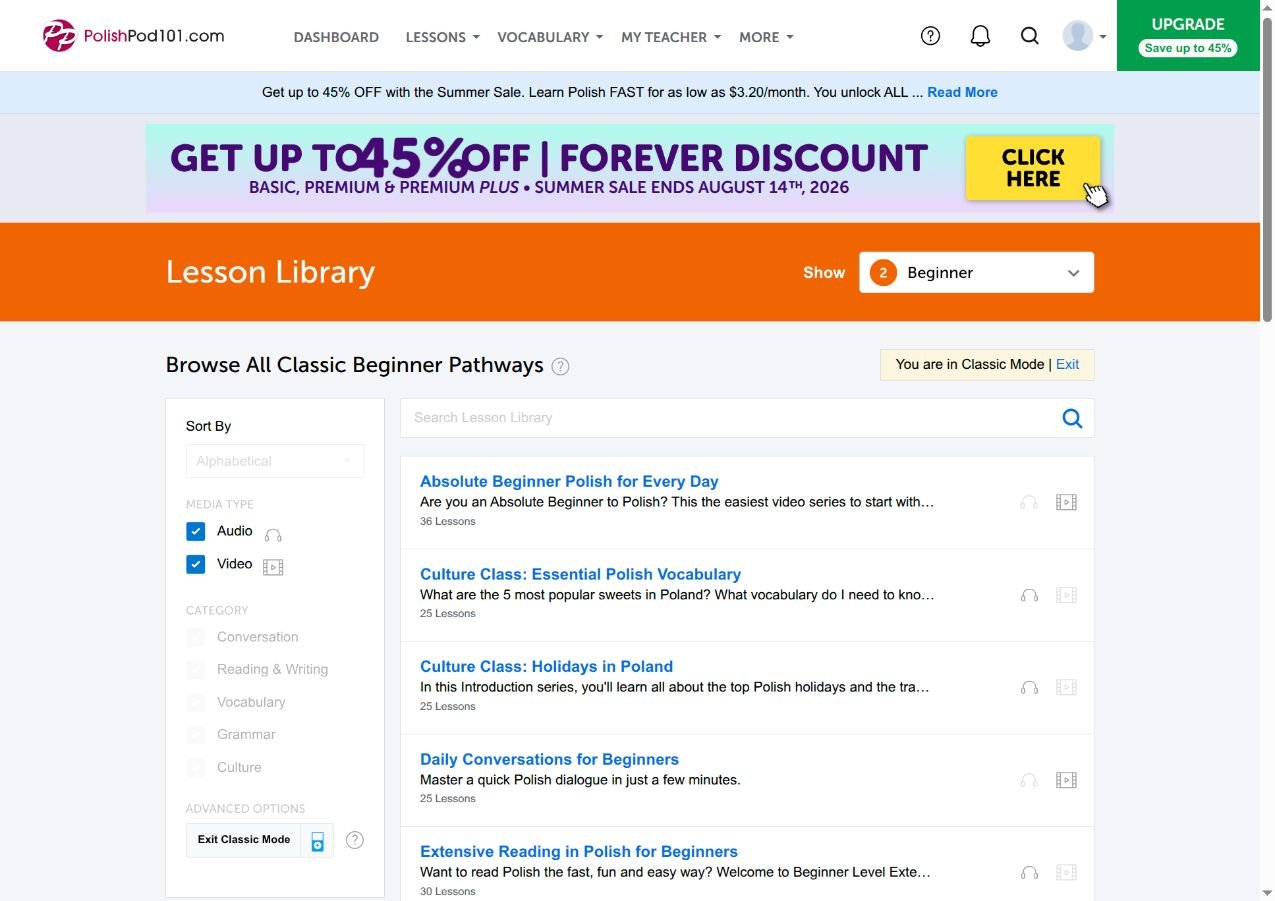
PolishPod101 offers a level choice and suggested pathways through a broad lesson library. Begin with one Absolute Beginner pathway and leave the rest alone for two weeks. A stable sequence matters more than finding the theoretically perfect starting lesson.
The free membership currently gives you a limited lesson selection, vocabulary resources and a short Premium trial without a card. That is enough to test the dialogue style, notes and line-by-line audio.
If you already know some Polish, choose a lesson whose dialogue you partly understand without text. If everything is obvious, move up. If you cannot identify the subject or situation after two listens, move down. The right level should leave you with a small, clear gap to close.

Making Polish Pronunciation Manageable
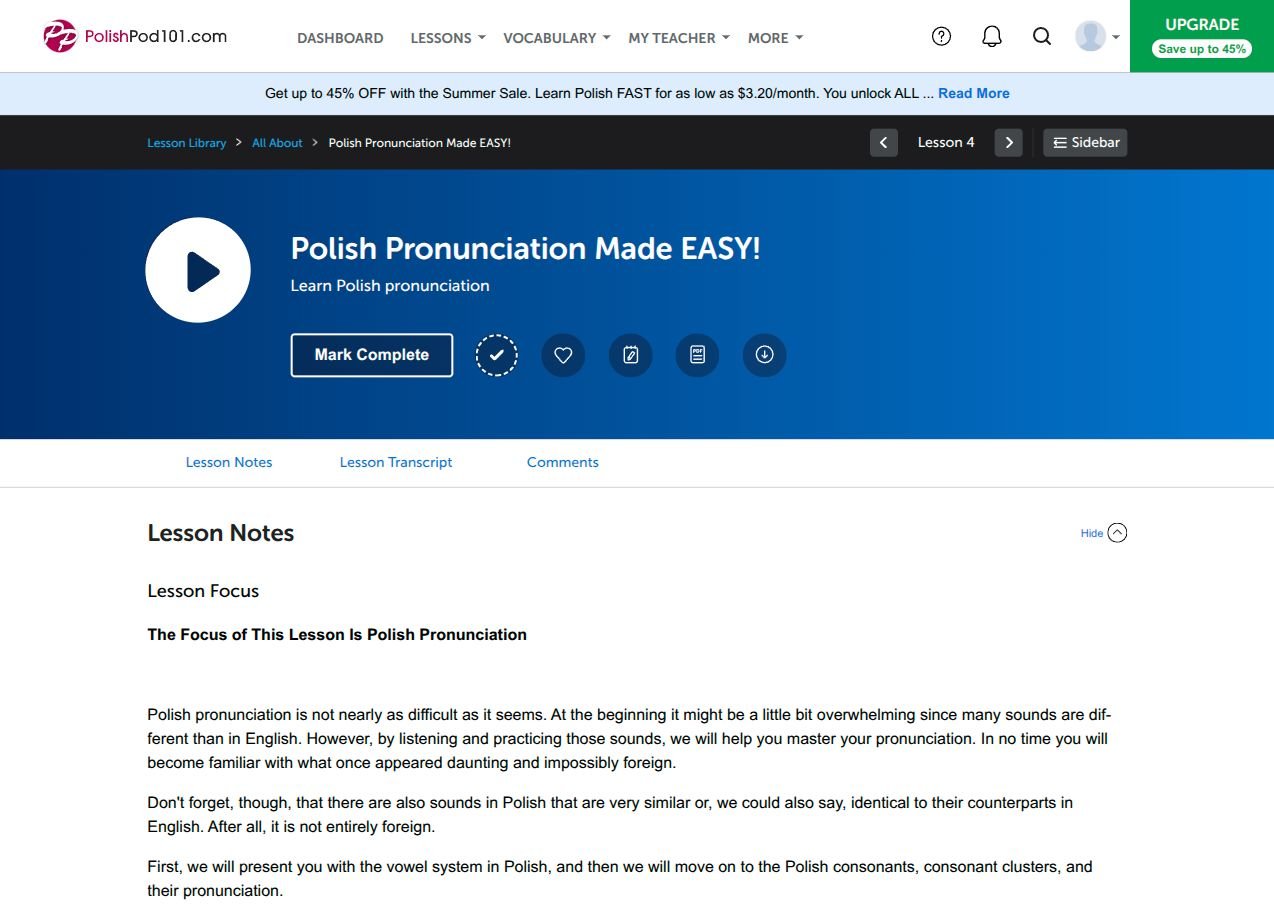
PolishPod101 has dedicated material on consonants, affricates, clusters, diacritics and voicing. These lessons are valuable because an English approximation can merge Polish sounds that native speakers keep distinct.
Learn clusters as movements, not as a row of isolated letter names. Play a word, slow it down, and copy the full mouth movement. Then place it back in the sentence. Adding artificial vowels between consonants may make the word easier to say, but it also makes it harder for a Polish listener to recognise.
Voicing changes explain why the end of a word or a consonant beside another consonant may not sound as expected from the spelling. Nasal vowels also change by context. A simple “ą always sounds like X” rule will fail quickly.
Use the recorder to compare your rhythm with the model. Polish stress is often predictable, which gives you one stable feature while individual sounds are new. Aim for clear contrasts and a steady phrase before chasing a perfect accent.
Reading Polish More Reliably
The alphabet looks dense because Polish represents several sounds with digraphs and diacritics. Once you know the combinations, the route from written form to pronunciation is fairly regular.
Build that knowledge from words you can use. Group sz, cz, rz, dz, dź and dż by sound, then contrast them inside short phrases. Do the same with ś, ć, ź, ń and their spelling before i. A chart helps, but audio keeps the chart attached to real speech.
PolishPod101’s transcript lets you predict a word before hearing it. Cover the romanisation if it appears, read the Polish aloud, then compare with the native recording. Mark the precise source of a mistake, such as voicing, stress or a digraph.
Do not call Polish perfectly phonetic. Reading aloud becomes dependable sooner than spelling from dictation because several spellings can share a sound. That distinction makes your progress easier to judge.
Cases, Gender and Aspect in Real Sentences
PolishPod101’s grammar notes explain cases, agreement and aspect when they appear in a dialogue. This keeps grammar connected to meaning. A location phrase, for example, gives you a preposition, a case ending and a useful answer at the same time.
The weakness of dialogue-led grammar is coverage. Seeing one genitive ending does not teach the entire genitive system, and recognising a perfective verb does not guarantee you can choose its partner under pressure.
Keep a small pattern notebook beside the platform. Write the complete phrase, label the function, then make two substitutions. For aspect, store common verbs as pairs with one example for each. Review the contrast through sentences, not English definitions alone.
Learn Polish in one hour provides a speaking-first introduction when declension tables start delaying your first attempts. The Fi3M free Polish resources guide can supply a more systematic grammar reference alongside the audio course.
Inside a PolishPod101 Lesson
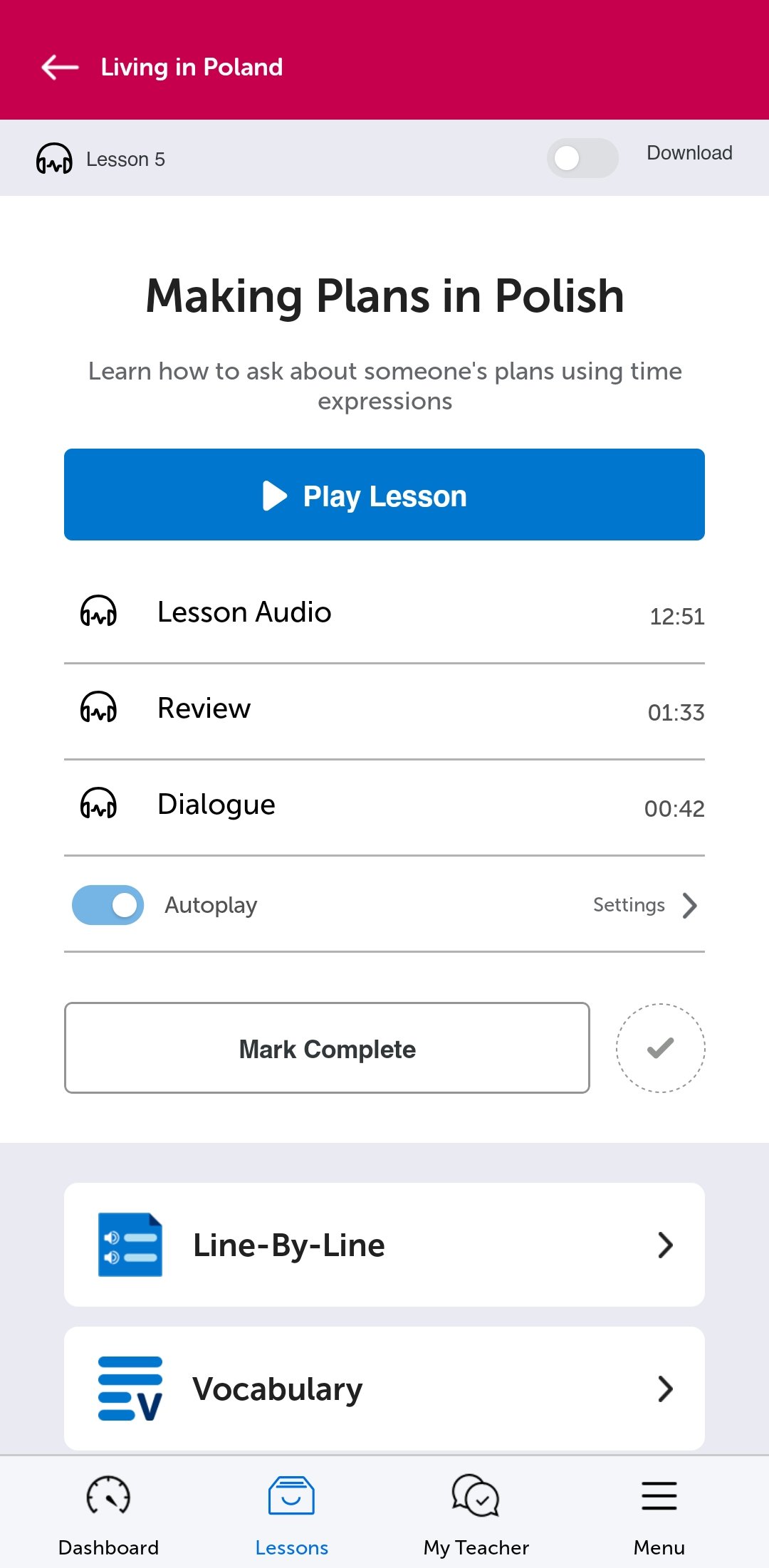
A standard lesson revolves around a Polish dialogue, followed by vocabulary, grammar and cultural explanation in English. The format is approachable for beginners and easy to split across short sessions.
Listen once without the transcript and identify the situation. On the second pass, follow the Polish text and underline the exact ending or cluster you missed. Use line-by-line audio to solve that small problem. Read the notes after you have tried to infer the pattern.
Finish by changing the dialogue. If someone orders one item, order a different one. If a sentence describes yesterday, adapt it to a plan for tomorrow and check the aspect again. This is where knowledge starts becoming choice.
Some lessons contain more English discussion than an experienced learner needs. Skip to the dialogue, vocabulary or notes when the explanation is already familiar. The platform rewards selective use.
Vocabulary and Review Tools
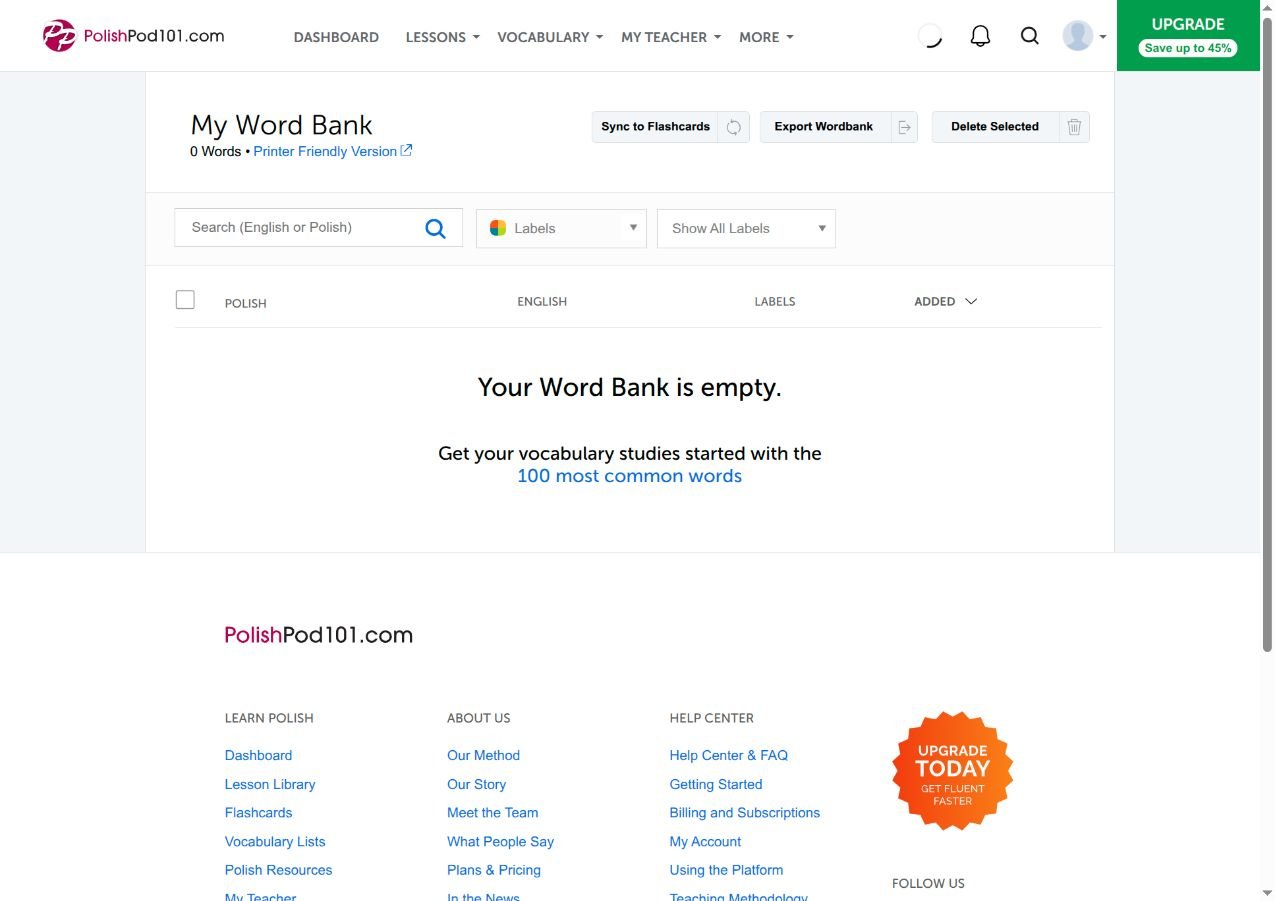
Premium includes a word bank, spaced-repetition flashcards, assessments, pronunciation tools and line-by-line audio. The line player is the most useful feature for early Polish listening because it lets you isolate a cluster or ending without replaying the full dialogue.
Save nouns with a phrase that reveals gender or case. Save verbs with an aspect partner where possible. Keep audio on the card. A single Polish word beside an English gloss hides the information you will need to build a sentence.
Assessments and core lists can identify missing high-frequency vocabulary, but Polish learners also need productive review. Before turning a card over, say a short sentence. Write one if the ending is the target.
The built-in recorder supports comparison but does not diagnose your pronunciation or grammar. Premium PLUS adds teacher guidance and marked work. Live tutoring through a service such as italki is another way to focus on your own errors.
Using the App
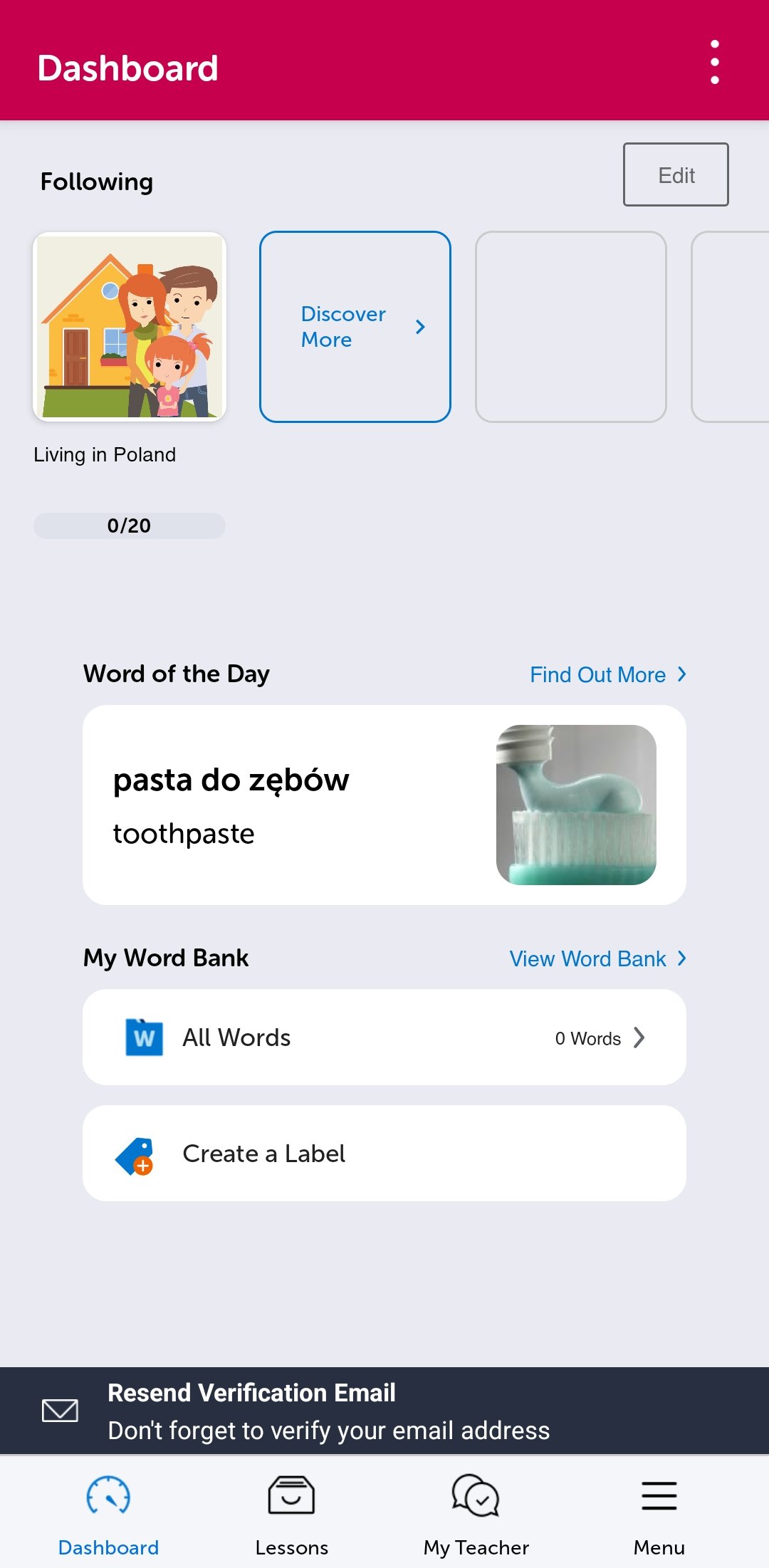
PolishPod101 is available through the shared Innovative Language app. It supports offline lessons, synced progress, notes, line-by-line playback and vocabulary review. Audio can travel with you, which is useful when clusters need many short repetitions.
Overall app-store feedback is positive. Individual reviews also say that the mobile experience lacks some of the website’s flexibility, and occasional loading or performance issues appear in user comments.
Plan and study new grammar on the website. Use the app for replay, shadowing and flashcards. A driving or walking session can reinforce familiar material, but save recorder work and careful transcript comparison for a safe place where you can give them attention.
What Learners Say
Polish learners often describe PolishPod101 as a useful source of audio, including for commutes and repeated listening. They also praise the cultural context and the ability to study at their own pace.
The main criticism is that finding a coherent route can take work. Some learners use the platform among several resources and look elsewhere for fuller grammar explanations. Others recommend selected grammar lessons while still treating classes or conversation as important for serious progress.
That pattern matches the product. It has substantial material, and the quantity does not automatically become a syllabus. A learner who keeps one pathway and a simple pattern notebook can get far more from it than someone who opens a different playlist every day.
PolishPod101 and Pimsleur
Pimsleur Polish is a simpler speaking-first alternative. Its core audio sessions ask you to retrieve language aloud in a fixed order. That structure helps if decisions and screen time are the main obstacles to study.
PolishPod101 lets you inspect the language more closely. Transcripts and grammar notes show case endings and aspect in context, while line-by-line playback makes pronunciation problems easier to isolate. It also offers a wider range of topics and study tools.
Choose Pimsleur if you want one daily spoken routine and prefer not to organise resources. Choose PolishPod101 if you want text beside audio, detailed notes and flexible review. Whichever you choose, Polish inflection needs output. Say and write complete sentences instead of only recognising the correct ending.
How Much Does PolishPod101 Cost?
The advertised monthly equivalent depends on the length of the subscription. The lowest monthly anchors come with the longest billing period, so check both the term and total before paying.
| Plan | Rough monthly anchor | What it includes |
|---|---|---|
| Free | Free | A limited lesson selection, vocabulary resources, the app and a Premium trial |
| Basic | About US$4 | The lesson library and detailed lesson notes |
| Premium | About US$10 | Basic plus line-by-line audio, assessments, flashcards, word bank and pronunciation tools |
| Premium PLUS | About US$23 | Premium plus a teacher, marked work and personalised guidance |
Paid plans currently include a 60-day money-back guarantee.
Premium is the practical choice for most independent Polish learners. Its line-by-line audio and review tools justify the step up from Basic. PLUS can be worthwhile if you need accountability and will submit regular writing or recordings.
Check the current PolishPod101 price through our link. The discount is applied at checkout via our link. The amount varies, so check the current price before paying.
PolishPod101 Pros and Cons
Pros
- Strong pronunciation material for consonants, voicing and nasal vowels
- Native audio with transcripts and line-by-line playback
- Grammar notes connect cases, gender and aspect to real sentences
- Useful vocabulary and spaced-repetition tools
- Short lessons work well on web and mobile
- Teacher feedback is available through Premium PLUS
Cons
- The library can require more planning than a linear course
- Grammar coverage is not always systematic enough for Polish inflection
- Listening lessons do not force accurate speaking or writing
- The app has fewer options than the full website
- Advanced learners will need longer native material
Who Will Get the Most from It?
PolishPod101 is a good match for beginners and lower-intermediate learners who enjoy audio and want to inspect the transcript whenever speech becomes unclear. It also helps heritage learners who recognise spoken words but need organised reading and grammar support.
It is a weaker match for someone who wants live group classes, a fixed daily course or exhaustive exam preparation. Advanced learners should add books, podcasts, television and regular correction from Polish speakers.
A balanced week could include three new lessons, daily five-minute flashcard review, two short pattern-writing sessions and one conversation. The library provides the input. Your own sentences supply the productive work it cannot automate.
Is PolishPod101 Worth It?
PolishPod101 is worth considering if listening and pronunciation are your first barriers. Its line-by-line audio makes clusters and endings easier to hear. The notes give you enough grammar to understand why a sentence changes.
It needs support in the areas Polish makes most demanding. Keep a separate record of case and aspect patterns, produce complete sentences, and get correction from a person. Stay on one pathway so the large library serves your plan instead of replacing it.
I rate PolishPod101 4.2 out of 5. Try the free lessons, select one pronunciation-heavy dialogue, and see whether the player helps you hear details you were missing. If it does, Premium offers the strongest balance of tools and price.
Try PolishPod101 and check today’s price.

Social