



My First Polish Conversation After One Hour of Study

Full disclosure: This post contains affiliate links. ?
From the blog’s origin era (2009–2014), kept as lived proof of the method. See all the missions.
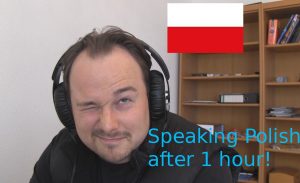
In March 2013, I planned to spend five hours learning enough Polish for a brief visit to Warsaw. Other work got in the way, so I studied for two hours in total. After the first hour I tried a video call in Polish. After another hour of study, I tried a short conversation in person.
This was not “learning Polish in one hour”. I could not discuss an unfamiliar topic or reliably build new sentences. I prepared a small script, used context, asked for help and accepted a lot of mistakes. The useful question is narrower: what can one focused hour give you for a first attempt?
This is the video call I made after that first hour of study:
A note from the Fluent in 3 Months team before we get started: You can chat away with a native speaker for at least 15 minutes with the “Fluent in 3 Months” method. All it takes is 90 days. Tap this link to find out more.
Getting Ready in the First Hour
My immediate goal was travel, not a general introduction to Polish. I wanted to say where I was going, order something, ask a basic question and survive a short exchange. I chose a small number of words and phrases that fitted those situations, then kept prompts beside me during the call.
I also spent a few minutes on spelling and pronunciation. Polish spelling offers more consistent clues than English spelling, but my comparisons with languages I already knew were too loose. Here is the safer version:
- Polish c represents a ts-type sound.
- ć and ś are distinct soft Polish consonants. Esperanto ĉ and ŝ helped me remember that the marks mattered, but they are not sound-for-sound equivalents.
- In modern standard Polish, ł is commonly pronounced rather like English w.
- The pronunciation of ą and ę changes with their position and neighbouring consonants. Copying a Portuguese nasal vowel is not a reliable rule.
Those are starting clues, not a complete pronunciation system. I should have used trustworthy Polish audio for each phrase instead of assuming that a familiar letter or another language supplied the answer. The current Fi3M guide to learning Polish explains the spelling system, cases and verb patterns in more depth.
I used a German-language phrasebook because it was the affordable book I found locally. The prior languages helped me form hypotheses, but the book, an online dictionary and my tutor were there to check them. Familiarity can speed up recognition; it can also make a wrong guess feel convincing.
The most useful preparation was the script. I knew I would talk about myself, my trip and why I was learning Polish. I also needed repair language: a way to ask for repetition, say that I did not understand and request a written word. When the full phrase was too much, I used a shorter prompt and let my tutor help me continue.
I did use a little English and typed support. That did not invalidate the attempt. The aim was to keep a bounded exchange moving and find out what I needed next, not to prove that I could already operate entirely in Polish.
Speaking When You Know Next to Nothing
After the video call, I studied for another half hour and then spoke with a friend in person. The source described the encounter as spontaneous because she noticed the camera when we began. That is not a recording method to copy: ask before filming, explain where the recording may appear and get a clear yes before you start.
This second video was recorded after two hours of total study:
I moved between prepared sentences and guesses. In the old article I turned a quick look at a conjugation table into a rule about first- and second-person endings. That rule was not reliable. Polish verb endings depend on the verb and form, and a glance at one table is not enough to generate them safely.
Context did more work. I knew we were going for coffee and then to a Fi3M meetup. I recognised a few familiar words, my name and the blog name, then used the situation to form a hypothesis about the rest. That is the kind of contextual inference that can keep a low-stakes conversation moving.
A hypothesis is not the same as understanding. Check it by asking a question, repeating what you think you heard or requesting a simpler version. Do not guess when the details affect safety, health, money, consent, directions or another important decision.
Laughing at my own mistakes helped me stay in the exchange, but it did not oblige the other person to interpret me or correct everything. A first conversation works better when both people know the aim, the time limit and the kind of help that is welcome.
Using It for Real
The practical goal was modest. During the trip I used Polish to tell a taxi driver where I wanted to go, order food, ask for directions and exchange basic pleasantries. Because I was travelling with English speakers, I sometimes became the group’s “designated Polish speaker” for these short tasks.
That outcome does not show that any learner can handle any language in an hour or two. I brought experience with other languages, a familiar travel context, a phrasebook, dictionary support and people willing to help. Another learner may need more time, different access support or a less pressured first setting.
It also does not show that grammar, cases or pronunciation can be discarded. I postponed most of them for one tiny task, made errors, then had evidence about what to study. Speaking early and studying carefully can support each other: prepare a sentence, use it, get a correction and retrieve the corrected version later.
I still prefer a real exchange to being ordered to “perform” a language on demand. The difference is agency and purpose. Ordering a meal or meeting a friend gives both people a reason to communicate. A surprise test makes the learner’s level the spectacle.
If you want to try a smaller version of this experiment, choose one low-stakes situation. Prepare five useful phrases plus one way to ask for repetition. Check them against reliable audio, arrange a ten-minute conversation with someone who knows the plan, and note one correction to review afterwards. The win is completing a respectful first exchange and learning what your next hour should contain.

Social