


How to practise a foreign language for free without travelling

Full disclosure: This post contains affiliate links. ?
Those of you who have been following this blog and reading some of my best tips, know that sometimes I focus on advice for those of you already abroad. Even though you don't have to be rich to be able to travel to another country to learn a language, sometimes it just isn't desirable or possible right now for some people.
This doesn't mean that you can't get a head-start and practise, and even improve a foreign language to a pretty good level while at home! In this post, I'm only going to discuss free practising methods, rather than learning ones, because it goes without saying that you can invest hundreds or thousands in audio courses, group classes, software etc.
Listening, reading and self-study can all build your language skills. I still prefer to bring two-way communication in early, but people learn in different ways. To practise speaking, add regular conversations when you can, even if they begin with short, simple exchanges.
A note from the Fluent in 3 Months team before we get started: You can chat away with a native speaker for at least 15 minutes with the “Fluent in 3 Months” method. All it takes is 90 days. Tap this link to find out more.
Don't you need to be abroad to speak a foreign language?
Of course not! Most major (and even some minor) languages are much easier to come across than you think! You may live in an English speaking country (or otherwise), but it is filled with people from all around the world, some of which may be happy to help you learn, as well as fellow enthusiastic learners at the same level as you.
The internet can help you meet people, and video calls can make regular two-way conversations possible when you cannot meet in person. Writing with penpals can help your spelling and grammar too. Speaking practice matters, but access, time, cost, disability, safety and local community all shape what is realistic. Start with the options you do have, online or in person.
Several years ago, I decided that I wanted to speak Portuguese, but this was while I was living in Paris. Using a variation of some of what I say below while in France and in other countries, when I arrived in Brazil for the first time I was already able to communicate with and understand the locals pretty well! I have been able to regularly practise any language that I choose in almost any location because of this.
But there is nobody who speaks that language where I live!
Actually, I take back what I said about the being in a village on the mountain being the exception to being able to practise a language. All you really need is just one person to converse with and even if all you have is a fellow villager also interested in that language, you are already on the right track! As long as you have both studied at least the basics, there is a chance to practise what you know!
Believe it or not, the person with whom you practise does not have to be a native. If you want to reach the intermediate stage of being able to converse in a language that you are currently uncomfortable about speaking, it can actually be better speaking with non-natives. Seriously.
I learned most of my Spanish (my first foreign language) thanks to the French, German, Italian etc. Erasmus students when I was living in Valencia. Of course, we were all in the country already, but you can motivate yourself to speak the language no matter where you are. It turns out that it is easier to speak with other learners! Spaniards tend to speak quite quickly, and as any native speakers, they use complicated words and turns of phrase that makes any language rich and expressive. However, in the early stage, trying to understand all of that may be too much work, and very simply being able to communicate is a barrier that needs to be overcome first.
My other foreign friends spoke slower, and used more basic vocabulary that I was extremely likely to know too, and most important of all, since they were at the same level as me, I didn't feel embarrassed or intimidated when speaking with them and could relate to them much more as a learner. Although you can only really improve your language skills very well with natives, learners can help you with parts of the language they are more familiar with and you can return the favour.
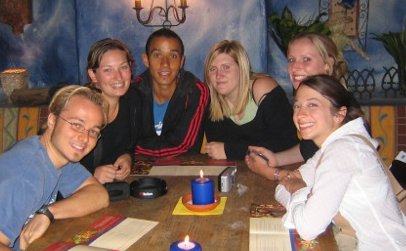
Some people will be patient with a beginner and some will not, whatever language they speak. Practising with other learners can reduce the pressure and help you build confidence. Native speakers are one useful source of feedback, but they are not the only people you can practise with.
Language meet-ups
Language is for communication, but you do not have to force yourself into a crowded event to practise it. If you’re introverted, start with a one-to-one call, a small group or a written exchange. What is available depends on where you live, and it is fine to build up gradually. In the meantime, here are a few ways to look for people to practise with.

Meetup can help you find local groups, including language groups. Check the event details, choose a setting that feels comfortable, and suggest a language meet-up if you cannot find one.

You do not need to host strangers to meet language learners. Look for a public language exchange, ask a friend for an introduction, or arrange a video call. Our guide to finding a language exchange partner has more current options.
Use a current local-events directory or community group to look for language meet-ups. If you contact people directly, be clear about the language-exchange purpose, respect a no, and meet in a public place if you choose to meet in person. You can also start with a video call.
You can also ask at a university, library, community centre or local language school. A noticeboard or an existing group may be enough to find someone who wants to practise the same language.
Then of course, there are the ways that don't require any use of the internet! By word of mouth, or asking your friends, you may see that someone shares a common interest in learning the same language and you can arrange to meet up to try to chat and practise whatever you know. You can also put up advertisements, especially in universities. If you feel you are ready to talk with a native, you can of course get private lessons, but to avoid paying for them, you could arrange for a tandem exchange.
Travelling is not the only way to practise a language. A regular conversation, however short, gives you something concrete to build on.
Pick one option that feels manageable this week and arrange your next conversation.

Social