


Ser vs. Estar: Key Differences, Rules and Examples

Full disclosure: This post contains affiliate links. ?
Ser and estar can both translate as “to be”, but they are not interchangeable.
If choosing between them feels difficult, you are not alone. I had to practise the contrast too.
In this post, you will learn:
- when to use ser vs. estar
- a pair of ser vs. estar acronyms that will help you memorize the previous point
- ser vs. estar conjugation
- how to efficiently practice ser vs. estar
You may also wonder why Spanish developed two verbs where English often uses one.
The short answer is that they come from different Latin verbs and developed different jobs.
This guide gives you a decision framework, conjugation tables and examples. It will not remove every difficult case, because context and adjective meaning matter.
I’ll also explain the history briefly, then give you a short practice check with answers.
Start with what each verb is doing in the sentence, not with an English translation alone.
One warning before the mnemonics: “permanent versus temporary” is not a reliable rule by itself.
If you want a clear structure for putting your Spanish into practice, take a look at the Fluent in 3 Months Bootcamp. It’s a 90-day programme with weekly coaching calls, a private community and a focus on speaking from day one.
When to Use Ser vs. Estar
Use ser mainly for identity, classification, origin, relationships, time and events. Use estar mainly for location, states, conditions, results and progressive constructions.
Those categories are more dependable than asking whether something lasts forever.
The Rules With Ser and Estar
No one-line rule covers every case, but a small set of contrasts will handle many beginner sentences.
Ser often identifies or classifies; estar often locates or describes a state. Duration is not the deciding test: Es joven (“He is young”) uses ser for a life stage, while Está muerto (“He is dead”) uses estar for a resulting state.
English translations can look identical, so read the whole Spanish sentence and ask what the verb connects.
Examples:
- Soy feliz (“I am a happy person / I have a happy disposition”) vs. Estoy feliz (“I am feeling happy”).
- El café es colombiano (“The coffee is Colombian”) vs. El café está frío (“The coffee is cold”).
- El agua es clara (“The water is clear”) vs. Está claro que entiendes (“It’s clear that you understand”).
Ser is the “identity” or “nature” verb: Soy Benny (“I am Benny”), Soy un hombre (“I am a man”), Los parques de aventura son geniales (“Adventure parks are amazing.”)
Estar can describe a state or introduce a progressive construction: Estoy feliz de estar ayudando (“I am happy to be helping”).
People and things normally use estar for location, however long they stay there: Mi casa está al otro lado del río (“My house is on the other side of the river”).
Events are the important exception: use ser for where an event takes place. La reunión es en la biblioteca means “The meeting is in the library.”
Some adjectives also change meaning with the verb. Es aburrido means “He is boring”, while Está aburrido means “He is bored.”
Ser vs. Estar: Acronym Trick
Two English-language mnemonics can help you recall the most common categories.
Treat them as starting checklists, not complete grammar rules. The event-location exception and adjective contrasts above still apply.
The acronyms are D.O.C.T.O.R. for ser and P.L.A.C.E. for estar.
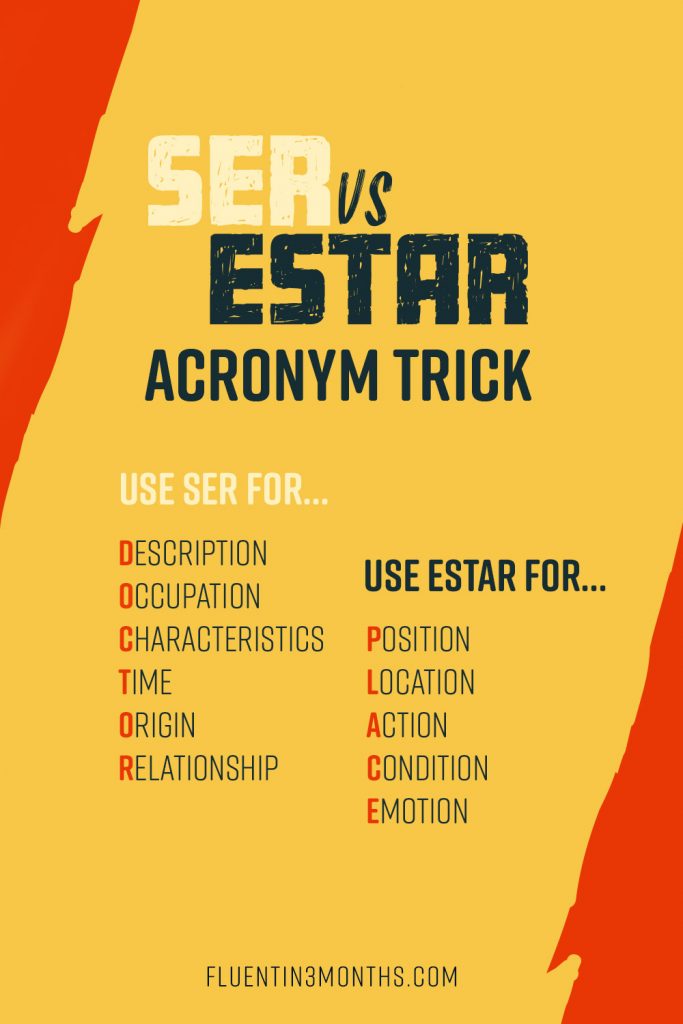
When to Use Ser: Remember D.O.C.T.O.R.
The acronym that will help you remember when to use ser in Spanish is D.O.C.T.O.R.
Its letters stand for:
Description → Identify or describe a defining quality, without using permanence as the test.
Example: Mi pelo es castaño – “My hair is brown.”
Occupation → Describe what a person does for work or as a hobby.
Example: Soy viajero – “I am a traveller.”
Characteristics → Describe a person’s character and personality.
Example: Mi amigo es divertido – “My friend is funny.”
Time → Tell the time or identify a date.
Examples: Son las dos (“It’s two o’clock”) and Hoy es mi cumpleaños (“Today is my birthday”).
Origin → Where a person or thing comes from.
Example: Soy de Irlanda – “I am from Ireland.”
Relationship → Describe a person’s ties and relationships.
Example: Matt es mi amigo – “Matt is my friend.”
When to Use Estar: Remember P.L.A.C.E.
P.L.A.C.E. recalls five common uses of estar:
Position → Say where or in what position something or someone is.
Example: Estamos sentados en el vagón – “We are seated in the train carriage.”
Location → Say where a person or thing is. Remember that event locations use ser.
Example: El parque está en el medio de la ciudad – “The park is in the middle of the city.”
Action → Form a progressive construction with estar + gerund. Spanish does not use it in every place English uses “be + -ing”.
Example: Nos estamos divirtiendo – “We are having fun.”
Condition → Describe a condition or resulting state; it does not have to be temporary.
Example: Mi amiga está cansada – “My friend is tired.”
Emotion → Describe how someone feels in the situation.
Example: Estoy feliz de estar aquí – “I am happy to be here.”
When Ser and Estar Are Auxiliary Verbs
There is another situation in which you need to choose between ser and estar: when you need an auxiliary verb.
Auxiliary, or helping, verbs combine with another verb form to build tenses, passive clauses and verbal periphrases.
The English auxiliary verbs are:
- to be: “I am being.”
- to have: “I have done.”
- to do: “I did go.”
Three auxiliary verbs especially relevant here are:
- haber (“to have”)
- ser
- estar
Haber forms compound tenses, estar appears in progressive periphrases and ser can form the analytic passive.
Estar in Progressive Constructions
Estar is the auxiliary used in the progressive periphrasis in Spanish. This construction combines a conjugated form of estar with a gerund.
I told you we would talk about it more in depth, so here we are.
Here are common examples of estar + gerund in different tenses and moods:
- Present progressive: Estoy haciendo (“I am doing”)
- Imperfect progressive: Estaba haciendo (“I was doing”)
- Preterite progressive: Estuve haciendo (“I was doing” for a bounded period)
- Past perfect progressive: Había estado haciendo (“I had been doing”)
- Future progressive: Estaré haciendo (“I will be doing”)
- Conditional progressive: Estaría haciendo (“I would be doing”)
- Present subjunctive progressive: esté haciendo (“be doing” in a subjunctive clause)
As you can see, the various progressive tenses follow the following pattern:
appropriately conjugated estar + verb gerund
The terminology looks dense, but the core pattern stays the same: conjugate estar, then add the gerund.
First step is knowing your estar conjugations, and I’ve got you covered. I’ll talk about them in detail later.
Regular gerunds use the verb stem plus a standard suffix:
- -ando if the verb belongs to the first group, i.e. ends in -ar
- -iendo if it belongs to the second or third group, i.e. ends in -er or -ir
Examples: Estoy caminando (“I am walking”) and Estaremos comiendo (“We will be eating”). Some gerunds are irregular, including leyendo, durmiendo and diciendo.
Jump to this article if you want to learn more about Spanish verb groups!
Spanish also has other gerund periphrases. Voy caminando hacia tu casa can mean “I’m making my way to your house on foot”, while fui preparando la cena presents preparing dinner as something that unfolded gradually. These are standard constructions with their own nuances, not regional substitutes for every use of estar + gerund.
Ser in the Analytic Passive
A conjugated form of ser plus a participle can form the analytic passive. Spanish also often prefers an active sentence or a passive construction with se, depending on context.
In a passive clause, the grammatical subject receives or is affected by the action: “The apple is being eaten.”
In Spanish, the passive voice is formed according to this format:
appropriate ser tense + past participle
Examples:
- Las casas fueron destruidas por la tormenta – “The houses were destroyed by the storm.”
- El premio es entregado por la directora – “The prize is presented by the director.”
- La comida será preparada por mi abuela – “The food will be prepared by my grandmother.”
The pattern is compact, but the participle must agree with the subject in gender and number.
In the next section, I will teach you how to conjugate ser.
Here is how you form regular past participles in Spanish: verb stem + appropriate suffix:
- -ado if the verb belongs to the first group, i.e. ends in -ar
- -ido if it belongs to the second or third group, i.e. ends in -er or -ir
¡Ojo! Irregular participles include hecho, visto and escrito. In the passive, the participle agrees with the subject.
If the subject of the sentence is:
- masculine singular, the participle ends in -o.
- feminine singular, the participle ends in -a.
- masculine or mixed plural, the participle ends in -os.
- feminine plural, the participle ends in -as.
Ser vs. Estar: Conjugation Tables
To choose the right verb in a sentence, you also need the relevant conjugated form.
These tables show seven useful tenses and moods for ser and estar. They use the -ra series for the imperfect subjunctive; the -se series is also valid. This is a reference, not a complete conjugation of every compound form or command.
First, review the subject pronouns. Vos forms vary by region, so confirm local usage if you are learning a particular variety.
| yo | I |
| tú | you, informal singular |
| vos | you, informal singular in parts of Latin America |
| él / ella / usted | he / she / you, formal singular |
| nosotros / nosotras | we, masculine or mixed / we, feminine |
| vosotros / vosotras | you, informal plural in most of Spain, masculine or mixed / feminine |
| ellos / ellas / ustedes | they, masculine or mixed / they, feminine / you, plural |
Now use the pronoun row to find the form you need.
| Indicative Present | Indicative Preterite | Indicative Imperfect | Indicative Future | Indicative Conditional | Subjunctive Present | Subjunctive Imperfect | |
|---|---|---|---|---|---|---|---|
| yo | soy | fui | era | seré | sería | sea | fuera |
| tú | eres | fuiste | eras | serás | serías | seas | fueras |
| vos | sos | fuiste | eras | serás | serías | seas | fueras |
| él / ella / usted | es | fue | era | será | sería | sea | fuera |
| nosotros / nosotras | somos | fuimos | éramos | seremos | seríamos | seamos | fuéramos |
| vosotros / vosotras | sois | fuisteis | erais | seréis | seríais | seáis | fuerais |
| ellos / ellas / ustedes | son | fueron | eran | serán | serían | sean | fueran |
| Indicative Present | Indicative Preterite | Indicative Imperfect | Indicative Future | Indicative Conditional | Subjunctive Present | Subjunctive Imperfect | |
|---|---|---|---|---|---|---|---|
| yo | estoy | estuve | estaba | estaré | estaría | esté | estuviera |
| tú/vos | estás | estuviste | estabas | estarás | estarías | estés | estuvieras |
| él / ella / usted | está | estuvo | estaba | estará | estaría | esté | estuviera |
| nosotros / nosotras | estamos | estuvimos | estábamos | estaremos | estaríamos | estemos | estuviéramos |
| vosotros / vosotras | estáis | estuvisteis | estabais | estaréis | estaríais | estéis | estuvierais |
| ellos / ellas / ustedes | están | estuvieron | estaban | estarán | estarían | estén | estuvieran |
Why Spanish Has Ser and Estar
Why does Spanish have two common verbs that English often translates as “to be”?
The history explains where the verbs came from, but it is not a shortcut for choosing between them today.
A copular verb links the subject of a clause to a description or identity. Spanish developed its modern copulas from more than one Latin source.
Portuguese also contrasts cognates of ser and estar. Other Romance languages divide this territory differently, so the Spanish rules should not be projected onto all of them.
The word copula comes from Latin for a link. In grammar, the verb connects the subject to a complement, as in El café es colombiano.
English “to be” is also a copular verb in sentences such as “The coffee is Colombian.”
Spanish ser reflects Latin sedēre (“to sit”) and influence from the conjugation of esse (“to be”).
Latin sedēre developed into the now-obsolete Spanish seer, from which modern ser derives.
Estar derives from Latin stare, “to stand”. Its modern uses cannot be reduced to “temporary”.
That history helps explain why Spanish has two forms, but modern usage is learned through the contrasts and examples above.
Ser vs. Estar: Practice
Practice helps the common patterns become easier to retrieve, especially when you explain each answer rather than guessing from “permanent” or “temporary”.
Try these: 1. ¿Dónde ___ el libro? 2. La clase ___ en el aula 4. 3. Ana ___ aburrida hoy. 4. Nosotros ___ de México. 5. Mis padres ___ estudiando español.
Answers: 1. está, location of a thing; 2. es, location of an event; 3. está, a state in this context; 4. somos, origin; 5. están, progressive action. If one trips you up, say the complete sentence aloud and make a new example with the same pattern. Mistakes give you useful feedback; here is how I use them.
Es Momento de Despedirnos – “It’s Time to Say Goodbye”
You now have a better test than permanence: ask whether the sentence expresses identity, classification, origin, a relationship, time, an event, location, a state, a result or a progressive action.
Keep the D.O.C.T.O.R. and P.L.A.C.E. mnemonics as prompts, then check the event exception and any adjective whose meaning changes.
For your next practice session, write five true sentences about yourself with ser and five about your location, condition or current activity with estar.
Read them to a tutor or exchange partner if you have one, or compare them with reliable examples and note any correction.
If you want another tool, browse my Spanish learning resources and choose one that fits the skill you are practising.
The goal is not to eliminate mistakes before you speak. It is to notice the pattern, try it in context and use the correction in your next sentence.
Return to the five-question check in a few days and see whether you can explain each choice without looking at the answer.
¡Hasta luego!

Social