



Spanish Accent Marks: The Ultimate Guide

Full disclosure: This post contains affiliate links. ?
Spanish accents can be confusing – and I'm not just talking about the way they pronounce things in Chile. What about the written accent marks that go above Spanish letters?
In Spanish, these marks help distinguish sounds, stress and sometimes meaning. Leaving one out can change the word you're writing.
For example, you definitely don't want to confuse año (year) with ano (anus).
A proper understanding of Spanish accent rules is therefore essential if you want to read and write Spanish effectively.
How does it all work?
Spanish accent marks follow consistent spelling rules. Learning the main patterns will help you spot when a mark is needed.
In this article, I'll explain the main rules for Spanish accent marks.
We'll cover what the accents in Spanish are, how and when they're used, how they affect pronunciation, and how you can type them on Windows or a Mac. We'll also work through when to write como or cómo.
A quick note before we get started: Technically these “accent marks” are called diacritics – an extra symbol added to an existing letter. Spanish uses three such diacritics: the diaeresis (ü), the acute accent (é), and the tilde (ñ). Grave accents (è) and circumflexes (ê) are not used in standard Spanish spelling, though they can occur in unadapted foreign names and words.
Let's start with the simplest diacritic of Spanish’s three:
If you want a clear structure for putting your Spanish into practice, take a look at the Fluent in 3 Months Bootcamp. It’s a 90-day programme with weekly coaching calls, a private community and a focus on speaking from day one.
The Tilde in Spanish (ñ)
This accent mark is only ever found above an “n”. While a tilde-less “n” is pronounced like the English letter “n”, an “ñ” is pronounced roughly like an English “ny”.
In Spanish, “n” and “ñ” are considered to be two completely separate letters. They have different names – “ene” vs. “eñe“, and are listed separately in the dictionary – so for example leñador comes later than lengua and lento. They even have separate keys on a typical Spanish keyboard.
In English, “tilde” refers to the ~ symbol. In Spanish spelling discussions, tilde usually means the acute accent, as on é, though the word can also refer to other small strokes, including the mark on ñ.
What English speakers call a “tilde”, Spanish speakers call la virgulilla or la tilde de la eñe.
The Diaeresis in Spanish (ü)
This symbol – two dots above a letter – is called a diaeresis (pronounced “die heiresses”).
Sometimes people call it an umlaut, but technically, an umlaut and a diaeresis aren't the same thing, despite looking identical.
Suffice to say that Spanish has no umlauts, only diaereses, as seen in words like pingüino or vergüenza.
Truth be told, there aren’t many words in Spanish that use a diaeresis. Here are the ones you’re more likely to encounter:
- ambigüedad – ambiguity
- antigüedad – antiquity
- argüir – to argue
- bilingüe – bilingual
- cigüeña – stork (the bird)
- desagüe – drain
- lingüista – linguist
- lingüística – linguistics
- monolingüe – monolingual
- paragüero – umbrella stand
- pingüino – penguin
- piragüista – canoeist
- plurilingüe – multilingual
- vergüenza – shame
Did you spot the pattern? In all of these words, the diaeresis appears above a “u”, between a “g” and an “e” or “i”. That's the ordinary spelling use. Poetry can also use a diaeresis on other vowels to signal an extra syllable.
To understand what’s going on here, we need to consider how the “gue” and “gui” letter combinations are pronounced when they don’t have diaeresis.
Before a, o or u, Spanish “g” represents a sound that can be like English “g” or softer, depending on its position. Before “e” or “i”, as in gemelo (twin) or girar (to spin), it represents the same sound as Spanish “j”. This may be a raspy sound at the back of the mouth or a softer h-like sound, depending on the accent. So gemelo, for example, sounds as if it were written jemelo.
But wait – what if you have an “e” or “i”, and you want to preserve the regular “g” sound without turning it into a “j”?
Spanish does this by sticking a “u” in the middle, as in words like guitarra (guitar) and manguera (hose). That extra “u” is silent – it’s just there to tell you that the “g” should be pronounced like a regular “g”, not like a “j”.
So guitarra is roughly “ghee-TAH-ra”, with a Spanish rr sound. If it were spelled gitarra, it would start with the Spanish j sound, roughly “hee-TAH-ra” in accents with a softer j.
But hold on: what if you don’t want the “u” to be silent? That’s where the diaeresis steps in.
In a word like pingüino, the diaeresis tells you that the “u” is pronounced. Here it joins the following vowel in a diphthong, giving a w-like glide rather than a separate syllable.
So pingüino is pronounced like “peen-GWEEN-oh”. If it didn't have the diacritic on the “u”, it would be pronounced “peen-GHEEN-oh”.
With that out of the way, it’s time to tackle the biggest and baddest of Spanish accent marks:
The Acute Accent in Spanish
The acute accent (é) can appear above all five vowels: á, é, í, ó, ú. A word written as a single unit has at most one acute accent; in a hyphenated expression, each component keeps its own accent if needed.
Generally, an acute accent is used to denote word stress. If you don't know what that means, let me quickly explain:
What Is Word Stress?
In linguistics, stress is when a particular syllable or syllables in a word are emphasised when speaking. Usually this means the syllable is pronounced louder and longer than its neighbours.
English makes liberal use of word stress, and you need to get it right. In the word “language”, the first syllable is stressed – “LANG-gwij”. Pronouncing the stress on the second syllable – saying “lang-GWIJ” – would sound very strange to a native English speaker.
Sometimes in English, changing the stress can change the meaning of the word. For example, the word “present” can be pronounced as “PREH-sunt” (as in “a Christmas present”) or “pruh-SENT” (as in “present your case”).
Annoyingly, English spelling doesn't tell you much about where to put the stress. If you read the word “present” with no context, you don't know which way to pronounce it.
Spanish is much kinder in this regard.
Word Stress in Spanish – and How it Relates to Spanish Accents
Spanish spelling gives you reliable clues to pronunciation, though it doesn't encode every detail of spoken Spanish. For stress, start with the patterns below.
This is also true for word stress. When you read a Spanish word, you can apply consistent rules every time to figure out which syllable receives the emphasis.
In a nutshell, those rules go like this:
- For an unaccented word of more than one syllable ending in a vowel, or n or s after a vowel, stress the last-but-one syllable:
- hablo = “HA-blo”
- joven = “JO-ven”
- computadora = “com-pu-ta-DO-ra”
- hombres = “HOM-bres”
- For other unaccented words of more than one syllable, stress the last syllable. Final y counts as a consonant here, as do consonant clusters such as -ts:
- español = “es-pa-ÑOL”
- estoy = “es-TOY”
- feliz = “fe-LIZ”
- trabajador = “tra-ba-ja-DOR”
- If the word has an acute accent, ignore the above rules and stress the accented syllable:
- habló = “ha-BLO”. Without the accent it would be “HA-blo”.
- jóvenes = “JO-ve-nes”. Without the accent it would be “jo-VE-nes”
- inglés = “in-GLES” Without the accent it would be “IN-gles”
- estábamos = “es-TA-ba-mos”. Without the accent it would be “es-ta-BA-mos”
Often, an acute accent marks an exception to those default stress patterns. It can also mark a stressed i or u beside an open vowel, or distinguish grammatical words, as we'll see below. Adverbs ending in -mente keep the accent of their base adjective, if it has one, and have stress on both the adjective and -mente.
Remember those simple rules, and you'll be fine most of the time. It's all you really need to know as a beginner. (Mnemonic for remembering the “n” and “s” exception: the word “nose”.)
But we can break it down further. For starters, it helps to clarify exactly what we mean by a “syllable”.
Breaking Down Spanish Words Into Syllables
Generally, when a vowel isn't next to another vowel, it forms its own separate syllable:
- hablo – two syllables, “HA-blo”
- confortable – four syllables, “con-for-TA-ble”
But when a word has two or more vowels in a row (as in creo or acuerdo), it gets a bit more complicated.
First, understand that the vowels a, e, and o are considered in Spanish to be the “strong vowels”. i and u are the “weak vowels” (Mnemonic: you and I are weak).
Two strong vowels in a row are considered to be two separate syllables:
- creo – two syllables, “CRE-o”
- caos – two syllables, “CA-os”
- coreano – four syllables, “co-re-A-no”
For accent-mark rules, an open (strong) vowel beside an unstressed closed (weak) vowel, or two different closed vowels, is treated as a diphthong. This spelling convention does not always match every speaker’s syllable division:
- nueve – two syllables, NUE-ve
- saliera – three syllables, sa-LIE-ra.
- fui – one syllable, FUI
This distinction matters when you're figuring out where to put the stress.
For example, the word bacalao (“cod”) ends in two strong vowels, so the stress goes on the first of the two: “ba-ca-LA-o”. The word hacia (“towards”), on the other hand, ends in a diphthong, so the stress goes elsewhere: “HA-cia”
What if the word stress does fall on a diphthong? For example, the word durmiendo (“sleeping”) has three syllables, no written accent, and ends in a vowel. Therefore the stress must go on the diphthong in the middle: “dur-MIEN-do”. There's no reason why this can't happen.
In a diphthong containing a strong vowel, that vowel is the nucleus, whether it comes first or second. With two different weak vowels, a written accent, if required, goes on the second. For example, in fui, the usual pronunciation has the i as the nucleus; the word needs no accent because it counts as one syllable for spelling.
When a stressed i or u sits beside an unstressed a, e or o, they form separate syllables, called a hiatus. The i or u must carry a written accent, even if the default stress rule would put the stress there anyway:
- compraríamos (“we would buy”)
- tío (“uncle”)
- búho (“owl”)
(How does the “h” in búho affect the placement of the accent? The answer: it doesn't. The RAE have ruled that, for the purposes of word stress and written accents, an “h” has no effect. You treat it as if it wasn't there at all. So the “u” and “o” in búho are still considered to form a hiatus, even though there's an extra letter in between them.)
Why Are Some Words Accented In Some Forms, But Not Others?
Can you see now why jóvenes is written with an accent, but joven isn't? Remember that joven means “young”, and jóvenes is its plural form:
- El hombre joven = the young man
- Los hombres jóvenes = the young men
In the singular form, the first syllable (“jo”) is stressed. The word ends in an “n”, so rule #1 applies: the last-but-one syllable (which in this case is also the first syllable) receives the stress.
When pluralised, however, we add an extra syllable. With no written accent, we'd have jovenes, and the stress would now “naturally” fall on the second syllable (“ve”). That's wrong – the stress needs to stay on the “jo”. So we now write an accent to show that, despite the pluralisation, the “same” syllable still has the stress.
Another place this happens is when combining pronouns with imperative verbs. Compra means “buy”, but if you want to say “buy them for me”, you combine compra with me (“for me”) and los (“them”) to get cómpramelos. The accent is now necessary because without it, the stress would become “com-pra-ME-los”.
Using An Acute Accent to Distinguish Homonyms in Spanish.
I've explained how the acute accent affects word stress in Spanish. It has one other function you need to know about.
You know how in English, “there”, “they're” and “their” are all pronounced the same? Or “won” and “one”, “right” and “write”, etc.? And you know how some people find this hard, and don't know which won their supposed to right? (Tee-hee.)
Spanish uses a diacritical accent to distinguish certain grammatical pairs. For example, sí means “yes” and si means “if”. Their consonant and vowel sounds are alike, but sí normally has its own stress, while si is normally unstressed within a sentence.
You need to learn the following pairs of words:
| Unaccented Spanish word | English | Accented Spanish Word | English |
|---|---|---|---|
| de | of, from | dé | give (first-/third-person singular present subjunctive; also the usted command) |
| el | the (masculine singular) | él | he |
| mas | but* | más | more |
| mi | my | mí | me (after a preposition, as in para mí) |
| se | pronoun or grammatical marker with several uses, including reflexive | sé | I know; also “be!” (the tú command of ser) |
| si | if | sí | yes |
| te | you (object pronoun) | té | tea |
| tu | your | tú | you |
*FOOTNOTE: the word mas, meaning “but”, is very literary and is rarely used in everyday speech. Use pero instead.
Spanish Accent Marks and Question Words
The following words may also be written with or without an accent:
- ¿Cuál? (Which?)
- ¿Cuándo? (When?)
- ¿Cuánto? (How much/many?)
- ¿Cómo? (How?)
- ¿Dónde? (Where?)
- ¿Por qué? (Why?)
- ¿Qué? (What? / Which?)
- ¿Quién? (Who?)
The main distinction is grammatical: interrogative and exclamatory forms take an accent, including in indirect questions and exclamations; their unstressed relative or conjunction counterparts do not. Compare:
- ¿Quién es él? – “Who is he?”
- Es el chico de quien te hablé – “He's the guy who I told you about”
Let's look at how that distinction works inside complete sentences.
If a question word is used in an indirect question, it has an accent:
- Quiero saber quién eres – “I want to know who you are”
- No sé dónde está – “I don't know where he/she/it is”.
In the following examples, these words function as unstressed relatives or conjunctions and have no accent:
- El celular que compré está averiado – “The phone that I bought is broken”
- Me iré cuando él llegue – “I'll go when he arrives”
- Es la ciudad donde pasó – “It's the city where it happened.”
Cómo with an accent means “how”. Como without an accent means “as” or “like”.
(Coincidentally, como is also the first-person singular present form of comer, “to eat”.)
- Me explicó cómo hacerlo – “He/she explained to me how to do it”
- Tan grande como un elefante – “As big as an elephant”
- Como arroz – “I eat rice”
When qué means “what,” write it with an accent:
- Por favor, muéstrame tú qué hacer – “Please, show me what to do.”
- ¡Qué día más bonito! – “What a lovely day!”
When cuánto/cuánta/etc means “how much/many”, write it with an accent:
- Me dijo cuántas personas vendrían – “He told me how many people would come”
Don't forget: this distinction is not purely visual. Interrogative and exclamatory cómo, dónde, cuándo, etc. are stressed words. Their relative or conjunction counterparts are usually unstressed within the sentence.
The accent in cómo, dónde and cuándo marks that stressed grammatical use. An unaccented verb form such as como (“I eat”) is also stressed, so spelling and grammatical context work together.
Spanish Accent Marks: Demonstrative Pronouns vs. Adjectives
There's one last set of words which we need to cover – the demonstrative pronouns and demonstrative adjectives.
A demonstrative adjective is a word like “this” or “that” which describes a noun:
- Este carro – “this car”
- Esa persona – “that person”
- Aquellos libros – “those books”
In English, we have a distinction between “this/these” (used for objects which are close to you) and “that/those” (for objects which are further away). Spanish has three such degrees of distance, explained in the table below.
Like all Spanish adjectives, demonstrative adjectives must also agree with their noun in number and gender:
| distance | masculine singular | feminine singular | masculine plural | feminine plural |
|---|---|---|---|---|
| near | este | esta | estos | estas |
| far | ese | esa | esos | esas |
| further | aquel | aquella | aquellos | aquellas |
Sometimes in English, we don't need to explicitly say “that car” or “this book”. Instead we can just say “this one”, or “that one”, and it's obvious from the context whether “one” refers to a car, a book, and so on.
In Spanish you can do something similar, except “this/that one” is translated to a single word:
- Este es mi carro – “This is my car”
- No tengo esa – “I don't have that one”
These are the demonstrative pronouns. They're like the demonstrative adjectives, except they stand by themselves with no need for a supporting noun. Again, they must match the noun they replace in number and gender:
| distance | masculine singular | feminine singular | masculine plural | feminine plural |
|---|---|---|---|---|
| near | este | esta | estos | estas |
| far | ese | esa | esos | esas |
| further | aquel | aquella | aquellos | aquellas |
Good news: there’s nothing extra to memorise, because demonstrative pronouns are spelt exactly like demonstrative adjectives. Este carro means “this car”, while este on its own means “this one”. For once, Spanish is being considerate.
- Este carro no es tan rápido como ese – “This car isn't as fast as that one”
- Esa silla y aquella – “That chair and that one”
- “¿Tienes aquel libro del que te hablé?” “No, solo tengo este.” – “Do you have that book I was telling you about?” “No, I only have this one.”
You’ll still run into éste, ésa and aquél in older books, and on plenty of websites that haven’t caught up. Under the 1959 rules, that accent was optional, but the RAE’s 2010 Ortografía removed it from the normal spelling. Today, it’s permitted only when the writer sees genuine ambiguity in the sentence; anywhere else, the accent counts as a spelling mistake.
For your own writing, you can keep the rule simple and leave demonstratives unaccented, even where ambiguity is possible. An accented form may follow older practice or the limited current allowance described above.
There are also three “neuter” demonstrative pronouns: esto, eso and aquello. Use these to refer to abstract concepts and ideas when there's no specific noun being replaced:
- Me gusta, y eso es lo importante. – “I like it, and that's the important thing”.
You can also use a neuter form when asking what something is. If you then refer to it through a particular noun, choose an agreeing form such as este/esta/ese. This is about how you're referring to the thing, not a rule that the neuter becomes forbidden once you know its gender:
- “¿Qué es aquello?” “Aquella es mi casa” – “What's that?” “That's my house”
Note that esto, eso and aquello never take written accents. Unlike este, ese and aquel, these neuter forms have no optional accent in ambiguous uses.
How to Type Spanish Accents
Don't know how to type “é”, “ñ”, etc.? If all else fails, just copy and paste the characters from this list:
- á
- é
- í
- ó
- ú
- ñ
- ü
But you can do better than that. Here's a more convenient way to type them on Windows or a Mac:
How to Type Spanish Accents On a PC
The following shortcuts work in supported desktop versions of Microsoft Word and Outlook on Windows, not throughout Windows or in every app. Release the shortcut keys before typing the letter:
- To get an accented vowel press Ctrl + ‘, then the vowel.
- To get “ñ”, press Ctrl + Shift + ~, then “n”
- To get “ü”, press Ctrl + Shift + :, then “u”.
If that doesn't work, you can try inputting the character code directly.
The characters below can also be entered with four-digit Alt codes in supported Windows apps. Turn Num Lock on, hold down Alt while typing the code on the numeric keypad, then release Alt. The number row above the letters won't work. Without a numeric keypad, use a Spanish keyboard layout or the app's symbol picker.
| Character | Code |
|---|---|
| á | Alt + 0225 |
| é | Alt + 0233 |
| í | Alt + 0237 |
| ó | Alt + 0243 |
| ú | Alt + 0250 |
| ñ | Alt + 0241 |
| ü | Alt + 0252 |
How to Type Spanish Accents On a Mac
On a Mac using the ABC or U.S. keyboard layout, you can enter these characters with Option, also labelled Alt or “⌥” on some keyboards. Other layouts may use different shortcuts; Keyboard Viewer shows those for your active layout:
| Character | Code |
|---|---|
| á/é/í/ó/ú | press “alt” and “e” together, then release them and press the vowel you want |
| ñ | press “alt” and “n” together, then release them and press “n” again |
| ü | press “alt” and “u” together, then release them and press “u” again |
Depending on your keyboard and system settings, you may also be able to type special characters by holding down a regular letter key. For example, when I hold down “e” on my Mac for a second or so:
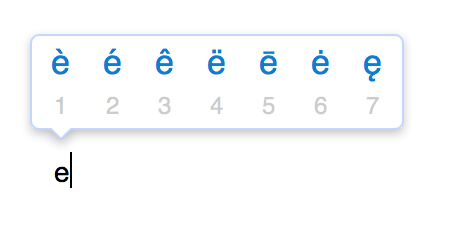
In this screenshot, pressing “2” selects é. Use the number shown in your own menu, since the options can vary.
Those are the main patterns. Keep a few examples handy as you write, and check a dictionary when you meet an unfamiliar word.
If you want to keep going, the difference between por qué, porque, por que and porqué can be confusing, so it gets a guide of its own. Our Spanish pronunciation guide covers the sounds those written marks point you towards. For hearing them in real sentences, sign up for SpanishPod101; if you want to know what you’re getting first, read our SpanishPod101 review.
And when you’d rather be speaking Spanish than spelling it, join the Fluent in 3 Months Bootcamp. You’ve got 90 days to reach a 15-minute conversation with a native speaker.

Social