


Mission: Read and speak Thai in 8 weeks

Full disclosure: This post contains affiliate links. ?
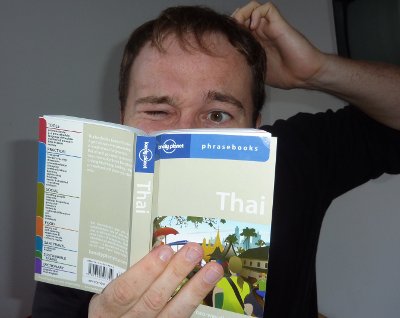
From the blog’s origin era (2009–2014), kept as lived proof of the method. This is Benny’s mission plan from January 2010, not current advice about visas, routes, prices or conditions in Thailand. See all the missions.
Note: Posted in 2010
As always, I'm setting an ambitious goal.
In a few short hours, I'm taking a complicated route from Krakow to Prague, then Amsterdam and Bangkok. It was the cheapest option and earned me miles in my preferred programme.
With an extended tourist visa and a ticket back to Europe 8 weeks later, I plan to be able to read and speak Thai by the end of my stay.
I'd never been to Thailand before, despite already having travelled for 7 years, and I didn't speak another Asian language. I'd never studied a tonal language or learned to read a language written in a script other than the Latin alphabet.
Despite all of that, I'm confident that I've got a good chance of reaching my goal! But first, I should very clearly define that goal!
A note from the Fluent in 3 Months team before we get started: You can chat away with a native speaker for at least 15 minutes with the “Fluent in 3 Months” method. All it takes is 90 days. Tap this link to find out more.
The hard part
I planned to make the five tones of Standard Thai recognisable and read a new text of several sentences aloud so that Thai-speaking listeners could understand it. That was deliberately ambitious for an eight-week, part-time project.
This involved learning to read Thai. A common learner model counts 44 consonant letters, 21 initial consonant sounds and eight final consonant sounds. Vowel totals vary because teaching systems count symbols, sounds and combinations differently, so “32 vowels” is a traditional classroom inventory rather than the only linguistic analysis. The script was entirely new to me. Thai normally uses spaces between phrases or clauses rather than between every word, so I also had to learn where words begin and end.
I didn't expect a perfect Thai accent, but I wanted Thai speakers to understand me. Tone is part of a syllable’s pronunciation, alongside its consonants and vowel length, and a wrong tone can change a word or make it harder to recognise.
Several words can look like mai in a basic romanisation: ใหม่ (mài) means “new”; ไม่ (mâi) means “not”; ไหม (mǎi) can mean “silk” or serve as a yes-or-no question particle; and ไม้ (máai) means “wood”. This is not one written word whose meaning changes by tone alone. The Thai spelling, vowel length and lexical context also distinguish the words.
So I believed this was an ambitious goal. I would award myself 5 stars at the end of the eight weeks if I could read an unseen text of several sentences to several Thai speakers and they could show that they understood it. Their English ability was irrelevant to whether my Thai was intelligible.
To make the mission even harder, I will be working full time (as always), so all work I put into learning and practising Thai will be less than part time, since I also plan on enjoying myself in my free time in ways other than speaking the language :).
The more familiar part
I expected reading and tones to take much of my attention. Thai verbs do not inflect for person, gender or number in the way verbs do in many European languages, but that does not make the whole grammar objectively simpler. Word order, aspect, classifiers, pronouns, particles and levels of politeness bring their own learning work. My advantage was seven years spent developing and applying my language-learning method.
Some parts of my routine, including conversation practice and vocabulary association, could transfer from earlier missions. I could not assume that Thai would otherwise work like a European language.
Because I had set a demanding reading and pronunciation test, I wasn't also claiming that I would become fluent. I chose to focus on the features that were new to me in Thai: its tone system and script. Many Asian languages are not tonal, and they use several unrelated writing systems, so this was a Thai mission rather than a model for an entire continent.
The word “speak” in the title was deliberately broad. My point was that a goal such as a New Year's resolution works better when you define what success will look like.
“Speak” can describe anything from producing a few memorised sentences to handling a wide range of conversations. On its own, it says little about comprehension, range or independence. I therefore needed an operational target for this mission.
More specifically, I aimed to handle a practical beginner range in Thai during those eight weeks: asking directions, ordering food, making basic small talk, negotiating a price where appropriate, and understanding the gist of typical replies without relying on my phrasebook. This was my task definition, not a claim to a standardised proficiency level.
I kept the goal bounded because I planned to spend time on southern islands and expected to encounter plenty of English in tourist areas. More Thai interaction would have helped, but avoiding English is not the only route to progress. I was also honest that this eight-week visit would show me only a small part of Thailand; no region or travel style is uniquely “authentic”.
Most of the rest of 2010 will involve other intensive language projects and even harder goals. In Thailand, I plan to spend time on a beach, get regular massages, work full time, and hang out with Thai people and other tourists.
At the end of my stay I'll make a short video entirely in Thai, so any curious readers of the blog can hear how I'm speaking.
I'll be in Bangkok for my first days and will investigate where to go to from there.
Can it be done?
Although I will be a tourist in Thailand, I plan to put focused work into the tones and writing system. I know this will be hard work.
Since this was new territory for me, I planned to seek advice alongside using my own experience. Suggestions included working with a tutor who could correct my tones and using music for listening practice. A tutor would add feedback that independent practice could not provide.
If you have useful advice, such as image associations for the symbols, please share it. Otherwise, I'll develop my own method.
I hoped that learning how I personally handled Thai tones and an unfamiliar script would improve my approach to later languages. It could not prove that I would become fluent in 3 months in other Asian languages, each of which has its own sound system, writing system and social context.
That still made the mission a long-term investment for me. Rather than postpone Thai reading and tone practice, I would work on them from the start and record what helped. Learners differ in what they find difficult, and success with these features would not remove the vocabulary, grammar, listening, interaction and cultural knowledge needed for wider fluency.
If I don't achieve my goal, I'll analyse why and try again later. Until then, I'll work on the assumption that I can succeed.
So, what do you think? Can it be done? Did I set the bar too high? Was 8 weeks way too short a time? Any advice to help me succeed?

Social