


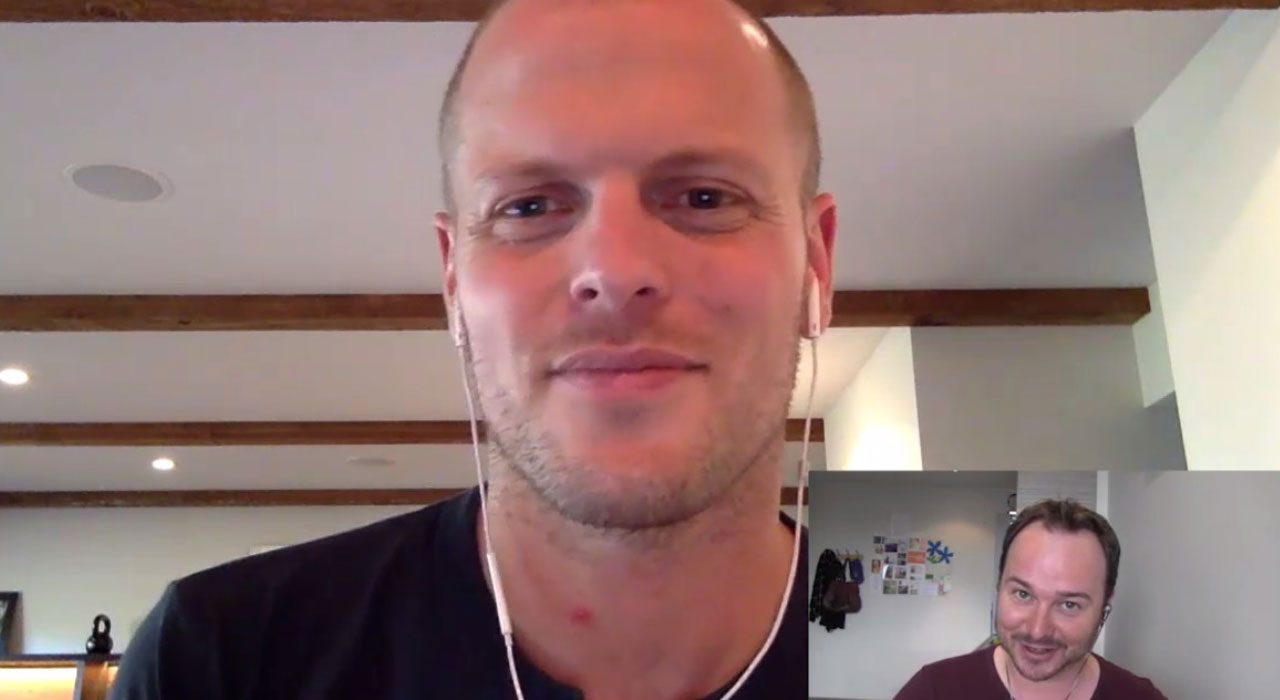
Tim Ferriss on Rapid Language Learning: Full Interview

Full disclosure: This post contains affiliate links. ?
My first interview with Tim Ferriss covered language learning around the launch of The 4-Hour Chef. My connection from Brazil forced me to upload that conversation at low quality, though the original video remains available. I was glad to speak with him again on a clearer recording.
This 2015 interview accompanied The Tim Ferriss Experiment, his series about accelerated learning. The full series is now available free on Tim’s YouTube channel. I had also crossed paths with his language projects twice, which gave us two concrete experiences to discuss:
- By coincidence, we had studied one language with the same teacher, who remembered Tim as an unusually intensive student.
- For one episode, Tim prepared for a short televised interview in Tagalog over three or four days. He asked me for Tagalog pointers and the techniques I used before early video calls and YouTube updates. The result was a narrow, rehearsed performance rather than general fluency, and we discuss both its value and its limits.
Our main subject is rapid preparation for an immediate language task: what can help, what disappears without maintenance, and why a short challenge should not be confused with broad proficiency.
You can read along with an edited transcript below. I repaired transcription errors and clarified claims where the 2015 wording could mislead a current reader; the video remains the original record of the conversation.
Health and safety note: Tim briefly describes using a supplement during an extreme filming schedule. That anecdote is not a recommendation from Fluent in 3 Months. Sleep products and dietary supplements can have side effects or interactions, so discuss them with a qualified health professional rather than copying an experiment.
A note from the Fluent in 3 Months team before we get started: You can chat away with a native speaker for at least 15 minutes with the “Fluent in 3 Months” method. All it takes is 90 days. Tap this link to find out more.
Benny: Hey everyone, how are you doing? This is Benny Lewis and I’m interviewing Tim Ferriss again. I wanted to ask him a few different questions from the last time we had a great chat, as he was launching The 4-Hour Chef. This time he is launching The Tim Ferriss Experiment TV show, where he tries to cram as much knowledge as he can on completely different topics in a single episode. I want to talk to him today about one particular episode, which involved cramming a language in a short period of time. How are you doing, Tim? Great to have you back.
Tim: I’m doing well, thanks so much. I appreciate you having me back. This TV show was a test of endurance: 13 weeks, or 16 weeks I think, of filming 12 to 16 hours a day for five to six days a week. Definitely not a four-hour workweek in television. So I’m taking a break from TV, but I’m happy with what we did.
Benny: Yeah, that’s right. To give people the summary, in the language episode you had to survive a brief televised interview in Tagalog, and you only gave yourself three days to prepare for it. Am I right?
Tim: Yeah, it was three or four days. There are two things to realise about that. As one of the executive producers, I severely underestimated how much of my time would be taken up not training. In retrospect, it’s so obvious that I would have all these obligations that would consume at least half the day, and in some cases three quarters of it. I had three or four days to prepare for a three- to six-minute interview in Tagalog, which is long. That’s like ten Good Morning Americas right there!
So I probably only had three or four hours a day to prepare. It was maybe 12 hours of total preparation, which was brutal. Obviously, you were instrumental in helping me pick which language to tackle and also gave me some very helpful tips on a potential approach. I had the chance to interact with a guy named Ed Cooke as well, who’s a memory competitor. That is not specific to language, although he has a lot of experience there. I had a real A-team to help me try to survive.
You know, I’ve done a lot of languages but doing it in a week is a lot different than doing it in a couple of weeks or doing it in a couple of months.
Benny: Exactly, yeah.
Tim: Very, very stressful. I think part of the reason is that you don’t have as many sleep cycles for consolidating what you’re absorbing. I only had two or three nights and, as you might imagine given the stress of the situation, I wasn’t sleeping soundly for eight, nine or ten hours. These were short stints of sleep, so I used things I might not ordinarily use, including Huperzine A, to try to increase my percentage of REM sleep. It is powerful, so talk to your doctor before you use it.
Those were unusual measures I might not ordinarily use. The other thing you have to realise is what happens when you do 13 experiments in a row. If I learn some Turkish for a trip to Turkey, then cram Greek the next week, much of the Turkish becomes difficult to retrieve. I would need to return to Tagalog and review it in depth after the nine or ten episodes that followed.
Same thing with poker, same thing with professional poker, you know a lot of these skills made a dent but I’d have to go back and get reacquainted to be comfortable with any of them.
Benny: Yeah, I’ve actually found exactly the same thing myself. The thing is both you and I write very consistently about intensive learning, learning things quickly, you know, language hacking or life hacking or whatever it may be. But there is the downside that the quicker you learn something if you’re not maintaining it the quicker you’re going to forget it. And I’ve had exactly the same experience. If I’ve learned a language for 1 month or 2 months then if I do not maintain that it’s gone, it’s just out of my head.
Something else you said relates to my own language projects. Even if you’re learning intensively over a week or a few months, documenting it for the world takes time away from learning. There is talking to your video person; in my case, I’m doing the editing, sound and subtitles myself. So three days does not mean 24 hours of study per day. I also want to emphasise what you said about going from Turkey to Greece and so on.
Based on your experience of moving between places quickly, imagine someone plans to spend a week in each country on a European trip. They do not have much preparation time, but they can focus for two or three days before leaving. We both discuss long-term language learning, but how would someone prepare efficiently for that immediate task? They are not going to become fluent, but they want to be a respectful tourist. Based on this and your past experiences, what would you advise?
Tim: That should be the goal. Being a respectful tourist also serves your own interests. Five to ten useful phrases can change an interaction because you have made an effort and can handle a few basics. The response will vary, but the preparation is small enough to be a worthwhile experiment.
The way I prepare starts with the writing system. If I’m flying to Turkey or Greece, I get a reliable phrasebook and learn the main relationships between letters and sounds. You have attempted more languages than I have, so I’m sure you have your own set of techniques.
For a letter such as Turkish ç, I ask what sound it represents and practise that sound in a few words. I take the same approach when learning the Greek alphabet: identify the letter, learn its common sound values and test them in context.
And the reason that it’s so important is that if you understand how to read the script, you can start noticing words around you. With a Latin alphabet or even Cyrillic, for instance in Russian, you may be able to learn the basic letter-sound relationships quite quickly. Japanese and Chinese writing require a different scale of commitment, so I would set a much narrower reading goal for a one-week trip. You can use mnemonic devices to help. Once you’ve done that, let’s say you memorise some useful words and 10 to 20 phrases. Images, the link-word technique or the method of loci, where you place objects along a familiar route, may help you remember them. The exact number you can retain in a day or two will vary.
There are books that teach these memory techniques. I found Your Memory and How to Improve It useful, and you discuss memory techniques in your own work too.
The goal then here is once you land, when you know how to read, you’d be like, Oh! I forgot how to say bathroom but I see that sign over here and that says bathroom. Or you see a sign that says “McDonald’s, on sale, 99 cents”, you can read and be like, hmm; I wonder if that means on sale? Then you can look it up on your smartphone or in a dictionary and you’re like, cool, that does mean on sale.
You can start noticing and looking up many words over a week or ten days without relying only on flashcards. My first step is the script or orthography and its main sound relationships.
Then I would learn the usual phrases: “Good morning”, “Good evening”, “Thank you”, “I’m sorry”, “Excuse me”, “Help” and “Where’s the bathroom?” I also like to learn one unusual question from a reliable phrasebook, perhaps “Are you allergic to eggplant?” It can be a playful surprise, although humour and reactions vary by person and culture.
In Greek, I learned a rather formal, old-fashioned way to say “goodbye” or “see you later”. The exact Greek wording is not clear enough in the recording to transcribe responsibly, but I would use it when leaving and sometimes get a laugh by playing the clown.
In Japanese, after going to school there and learning from some violent comic books, I learned how to say “detached retina”. The Japanese wording is not clear enough in the recording to transcribe responsibly. Why would I need to know that? Many English speakers would not use the term often either.
I like these kinds of gags. Proverbs can work well. When I was in Greece, I asked what Greek speakers say instead of the English expression “That’s all Greek to me”. They gave me a Greek expression meaning “That’s Chinese to me”. The exact wording is not clear enough in the recording to transcribe responsibly. I started using it and people would ask, “Do you speak Greek?” I’d reply, “Sorry, it’s all Chinese to me.” A proverb can open a playful exchange, but it is worth checking the wording and setting with a proficient speaker first.
At that point, once you have 10 to 20 memorised phrases and can read some things, I start looking at the grammar. I’m fascinated by grammar, although I haven’t always been. I look at basic sentence structure and how the language expresses time, then return to my set phrases. I’m going to risk an example: “child” in Turkish is çocuk and “children” is çocuklar, so -lar marks the plural in this example. I noticed the same ending in a greeting from my phrasebook and asked a proficient speaker to explain it. That connection made the pattern easier to remember.
Now I have a reminder of the grammar built into my phrases. Your memorised phrases become a crib sheet for grammatical patterns that you can keep noticing and reinforcing.
A week is tough, but being in a place where the language is used gives you opportunities to apply what you prepare. If you have one week in Greece, do not spend eight hours a day in a hotel room memorising phrases. Use some of the time in real, respectful interactions.
Benny: Right.
Tim: Get out there. Don't confuse the means with the end. But man, a little goes a long way, as you know.
Benny: It does. Another thing that I wanted to talk about today that I didn’t see on your blog, I didn’t see it mentioned there, but I managed to get a little glimpse into how you managed to learn one of your languages. I was passing through Bali and I decided to get a bit of a crash course in Indonesian. I went to this School and my teacher – for just an hour, I just learned a few basics – was Daniel
Tim: Daniel, yeah!
Benny: He was telling me about your experience learning Indonesian and I was impressed because I was there kind of on holiday. I had just finished a very long stretch of my book tour so I just wanted to get the basics. I wasn’t intensively learning Indonesian.
He said what you did was impressive because you certainly weren’t in your hotel room studying grammar from a book. You took classes with him, then continued speaking Indonesian over dinner after class.
Your approach was not to study the language, then use English for the rest of the day. You wanted to live through Indonesian as much as your level allowed.
I heard his perspective and I want to hear your perspective because you had started from scratch and you made it very far. You said that after a couple of days already you were able to have coherent conversations.
Tim: Yeah, that was fun and Daniel is also an amazing teacher. He’s a very good teacher; really funny guy.
Benny: He had some weird talent that he could write upside down so even though he was facing me, he would write all of the notes from my perspective.
Tim: I forgot about that. I was like, wait a second! What, you can write upside down? He was like, “Yeah, yeah, I’m very good at it.” Okay, that’s something I can’t do.
My perspective was that I’m either on or I’m off. If I’m going to do Indonesian, I’m going to immerse myself in Indonesia too. Language gives me one important context for understanding how people label and organise experience, although it is not a complete account of a culture.
Learning how people label things and organise language can reveal patterns in shared behaviour and beliefs. It gives you another route into the culture.
Japan is a good example. Many outside accounts repeat myths about Japanese people, especially when the writers cannot examine Japanese-language perspectives. Language knowledge does not prevent every error, but it gives you access to more evidence.
In Indonesia I basically asked myself, how can I stack the deck so that I can learn as much as possible?
First, I narrowed down the schools with help from a couple of people. Second, I asked the school to organise activities that required Indonesian, including woodcarving and painting. I also found a host family and lived with a farmer and his family.
Benny: Wow!
Tim: …in this communal living environment and they had roosters right next to my room which was actually a big problem because they woke up at like, 4 in the morning and just started going berserk!
I remember my first night; I got there like 2 in the morning and I was like, thank God! and I lay down. Two hours later, “flap-flap-flap…” what is that? Then “ Cukooo!” Right through the wall! There’s a big hole in the wall, no screen, no door, nothing. This rooster’s going completely bananas. Then they had pigs on the property and everything.
I got to interact with the father and the older women in the family, then younger adults who spoke some English and children with their own ways of speaking. I practised with people of different ages, and I was a visitor they were curious to talk to. One person spoke enough English to help when I was completely lost.
Bali was an encouraging environment for me. The people I met were accommodating and friendly, which made Indonesian a welcoming first intensive project. That was my experience, not a promise about every interaction. Some core grammar patterns felt straightforward to me.
Every language has complex aspects. Indonesian and Spanish each had some patterns that I found approachable, but “easy” depends on the learner, their other languages and the task.
Out of curiosity, what have been the easiest languages for you to pick up? This is a bit of a trick question because you’ve learned so many languages…
Maybe I should rephrase this. As an English speaker, if you were sending people off on a maiden voyage and they wanted to cram for a given language and experience some success, what are the languages that you think give them a good shot?
Benny: My first suggestion is Esperanto, a planned language. I had read about a classroom experiment in which one group studied French while another studied Esperanto first and then French.
The reported result was that the Esperanto-first group later performed better in French despite spending less time on French. Esperanto has highly regular core grammar and vocabulary from several European-language sources, so it can give some learners a quick introduction to analysing and building sentences.
The regular patterns let you build simple, grammatical sentences with a modest starting vocabulary. For me, that early success helped build confidence.
For me, “hardest” and “easiest” are personal judgements. A first serious language project may feel especially difficult because you also have to discover an approach that works for you.
You have your advice and I have mine, but each person needs to find techniques that help with their particular goals. A first serious project can feel harder because you are learning how you learn as well as learning the language.
That is why I have sometimes recommended trying Esperanto for two weeks, then moving to the language you are genuinely passionate about, whether that is Japanese, German, Spanish or Turkish. It is an optional confidence experiment, not a prerequisite.
You may notice a confidence boost after trying to speak Esperanto online, and free resources are available. If the detour does not motivate you, start directly with the language you care about.
It is a different route, with an active international community and a substantial Esperanto Wikipedia. Exact speaker estimates vary, so community size is not the reason to choose it.
If someone does not want to learn a planned language, Indonesian is another option I found approachable. From the little I studied, several core patterns seemed regular and logical. That personal impression should not be treated as a universal difficulty ranking.
Spanish was my hardest language emotionally because it was my first serious project. I worried, “I’m not worthy of speaking this. They’re going to laugh at me. If I don’t conjugate the subjunctive perfectly, I’ll be a laughing stock.” Those fears mattered more than any objective ranking of Spanish.
Tim: [Laughs] Yeah, it’s like si tuviera un millón de dólares: “if I had a million dollars”. That’s an example using the imperfect subjunctive. In every language, that seems to be the example. That’s very interesting. I never thought of Esperanto that way, as a dress rehearsal or preparation.
Editor’s note: Research on Esperanto as a starter language is limited and does not establish that it gives every learner a lasting advantage in a later language. Treat Benny’s two-week suggestion as a personal experiment, not a research-backed requirement.
Benny: In the last few minutes before we sign off, I want to ask about starting from scratch. You have learned poker and many other skills intensively, built a successful website and published several books. Then you begin a language and have to accept being a complete beginner on day one.
How does that feel from your perspective? People may look from the outside and assume it is easy for you because you have done this many times. Do you still feel nervous or frustrated by your limitations when you start?
Tim: Oh yeah, absolutely. I’m a bumbling idiot much of the time anyway. People sometimes find that hard to believe because they see the highlight reel or read my biography. If you write books, you get good at writing a biography that makes you sound impressive.
I once used a deliberately provocative working title with mental-health terms I would not recommend as casual labels for other people.
I have insecurities that I need to address, and being on camera intensifies them. The Tim Ferriss Experiment was intended to show a human set of mistakes and challenges.
When you watch these things, they do not all turn out well. There are accidents, injuries and plenty of embarrassing moments for me. There are also occasional breakthroughs. In those cases, I explain how the result happened and which parts another person might be able to test safely.
So I definitely feel the same way. I had tremendous self-doubt and anxiety because, on top of being a normal human, I had cameras in my face and obligations that kept me from being able to practise.
That was the biggest “Oh, no” moment for me. During the first episode in June, I realised I had planned as if I would have eight to 12 hours a day to practise, but I actually had two to four. I had to rethink the plan.
It was too late. You can’t be half-pregnant with that stuff. I was already committed so I had to make it work.
Benny: That makes the experiment more relatable because most people do not have eight to 12 free hours a day for intensive learning. Some may be able to find two to four focused hours, even over a weekend. The episode shows what concentrated preparation can do within a narrow task, not that a camera crew or unlimited time makes every result automatic.
Where can people find The Tim Ferriss Experiment? Apart from the Tagalog project we discussed before you started, what other intensive learning missions were in the season?
Tim: One of my secret agendas is also to do skills that would help me become Jason Bourne. And these are with some of the world’s best performers in all these skills. So among the Jason Bourne and also among the James Bond skill set, you have the language learning, rally car racing for you know, escape scenes. Then you have professional poker in Vegas, tactical gun shooting and competitive shooting which was awesome; that was actually really fun.
The dating game…becoming a ladies’ man which I’m terrible at! One of the most embarrassing episodes imaginable. It was with Neil Strauss who wrote The Game; really funny episode, a lot of good takeaways not just for men but for women. I had a computer hacker help with all the online dating stuff, which was fascinating.
We did surfing with Laird Hamilton, one of the legends of the sport. In a few episodes I helped students rather than being the guinea pig. We had a business-building episode and a coached long-distance swimming episode for someone who could not swim one length. The challenge was to prepare her over three or four days for an open-water swim of about 800 m, in water about 15 m deep.
Benny: Wow.
Tim: That’s a serious challenge. There was drumming too. I had to play with Foreigner for a large audience at the end of the week, with The Police drummer Stewart Copeland helping me prepare.
You can find the series and bonus footage on my TV page. [Editor’s update: Tim’s official TV page now links to the full free YouTube playlist.]
Benny: Excellent. I’ll put the links in the description. I saw the language episode and I’m looking forward to seeing everything else. It is striking how much focused work can change a narrow skill in a short time.
Like you said, we can dream about a skill, but what if we test a small version? Over a weekend, you might give two or three focused hours to one narrow task. You will not master it, but you can discover what a concentrated start makes possible for you.
I like encouraging people to kick-start something they care about, then decide how to continue after the experiment.
Tim: Absolutely. I think about time that disappears into low-priority activities. Moving even two hours from passive scrolling to a carefully chosen task can create room for meaningful practice. In my case, coached Total Immersion instruction with Terry Laughlin helped me make rapid progress and confront a long-standing fear of swimming. That was an individual result in a supported setting, not a universal two-hour promise.
Like you said, people may have more room to improve than they assume. A bounded experiment can give them evidence about their current limits without promising the same result as someone else.
Benny: Great stuff. Thanks for coming back on my YouTube channel. I’ll give everybody the links. It was great chatting to you again. I’ll see you soon, Tim.
Editor’s note: Intensive challenges can be motivating, but the outcomes in a produced series depended on expert coaching, a defined performance and individual circumstances. Use the interview as a source of experiments, not a guarantee of speed, safety or proficiency.
Tim: All right, buddy. Thanks very much.

Social