


Turkish Numbers: How to Count from 1 to 1000+ in Turkish

Full disclosure: This post contains affiliate links. ?
You’ll need Turkish numbers to pay a bill, give someone your phone number, tell the time and buy the right quantity at a shop.
Start with 1 to 10: bir, iki, üç, dört, beş, altı, yedi, sekiz, dokuz, on. Once those feel familiar, learn 11 to 20 and the multiples of 10 up to 100.
A note from the Fluent in 3 Months team before we get started: You can chat away with a native speaker for at least 15 minutes with the “Fluent in 3 Months” method. All it takes is 90 days. Tap this link to find out more.
Table of contents
- The Basics: Turkish Numbers 1–10
- Moving Forward: Turkish Numbers 11–19
- Counting by Tens: Turkish Numbers 20–90
- The Big Ones: 100, 1000, and Beyond in Turkish
- Turkish Ordinal Numbers: How to Say “First,” “Second” and “Third”
- Using Turkish Numbers in Real Life: 5 Contexts You’ll Use Turkish Numbers
- FAQs
- Practise Turkish Numbers
Before looking at the patterns, listen to the key Turkish numbers from 1 to 100, plus 1,000:
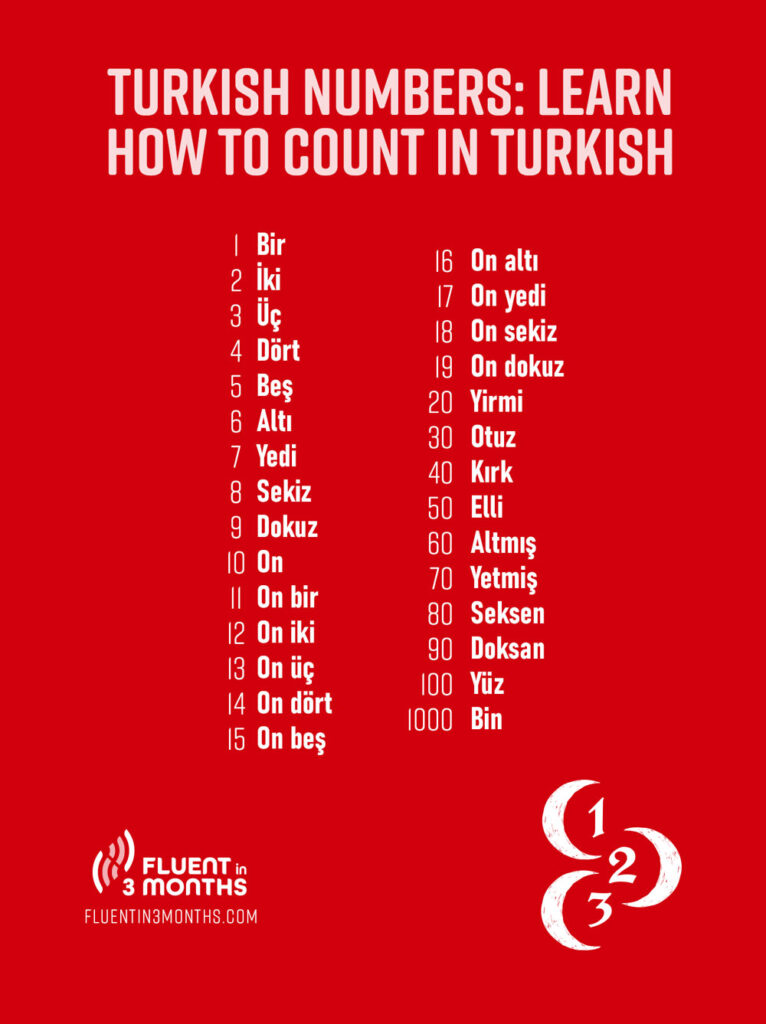
| Number | How it’s written in Turkish | Pronunciation in Turkish |
|---|---|---|
| 1 | Bir | |
| 2 | İki | |
| 3 | Üç | |
| 4 | Dört | |
| 5 | Beş | |
| 6 | Altı | |
| 7 | Yedi | |
| 8 | Sekiz | |
| 9 | Dokuz | |
| 10 | On | |
| 11 | On bir | |
| 12 | On iki | |
| 13 | On üç | |
| 14 | On dört | |
| 15 | On beş | |
| 16 | On altı | |
| 17 | On yedi | |
| 18 | On sekiz | |
| 19 | On dokuz | |
| 20 | Yirmi | |
| 30 | Otuz | |
| 40 | Kırk | |
| 50 | Elli | |
| 60 | Altmış | |
| 70 | Yetmiş | |
| 80 | Seksen | |
| 90 | Doksan | |
| 100 | Yüz | |
| 1000 | Bin |
The Basics: Turkish Numbers 1–10
The numbers from 1 to 10 are the building blocks for the rest. To say 23, yirmi üç, for example, you combine 20 with 3.
The Turkish numbers from 1 to 10 are:
- bir
- iki
- üç
- dört
- beş
- altı
- yedi
- sekiz
- dokuz
- on
Moving Forward: Turkish Numbers 11–19
Once you’ve mastered 1-10, it’s time to tackle 11-19. In Turkish, these numbers follow a logical pattern — just combine on (“ten”) with the corresponding single digit. So “eleven” in Turkish would be on bir, a combination of on (“ten”) and bir (“one”).
- on bir (“eleven,” literally “ten one”)
- on iki (“twelve,” “ten two.” This pattern continues for all the other numbers until 19)
- on üç
- on dört
- on beş
- on altı
- on yedi
- on sekiz
- on dokuz
Counting by Tens: Turkish Numbers 20–90
Once you know individual numbers for 20, 30, 40, and so on, you can construct any number between 20 and 99 with ease. For example, 20 in Turkish is yirmi. Memorizing yirmi means you know 21 as well, as you simply add bir (“one”) to the end, to make up yirmi bir, “twenty one.”
The numbers you should know between 20 and 90 are:
- yirmi
- otuz
- kırk
- elli
- altmış
- yetmiş
- seksen
- doksan
Then, to form numbers between these multiples of ten, you combine the multiple of ten with the single digit. For example:
22 is yirmi iki
37 is otuz yedi
45 is kırk beş
51 is elli bir
The Big Ones: 100, 1000, and Beyond in Turkish
“One hundred” in Turkish is yüz. How do you say two hundred? This time, you add iki (“two”) before yüz. So here are the numbers 100 to 900:
- yüz
- iki yüz
- üç yüz
- dört yüz
- beş yüz
- altı yüz
- yedi yüz
- sekiz yüz
- dokuz yüz
Then you can form the numbers in between. Here are some examples:
- iki yüz otuz beş
- üç yüz yirmi
- dört yüz doksan dört
- beş yüz doksan üç
- altı yüz on sekiz
- dokuz yüz doksan dokuz
After 999, the most important number is “one thousand,” bin. 2000, 3000, 4000, and the rest all follow the same logic as the hundreds: you add the number before bin.
- bin
- iki bin
- üç bin
Turkish Ordinal Numbers: How to Say “First,” “Second” and “Third”
You’ll hear ordinal numbers often in Turkish — they indicate order or sequence, similar to their English counterparts (first, second, third, etc.). To form ordinal numbers in Turkish, we generally add the suffix -ıncı, -inci, -uncu, -üncü to the number, with the exact form depending on vowel harmony rules. Don’t worry if this sounds complicated right now — it gets easier with time.
Here is how you say first to tenth in Turkish:
birinci (“first”)
ikinci (“second”)
üçüncü (“third”)
dördüncü (“fourth”)
beşinci (“fifth”)
altıncı (“sixth”)
yedinci (“seventh”)
sekizinci (“eighth”)
dokuzuncu (“ninth”)
onuncu (“tenth”)
Using Turkish Numbers in Real Life: 5 Contexts You’ll Use Turkish Numbers
Now it’s time to put knowledge into practice! Let’s take a look at some real-life situations where you’re likely to use numbers:
Telling Time
In formal Turkish, you’ll hear the time expressed using the 24-hour clock system:
- 3:15 – Üç on beş (literally “three fifteen”)
- 14:30 – On dört otuz (“fourteen thirty”)
- 22:45 – Yirmi iki kırk beş (“twenty-two forty-five”)
As for informal situations, you will often hear the words buçuk (“half”) and çeyrek (“quarter”) alongside the number. Here is how you would tell the time on a daily basis:
- 6:30 – Altı buçuk (“six and a half”)
- 7:45 – Sekize çeyrek var (“quarter to eight”)
- 10:45 – On bire çeyrek var (“quarter to eleven”)
Shopping and Prices
The Turkish currency is the lira (TL). Here’s how prices are typically expressed:
- 5 TL – Beş lira
- 12,50 TL – On iki lira elli kuruş or on iki buçuk lira
- 99,99 TL – Doksan dokuz lira doksan dokuz kuruş
Note: kuruş is the equivalent of cents.
Another useful phrase here is Fiyatı ne kadar?, meaning “How much does it cost?”
Giving Your Phone Number
Turkish phone numbers have 10 digits after the country code, or 11 in domestic format when the leading zero is included. People usually say them in groups:
- 0532 123 45 67 – Sıfır beş yüz otuz iki – yüz yirmi üç – kırk beş – altmış yedi (“zero, five hundred and thirty-two, one hundred and twenty-three, forty-five, sixty-seven”)
Age and Birthdays
To tell your age in Turkish, use the number followed by “yaşındayım:”
- Yirmi yedi yaşındayım: “I’m 27 years old.”
- Annem elli iki yaşında: “My mother is 52 years old.”
- Otuz yaşındasın: “You’re thirty years old.”
Measurements and Quantities
You’ll also hear numbers when buying things by the kilogram, gram or metre:
- 2 kilograms: İki kilo
- 500 grams: Beş yüz gram
- 1.5 metres: Bir buçuk metre
FAQs
How do you count to 10 in Turkish?
Counting from 1 to 10 in Turkish is as follows:
Bir
İki
Üç
Dört
Beş
Altı
Yedi
Sekiz
Dokuz
On
How are numbers written in Turkey?
Numbers in Turkey are written using the Arabic numeral system, which is the same system used in most Western countries — 1, 2, 3, 4, 5, 6, 7, 8, 9, 10.
When writing large numbers, Turkish uses a full stop as the thousands separator and a comma as the decimal separator. For instance, 1.000.000,50 means one million lira and fifty kuruş. English usually reverses those two separators.
What are the numbers to 20 in Turkish?
Here are the numbers from 1 to 20 in Turkish:
Bir
İki
Üç
Dört
Beş
Altı
Yedi
Sekiz
Dokuz
On
On bir
On iki
On üç
On dört
On beş
On altı
On yedi
On sekiz
On dokuz
Yirmi
Practise Turkish Numbers
Start with 1 to 10, then build up to 100 and 1,000. Use prices, times and phone numbers for practice, and try the podcasts, apps, dictionaries and books in our recommended Turkish resources.

Social