



How to Learn the Vietnamese Alphabet: An In-Depth Guide

Full disclosure: This post contains affiliate links. ?
If you've just started learning Vietnamese, then the alphabet can look a bit challenging. Sure, it's based on the same Latin alphabet that we use in English, but it has some additions, like đ and ơ.
What’s more, the written language is covered all over with diacritics (accent marks). You'll often see multiple accents per word, or even per letter. It can be difficult for your mind to process if you’re not used to it, and it's far from obvious how to pronounce words like đỡ, một, or người.

But don't get too discouraged. If you're familiar with the Latin alphabet, many Vietnamese letters will already look familiar. The extra letters, tones and unfamiliar sounds still take practice, but you have a starting point.
In this article I'll explain the letters and marks you'll need to start reading Vietnamese.
A note from the Fluent in 3 Months team before we get started: You can chat away with a native speaker for at least 15 minutes with the “Fluent in 3 Months” method. All it takes is 90 days. Tap this link to find out more.
The Vietnamese Alphabet: A Historical Introduction
Vietnamese was historically written in chữ Nôm, a script that borrowed Chinese characters and created others to represent Vietnamese words. Classical Chinese was also used, especially in official writing. Today, chữ Nôm survives mainly in historical texts and preservation work. Modern Vietnamese uses a Latin-based alphabet called chữ Quốc ngữ (“national language script”), developed from the 17th century through work by European missionaries, including Portuguese, Italian and French contributors, and Vietnamese collaborators.
Chữ Quốc ngữ has 29 letters and here's what they look like:
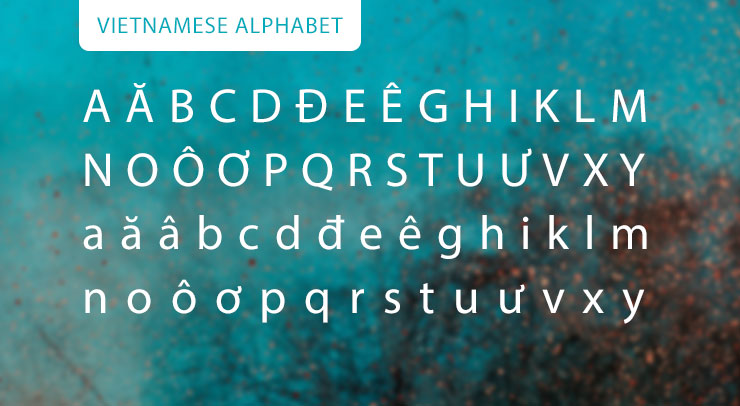
(The uppercase row in the image above is missing Â; it belongs between Ă and B, as â does in the lowercase row. F, J, W and Z are not part of the standard 29-letter alphabet, though you may see them in foreign names and borrowings.)
Vietnamese spelling gives you many useful pronunciation clues. Once you learn the rules for the variety you're studying, you can usually work from a written word to its sound. The reverse isn't always possible: regional sound mergers mean different spellings can sound alike.
Before I explain what those pronunciation rules are, I want to address the number one question that new learners of Vietnamese always ask:
Why Do Some Vietnamese Letters Have Two Accents?
A very distinctive feature of Vietnamese writing is that some letters are written with two accents, like the “ế” in the word tiếng (“language”).
In my experience, this is such a major point of confusion for beginners that it's worth addressing before we go any further. If I don't clear things up now, it will be harder to explain later.
The problem goes back to those missionaries who wanted to write Vietnamese using the Latin alphabet. The five basic vowel letters – a, e, i, o, and u – are not enough on their own to give each Vietnamese vowel sound a separate letter.
They could have used the same symbol to represent multiple sounds, as is common in English. (E.g. “a” is pronounced differently in the English words mat, mate, and car.) Or they could have invented some entirely new symbols that look nothing like a, e, i, o and u.
Instead, they decided to add six new letters: ă, â, ê, ô, ư, ơ.
These new symbols should not be thought of as “a with a hat” or “u with a hook/tail”. In Vietnamese they're considered to be completely separate letters from the five “normal” Latin vowels.
They're listed separately in the dictionary, have their own names, and are pronounced differently. For example, e is pronounced like the “e” in the English “get”, and ê is (roughly) like the “ay” in “hay”.
So that explains the “hats” on ă/â/ê/ô, and the hook thing (technically called a “horn”) on ơ/ư. You'll never see those symbols on any letters apart from the ones I just mentioned, so you'll never see an “i” with a hat or an “a” with a horn.
You'll also never see these three diacritics in combination with each other. So, for example, no Vietnamese letter has both a circumflex (ˆ) and a breve (˘).
When would you put two accents on one letter? Before we can finish this long explanation, I need to explain another essential aspect of Vietnamese speaking and writing:
How to Read and Write Vietnamese Tones
Vietnamese is a tonal language. Pitch and voice quality help distinguish words, so changing the tone can change the meaning.
For example, ba, said with a level tone, means “three”. With a rising tone, bá is a historical title of nobility; with a low, constricted tone in Hanoi speech, bạ can mean a register or ledger. The written tone mark tells you which form you're reading.
Tones can take practice if your first language doesn't use them to distinguish words. A full explanation of how to pronounce them is beyond the scope of this article. For now, you need to know that Vietnamese spelling distinguishes six tone categories, though their pronunciation and any mergers depend on the dialect. Try watching this short video for a quick introduction to how they sound.
In many tonal languages (e.g. Chinese), the writing system doesn't provide much information about which tone to use for a given word. Or the tone might be encoded in the written word, but the rules for figuring it out are very tricky and convoluted (as in Thai).
Here's the good news: reading Vietnamese tones is very easy. This is because the tone is clearly denoted using one of five accent marks. There are five such symbols for the six tones, because the “flat” tone is denoted by having no accent mark. Four of the tone symbols are written above the vowel, and one is written below.
In full, the six tones and their symbols are:
| Tone name | symbol | example word |
|---|---|---|
| ngang (“level”) | (none) | ma (“ghost”) |
| sắc (“sharp”) | ´ | má (“mother”, especially in southern speech; also “cheek”) |
| huyền (“falling”) | ` | mà (“but”, “that” or “which”, depending on the sentence) |
| nặng (“heavy”) | ̣ | mạ (“rice seedling”) |
| hỏi (“asking”) | ̉ | mả (“tomb”) |
| ngã (“tumbling”) | ˜ | mã (“horse” as a Sino-Vietnamese word element; also “code”; the usual everyday word for a horse is ngựa) |
Again, I can't precisely explain in writing how the tones sound. They can distinguish words, so practise them with recordings from the variety you want to speak.
In much of southern Vietnam, the hỏi and ngã tones merge in speech. Speakers pronounce mã the same as mả, although the words and their spellings remain distinct.
So take the letter e, which as I've already explained is pronounced like in the English “get” or “bet”. Depending on the tone, this could be written e, é, è, ẻ, ẽ, or ẹ.
A syllable can't have more than one tone, so you'll never see two tone marks on the same letter. E.g. the hỏi and ngã symbols ( ̉ and ~) would never be used together.
However, you can add a tone symbol to an “accented letter” like ă, ê, or ư. This is the only occasion on which a Vietnamese letter can have more than one accent. So ế, ỗ, ợ, and ữ are all valid, to give just a few examples.
Note that tone marks are only written on vowels. You'll never see ´ or ~ written above a consonant. But note that “y” is considered a vowel in Vietnamese, so ý, ỳ, ỷ, and ỹ are valid combinations.
So, in summary: there are two types of “accent marks” in Vietnamese. First, there are the accents on ă, â, ê, ô, ư, and ơ, which tell you that you're dealing with a different vowel from the equivalent with no accent. Second, there are the tone marks: é, è, ẻ, ẽ, ẹ, which can appear on any vowel, including the six vowels which already have some kind of accent mark. A vowel can have one accent from each category, as in ể or ộ – and this is the only circumstance in which a Vietnamese letter can have more than one accent mark.
Hopefully this long explanation has made things crystal-clear. That's the last thing I'll say about Vietnamese tones, or the accents used to write them.
Now it's finally time to explain how the individual letters of the Vietnamese alphabet are pronounced.
How to Pronounce Vietnamese Letters
There are a few things to understand before explaining how each Vietnamese letter is pronounced:
Firstly, some letters are pronounced differently across Vietnam. I'll point out common northern and southern patterns, but these broad labels don't cover every local accent or speaker.
Secondly, the pronunciation of some consonants changes depending on whether they're at the beginning or the end of the word. Again, I'll do my best to explain this in the table below.
Also: you know how the combinations “th”, “sh”, and “ch” have special pronunciations in English? That is, a “th” is not simply the combination of a “t” and an “h”, but its own separate sound. The same thing exists in Vietnamese; certain combinations of letters have their own pronunciations, which will also be given below.
Finally, a word of warning. Vietnamese is not an easy language for English speakers to pronounce. Several of its vowels and consonants have no equivalent in English, and it can take a lot of practice to get them right and have native speakers understand you.
There's only so much I can explain in writing; make sure to listen to recordings of each, get help from native speakers when possible, and above all, keep practising. You'll get there eventually.
The following is a rough guide to Vietnamese letters and common letter combinations. Ch, not given its own row below, is often pronounced /tɕ/ initially in Hanoi speech, where it merges with tr; southern speech can distinguish ch /c/ from tr /ʈ/. Final ch is an unreleased stop whose pronunciation depends on the vowel and dialect. I include the IPA symbol for each letter – if you don't know what IPA is or how to read it, see my previous article on the topic.
| Letter | IPA | Description |
|---|---|---|
| A a | /a/ | An open “a” sound, roughly like the vowel in “father”, without an “r” sound |
| Ă ă | /ă/ | Like “a”, but shorter |
| Â â | /ə̆/ | A short central, unrounded vowel; English comparisons are only approximate |
| B b | /ɓ/ | An “implosive b” sound. (See below for more about implosives.) |
| C c | /k/ | Like an English “k” |
| D d | /z/ (northern), /j/ (southern) | Like a “z” in northern Vietnamese, and a “y” in Southern Vietnamese. Make sure not to pronounce this like an English “d” – this is a common mistake among beginners! |
| Đ đ | /ɗ/ | An “implosive d” sound. (See below for more about implosives.) |
| E e | /ɛ/ | Like the “e” in the English “get” or “bet” |
| Ê ê | /e/ | Like the “ay” in the English “say”, but not diphthongised (see below) |
| G g | /ɣ/ | A voiced fricative made near the back of the mouth. The softer Spanish “g” in hago is an approximation, not an identical sound. Sometimes written “gh”; see below |
| Gi gi | /z/ (northern), /j/ (southern) | Like a “z” in northern Vietnamese, and a “y” in Southern Vietnamese. In the common northern and southern patterns described here, this merges with Vietnamese “d” |
| H h | /h/ | Same as the English “h” |
| I i | /i/ | Like the “ee” in the English “bee” |
| K k | /k/ | Same as a Vietnamese “c”, i.e. an English “k”. See note below about when to write “c” and when to write “k” |
| Kh kh | /x/ | A raspy “h” sound, like the “ch” in the Scottish “loch” |
| L l | /l/ | Same as the English “l” |
| M m | /m/ | Same as the English “m” |
| N n | /n/ | Initially, roughly like English “n”. Final n is usually alveolar in Hanoi speech; in southern varieties it can merge with ng, depending on the preceding vowel. |
| Ng ng | /ŋ/ | Like the English “ng”, as in “sing”. The difference is that, in English, the “ng” sound only ever comes at the *end* of a syllable. In Vietnamese it can also appear at the beginning of a syllable/word. Sometimes spelled “ngh”; see below |
| Nh nh | /ɲ/ (beginning of word), /ŋ/ (end of word, northern), or /n/ (end of word, southern) | Initially, roughly like Spanish “ñ”. Final nh is a fronted velar nasal in Hanoi speech, not simply an initial nh moved to the end. Southern realisations depend on the preceding vowel and are often described with /n/. |
| O o | /ɔ/ | An open-mid, rounded back vowel. The vowel in English “thought” can be a rough guide in accents that keep it distinct from “cot”, but listen to Vietnamese examples. |
| Ô ô | /o/ | Like the “ow” in “below”, except not diphthongised (see below) |
| Ơ ơ | /ə/ | To my British ear, this is roughly like the vowel in “bird” or “fur”, without an “r” sound. Transcriptions vary; you may also see /ɤ/. |
| P p | /p/ | Usually a final, unreleased “p”: close your lips without adding a burst or extra vowel. Initial p occurs in some borrowed words; ph represents a different sound (see below). |
| Ph ph | /f/ | Like the English “f”. Only ever seen at the beginning of a word |
| Qu qu | /kʷ/ | Like the “qu” in English, e.g. “queen” |
| R r | /z/ (northern), /r/ (southern) | Commonly /z/ in Hanoi speech. Southern r varies considerably, so /r/ here is a broad label, not an instruction to use one particular tap or trill. |
| S s | /s/; also /ʂ/ in varieties that distinguish s from x | Common Hanoi speech merges s and x as /s/. Some speakers elsewhere distinguish a retroflex s, roughly like English “sh”, but many southern speakers merge them too. |
| T t | /t/ | Initially unaspirated, roughly like the t in English “star”. Final t is unreleased; southern realisations can merge with k depending on the preceding vowel. |
| Th th | /tʰ/ | An “aspirated” t (see below) |
| Tr tr | /tɕ/ (northern), /ʈʂ/ (southern) | Common Hanoi speech merges tr with ch. Southern varieties often distinguish a retroflex tr; English “tr” is only a rough comparison, not an exact match. |
| U u | /u/ | Like an English “oo”, as in “shoot” |
| Ư ư | /ɯ/ | This vowel is very hard to pronounce. I give a detailed description below |
| V v | /v/ or /j/ | Like the English “v”, although southerners often pronounce it like a “y”. |
| X x | /s/ | Like the English “s”. |
| Y y | /i/ | Like the “ee” in the English “bee”. (Same as the Vietnamese “i”) |
As you can see, there's a lot to learn! Here are a few other things to note:
How Do You Pronounce “ư” in Vietnamese?
The vowel “ư” can be unfamiliar to English speakers.
Linguists call this the “close back unrounded vowel”, and if you go to Wikipedia you can hear a recording of it. My best explanation of how to pronounce it is this:
- Position your tongue and lips as if you were going to say an “oo” sound, as in “shoot”. Notice that your tongue is high and back in your mouth, and your lips are rounded.
- Without moving your tongue much, gently unround your lips.
- Make a sound with your lips unrounded, then compare it with a Vietnamese recording. This is a starting approximation for “ư”, not a guarantee of a perfect match.
How Do You Pronounce “ê” and “ô” in Vietnamese?
In the table above, I told you not to “diphthongise” the “ê” and “ô” sounds. But what does that actually mean?
This is actually the same advice that's required when learning how to pronounce the “ê” and “ô” sounds in Portuguese, or the “e” and “o” sounds in Spanish. For example, see tip number 2 in this list of pronunciation tips I wrote for Spanish learners, and the exact same point applies here.
Essentially, a Vietnamese ê is roughly like the start of “ay” in “way”, and Vietnamese ô like the start of “oe” in “toe”. In many English accents, the tongue moves during these vowels. The sound glides between two vowel positions within one syllable; linguists call this a “diphthong”.
When saying ê and ô in Vietnamese, however, you mustn't move your tongue like this. Start saying the “ay” or “oe” sounds, but only say the first part; keep your tongue still.
“K” vs “c”, “G” vs “Gh”, and “Ng” vs “Ngh”
At the start of a syllable, “k” and “c” represent the same sound. Leaving the combination “qu” aside, the standard spelling pattern is:
- Before an i, y, e, or ê, write “k” – as in kem (cream)
- Before the other vowel letters, write “c” – as in có (to have)
Similarly, “g” and “gh” are pronounced the same, as are “ng” and “ngh”. For these syllable-initial pairs, the rules are the same and only slightly different from the k/c rule:
- Before an i, e, or ê, write “ngh” or “gh” – as in nghe (“to hear”) or ghe (“boat”)
- Before the other vowel letters, write “ng” or “g” – as in Nga (“Russia”) or gái (“girl”).
Vietnamese Implosives
Two of the most tricky sounds in Vietnamese are the “b” and “đ” consonants. (Remember that “d” in Vietnamese, without the line through it, is nothing like an English “d”.)
“B” and “đ” can sound different from English “b” and “d”, although an English-like pronunciation may still be understood. They are commonly described as implosive consonants, but the degree of implosion varies between speakers.
What does that mean? Well, according to Wikipedia:
Implosive consonants are a group of stop consonants … with a mixed glottalic ingressive and pulmonic egressive airstream mechanism. That is, the airstream is controlled by moving the glottis downward in addition to expelling air from the lungs.
Get it? I thought not. It's hard to explain. But you can start by listening to these clips to get an idea of what the “b” and “đ” sound like:
When practising Vietnamese “b” and “đ”, keep your voice going and do not try to inhale while speaking. The implosive gesture involves lowering the larynx; use the recordings as your model, without forcing your throat.
An inward sensation can be a misleading shortcut. It does not mean taking a breath in as you say the consonant.
For a more detailed description of implosives (and other unusual sounds, including some that aren't found in Vietnamese), try this video.
The Difference Between ‘t' and ‘th' in Vietnamese
Another tricky thing for English learners of Vietnamese is the difference between the “t” and “th” sounds.
If you want to get a deep understanding, I suggest looking up the linguistic concept of “aspirated vs. unaspirated consonants”. I wrote a little about this in my article on the International Phonetic Alphabet.
For now, here's the basic idea: Vietnamese initial t is unaspirated, with little puff of air. The t in English “star” is a closer starting point than the t at the beginning of “top”.
Vietnamese th, on the other hand, is aspirated: it has an audible puff of air, roughly like the initial t in English “top”.
Think of Vietnamese “th” as one consonant with a puff of air, not two separate sounds. It is different from the English th in “thin” or “this”.
Listen to native speakers, keep practising, and you should pick up the difference fairly quickly.
Closing Your Mouth/Puffing Out Your Cheeks
There's one last thing to note. When you talk with Vietnamese people, you'll notice they sometimes puff out their cheeks when they speak. You'll notice this, for example, with the word không, which means “no”.
This can happen with words ending in -ong, -ông or -ung. The final consonant combines an ng-like closure at the back of the mouth with a simultaneous m-like lip closure. In không, don't say ng and then m as two separate sounds.
Closing the lips during this sound can trap air and make the cheeks puff slightly. Focus on the simultaneous closure you hear and see in your model speaker; there's no need to exaggerate the cheek movement.
You Can Learn the Vietnamese Alphabet!
This covers the basics of Vietnamese spelling and pronunciation, although, as we've seen, things really aren't that basic! There's a lot to take in.
Practice can pay off. As someone who has lived in Vietnam, I found that even a little Vietnamese could get an enthusiastic response. As a người nước ngoài (foreigner), being willing to try the language can help you connect with people, even while you're still learning the basics.
So I hope that the above guide is a useful starting point. Have fun as you learn the Vietnamese alphabet!
There’s only so much that writing can do for Vietnamese pronunciation, so the next step is to hear these letters and tones from native speakers. You can sign up for VietnamesePod101, which gives you plenty of audio to practise with, and if you want the good and bad before deciding whether it’s for you, our separate VietnamesePod101 review covers that. Once those sounds start to make sense, try them out with our companion guide to saying hello in Vietnamese, preferably with an actual Vietnamese speaker rather than your laptop. They’ll probably be far more impressed than you expect!
If you’d like to go beyond hellos and hold a proper conversation, the Fluent in 3 Months Bootcamp gives you 90 days to reach a 15-minute conversation with a native speaker. That may sound like a fair leap from staring at ă, â and ê, but once you start using the language with real people, even the basics can take you surprisingly far.

Social