


Water in French: Essential Vocabulary (with Audio)

Full disclosure: This post contains affiliate links. ?
“Water” in French is eau (pronounced /o/).
Eau often goes with a definite or partitive article, or follows de, so you’ll mostly see it as de l’eau, d’eau, or l’eau.
It’s a useful word in many situations, whether you’re traveling in France, eating at a French restaurant, or renting a house from a French-speaking person!
As a French graduate, here is my handy vocabulary list to say water in French and use the word in different situations.
Editor's note: Before we get started, if you’re looking for an online French course, here’s the course we recommend: French Uncovered – Learn French Through the Power of Story, a course with a fascinating new method by Olly Richards. You can try it for free for 7 days!
Table of contents
Still Water, Tap Water, and Sparkling Water in French
In France, tap water is normally safe to drink unless the local authorities or water supplier issue specific advice. If you prefer bottled water, whether still or sparkling, you’ll need to know how to order it in a restaurant or what to look for in a supermarket.
Here is a useful vocabulary list:
| English | French | Audio |
|---|---|---|
| “Still water” | L'eau plate | |
| “Sparkling water” | L'eau gazeuse | |
| “Sparkling water” | L'eau pétillante | |
| “Mineral water” | L'eau minérale | |
| “Tap water” | L'eau du robinet |
How to Order Water in French Restaurants
Une bouteille d’eau is “a bottle of water,” while un verre d’eau is “a glass of water.” So if you’re eating alone, you might want to ask for un verre d’eau, by saying Puis-je avoir un verre d’eau, s’il vous plaît? (“Can I have a glass of water, please?”) If you’re with a group of friends, you can order une bouteille d’eau, so you can share. In this case, say Peut-on avoir une bouteille d’eau, s’il vous plaît? (“Can we have a bottle of water, please?”)
You can also ask for une carafe d’eau, which is “a pitcher of water.” Ask specifically for a carafe if you want ordinary tap water rather than a bottle. With a restaurant meal in France, the carafe and bread are included in the price. You can also ask for free drinking water at a café when you order a coffee.
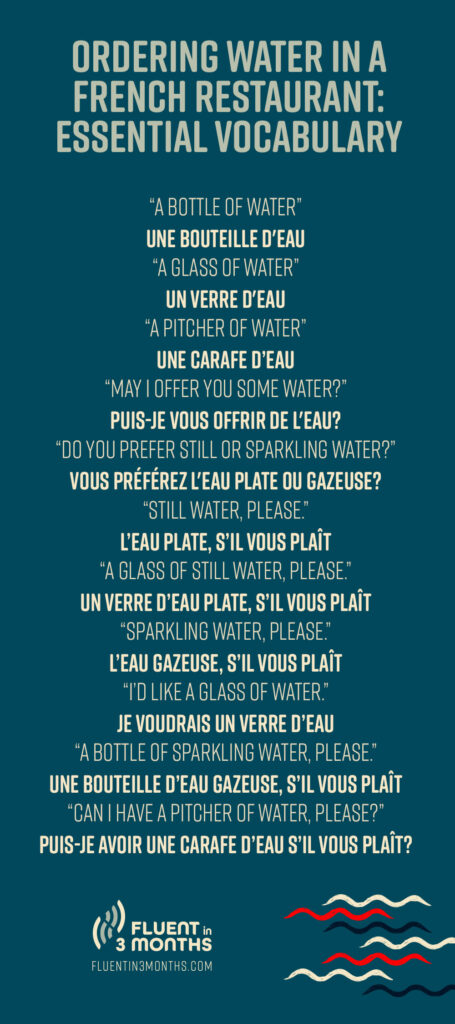
Here is a vocabulary list for ordering water in French, including what the waiter might say when asking if you’d like some water.
| English | French | Audio |
|---|---|---|
| “A bottle of water” | Une bouteille d'eau | |
| “A glass of water” | Un verre d'eau | |
| “A pitcher of water” | Une carafe d’eau | |
| “May I offer you some water?” | Puis-je vous offrir de l'eau? | |
| “Do you prefer still or sparkling water?” | Vous préférez l'eau plate ou gazeuse? | |
| “Still water, please.” | L’eau plate, s’il vous plaît | |
| “A glass of still water, please.” | Un verre d’eau plate, s’il vous plaît | |
| “Sparkling water, please.” | L’eau gazeuse, s’il vous plaît | |
| “I’d like a glass of water.” | Je voudrais un verre d’eau | |
| “A bottle of sparkling water, please.” | Une bouteille d’eau gazeuse, s’il vous plaît | |
| “Can I have a pitcher of water, please?” | Puis-je avoir une carafe d’eau s’il vous plaît? |
Puis-je…? is polite and slightly formal. Je voudrais… is also a natural choice in a restaurant. For more options, see our guide to saying “please” in French.
Water Brands in French
Looking for a specific water brand? Examples of mineral and sparkling water brands you may see in France include:
- Evian
- Perrier
- Vittel
- Contrex
- Badoit
If the restaurant has one of these brands, order with de plus the brand name. Before a vowel, de becomes d’, as in une bouteille d’Evian. Before a consonant, it stays de, as in une bouteille de Vittel.
- Une bouteille d’Evian, s’il vous plaît. “A bottle of Evian, please.”
- Puis-je avoir une bouteille de Vittel? “Can I have a bottle of Vittel?”
Hot Water and Cold Water in French
Imagine you’re an exchange student in France, you moved into a new apartment, and there’s no hot water. You need to call the landlord, but there’s an important phrase you should know: hot water!
Hot water is l’eau chaude in French. In each of the four temperature phrases below, the adjective comes after l’eau and agrees with the feminine noun eau. That’s why it’s l’eau chaude, not l’eau chaud.
| English | French | Audio |
|---|---|---|
| “Hot water” | L’eau chaude | |
| “Cold water” | L’eau froide | |
| “Lukewarm water” | L’eau tiède | |
| “Boiling water” | L’eau bouillante |
Idioms with Water in French
Water is a huge part of our everyday life, so it’s only natural that many languages have expressions with “water.” French is one of them. Here are a few fun idioms to try out:
Être comme l’eau et le feu literally translates to “to be like water and fire.” It means that two people have opposing temperaments, like oil and water. This expression is dated, so it’s more useful to recognise than to make your first choice in conversation.
If you want to emphasize how similar two people are, that’s also a water-related expression in French. Se ressembler comme deux gouttes d’eau is the idiom you’re looking for. It means “to resemble each other like two drops of water,” or “to be two peas in a pod.”
La goutte d’eau qui fait déborder le vase is the French equivalent of “the last straw”: one final event, after many others, causes anger to spill over. Literally, it is “the drop of water that makes the vase overflow.”
Now You Know the Basics of Water in French
Whether you’re ordering a drink, explaining a problem with the hot water, or learning an expression, you’ll often use the word l’eau. Take a look at our list of core French words for more useful vocabulary.
For a structured next step, Language Hacking French builds beginner conversations around useful phrases.

Social