


How to Say Yes in French in Every Context

Full disclosure: This post contains affiliate links. ?
“Yes” in French is oui.
And if you’re learning French and want to recognise how agreement changes with context, there are several more ways to say “yes” in French.
Think about how often you say “yes” in English, and how often you replace it with other words like “yep”, “yeah”, “okay”, “sure thing”, “of course” and “certainly”.
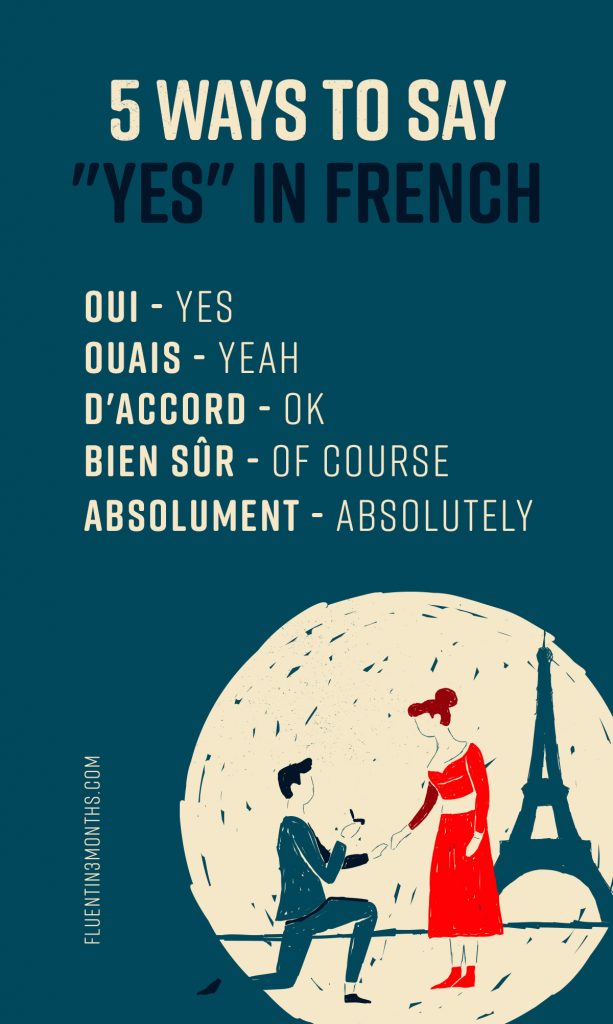
Here is a quick list of ways to say “yes” in French:
- “yes” in French: oui
- “yeah” in French: ouais
- “OK” in French: d’accord or OK (pronounced oké)
- “of course” in French: bien sûr
- “absolutely” in French: absolument
And “no” in French is non.
Read on to find out more about how to say “yes” in French, including:
- What oui means in French?
- What’s the meaning of si in French?
- How do you say “sure” in French?
I’ll even tell you about a famous French cartoon called Oui-Oui, a small cultural detour before we begin.
Are you ready? Oui?
Then let’s go!
Editor's note: Before we get started, if you’re looking for an online French course, here’s the course we recommend: French Uncovered – Learn French Through the Power of Story, a course with a fascinating new method by Olly Richards. You can try it for free for 7 days!
How to Say “Yes” in French with Oui
You probably already know this… French people will answer your questions with oui, meaning “yes”!
But did you also know that the double oui is quite popular too?
French speakers may repeat oui to add emphasis or insistence. It is a little like stressing “I do” in English: Oui, oui, j’aime ça ! (“Yes, I do like it!”)
The Meaning of Mais Oui
Mais oui literally translates to “but yes”. This literal translation doesn’t make sense in English.
In most cases, mais oui is an interjection to say “that’s right” or to make the oui stronger. The mais (“but”) doesn’t translate in English when it’s part of this phrase.
Examples:
- Mais oui, c’est correct ! – “Yes, that’s right!”
- Mais oui, j’arrive – “Yes, I’m coming.”
Mais oui on its own can also mean “but of course.”
“Yes” in French – What Does Oui Mean?
Language lovers might have another question besides How do you say “yes” in French?
If you’re familiar with romance languages such as Spanish, Italian, and Portuguese, this question might be: Why don’t the French use: “si” like many other romance languages?
This is a very good question, with an even better answer.
“Yes” in Italian is sì. In Spanish it is sí. In Portuguese, sim. But in French, it’s oui.
So how come, if all these languages are derived from Latin, they don’t use the same word for “yes”?
These words share a Latin background, but they did not all inherit one general-purpose Latin word for “yes”. French oui developed from Old French oïl, formed from o (“that”, from Latin hoc) plus the pronoun il.
Modern French also uses si, but in a more specific situation.
The French language also adopted si, though only for specific situations. Let me tell you more about it.
What Does Si Mean in French?
We French like to be eccentric. This is why we have a “yes” to use in specific situations.
Si is the French “yes” to answer a question that was asked negatively.
You’d think that doesn’t happen often, but it surprisingly does. You would ask a French: Tu n’as pas faim ? (“You’re not hungry?”) and they’d answer si, meaning “yes”!
Examples:
- Ça ne va pas ? (“Are you not okay?”) → Si, ça va. (“I’m fine.”)
- Ne vient-il pas ? (“Is he not coming?”) → Si, il est en route. (“Yes, he’s on his way.”)
How to Say “Yeah” in French with Ouais
Why would you want to learn how to say “yeah” in French? It’s not “proper” language.
Well, think about how many times you use “yes” in English. Then think about how many times you use “yeah” daily.
Yeah, that’s what I thought.
Whether your go-to lazy yes is “yeah” or “yep”, you probably use it more often than “yes”. You would do the same in French with ouais.
You will also hear French saying mouais. It’s ouais but with a disinterested or doubtful tone.
How to Say “OK” in French with D’Accord
If you look for the French translation of “okay” on the Internet, the answer you will get is d’accord.
D’accord literally means “in agreement”. It is a neutral, standard way to say “OK”, “all right” or “fine”.
If you’re looking for the more familiar “okay”, don’t look further. No, I mean it, don’t look further than “okay”. Simply using ok has become very popular among the French population. We pronounce it oké.
In informal messages, you may also see the abbreviation d’acc.
How to Say “Of Course” in French with Bien Sûr
Bien sûr in English would literally be “well sure” as bien is “good” or “well” and sûr is “sure”.
But bien sûr is the French equivalent of “of course”!
In careful writing, keep the circumflex: sûr means “sure”, while sur usually means “on”. You will often see accents omitted in quick messages, but it is worth learning the standard spelling.
A Canadian French Way to Say “Sure” with Pour Sûr
In Québec French, pour sûr can mean “for sure” or “certainly”.
It is not the most broadly useful choice for learners, especially if you are speaking with people from several French-speaking regions.
For a dependable equivalent of “of course”, use bien sûr. Let regional expressions come later, once you know the variety of French you are hearing.
If you want to say “sure” as in the more familiar way, use ouais or OK.
How to Say “Absolutely” in French with Absolument
After learning to say “for sure” in French, you have to learn how to say “absolutely”. You never know how affirmative you need to be in future situations.
In French, “absolutely” is absolument. Isn’t it similar to the English word? You’re lucky, it makes it even easier to remember!
If you like French grammar (or at the very least are familiar with it), you’ll recognize the construction of the adverb: adjective (absolu, “absolute”) and the suffix -ment.
Words that are the same in English and French are called cognates. There are hundreds of French words that you can learn this way. It’s a quick way to build your French vocabulary.
How to Say “It's Okay” in French with Ça Va or C’est Bon
How you say “it’s okay” in French depends on the situation and context.
Depending on the situation, ça va can mean “it’s fine” and c’est bon can mean “that’s fine”, “that’s enough” or “it’s good”.
Ça va literally translates to “it goes” in English. It’s the short version of ça va bien (“it’s going well”). C’est bon means “it’s good”.
As I mentioned earlier, French people do say ok. You might hear them saying c’est ok as well.
How to Say “To Agree” in French with Acquiescer
Sometimes, you don’t even need words to say “yes”. You just have to nod!
In French, acquiescer means “to agree” or “to assent”. It can describe agreement expressed with a nod, but it does not name the physical gesture itself.
Acquiescer is a first-group -er verb, but its spelling changes before a and o: for example, nous acquiesçons. Also note that not every verb ending in -er is regular; aller is the familiar exception.
However, watch out for the ç cedilla. It appears in front of the vowels a, o, u but not e, i because they already make the c soft. This is why there is no ç in the infinitive of acquiescer.
| Passé Simple | Imparfait | Passé Composé | Présent | Futur | |
|---|---|---|---|---|---|
| je – I | j'acquiesçai | j'acquiesçais | j'ai acquiescé | j'acquiesce | j'acquiescerai |
| tu – you (singular and informal) | tu acquiesças | tu acquiesçais | tu as acquiescé | tu acquiesces | tu acquiesceras |
| il / elle / on – he / she / one; on often means “we” in speech | il/elle/on acquiesça | il/elle/on acquiesçait | il/elle/on a acquiescé | il/elle/on acquiesce | il/elle/on acquiescera |
| nous – we | nous acquiesçâmes | nous acquiescions | nous avons acquiescé | nous acquiesçons | nous acquiescerons |
| vous – you (plural or formal) | vous acquiesçâtes | vous acquiesciez | vous avez acquiescé | vous acquiescez | vous acquiescerez |
| ils – they (masculine or general) / elles (feminine) | ils/elles acquiescèrent | ils/elles acquiesçaient | ils/elles ont acquiescé | ils/elles acquiescent | ils/elles acquiesceront |
To name the physical gesture “to nod”, use hocher la tête.
How to Say “Thumbs-Up” in French
A lot of our communication as humans depends on body language, so it only makes sense that we have more than one gesture to show that we’re saying “yes”.
If nodding isn’t your thing, you may prefer a thumbs-up. In French, a thumbs-up is un pouce levé.
The opposite gesture, thumbs-down, is le pouce baissé.
You may also hear un pouce en l’air.

Other Ways to Say “Yes” in French
Here are a few more ways to say yes without actually saying “yes” in French:
- Affirmatif – “affirmative”; mostly a military, radio or playful register
- Compte sur moi – “count on me”, when you are agreeing to do something
- Comptez sur moi – plural or formal “count on me”
- Ça roule – “all good” or “OK” (familiar)
- Ça marche – “that works” or “OK” (familiar)
Oui-Oui, the French Name for Noddy
This is a small cultural detour about a familiar children’s character in France.
Have you heard of Oui-Oui? Or maybe you know him as Noddy?
Still not ringing a bell? Maybe you’ll recognize him then:
Oui-Oui is the French name for Noddy, the children’s character created by British author Enid Blyton.
His French name literally reads “Yes-Yes”, which makes it a memorable little connection to this article.
Now You Know How to Say “Yes” in French, It’s Time to Part Ways
You now have a range of ways to agree in French. Start with oui, si and d’accord, then add the more informal or regional choices when the context fits.
Are you happy? Oui!
Do you feel confident with your knowledge of French words for “yes”? Bien sûr!
Are you ready for more French learning? Absolument!
That’s what I wanted to hear!
For a wider study plan, see this list of French-learning resources.

Social