Join over ¼ million
monthly
readers!

Contact Me

Current mission

Travel China using
the Mandarin I
learned in 3 months!

Previous post:

Next post:

Shocking truth about passive listening

| 109 comments | Category: learning languages

A whole industry of language learning products is based on something that I have to frankly say that I think is absolute rubbish.

Some people swear by it, and yet it rarely ever produces any useful results.

The shocking truth is that passive listening is never going to get you to fluency in a language. What’s even worse is that it won’t even help your ability to understand.

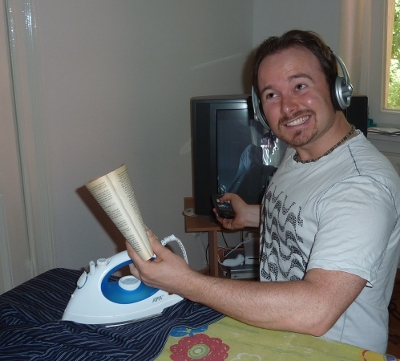
Learn a language while you sleep? Dramatically improve your ability to converse by having the radio/TV on in the background for thousands of hours? Master a language while you work or do your taxes with your shiny iPod blaring noise you aren’t paying attention to?

Not a hope in hell.

This is something that really touches a nerve for me because I have met the results of this approach – people who have put thousands of hours into passive learning and they are barely any better off because of it.

It’s barely better-than-nothing.

I meet dozens of disappointed language learners every week, no matter where I am in the world, and I have declared war on the reasons holding them back from reaching fluency in their target language, and relying on passive learning (playing audio in the background while you are focused on something else) is high up on my list.

I want to destroy this myth and finally help these frustrated people do something useful. In the same way as just studying will never help you speak, passive listening will never help you speak and even understand a language.

Results of thousands of wasted hours?

I asked some people on twitter and on Facebook what their opinion of the actual results of this was and (among others) I got the following replies:

  • @hpp23 I tried passive listening but it didn’t help me in my learning. First understand actively, then listen passively & let it sink
  • @yearlyglot I think passive listening can only be done when you already know the language. But learning must be active.
  • @permanentnomad After two years of studying Japanese with it, I think my time would have been better spent speaking with natives.

I share these sentiments. When you already understand the language, it’s different – but to learn the language? The problem with embracing a passive means of learning a language is that a language is active. It requires your attention to understand and your ability to produce to actually converse.

Sorry to break it to you but you have to do some work to make progress in a language. Passive listening is a way to escape doing something useful, since you are doing something else at the same time.

Having thousands of hours of audio in the background will do you no good if you aren’t actively giving it your attention. It’s just noise unless you are actively listening to it.

My own disappointment with passive listening

This approach was already something I was sceptical about for several years, but as part of the last months’ input experiment (some of which has helped me improve my learning approach) I had the radio on in German all the time while I was doing something else (writing a book, or doing grammar or written exercises for the test) and gave it a real chance to see if it could help.

After sitting my German C2 exam, a few hours of spoken practise per week gave me 75% in the oral exam, and actively writing several texts for correction gave me 74% in the written exam, both of which I’m very pleased about. But passively hearing over a thousand hours of German radio got me a disappointing 37% in the listening exam.

The listening exam was hard, but it was very fair. The reason I got such a low result isn’t the test’s fault. It was my delusional belief that passive listening for a really long time gave me even the slightest edge. You definitely can’t listen your way to fluency, but you can’t even passively hear your way to a decent level of listening comprehension.

Some people have ludicrously suggested that I should have heard more to get a higher result. As if three thousand hours would have tripled my score(!)

The only reason I got even what I did would have been due to the spoken practise - which naturally involves focused listening. What I should have done for exam preparation is focus on any audio and analysed it while doing nothing else at the same time. I am confident that just five hours of this would have likely given me enough of an edge to pass the entire exam.

I realised this after doing an example exam a few days before the real one. If I had not done the active listening work the days before the exam, my result would have actually been even lower!

Why is it so popular?

It’s not even really passive listening I’m criticising here – that doesn’t actually exist; it’s passive hearing. When you are truly listening to something then it has your full attention.

So why is passive hearing so popular?

In this day and age we want short-cuts to everything. Drive-through fast-food, shampoo and conditioner in-one, phones that are also calculators/maps/Internet browsers/games. Sometimes this can be useful, but other times you are better just keeping it simple and doing one thing at a time. Learning languages is one of those things.

Learning a language while you do something else is lazy. It doesn’t show any devotion at all to the task at hand. It gives you a “sense” of doing something useful, and it can even be fun for some people! (Playing computer games and watching TV can also be fun, but it doesn’t mean you get anything useful out of it)

After the “honeymoon”, when you have to use the language you’ll just feel stupid that you can’t speak or understand when spoken to despite all that “work” you put in.

It answers people’s eternal question of “I don’t have time” to study/practise a language because “I’m too busy”, so just simply have it in the background to feel like you are doing work. Of course you have time! Stop making excuses and find the time! Even 10 minutes of focused learning/listening will give you way more benefits than 10 hours of noise you aren’t paying attention to.

The few benefits

Of course, there are some reasons that passive hearing can be beneficial.

However, it’s important to be aware of precisely what these reasons are! I am not writing this article to tell people to turn off their streaming radio or stop listening to podcasts – (I even wrote a post recently about how to find podcasts!) I want people to stop deluding themselves that it counts as their main useful step to fluency that deserves all the time it gets.

Here are some benefits, with some warnings:

  • In early stages, a language really feels like noise. If you have it on in the background you can get used to how it generally sounds and it seems less foreign. You don’t need to focus on it to get this feeling. I am attempting this with Hungarian to get used to the sound of the language before getting full-time exposure to it. But this is just familiarity for emotional comfort (which is indeed important) – it is not actual comprehension. Hearing Hungarian for years without actively analysing it (or better yet, using it with natives) will get me nowhere.
  • @don_rivers compared it to having coffee on your desk. You can take “sips” whenever you feel it’s important and tune in and focus when you decide to. I’d still argue that the times between the “sips” are only useful in that you are saved the “hard work” of pressing a button, and it otherwise doesn’t help. A solid distinction of right now I am focused on learning the language will help a lot of people, and they lose this if they vaguely tune in and out.
  • Even when not paying attention, your subconscious will be on the look-out for certain things. It’s like how we suddenly hear our name from across the room in a noisy party from a conversation we weren’t paying attention to. When listening to news etc. in a foreign language, you will hear key words you learned and might decide to tune in and focus then. I recognised “egy” (one) on streamed Hungarian radio and this is a confidence booster. But a thousand hours to get these minor buzzes is not worth it. The feeling is much better with natives.
  • @danielpwright says it is to be preferred over English (or your native tongue), if you  can’t actively listen/converse right now, although I would say this is just marginally better than nothing if you aren’t giving it your attention. It’s better to find some way to actively listen or converse rather than feel like you have done your language-learning work for the day.

Be more active!

I’m not trying to rain on people’s parade here – I just want learners to be clear about the fact that they need to put time into lots of different aspects of learning a language (especially speaking it). By all means, continue passively listening, but be aware of its usefulness so you try other learning approaches too and give them the time they deserve. Don’t use hearing “something” all day to get out of the guilt of not doing any real work!

Give the audio your full attention and analyse it. Even if just for a few minutes. This was my main mistake in my thousand-hour experiment. What I should have done was close my computer screen and give the audio my full focus for at least 5-10 minute segments and replay it if possible until I understood it all.

Having the radio/podcast on in the background isn’t doing you any “harm”, it can only help – the harm is in people’s understanding of how much it helps. If they think it helps more than it actually does, they may put less work into way more useful things.

Of course, my criticism on passive listening here is not related to active listening. But I’d argue that most people with their target language on in the background in some audible format, simply don’t pay attention to it, thinking that their brain is processing it magically for them. Even if this were true, without your focus you are getting a minuscule (maybe 1%?) amount of the benefit that some focus would give in a way smaller timeframe.

Rather than thinking that many hours a day “doing something” counts, take small parts of your day and do some active learning! Read in the language and try to understand as much of it as possible, listen to online radio but try to make notes of what is being said and use a dictionary if necessary – and most important of all find natives and speak to them - there is nothing stopping you from trying.

I like to study using SRS, and sometimes this gets as little as just two minutes when I’m on the metro or otherwise waiting somewhere. But that is two minutes of my full undivided attention. This is the only way to make useful progress in a language.

So please – stop trying to do everything at once! Be active with your language, even if that just involves actively listening. :) I would, of course, highly recommend finding ways to converse with natives as soon as possible.

Looking forward to your comments as always! Since I’m dropping a bombshell on a very much loved pastime of a lot of people, I expect some disagreement – but keep it relevant and insult-free or I’ll eat your comment up! I have my nom-nom-nom finger posed!

Share this on Facebook and twitter if you think more people need a fire lit under their asses!

***********************

Want more language learning tips and cool links delivered to your inbox, as well as two free chapters of the Language Hacking Guide? Join the Language Hacking League by entering your e-mail on the top-right of the site!


This article was written by

Comments: If you liked this post or have anything to say, please leave a comment! I love reading them :) You don’t even have to write in English! I will reply to all comments in any language listed on the right with the flags.
Just keep in mind that I’ll delete any comments that:
1. Are unnecessarily nasty and mean to me or any other commenter or otherwise totally inappropriate.
2. Are irrelevant to the particular post they follow, or leave a link to a site that is totally irrelevant or are clearly spam. If you have a general language learning question, please ask it in the forums.
3. Use a commenter name of a business or brand instead of a human being or a spammy temporary disposable e-mail service, or a clearly fake address.
But that’s not you, so don’t worry! Can’t wait to see what you have to write… don’t be shy!! :)


———————————–

  • http://sndrsch.blogspot.com Sandra

    In the first moment I was a little bit irritated, because I’m learning languages by the so called Birkenbihl-approach. And in this method passive listening is a very important and helpful step, because the brain builds the necessary nerves for the language you are learning. But it’s the third step after translating and active listening; and you are right: you have to understand the text. When passiv listening follows this condition it works. For more information you can read here: http://www.birkenbihl-insider.de/PDF/MethodEnglish.pdf For those who can read and understand german you can find more information about this in my blog: http://sndrsch.blogspot.com/2010/04/vera-f.html

  • Jasmine

    I’m sorry but I have to disagree! I spent time in Egypt, and never studied Arabic. I never spoke in Arabic and nobody ever spoke to me in Arabic. Nobody ever translated anything that was said into English. But just listening to others talking, phonecalls and TV (again no translation) and after just a few months I can understand Arabic and translate.

  • Daniel

    Well, I’ll have to agree with your opinion. Sure, just hearing to your target language won’t make you understand very much the language. It is like: “Oh, if now I’ve already heard about 2k hours of X, I’ll be able to read the Extra-difficult-book-for-natives Y”. It won’t work. You’ll have to make some effort and make your own brain work a little more to understand what’s been spoken. I’m a living proof that it isn’t hardcore listening that makes the learner: while I was a child, I’ve learned English ONLY playing videogames (N64). Basically, no listening skills were necessary. Just a good game and a good dictionary. My listening skills came with time and later exposure to movies, music etc.

    However, I think that listening is very important when studying a new language. When I’m listening (or hearing) to the radio, in my language (Portuguese), sometimes I’m not even thinking about the news. The radio is there, playing, and I’m just singing another thing. The point is: when I ‘catch’ some information that should be interesting, I stop EVERYTHING to listen. Well, this case applies to your opinion: I already known the language, so, it’s passive after active.
    In short,’passive’ learning in a foreign language helps the learner to ‘catch’ words he/she already know in a normal speed conversation, depending on the learner’s skill, thus providing a kind of revision. Plus, it makes the learner ‘get used’ to the language sounds before actually understand it.
    That’s what I think. Thanks for your post and enjoy your study!

    Daniel – Brazil

  • Katie

    I was ready to be irked by your post by the title alone, but having read it, I think you’re spot on.

    On the other hand, more than a few friends of mine who immigrated to the U.S. as teens told me they learned English by watching tv. I think it’s probably not as simple as that, though, as they were thrust into an anglophile world, with school and sports (they were swimmers), and tv probably helped. I grew up watching Mexican television, really hoping somehow I’d learn Spanish that way, and it did nothing for me. But having taken the time to actively learn the language, listening truly does help today, but specifically when I focus on it. I make mental notes of how words are used in combinations. Listening to French, which is a new language for me, does nothing.

    Interesting post. Somebody had to say it.

  • Yakov

    Just want to put another word in there for active listening. Unfortunately, I’m not constantly surrounded by people speaking foreign languages in my day-to-day life. (Although I do host couchsurfers from foreign countries, so sometimes I am :-) Listening to podcasts is a great way for me to learn while on the go. And I disagree– I can listen to a podcast while doing something else, as long as it doesn’t require much brainwork: washing the dishes, walking a familiar route, etc. Those are times when otherwise I would be doing no learning. I still try to pay attention to (almost) every word. I also try to only listen to audio where I understand a good amount, 50-70% at least, more if I can find simpler audio. (Unfortunately, this has been more challenging with less popular languages like Hungarian and even Russian.) Of course, that’s in addition to other techniques such as SRS, reading, even studying grammar (which I happen to enjoy!)

    I find that this so-called input-method has done wonders for my language-learning. Now when I do (happily) find myself in a situation where I’m actively using the language with fluent speakers, I find I can understand what they’re saying much better, and don’t have to constantly stop them to ask what they meant, trying their patience and increasing the chances they’ll try to switch to English.

    I agree however that just hearing without listening sounds pretty pointless. Even with kids –my little brother lived in Israel from birth till the age of 5, and went to nursery where everyone spoke Hebrew — but never learned more than the word for “water”. (He did learn fluent English, which we spoke at home.) Guess he wasn’t interested!

  • Dominick

    You can do two things at once as long as the listening is the one that you give all your concentration to. For example, there are tons of household chores that take zero mental ability to do, such as folding laundry, washing dishes, sweeping, weeding the garden, etc. that don’t take any mental effort because you could do “them in your sleep” (and for folding laundry I actually have) and these can give you an excuse for a good hour or two of active listening time. I like to consider this actively listening while passively doing chores. After a couple hours, the house chores are done and I can’t even really remember doing them, but I have learned about the latest advances renewable energy from the podcast I was listening to.

  • Jerry Bauer

    Wow! Benny you are 100% correct! I watch about an hour a day of Italian TV which I LOVE. I understand about 80% but when it comes to speaking I am PITIFUL! I have tried “shadowing” but they speak to fast for me to keep up. I thought that listening and reading would make me fluent. WRONG! I really don’t know how to become fluent! I live in New York and don’t know how to find native speakers to practice with.
    Jerry Bauer, Staten Island, NY
    Please help me!

  • Will

    It’s like saying you’ll become a concert pianist by listening to piano music all day long.

  • Aamba

    Not even babies learn language by passive listening. It has been shown that television or radio alone will not teach babies a language, interaction with live human beings is essential.

  • Tyler

    I’m really not quite sure where you find these people… ;) If they rely on passive listening, of course they are wrong and should stop.

    Passive listening isn’t even a step. It’s really just a way to fill in the cracks.

    Q: Why play the target language on mp3 while you sleep?
    A: To fall asleep to it, and then be able to wake up to it first thing in the morning without effort

    Q: Why play the target language in the background?
    A: You become used to hearing it. It’s not about comprehending it so much when you are passively listening to it. It’s about getting used to the sounds of the language. That’s really it.

    I think if you are to ask the right questions to all language learners, you could find the same answer: you shouldn’t rely on passive listening. But the same fact is, most people don’t rely on passive listening. Most of the passive listeners are actually getting into the language, perhaps even studying it. The target language playing in the background isn’t the end-all-be-all.

  • Scott3

    Hi Benny, I am 35 and I learned danish in 1 year. I am close to fluent. I did it from memorizing 20 danish films (with subtitles) on and off, I did it chapter by chapter on dvd’s. I also read everyday and SPOKE daily. I have shocked Danes I have meet who cannot understand how I speak so well. It took 3 months and I was sailing. from months 4-7 I got deep understanding.

    Here is the trick! Listening comprehension (understand ) come last!!The ears do not pop until months 9-12!! most people quit before this.

    I do no passive listening. Talking and saying the words out(and thinking) cememts the words.

    The key is output not imput. I have been blasted and cursed by langauge experts for saying this! After 4 months add listening to interviews in the new langauge(repeat..repeat ..repeat)

    passive listening is only go for the first 18 hours. Studies show that all the brain need to recognize the new language. You do NOT learn by passive listening( Krashen is a old joke)

    hope this helps someone

  • http://biesnecker.com/ John

    I'm surprised you meet so many people that rely *only* on passive listening. It's like tuning your TV to a baseball game while you do the dishes every day and wondering why you're not yet a star athlete…

  • Tom

    One problem is the ambiguity of the term itself. Some people have learnt languages purely through listening/watching to films, radio and other sources but ALWAYS through paying attention for most of their learning. Although this is in a way active because they are engaged it is sometimes referred to as passive as listening is one of the passive skills.

    I disagree that it can’t bring fluency because I’ve met people and heard of others who have succeeded, but I agree that it’s definitely not the most efficient way and far and above not the most fun way! There isn’t much point in life other than to enjoy it as much as you can and to help others enjoy it, and sitting in a room listening to languages by yourself doesn’t help much :P

    Despite it not being the best way in most aspects there are the mythical bonuses it gives; after a LONG period of actively listening apparently people usually have fantastic accents and native like usage so I think I might experiment some time in the future to see if this really does work or not, I can’t resist my curiousity ;) Because if this is true then there might be ONE situtation in which learning a language like this would be worth it; if you wanted to live in a country which spoke the language for MANY years because otherwise it’s a waste of time which could be better spent with people!

  • http://www.fluentin3months.com/ Benny the Irish polyglot

    Nobody relies *only* on passive learning. The problem is that they do so much of it, that they feel they don't need to do as much work in other areas. People actually tell me with pride how many thousands of hours they've “worked”.

    • http://biesnecker.com/ John

      Yeah, I guess the scare asterisks were a bit much… I should have said something like ‘put more or less all of their effort into passive listening.’ I actually do a lot of it when I’m doing other things, but I don’t count it as anything but background noise, just like listening to music while I run isn’t making me into a rock star :)

  • http://twitter.com/iraloiola iraloiola

    Hello, I'm a Brazilian learner of the English language. I didn't believe that while sleeping we can learn a language and I agree with you that active learning is what leads you to fluency. I love to listen to an American radio station but only when I really pay attention to what people are saying is when I can understand part or the whole thing of it. And when I don't understand the meaning of the words (I'm at the point that I can recognize sounds) I look up in an online dictionary.For example, a few days ago I've heard: kick up your heels. But what that means? I did my search and even wrote about it in a forum to share it.
    I think that this is active learning.
    Thanks for your post.

  • http://www.fluentin3months.com/ Benny the Irish polyglot

    Glad to see you are doing some active listening! Your progress in English is shown in fantastic writing abilities :)

  • http://www.fluentin3months.com/ Benny the Irish polyglot

    I had a look at the PDF you linked to and passive listening comes *after* active listening – as well as that, the benefits listed are pretty similar to what I said. I personally wouldn't put passive listening as a major step in a language learning program though.
    Claims like “the brain builds the necessary nerves for the language” sound hard to swallow. This may happen during active work, but I find it very unlikely for something you don't consciously care about. The subconscious can do many amazing things, but if the conscious doesn't give a sh*t then why would it bother?

  • Guest

    You can see the lack of benefit of passive listening in immigrants who never learn the target language. How many older immigrants have you seen who move to America, and never learn English? Surrounded by English every day, even among their family members, they never learn it. I'm not going to psychoanalyze their learning problems, but if passive listening could teach them English, they would be speaking it fluently.

  • http://www.fluentin3months.com/ Benny the Irish polyglot

    I really hate picking on immigrants (since technically I'm constantly one myself), but what you say is spot on. I meet expats abroad for 10 or more years with barely any abilities in the local language. They will definitely have been exposed to tens or hundreds of thousands of hours! All that exposure makes them feel stupid and I want them to know that it doesn't make a difference at all!

    Just because it comes from a headphone doesn't make it any more special – it's still noise you wouldn't be paying attention to.

    • Blahah404

      The fact that immigrants don’t know a language only through being exposed to a background chatter for years, without making any attempt to learn the language, is no evidence at all against the effectiveness of background listening as a learning tool.

  • Quokka

    I am quite surprised that there are so many people *believing* in passive listening.
    To be honest, I wouldn't have written such a long article about this issue.

    It's just common sense.
    Many people can't even remember that they put a pizza into the oven prior to booting their computer. ;-)

    Sorry for being so harsh this time. :-p

  • http://www.fluenteveryyear.com/ Randy (@Yearlyglot)

    “So why is passive hearing so popular?”

    For the same reason that diet pills are popular. And bankruptcy protection. Electro-shock muscle treatments, etc., etc. People want something for nothing. They want results but they don't want to do the work.

    But there is no free lunch. Nothing in life is free. That's why I have so much respect for a person who speaks a foreign language, or who has a muscular physique, or who can run 10 miles (16 km for the rest of the world). I don't need to know anything else about a person, because I can see from one single detail that this is a person who does the hard work, and is committed to something

    • KK

      Бесплатный сыр только в мышеловке.

  • Abby

    I appreciate reading this, because I know that it's absolutely true. I have spent 12 years “passively” listening to Arabic radio, music, etc. and had not really learned much except when the people around me were actually speaking Arabic and mixing in English. I was able to pick up on conversational words really well because I knew what the conversation was about and could sort of fill in the blanks. I could even “participate” sometimes, in English, of course, because I knew the subject and could at least enter my opinion. I know also that speaking the language does improve your learning. The more words you speak, the more words you'll understand, then you can use those words, and so on. Learning any language should be as natural as learning your first language was, except it really should go faster if you're an adult! No matter what people say about our brains not growing as fast anymore! That sounds like an excuse not to even bother trying! I know that my kids will probably be able to pass off as natives more easily than I could, but it doesn't mean I shouldn't try!

  • http://sndrsch.blogspot.com Sandra

    Oh, there are results of neurologists, which show that it's really so as I said… Mrs Birkenbihl refers to these results ;-)

  • Lisa

    I learned English through passive listening too! :P But well, I was very young when I heard English for the first time (probably already as a baby), so that doesn’t count, of course I agree you can’t learn through passive listening. I can’t do 2 things at the same time, no matter what it is, let alone something complicated like learning a language! I think it does give you a bit of an advantage though when you’ve done a lot of passive listening before learning a language. You get used to the way the language sounds, so it won’t sound so foreign later on. I used to watch a lot of anime (heh) and when I learned some Japanese it sounded pretty natural to me already.

  • http://www.fluentin3months.com/ Benny the Irish polyglot

    harsh hahaha. You need to read some of the e-mails and comments I get from people :P

    This is unfortunately not common sense: a lot of people waste this time and claim it works. You can see one comment defending it already and I'm sure there will be more…

  • http://www.fluentin3months.com/ Benny the Irish polyglot

    Very true. People who put such achievements down to natural talent / genetics are just as bad as people who think they can get results over night.

    Something that Khatz said when I interviewed him, to talk about appreciating the work involved in learning a language, was that people who watch the Olympics should have to watch the thousands of hours each trainer went through if they really want to appreciate their achievements. I doubt any of them trained for their passions while doing taxes and sleeping…

  • http://www.fluentin3months.com/ Benny the Irish polyglot

    Google translate tells me that means “Free cheese only on a mousetrap” – I like it :D

  • http://www.fluentin3months.com/ Benny the Irish polyglot

    You were either ACTIVELY listening (which is not what I am criticising), and doing other work (such as studying books, even if nobody translated it for you) or you have some magic forces working for you if you can understand Arabic with no real work :) You have discovered the magic pill! Give it to me :D :D

    • Jasmine

      Perhaps Nape is right.. I was 17-18 during this period

  • http://www.fluentin3months.com/ Benny the Irish polyglot

    She doesn't refer to them in the PDF you gave. It sounds like pseudo-science to me.

    Something I didn't say in the article but someone mentioned in a comment, is that people can spend DECADES in a country and never learn a language. They have been exposed to hundreds of thousands of hours of passive hearing. Surely their brain must have “built the necessary nerves for the language” thousands of times over by then?

    It's a lazy solution to a problem that involves actual work. If any approaches show results its because of the other aspects to it (this one you showed me has 3 other core aspects, which I'd argue are actually producing the results).

  • Nape

    Maybe she's very young. It seems that kids DO learn through passive listening, while adults can not.

    • http://biesnecker.com/ John

      Children absolutely do not learn through passive listening. There’s nothing passive about what they’re doing. I would submit that small children are by *far* the hardest working language learners on the planet.

      My son is 2, and he is constantly playing with language. He’ll repeat words and shift the vowels around to hear how they sound. He’ll ask what things are called and repeat the answers, he talks back to cartoons on the TV, and every time he learns a new word he repeats it until you *really* want to teach him another new word. And this is pretty much his entire waking life.

      When you think about it, it makes sense. Not being able to communicate with the people upon whom you depend for every single thing in your life is a massive problem, and so there’s a lot of motivation to be able to communicate. Before I had kids I thought they had it easy, too, but they don’t — little kids bust their balls to learn to speak and understand. It’s just that they don’t realize how hard they’re working, and so they don’t complain :)

  • Milind Bawankar

    I’m working on this accent and the only way to truely improve it is passive listening. Where can I listen to the Received Pronunciation british english accent in a pure form? whether be it audiobooks(websites), radio stations, (internet based) etc. and not BBC which isn’t really RP all the time, unfortunately.
    http://branson-hotels.net/

  • Anonymous

    I have to say that I don’t agree with this at all.

    I think that passive listening can be very useful in all stages of the language learning process. It helps to give the listener familiarity with the music, stress, emphasis of the language. Even if you don’t understand the words or the grammar, you subconsciously absorb a lot of information, and later when you come to formulate your own sentences, something automatically prompts you to arrange the words in an unfamiliar order.

    Without meaning to be rude (and thus get my comment deleted!), I think the recent you didn’t do well in the listening part of your German exam is because your German simply isn’t very good. It’s very easy to cram for reading/writing/speaking when you have advance knowledge of the themes and the format of the exam. In the listening part of the test, however, you have to react on the spur of the moment and it’s impossible to be fully prepared in advance, instead having to rely on your natural ability and genuine fluency.

    Just a thought.

  • http://twitter.com/don_rivers Don Rivers

    Having the sound on without listening is not passive listening. Passive listening is listening without responding. I realized this when someone mentioned that kids learn by passive listening. I realized the definition here was wrong (or at least, was being used differently by different people, leading to confusion). OF COURSE not listening is useless. So I think we are probably in pretty close agreement, just realize everyone is working from different definitions.

  • http://n-true.livejournal.com André Müller

    Hey Benny, altes Haus! =)

    I can imagine that listening to a language only passively doesn’t help much, besides maybe getting you a feel for the language’s melody and *perhaps* distinguishing their sounds. So it might be helpful at the very beginning and on the very end of language learning, I imagine… but then again, when you’re almost fluent and try to work on your melody/prosody.
    I’m having a hard time learning Chinese, and in August I will dive into the country itself, and I hope some of your suggestions and tips with help me gain fluency in the language I can read and write well, speak moderately, but cannot understand whatsoever when spoken (argh, my listening comprehension is approximately zero!).

    Hey… I’d like to know what you think:
    My Chinese vocabulary is quite large and by using Anki (I think you wrote about it before) and because I study Chinese at the university, I really know many words. But currently I can hardly even understand simple spoken sentences due to lack of practice.
    My friends (who all have way better listening comprehension) say, when I will go to China for one year, I will come back and speak Chinese WAY better than them, because all the “theoretically” vocabulary in my brain will be activated there and eventually I will understand every word I know.
    With your knowledge of Thai you can maybe understand how different understanding spoken Chinese/Thai is from understanding spoken Spanish or so. It feels much different… maybe because the language is so syllable-based and has these tones…
    What do you think? Will I quickly gain fluency and will all the theoretically learned vocabulary that I can produce and recognize in writing (of course I know their pinyin pronunciation) quickly be “activated” indeed? Do you think knowing much vocabulary before starting to really speak the language might help me becoming very eloquent in the close future?
    I know you suggest different approaches (diving into the language from the very 1st day on), but I already know Chinese, I just can’t “hear” it. :)

    Greetings from Leipzig (soon Kunming),
    - André

  • Pingback: Language Solution » Blog Archive » In praise of passive learning again.

  • http://www.ikindalikelanguages.com lyzazel

    I, for example, find I can usually listen to something and give attention to it while doing the dishes. I'd call that passive enough and it still works.

  • http://www.fluentin3months.com/ Benny the language hacker

    If you give the listening all your attention then it's not passive, it's active. Washing the dishes is etc. easy, of course you can focus on the audio for that.

  • http://www.fluentin3months.com/ Benny the language hacker

    Thanks for the comment Abby – other PEOPLE really are the key to making progress in any language. Too many people use lazy excuses as you say – we should all be more active :)

  • http://www.fluentin3months.com/ Benny the language hacker

    Thanks Katie – glad you agree. Despite all the protests, this does indeed need to be said ;)
    Anyone who learns a language by watching TV is being more active than they will admit.

  • http://www.fluentin3months.com/ Benny the language hacker

    Washing the dishes etc. is easy, but unless you spend your whole day doing something that requires no focus you can't focus on it. I've met housemaids and bored security guards who have learned plenty of a foreign language “at work”, but they were being ACTIVE in it. If your job requires focus then any audio in the background will be ignored.
    Your story of your brother shows that even children can't learn passively if the focus isn't there!

  • http://www.fluentin3months.com/ Benny the language hacker

    That's active learning. House chores require no real focus. If you work as a maid then you can learn a language really well that way, but people who have jobs that they need to focus on at the time and try to have “noise” on in the background cannot do two things at once so easily.

    • Dominick

      In fact I am not a made, I am a software engineer, which of course means I can’t listen at work, but only while at home doing chores.

      Perhaps in a later post you can explain how to analyze (I prefer the American spelling of the word, it looks cooler) what you are actively listening to in order to get results.

      • Dominick

        I meant to type “maid” btw

  • http://www.fluentin3months.com/ Benny the language hacker

    You live in New York and you don't know how to find ITALIANS?? hahaha
    Go to meetup.com and search for Italian meetups in NY. You will definitely find them. Then go to facebook and search for Italian New York and click on events. Then write to craigslist and see if anyone wants to meet up, and google Italian culture NY to see if there are organisations for it.
    Seriously – NY is the easiest place outside of Europe to find Americans…

  • http://www.fluentin3months.com/ Benny the language hacker

    That's why I corrected myself mid-article to call it passive “hearing” ;)

  • http://www.fluentin3months.com/ Benny the language hacker

    You are “passively” washing dishes while actively listening ;) That's why it works!

  • http://www.fluentin3months.com/ Benny the language hacker

    Nobody relies on passive learning, but it's the belief that it's so good that you can use it a lot and feel you are achieving something that I'm trying to address here.
    Filling in the cracks is fine, as long as people are focusing way more on good learning approaches between the “cracks” :)

  • http://www.fluentin3months.com/ Benny the language hacker

    A man after my own heart! Glad to see others achieving so much in just a few months :) Good work with your Danish!!

  • http://www.fluentin3months.com/ Benny the language hacker

    I agree, but that's for (as you said) *actively* listening. As you mention, it's a misunderstanding in the term itself.

  • http://www.fluentin3months.com/ Benny the language hacker

    I'll do some active listening for Hungarian and let people know if it helps :) Although my focus will be on active conversations ;)

  • http://www.fluentin3months.com/ Benny the language hacker

    I agree – the familiarity aspect is important (why I mentioned it in the post). I'm listening to Hungarian now to get “used to” how it sounds. However, I want people to be clear that it won't actually help you with your level of the language. It's a confidence and “feeling” issue instead – for that passive listening can help.

  • http://twitter.com/kelliwise Kelli Chatelain

    How do I know the words to countless songs that I've never listened to actively?
    I agree that active listening is more effective and should be the focus, but passive listening does do something.