


A Guide to the Italian Alphabet and Italian Pronunciation (With Audio!)

Full disclosure: This post contains affiliate links. ?
Italian spelling is more regular than English or French, which makes pronunciation easier to predict. It isn’t perfectly phonetic, though: written Italian normally marks stress only when it falls on the final vowel, and spelling alone won’t always tell you whether e and o are open or closed, or how s and z sound in a particular word.
Learn the main letter combinations and you’ll still be able to make a good first attempt at most unfamiliar words. That’s a very useful head start.
The guide below goes into detail. If you want a quick overview with pronunciation, start with this Fluent in 3 Months video:
Before we get started, if you’re looking for an online Italian course, here’s the course I recommend: Italian Uncovered – Learn Italian Through the Power of Story, a course with a fascinating new method by my friend Olly. You can try it for free for 7 days!
Table of contents
- Italian Alphabet 101: A Pronunciation Guide
- Italian ABC: The Italian Alphabet Song
- Italian Alphabet Pronunciation: Let’s Make Sense of the Italian Alphabet Sounds
- A to Z in Italian: How Italians Spell Out Words with a Phone Alphabet
- I’ve Learnt The Italian Alphabet – What’s Next?
To keep things consistent, I’ll use the International Phonetic Alphabet (IPA) to help you make sense of the sounds. And if you’re not familiar with it, don’t worry! I’ve included loads of audio to make sure you can get the pronunciation right.
Andiamo! (“Let’s go!”)
Italian Alphabet 101: A Pronunciation Guide
How many letters are there in the Italian alphabet?
The traditional Italian alphabet has 21 letters. That’s five fewer than the 26-letter English alphabet.
Wait, what?
Before we look for the missing letters, let me introduce you to the ones that turned up to create the Italian alphabet.
These are the 21 letters of the Italian alphabet:
Now that you’ve taken a good look at them, you might be wondering what happened to J, K, W, X and Y. They’re outside the traditional 21-letter alphabet, though you’ll encounter them in Italian too.
What Letters Are Not in the Italian Alphabet?
J, K, W, X and Y aren’t part of the traditional 21-letter alphabet, but Italian readers encounter them regularly in loanwords, names and symbols. Think of jazz, kilogrammo, web, xilofono and yogurt. You may also see J in some older spellings and names.
Italian ABC: The Italian Alphabet Song
What’s the Italian alphabet song? I had to think hard about this one because I couldn’t remember an easy Italian alphabet song.
When I asked my Nonna (“grandmother”) for one, she sent me a filastrocca (“nursery rhyme”):
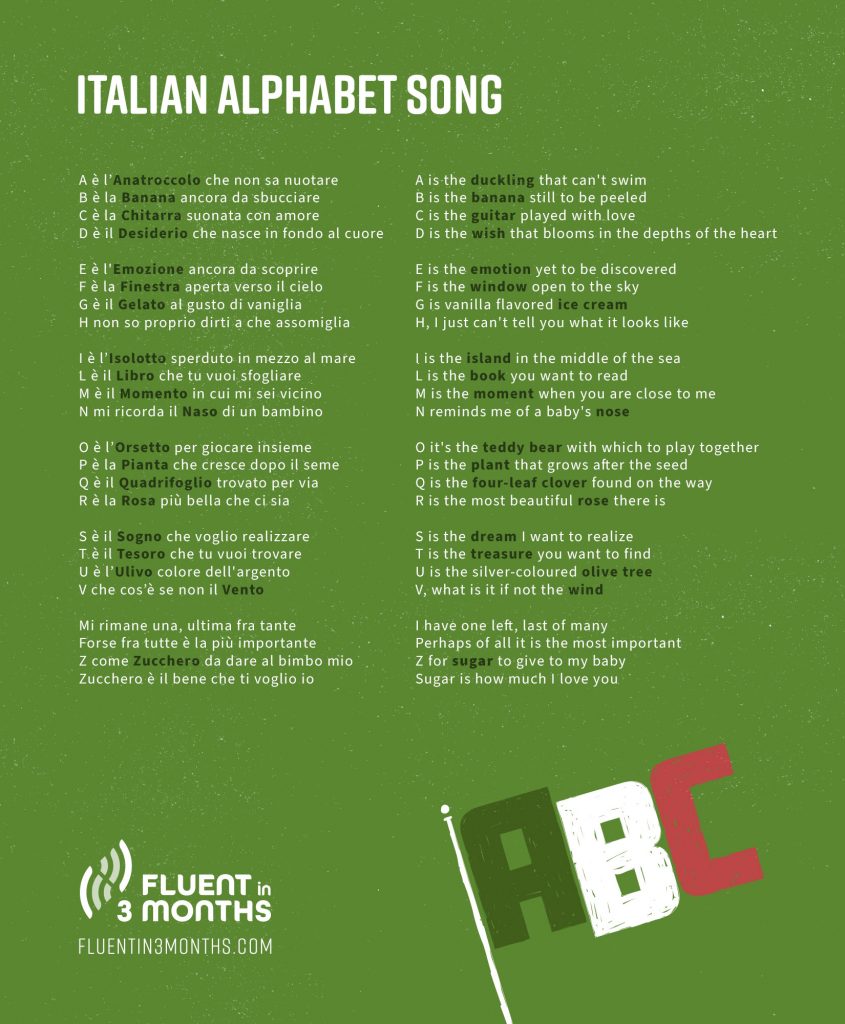
It’s quite long, and probably overwhelming for you if you’re a beginner Italian learner. I can almost hear you asking: “Doesn’t Italian have an easy ABC song?”
If you want something shorter, you can fit the Italian alphabet to the melody of the English ABC song.
You can include the five ‘extra’ letters in that version too, so you practise pronouncing all of them.
Italian Alphabet Pronunciation: Let’s Make Sense of the Italian Alphabet Sounds
Now that you’ve learnt the name of the letters, let’s go over the sounds they make.
As we saw in the introduction, Italian spelling is fairly regular. Once you know the main letter combinations, you can usually make a sensible first attempt at a new word, then check its stress and exact sounds with audio.
See what I meant when I said learning the alphabet would speed up your progress?
Let’s start by looking at the vowels.
Vowel Sounds in Italian
The sounds of the Italian vocali (“vowels”) are pretty straightforward: they’re mostly identical to the vowels’ names.
- → /a/
- and → /ɛ/ and /e/
- → /i/
- and → /ɔ/ and /o/
- → /u/
As you can see, the letter e and the letter o have two pronunciations: one more open and the other more closed.
Here are two examples of the open vowel sounds:
- (“I can”) → /ˈpɔsso/
- (“well”, or “good!” as an exclamation) → /ˈbɛne/
Note: In Italian dictionaries, the different sounds are indicated like this:
- è for the open
- é for the closed
- ò for the open
- ó for the closed
But it is not necessary to stress out over the difference just yet. It can become more marked depending on the Italian region, and as a Northern Italian myself, I don’t always strongly mark it.
Italian vowels stay recognisable, but adjacent vowel letters don’t always form separate syllables. The letters i and u can act like glides, as they do in words such as piano and uomo. Listening is still the safest way to learn where the syllables and stress fall.
Consonant Sounds in Italian
Several Italian consonants give English speakers a familiar starting point. The exact sound still depends on its position and neighbouring letters, so use the examples below as a guide rather than a one-to-one English match.
- B – (“white”)
- D – (“dice”)
- F – (“flower”)
- L – (“light”)
- M – (“hand”)
- N – (“nine”)
- P – (“door”)
- S – (“sun”) and (“house”)
- T – (“a lot”)
- V – (“voice”)
This leaves us with C, G, H, Q, R, and Z, which sound different in Italian.
The Consonants that Sound Different in Italian and English: C, G, H, Q, R, and Z
The Consonant C
In Italian, the letter C on its own can make two sounds: a hard /k/ or a soft /tʃ/. This depends on the letter that follows.
- A, O or U: /k/, as in casa, cosa and cura.
- E or I: /tʃ/, as in cena and cibo.
- CH before E or I: /k/, as in che and chilo.
- In CIA, CIO and CIU, the I usually works as a spelling marker for the /tʃ/ sound rather than a separate vowel, as in ciao.
- SC before A, O or U, and SCH before E or I: /sk/, as in scala and schiena.
- SC before E or I: /ʃ/, as in scena and scimmia.
The Consonant G
G works in a similar way to C in Italian.
- A, O or U: /ɡ/, as in gatto, gola and gusto.
- E or I: /dʒ/, as in gelato and giro.
- GH before E or I: /ɡ/, as in spaghetti and ghiro.
- In GIA, GIO and GIU, the I usually works as a spelling marker for the /dʒ/ sound rather than a separate vowel, as in giacca.
- The sequence GLI before another vowel often represents /ʎ/, as in famiglia. There are exceptions, so learn unfamiliar words with audio.
- GN represents /ɲ/, as in gnocchi and bagno.
The Consonant H
In Italian, the letter H doesn’t really have a sound.
It can either be:
- silent at the beginning of a word: (“you have”) and
- or used to modify the pronunciation of C and G, like we just saw.
The Consonant Q
In native Italian words, Q normally appears as QU and represents /kw/, as in quando and questo. It isn’t simply /k/ on its own.
The Consonant R
It was quite easy to explain the Italian sounds so far because they’re similar to English sounds, or easy enough to reproduce by English speakers. But the R is different.
If you can’t pronounce the R in (“rare”) or (“to laugh”), I’ve got the perfect guide for you.
Benny Lewis, founder of Fluent in 3 Months, put together a list of six techniques to help you roll your R.
This is also the perfect post if you’re learning Spanish, Hungarian, or any other language with a rolled R.
The Consonant Z
Italian Z can represent /ts/ or /dz/. The spelling doesn’t reliably tell you which one a word uses, so it’s best to learn the sound with the word:
- /dz/: (“backpack”) and
- /ts/: (“song”) and (“March”)
Speaking of double consonants…
Italian’s Crazy Love for Double Consonants
Double consonants are held longer than single ones, and that difference can change meaning. I hear it as a tiny hold before releasing the consonant. Some sounds are long between vowels even without doubled letters: the palatal sounds in famiglia, bagno and biscia are examples in standard Italian.
I’ll let you decide what they sound like to you:
- BB: (“we have”),
- CC: , (“hunt”)
- DD: (“goodbye”)
- FF: (“coffee”)
- GG: (“trip”)
- LL: (“rooster”)
- MM: (“mum”; US “mom”)
- NN: (“grandma”)
- PP: (“double”)
- RR: (“tower”)
- SS: (“red”)
- TT: (“cat”)
- VV: (“obvious”)
- ZZ:
There are double consonant sounds in English, too. They’re not usually within a single word, but you can hear it clearly when one word ends with the same letter that the next word begins with.
For example, the S sound in “I miss Sally” is way longer than it is in “I miss Ali”. So is the N sound in the phrase “one note” compared with “one oat”.
You may also hear a word-initial consonant lengthen after certain preceding words. This is called raddoppiamento sintattico. The pattern varies by region and follows particular grammatical and stress rules; it isn’t simply a habit of everyone in southern Italy. It affects speech, not the spelling of the separate words.
Pronunciation of the ‘Extra Five’ Letters in Italian
Here we are again with the five extra letters: J, K, W, X, and Y. But with good news!
J, K, W, X and Y mostly appear in loanwords, names and older spellings. Their pronunciation often reflects the source language, but borrowed words can be adapted in Italian, so check unfamiliar ones rather than assuming one fixed sound.
A to Z in Italian: How Italians Spell Out Words with a Phone Alphabet
If you’re going to travel to Italy, there’s something you need to know about how Italians spell out words. We’re going to talk about l’alfabeto telefonico (“the phone alphabet”).
Phone alphabets are used in other languages and countries too. You might be familiar with the NATO one, where Alfa stands for A, Bravo for B and Charlie for C.
The Italian phone alphabet is still frequently used in Italy to avoid confusing letters like and or and over the phone.
If you’re going to spell out your name to make restaurant reservations or you’re giving someone the name of the street where you’re staying, you might want to learn which words Italians associate with each letter of the alphabet.
Here’s a table of choices you may hear. There are regional and personal alternatives, so you don’t need to treat it as one fixed official list:
| Letter | Phone alphabet |
|---|---|
| A | Ancona |
| B | Bari |
| Bologna | |
| C | Cagliari |
| Como | |
| D | Domodossola |
| E | Empoli |
| F | Firenze |
| G | Genova |
| H | hotel |
| I | Imola |
| L | Livorno |
| M | Milano |
| N | Napoli |
| O | Otranto |
| Oristano | |
| P | Padova |
| Palermo | |
| Q | Quebec |
| Quarto | |
| R | Roma |
| S | Salerno |
| Sassari | |
| Savona | |
| T | Taranto |
| Torino | |
| U | Udine |
| V | Venezia |
| Z | Zara |
You can use the phone alphabet for the five extra letters too. Unlike most examples for the traditional 21 letters, several of these choices aren’t cities:
| Letter | Phone alphabet |
|---|---|
| J | simply i lunga |
| Juventus | |
| Jesolo | |
| K | simply kappa |
| Kenya | |
| kursaal | |
| W | Washington |
| X | xilofono |
| Y | yogurt |
Wow, this all looks like a lot. Don’t worry, you don’t have to learn all of them now!
I’ve Learnt The Italian Alphabet – What’s Next?
Now that you’ve learnt all about the Italian alphabet, you’ll be much more confident in your Italian reading, writing, and speaking.
Just think about it! Pronouncing the 500 core Italian words? Easy peasy. And because you’ll find it easier to pronounce them, you’ll remember them better.
And if you’re working with a language tutor, you’ll be able to understand what they say quicker because you’ll recognise the sounds they use to form words.
So, well done for deciding to learn the Italian alphabet!
If the regular spelling patterns have made Italian feel more approachable, read why Italian may be easier than you think. Then use the Italian learning hub for more grammar, vocabulary and culture.
To complement your learning, you could use one of Benny Lewis’s favourite resources to learn Italian. As the founder of Fluent in 3 Months, he’ll only give you il meglio del meglio (“the best of the best”).
Alright, I’ll leave you to it.
Ciao!

Social