



KoreanClass101 Review: Is It the Best Way to Learn Korean?

Full disclosure: This post contains affiliate links. ?
What is KoreanClass101?
KoreanClass101 is part of the Innovative Language family, built to get you understanding and speaking Korean from the very first lesson. Audio and video lessons taught by native speakers are its main feature.
- what it’s for:
- First contact with Korean, listening practice, vocabulary, the Hangul alphabet, pronunciation (the sound-change rules), and phrases and conversation material
- languages:
- Korean
- level:
- Absolute Beginner to Advanced
+ PROS
- Teaches the Hangul alphabet properly from day one
- Loads of native-speaker audio, exactly what Korean’s spelling-vs-sound gap needs
- A guided learning path, so there’s no guessing where to begin
- Honorifics and speech levels taught in context through real dialogues
- Excellent for building vocabulary, with a 2,000-word core
- Genuinely affordable, with a free tier and a 60-day guarantee
- CONS
- Grammar isn’t drilled in sequence, so particles, honorifics and word order need a companion resource
- Some older lessons have too much English chit-chat
- Upsell banners and marketing emails
- Best as an audio-and-vocab engine, so pair it with a grammar reference
- The mobile app doesn’t have all the best features
Quick Fire Review
A brilliant audio-and-vocabulary engine for Korean that teaches Hangul properly and trains your ear for its tricky pronunciation; pair it with a grammar resource for honorifics and word order. 4.5/5.
Korean is one of the hardest languages an English speaker can pick up. The US Foreign Service Institute puts it in its top “super-hard” category, alongside Japanese, Chinese and Arabic, and reckons it takes around 2,200 class hours to reach professional fluency. So when you choose your main Korean resource, you want one that actually deals with the things that make Korean Korean, not a generic app that treats it like Spanish with different letters.
I've been reviewing the Innovative Language “101” courses for a while now (you might have seen my SpanishPod101 and JapanesePod101 reviews), and most of the Fluent in 3 Months team have leaned on these podcasts for their own language missions, myself included. KoreanClass101 is the Korean member of that family.
So this review sets out to answer one question: does KoreanClass101 handle the bits of Korean that trip everyone up?
What Makes Korean So Different (and Where a Course Has to Earn Its Keep)
Before we get to the platform itself, let's be clear about what you're actually signing up to learn. These are the five things that make Korean genuinely different from a European language, and they're the yardstick I'll measure KoreanClass101 against.
1. Hangul, the writing system. Good news first: this is the easy hard part. Unlike Chinese with its thousands of characters, Hangul is an alphabet of just 24 basic letters, first designed in 1443 to be learnable by anyone. Most people can read it, slowly, after an hour or two, and comfortably within a week. If you want a head start, we've got a full guide to the Korean alphabet. Any decent Korean course should get you off romanisation and reading real Hangul almost immediately.
2. Pronunciation that doesn't match the spelling. This is the sneaky one. Korean has a set of sound-change rules where letters shift depending on what's next to them. The formal “to be” form, 입니다, is written ip-ni-da but spoken im-ni-da. 학교 (“school”) is written hak-gyo but spoken hak-kkyo. 같이 (“together”) comes out as ga-chi. These changes are completely regular once you know the rules, but they're invisible on the page, so you need a course with loads of native audio, not just text.
3. Honorifics and speech levels. In Korean, politeness is baked into the grammar itself. You speak differently to a friend (반말, casual) than to a stranger, an elder or your boss (존댓말, polite/formal). It's not just a “tu/vous” swap; the verb endings change. Get the level wrong and you sound rude or weirdly stiff. Even saying hello in Korean changes depending on who you're talking to. This is one of the biggest hurdles for English speakers, because English simply doesn't work this way.
4. Backwards word order and particles. Korean is Subject-Object-Verb: the verb always lands at the end of the sentence (“I lunch ate” rather than “I ate lunch”). Instead of relying on word order to show who did what, Korean tags each word with a little particle: 은/는 marks the topic, 이/가 the subject, 을/를 the object, 에/에서 location. Once those click, sentences stop feeling like a jumble. Until then, they feel like a puzzle.
5. Two completely separate number systems. Korean has two sets of numbers, native Korean (하나, 둘, 셋…) and Sino-Korean (일, 이, 삼…), and you have to know which to use when. Native numbers for counting things, your age, and the hour; Sino-Korean for dates, money, minutes and phone numbers. Then there are “counters”, special words you add depending on what you're counting (people, animals, flat objects…). It's the kind of thing that feels baffling at first and then becomes automatic (our guide to Korean numbers breaks down which system to use when).
Keep those five in mind. Here's how KoreanClass101 stacks up against them.
Getting Started with KoreanClass101
Like the rest of the 101 family, KoreanClass101 is built around audio and video lessons taught by native speakers, organised into level-based pathways: Absolute Beginner, Beginner, Intermediate, Upper Intermediate and Advanced.
Signing up is painless. You create a free lifetime account with just an email (no card needed) and pick your level. Not sure where you sit? Choose Absolute Beginner; you can move later. New accounts also get a 7-day Premium trial, so you get a proper taste of the paid features before deciding anything.
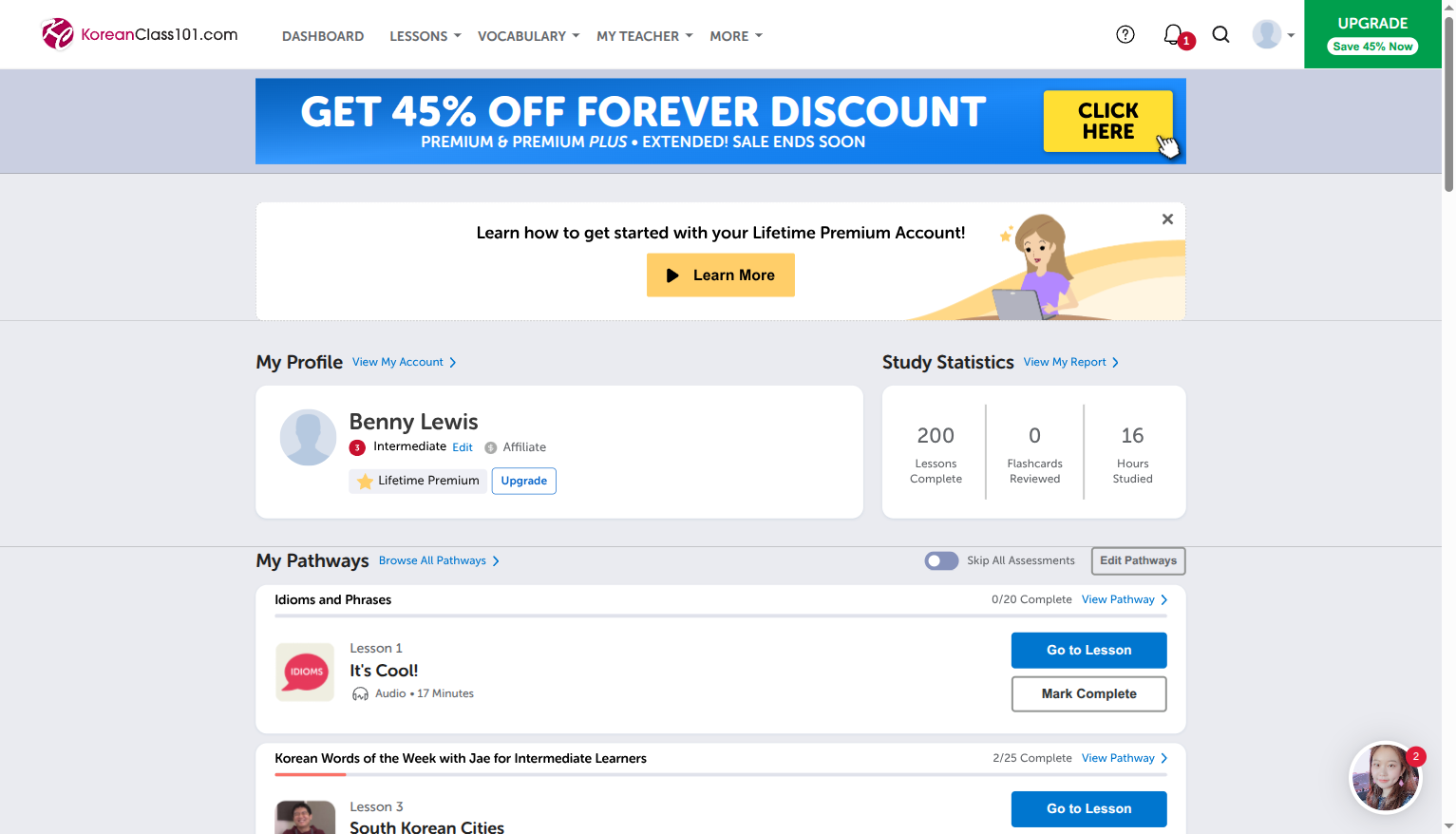
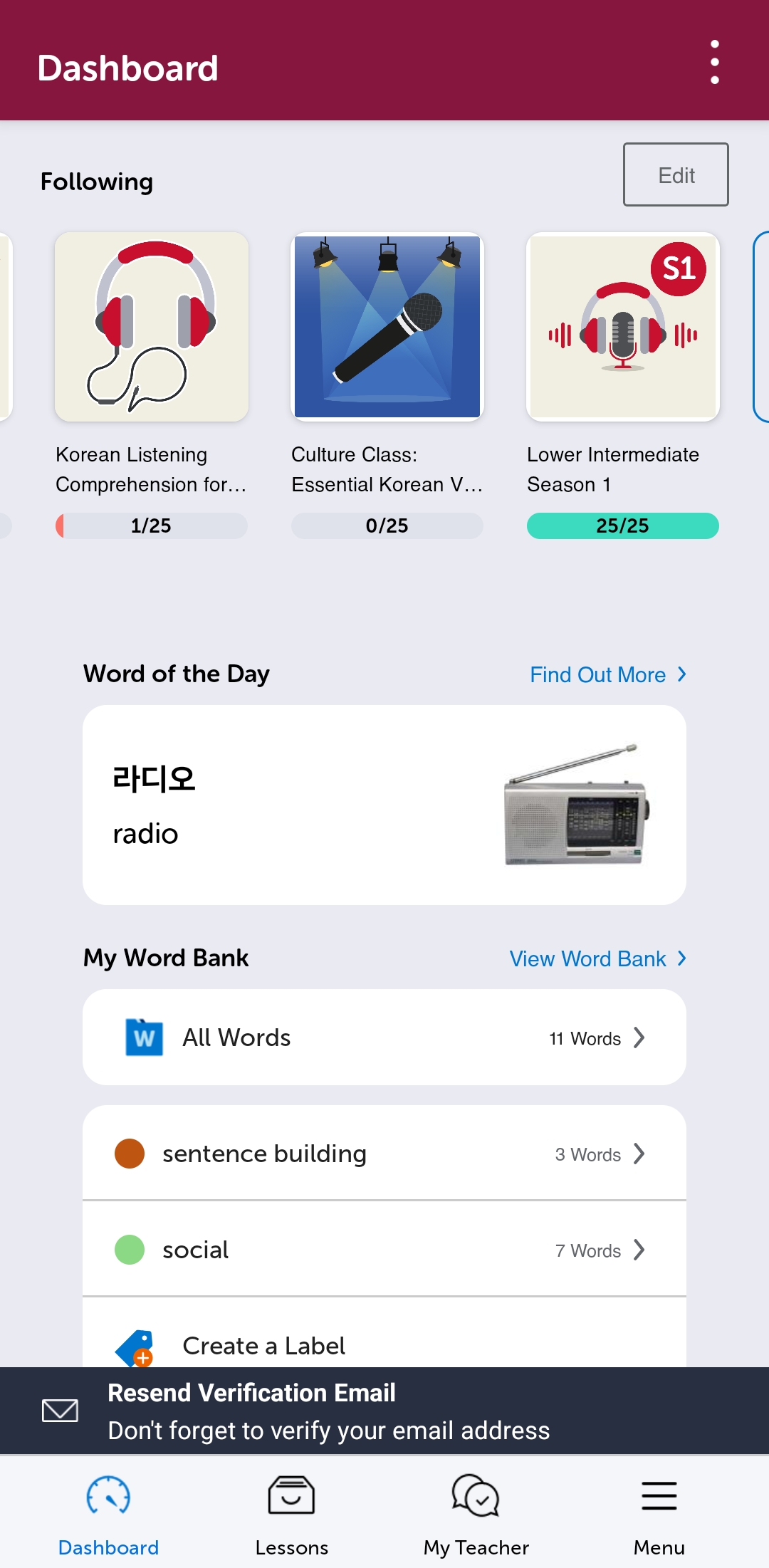
Once you're in, your dashboard hands you a learning path for your level, so you're not left staring at a library of a thousand lessons wondering where to start. That guided pathway is one of the platform's biggest strengths; the absolute beginner track alone runs to a long series of short lessons with built-in assessments.
Does It Teach Hangul Properly?
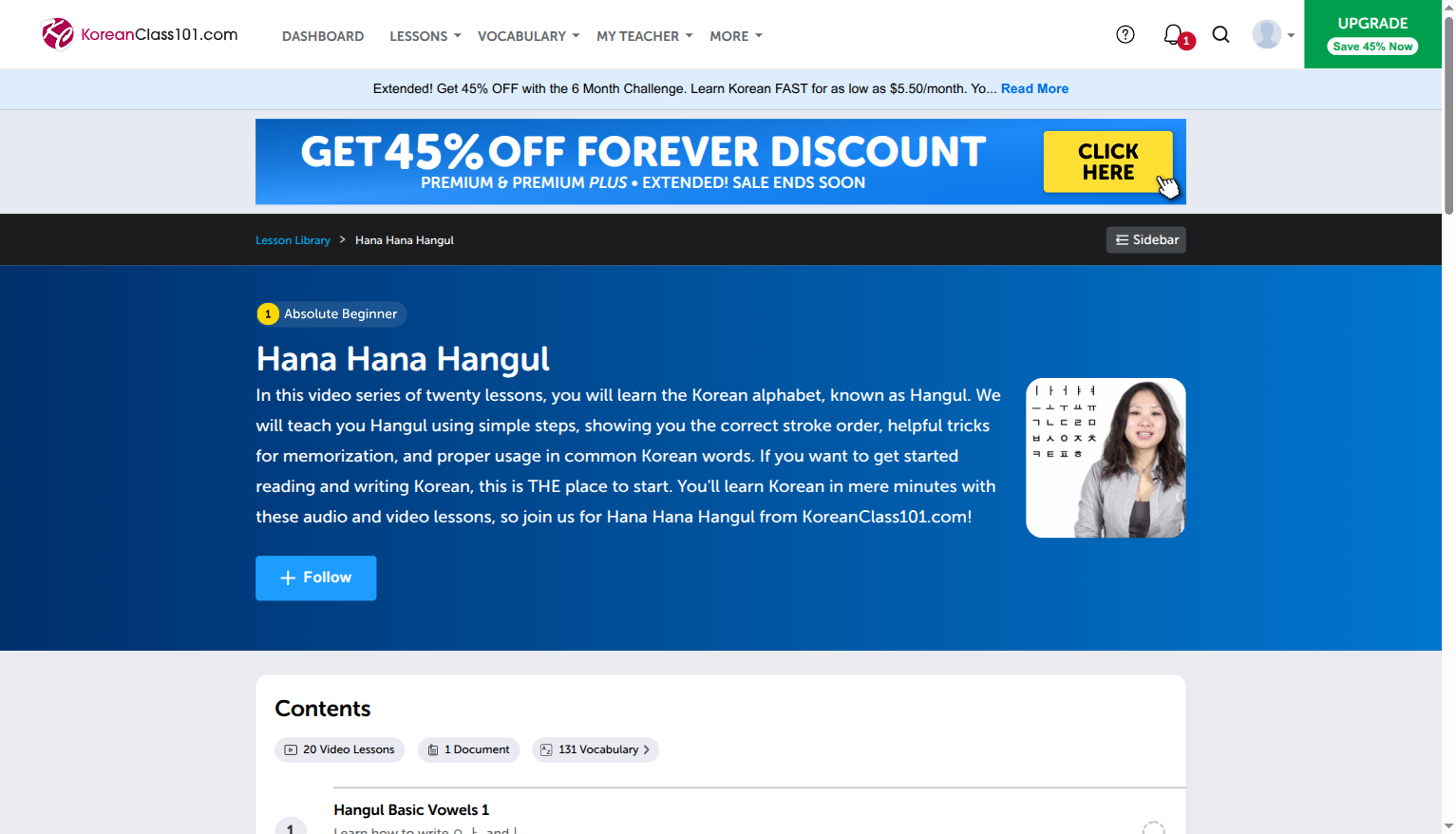
Yes, and this matters, because some courses lazily lean on romanisation for months. KoreanClass101 has a dedicated “Hana Hana Hangul” series that walks you through the alphabet and the syllable-block system from scratch, plus a free Hangul eBook and practice sheets and an “Ultimate Korean Pronunciation Guide.” They teach the script properly from the start rather than hiding it behind English spellings.
The pronunciation side is where the audio format really pays off. Because every lesson is built on native-speaker recordings with slowed-down, line-by-line playback, you actually hear those sound-change rules in action, so that 입니다 → im-ni-da shift becomes something you absorb by ear instead of memorising from a table.
Inside a KoreanClass101 Lesson
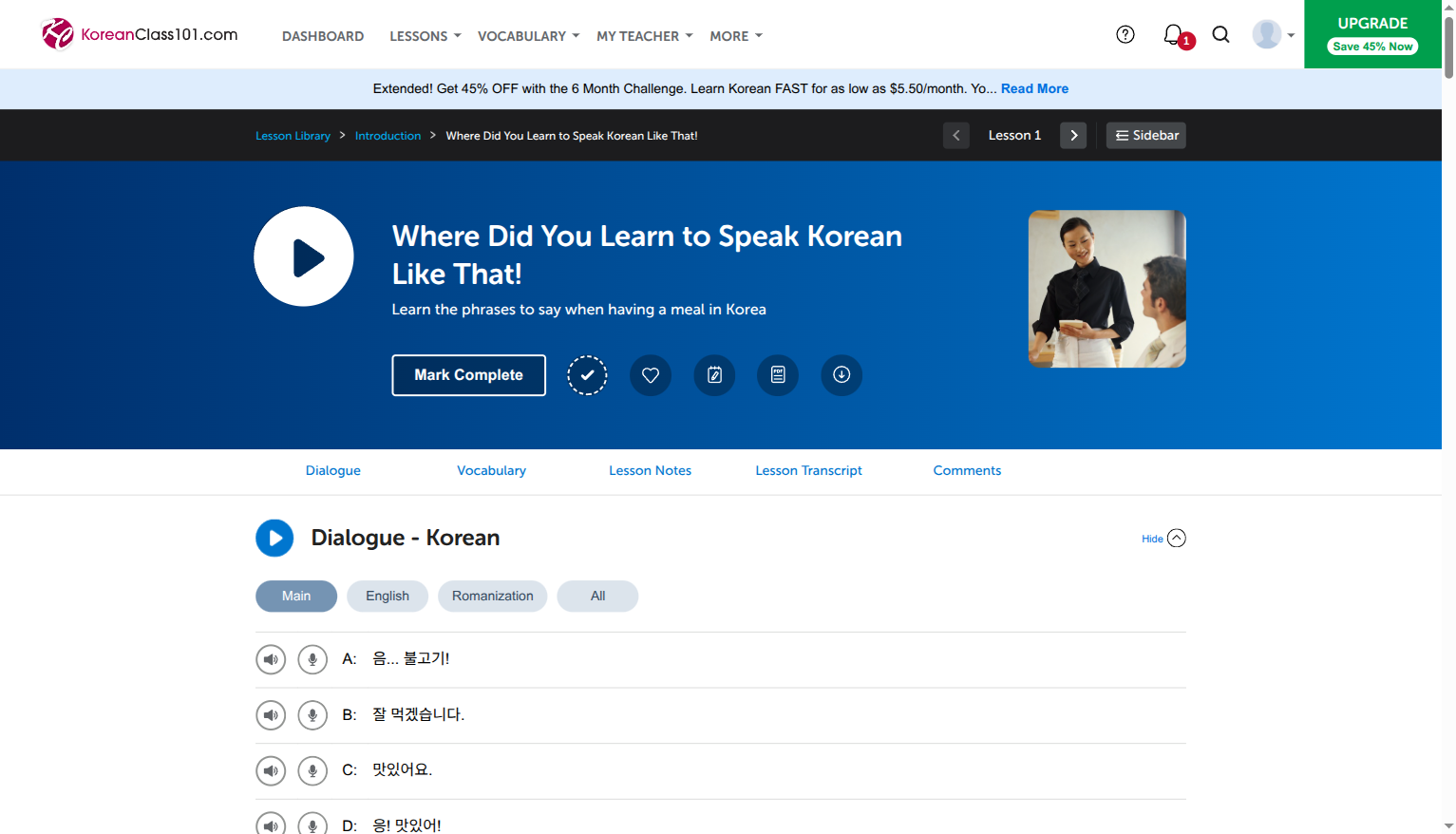
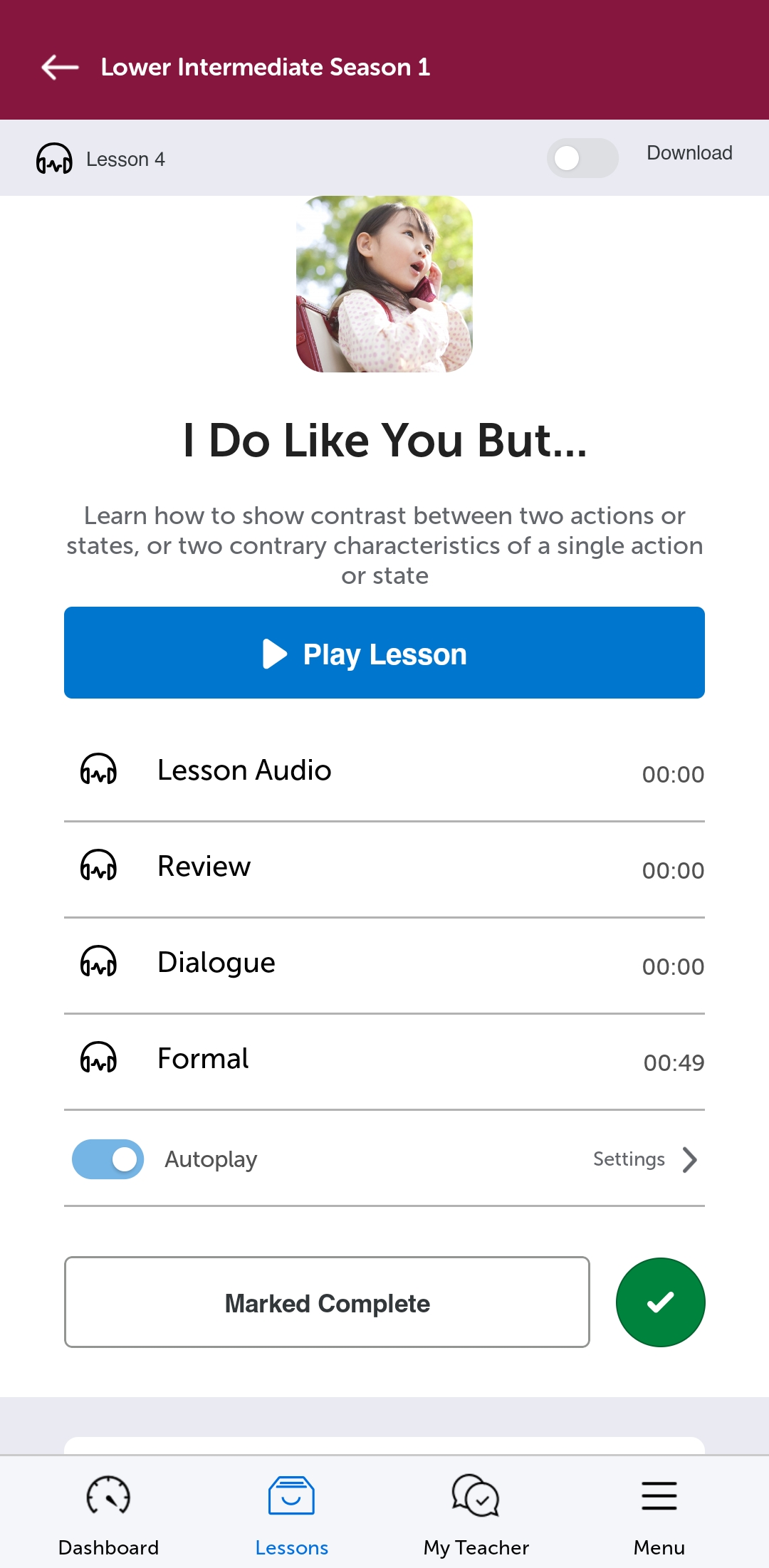
A typical lesson is short (most run 3 to 15 minutes) and follows a consistent shape: a native dialogue, a slow breakdown, vocabulary with natural-then-slow pronunciation, a grammar point, and a culture note. You get the audio, the full scripted dialogue, a vocab list, and downloadable lesson notes (a PDF) that dig into the grammar and cultural context.
This format is well suited to Korean's quirks. The dialogue-first approach drip-feeds honorifics in context: you hear casual vs polite endings used in real situations rather than as an abstract grammar rule, which is by far the easiest way to internalise them. The lesson notes are where the particles and SOV word order get unpacked, and the recurring cultural segments are a natural home for things like the politeness rules around speech levels.
The Study Tools
On a Premium plan, the lessons are wrapped in a solid set of study tools:
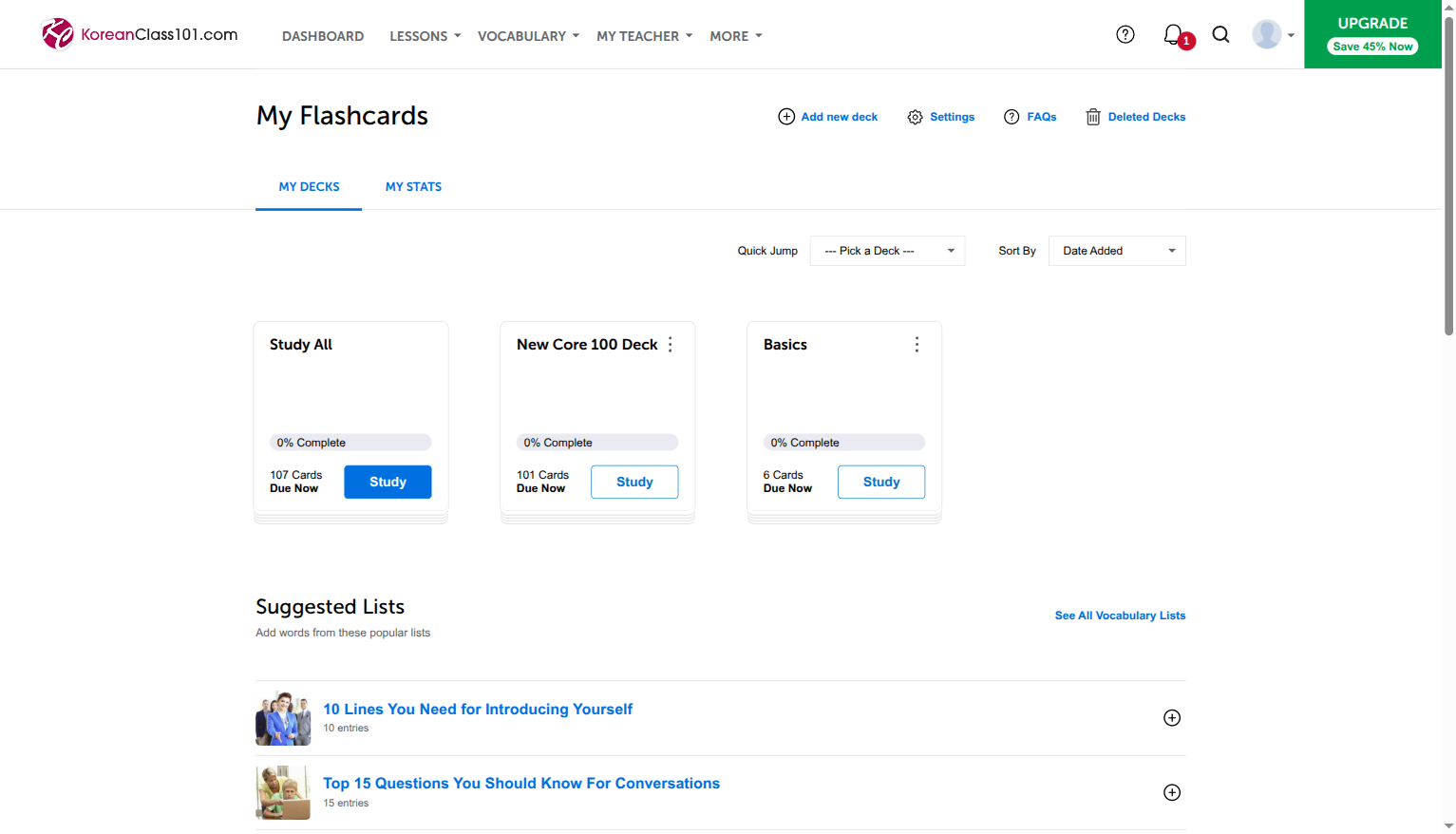
- Spaced-repetition flashcards and a personal word bank, where you add words straight from any lesson, which is perfect for hammering home Korean vocabulary (more on why that matters below).
- A grammar bank collecting the grammar points in one place.
- Multiple-choice assessments to check you've actually absorbed a section.
- A pronunciation tool that records you and lets you compare against the native audio, handy for those batchim sound-changes.
- 2,000 core words and phrases as a ready-made vocabulary backbone.
The Mobile App
There's an Innovative Language app that syncs with your account, so lessons you finish on your laptop show as done on your phone. It's clean and handy for listening on the go, exactly how loads of people use these courses, as a podcast for the commute.
The same caveat applies as on the other 101 courses, though: the app is a slightly stripped-back version of the website. You can't always follow your structured study path inside the app, and some of the best web features aren't fully there. The workaround is the same one I use elsewhere: pull the site up in your phone's browser when you want the full experience.
What Other Korean Learners Say
I dug through a stack of reviews and Korean-learning forums to double-check my own take. A few clear patterns came up.
The praise is consistent on two points. First, vocabulary breadth. Learners repeatedly say KoreanClass101 exposes you to far more varied vocabulary than grammar-focused alternatives. As one put it, it “introduced a lot more different vocab,” whereas some rivals “kept using the same exact words for the sake of illustrating grammar.” Second, the listening input: the short, digestible audio lessons make it an easy daily habit, and several learners credit the beginner pathways with getting them to the point of actually holding a conversation.
The criticism is consistent too:
- Some of the lessons, especially older ones, have too much English chit-chat around the Korean. The fix is simple: focus on the dialogue and vocab segments.
- KoreanClass101 is best thought of as a brilliant vocabulary-and-listening engine rather than your one-and-only resource. Many learners pair it with a dedicated grammar resource (Talk To Me In Korean is the usual companion) for the heaviest grammar explanations, and use it alongside an app like Anki for review. That's simply how most people use it.
Pricing and Plans
KoreanClass101 runs the same four-tier structure as the rest of the family:
| Plan | Roughly… | What you get |
|---|---|---|
| Free | Free forever | First 3 lessons of every series, Survival Phrases, Word of the Day, 100+ vocab lists, the app, plus a 7-day Premium trial |
| Basic | ~$4/mo | Everything free + access to all lessons and in-depth lesson notes |
| Premium | ~$5–10/mo | Everything in Basic + flashcards, word bank, line-by-line audio, assessments, grammar bank, pronunciation tool, 2,000 core words |
| Premium PLUS | ~$13–23/mo | Everything in Premium + your own teacher, hand-graded assessments and personalised guidance |
A few honest notes on the pricing. The headline per-month figures you see are based on the longest (24-month) plan, so the actual price depends on the billing period you choose; check the checkout. Innovative also runs a more-or-less permanent discount (the exact amount varies), so you should rarely if ever pay the “full” list price. And like the other 101 sites, you'll get a fair few upsell banners nudging you towards the higher tiers, mildly annoying but easy to ignore. There's a 60-day money-back guarantee, which takes the risk out of trying Premium.
For most people, Premium is the sweet spot: that's the tier where the flashcards, pronunciation tool and full lesson features live. Premium PLUS only makes sense if you specifically want a teacher checking your work.
Pros and Cons
Pros
- Teaches Hangul properly from day one with a dedicated alphabet series, no endless romanisation.
- Huge amount of native audio, which is exactly what Korean's spelling-vs-sound gap demands.
- A guided learning path so you're never guessing what to study next.
- Excellent for vocabulary, consistently the thing learners praise most.
- Honorifics and speech levels taught in context through real dialogues, the easiest way to absorb them.
- Affordable, with a usable free tier and a 60-day guarantee.
Cons
- Some older lessons are chatty, with more English than you'd like.
- Upsell banners crop up around the platform.
- Best as a vocabulary-and-listening engine, ideally paired with a dedicated grammar resource for the heaviest grammar work.
- The app is a lighter version of the full website.
Who KoreanClass101 Is (and Isn't) For
It's a brilliant fit if you're an absolute beginner who wants a clear, guided path from Hangul upward; someone who learns well by ear and wants Korean in your headphones on the commute; a K-drama or K-pop fan who wants real, usable Korean with cultural context; or anyone who wants to build a big vocabulary fast.
It's less ideal if you want a single resource that drills grammar mechanics above all else. In that case, use KoreanClass101 for vocabulary and listening, and bolt on a grammar-focused companion.
The Verdict
KoreanClass101 does the most important thing right: it takes Korean's specific challenges seriously. It teaches you to read Hangul early, it floods your ears with the native audio you need to crack Korean's tricky pronunciation, it slips honorifics in through real dialogue, and it builds vocabulary better than almost anything else out there. It's not a do-everything grammar bible, but as the audio-and-vocabulary core of your Korean study, it's hard to beat for the price.
My rating: 4.5 out of 5.
If you want to give it a go, you can start with KoreanClass101 here. Going through that link applies a discount automatically, so you won't pay the full list price. Set up a free account, take it for a spin, and see if learning Korean by ear clicks for you.

Social