


Mandarin Chinese Tones: A Practical Beginner’s Guide

Full disclosure: This post contains affiliate links. ?
Mandarin Chinese tones are pitch patterns that help distinguish one spoken syllable from another. Standard Mandarin has four lexical tones plus a neutral tone, and you need to learn each new syllable with its tone.
That description is more precise than saying “Chinese has five tones”. Cantonese, Hokkien, Shanghainese and other Chinese languages and varieties have their own tone systems. This guide is about Standard Mandarin.
You already vary pitch when you speak English, although English does not normally use lexical tone to distinguish words in the same way. The new skill is learning to hear and produce Mandarin pitch patterns as part of each syllable, then adapting them in connected speech.
A note from the Fluent in 3 Months team before we get started: You can chat away in Chinese for at least 15 minutes with the “Fluent in 3 Months” method. All it takes is 90 days. Tap this link to find out more.
Table of contents
- What Are the Tones in Standard Mandarin?
- Tone #1: High and Level, ā or a1
- Tone #2: Rising, á or a2
- Tone #3: Low or Dipping, ǎ or a3
- Tone #4: Falling, à or a4
- Neutral Tone: Light and Unstressed, a
- Why Do Mandarin Tones Matter?
- How Tones Change in Connected Mandarin
- How to Remember Mandarin Tones
- Speak Before Your Tones Are Perfect
- Mandarin Tone Practice: Imitate Short Audio
- Practise Tone Pairs in Real Words
- Listen Actively and Repeatedly
- Get Specific Feedback on Your Mandarin Tones
- A Seven-Day Mandarin Tone Routine
What Are the Tones in Standard Mandarin?
The four lexical tones are conventionally described as high level, rising, low or dipping, and falling. Pinyin can show them with a mark over a vowel, as in ā, á, ǎ, à, or with a number after the syllable, as in a1, a2, a3, a4. A neutral-tone syllable normally has no tone mark.
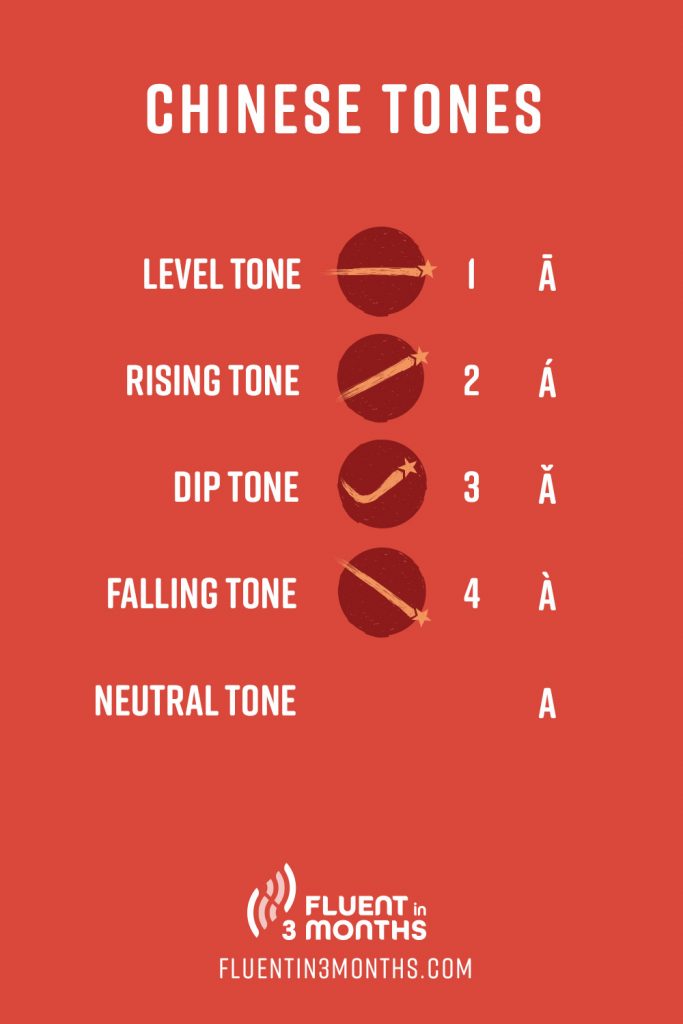
The lines show relative movement within your own comfortable pitch range. You do not need perfect pitch or a musical singing voice. A lexical tone is a pitch pattern across a syllable, not a fixed musical note.
These chart shapes are citation forms: clear versions used when a tone is pronounced alone. Normal speech compresses and adjusts them, especially the third and neutral tones.
Tone #1: High and Level, ā or a1
Start near the top of your comfortable speaking range and keep the pitch level: mā or ma1. The defining feature is the high, even contour, not an artificially long vowel.
Tone #2: Rising, á or a2
Begin around the middle of your range and rise towards the top: má or ma2. Listen for a continuous rise rather than two separate pitch steps.
Tone #3: Low or Dipping, ǎ or a3
In isolation or at the end of a phrase, the full third tone can fall into the bottom of your range and rise again: mǎ or ma3. In most connected speech before a non-third-tone syllable, it stays low and does not complete the final rise.
This “half third tone” is not careless speech. It is a normal realisation of the category. The University of Texas Pitch Perfect Pinyin guide provides examples of full and half third tones.
Tone #4: Falling, à or a4
Start high and fall decisively towards the bottom of your range: mà or ma4. Keep the movement inside one syllable rather than adding a separate low sound.
Neutral Tone: Light and Unstressed, a
The neutral tone is written without a tone mark. Pronounce the syllable lightly and briefly; its pitch is conditioned by the preceding syllable rather than simply matching that syllable's tone. Common examples include the second syllable of 妈妈 māma (“mum”) and particles such as 吗 ma and 的 de.
Some teaching tools label this “tone 5” or “tone 0”, but it is not a fifth fixed contour parallel to the four lexical tones.
Why Do Mandarin Tones Matter?
A syllable's tone can distinguish different morphemes and characters. The familiar ma set shows the contrast clearly:
- 妈 mā: “mum”
- 麻 má: “hemp”
- 马 mǎ: “horse”
- 骂 mà: “to scold”
- 吗 ma: a yes-no question particle
Tone is only one part of the information a listener uses. Mandarin has many homophones, so even a syllable-plus-tone combination can correspond to several characters and meanings. Sentence context usually resolves the difference. The practical lesson is to learn the tone with the syllable and word, not to expect one wrong contour to turn every sentence into nonsense.
How Tones Change in Connected Mandarin
A pinyin syllable consists of a final, an optional initial and a tone. In 你 nǐ, n is the initial, i is the final and the caron marks the third tone.
The citation tone is the category you memorise. The surface pronunciation can change with neighbouring syllables, a process called tone sandhi.
- Two third tones: when two third-tone syllables occur together, the first is normally pronounced with a rising second-tone contour. Standard pinyin writes 你好 as nǐ hǎo, while a simple pronunciation guide may show the surface form as ní hǎo.
- Third tone before another category: it is normally realised as a low “half third tone”, without the full final rise.
- 不 bù: before another fourth tone, it is pronounced bú. For example, standard spelling bù shì (不是, “is not”) is pronounced bú shì.
- 一 yī: it is pronounced yí before a fourth tone, as in 一共 yígòng (“altogether”), and yì before a first, second or third tone, as in 一天 yì tiān (“one day”). It keeps yī when isolated and in uses such as the ordinal 第一 dì-yī (“first”).
Standard pinyin normally writes the underlying tone rather than respelling a contextual tone change, so dictionaries may show nǐ hǎo, bù shì, yīgòng and yī tiān. Pronunciation-focused materials sometimes mark the surface tones to help beginners. China's official pinyin orthography rules state that ordinary tone marking uses the original tones, while pronunciation teaching may mark changes when useful.
Longer strings of third tones depend on word and phrase structure, so the two-syllable rule is a foundation rather than a complete algorithm for every sentence.
How to Remember Mandarin Tones
The pinyin marks are useful contour reminders: level ā, rising á, dipping ǎ and falling à. They do not tell you everything about timing, stress or connected speech, so pair the written form with audio.
Learn a complete item such as 马 mǎ, not an unmarked ma followed by a separate fact called “tone three”. On a flashcard, include the characters, marked pinyin, meaning, audio and a short example phrase. Colour can be a useful extra cue, but it should support the tone mark rather than replace it.
When typing without diacritics, tone numbers are a practical fallback. Be consistent: write ma1, ma2, ma3, ma4, and follow your dictionary's convention for neutral tone.
Speak Before Your Tones Are Perfect
I like the phrase “imperfect consistency”. I use it in fitness, and it applies here too. Waiting for flawless tones postpones the conversations that can show you what to practise next.
That does not make tones optional. Begin with short, prepared sentences, say them at a manageable pace and ask for one specific correction. Context can help a listener, but clear initials, finals, tones and rhythm all contribute to understanding.
Mandarin Tone Practice: Imitate Short Audio
Whenever you learn a word, listen to it inside a short phrase. A dictionary recording gives you a clear model; a sentence shows how the tone behaves next to other tones.
- Listen without looking at the pinyin.
- Look at the marked pinyin and identify the tone sequence.
- Replay one phrase and imitate it immediately.
- Record your version without speaking over the model.
- Compare the pitch movement, timing and final consonants, then try again.
Pleco is a practical Chinese dictionary option with pronunciation audio. Community-recording sites can add more voices, but recording quality and speaker variety differ, so do not treat every clip as an equal reference model.
Practise Tone Pairs in Real Words
Single tones are only the start. Practise two-syllable words that cover different combinations, including first-to-fourth, fourth-to-first and third-to-third. Use audio made for the exact word so you learn natural timing as well as the ideal contour.
Work with five pairs at a time. Mark the underlying tone numbers, listen for the surface pronunciation, and record each pair inside a short sentence. You can choose familiar items from our list of core Chinese words.
Listen Actively and Repeatedly
Background Mandarin can make the language feel more familiar, but focused repetition is more useful for learning tones. Choose a clip of 10 to 20 seconds, follow its transcript and listen several times for one feature.
On one pass, notice third tones. On another, listen for neutral syllables. Then shadow the whole phrase without trying to label every pitch movement in real time. Our lists of Chinese cartoons and Chinese-language films can help you find engaging material, although streaming availability changes by region.
Get Specific Feedback on Your Mandarin Tones
A teacher can tell you whether a problem comes from pitch, vowel quality, an initial, stress or timing. Ask for targeted feedback: “Which syllable was unclear?”, “Did that third tone stay low enough?” or “Can you record the whole phrase once at natural speed?”
For low-pressure conversation rehearsal, Teacher AI lets you practise with an AI version of Benny. Use a qualified teacher or trusted Mandarin speaker when you need a careful diagnosis of your tone production.
You can find a tutor through Preply; our Preply review explains the service in more detail. Our guide to choosing an online language teacher can help you compare candidates. A language exchange partner is another option, but agree in advance that you want direct pronunciation corrections.
A Seven-Day Mandarin Tone Routine
For one week, choose five useful two-syllable words with audio. Each day, listen, mark the underlying tone pair, imitate the word, record it in a sentence and compare. On day seven, use all five words in a short conversation and ask for feedback on the least clear syllable.
You are training several linked skills: hearing a category, producing its contour, adjusting it in context and retrieving the whole word while speaking. Improvement comes from repeating that cycle, not from memorising a chart once.


Social