


85 Cute Nicknames from Around the World (with Translations)

Full disclosure: This post contains affiliate links. ?
Looking for cute nicknames for your girlfriend, boyfriend, or kids? Here’s your master list of cute nicknames from around the world.
Pumpkin, peanut, bubby, baby, babe, bae, honey, darling, sugar, sweetie, honeybunch… English is packed full of fun, creative, and cute nicknames to call your loved ones.
From food to animals, to just plain gibberish words – lots of us love giving a cute nickname to our significant other, family, friends, and children.
And it's not just English. In every language, people have terms of endearment to show their love and affection. Learning these can add new depth to your language learning – especially if you're learning a language to speak with loved ones.
Learning pet names is also a fun way to expand your vocabulary, and it develops your cultural understanding. Many of the words used as nicknames reflect social relationships and are intertwined with the values of a particular culture.
Let's get into it! Here are some cute nicknames from around the world.
Before we get into the article, if you are interested in learning any of these languages yourself, you should know that I’ve created a bunch of digital products to help with many aspects of language learning, and run a coaching program (Bootcamp) that has had many aspiring learners take part and successfully speak after 3 intensive months.
You can see that I have specific courses for beginners struggling with Spanish, French, German, Italian, English and Chinese.
Please do check out these offerings, since I have put a lot of work into all of these, and I know they’ll make a huge difference to your language learning project! Thanks for considering, and now, back to the article:
Cute English Nicknames
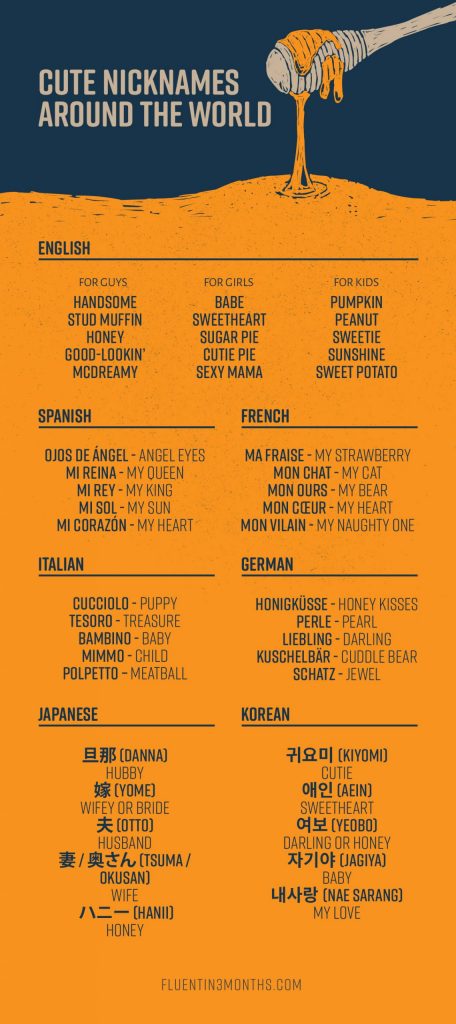
Starting with English, which is rich with cute and crazy nicknames for your significant other.
I listed some off at the beginning of this article, but here are some other cool nicknames:
For the guys:
- Handsome
- Boo
- Stud
- Stud muffin
- Bae
- Babe
- Honey
- Casanova
- Good-lookin’
- Sexy
- McDreamy
For the girls:
- Baby
- Babe
- Beautiful
- Love
- Darling
- Sweetie
- Cutie pie
- Boo
- Bae
- Sweetheart
- Sugar pie
- Pumpkin
- Peach
- Sexy mama
And for kids:
- Bub
- Bubby
- Buddy
- Pumpkin
- Peanut
- Sweetie
- Cutie
- Baby
- Sunshine
- Sweet potato
Examples of how to use them:
- “Hey babe, can you come here?”
- “‘Sup, sexy mama.”
- “Bubby, eat your food.” (To a child, obviously.)
Cute Spanish Nicknames
Spanish is known as a passion-infused language, so there's no shortage of cute nicknames in Spanish!
There are some creative Spanish nicknames, such as mi perrito (“my puppy”), mi cielito (“my little heaven”), and amorcito (“little love”).
Some more cute couple nicknames:
- Media naranja – “My better half” or literally, “half an orange”
- Ojos de ángel – “Angel eyes”
- Mi reina – “My queen”
- Mi rey – “My king”
- Mi sol – “My sun”
- Mi vida – “My life”
- Mi corazón – “My heart”
Spanish has plenty of cute nicknames for girls and boys, too. The most popular are:
- Chiquito / chiquita – “Little boy” and “little girl”
- Chulo / chula – “Cutie”
- Chica / chico – “Kid” / “girl” / “guy” (This one can also be a nickname for friends!)
Examples of how you can use them:
- Hola, chica – “Hey, girl”
- Ven aquí, mi chiquito – “Come over here, little one”
- Eres mi media naranja. Te amo – “You're my better half. I love you”
You can also learn other romantic phrases to show your love in this Spanish article.
Cute French Nicknames
You can hear loads of these said aloud in this video on romantic French words and phrases to show your love:
The French have tons of affectionate pet names they call each other. But some of them are a little less cute when translated into English.
Nicknames like mon saucisson (“my sausage”), mon petit chou (“my little cabbage” but used like “sweetie”), mon gros (“my fat one”), and ma puce (“my flea”) are a bit strange in English.
I don't know about you, but being called a flea doesn't sound all that affectionate!
Other affectionate names include:
- Ma fraise – “My strawberry”
- Mon amour – “My love”
- Mon ange – “My angel”
- Ma chérie or mon chéri – “My darling” (for a woman or a man, respectively)
- Mon chat – “My cat”
- Ma belle – “My beautiful”
- Mon trésor – “My treasure”
- Mon bijou – “My jewel”
There are so many different ways to address your loved ones in French!
For guys, there are endearing terms like:
- Mon prince – “My prince”
- Mon ours – “My bear”
- Mon loup – “My wolf”
- Mon râleur – “My grumpy one” (If your husband is on the crotchety side, you could tenderly call him this)
Looking for good nicknames to use for your kids? Try:
- Mon bébé – “My baby”
- Mon doudou – “My cuddly thing”
- Mon cœur – “My heart”
- Mon petit monstre – “My little monster”
- Mon vilain – “My naughty one”
Some are gentle endearments; others are teasing. Pick one the other person actually likes, especially with names that mention size or appearance.
Try expressing your love with phrases like:
- Je t'aime, ma belle – “I love you, my beauty”
- C'est mon petit monstre – “He is my little monster”
- Merci, mon loup. – “Thank you, my wolf”
Cute Italian Nicknames
Let's face it, who wouldn't want to be whispered sweet nothings in Italian? Italy is known for being warm and affectionate, and their nicknames help infuse that affection into the language.
In Italian, “Amore mio!” means “My love”. You can shorten it to Amore, or the informal Amo. Another affectionate option is “Vita mia!” – “My life”.
Italian pet names called nomignoli are used freely and often for everyone, especially for children. Here are some examples:
- Cucciolo – “Puppy”
- Tesoro – “Treasure”
- Bambino – “Baby”
- Mimmo – “Child”
- Polpetto – “Meatball”
Some of these have feminine forms: cucciolo becomes cucciola, and bambino becomes bambina. But don't change every final -o to -a: tesoro stays tesoro even when you're talking to a woman.
With your significant other, you can use romantic Italian terms like:
- Gioia mia – “my joy”
- Biscottino – “little biscuit”
- Pasticcino – “little pastry”
You can even passionately exclaim, “Luce dei miei occhi!” (“Light of my eyes!”) when you see your loved one — although that's often used more as a joke.
As for cute Italian nicknames for friends, you can use:
- bella / bello – “beautiful” (for women and men respectively)
- cara / caro – “dear”
- zia / zio – “aunt” or “uncle”
Some people will only call their closest friends these terms, while others refer to everyone with pet names like these.
Try them out in sentences like:
- Pensando a te, amore mio – “Thinking of you, my love”
- Sei bellissima, cara – “You're beautiful, dear”
- Sei il mio mondo, topolino – “You're my world, little mouse”
Cute German Nicknames
There's a surprising number of ways to express your affection and Liebe auf Deutsch.
Granted, some German expressions may seem a bit odd to call someone. One of the most common and popular nicknames for women is Maus or Mäuschen, which translates to “mouse” and “little mouse.” It's common to hear a man call his wife or girlfriend that.
Even more interesting, the Germans have created their own hybrid animal nickname, which I personally love: Mausebär (“mouse bear”). Adorable, right?
Other good terms of endearment for your boyfriend or girlfriend:
- Schnuckiputzi – “Sweetie” or “cutie-patooty”. (It’s a hybrid word, from schnuckelig and putzig, which mean “cute” and “sweet”.)
- Honigküsse – “Honey kisses”
- Zuckerbienchen – “Little sugar bee”
- Perle – “Pearl”
- Liebling – “Darling”
- Kuschelbär – “Cuddle bear”
Cute nicknames for children are:
- Erdbeerchen – “Little strawberry”
- Bärchen – “Little bear”
- Schatz – “Jewel” or “treasure”
German also uses diminutive endings such as -chen and -lein. They can make a word sound small or affectionate, but you can't attach them to every nickname and expect a natural result.
Try them out with phrases like:
- Ich liebe dich so sehr, Honigküsse: “I love you so much, honey kisses”
- Mein Schatz, komm hilf mir: “My jewel, come help me”
- Du bist der Beste, Schnuckiputzi: “You're the best, sweetie”
Cute Japanese Nicknames
Japanese has plenty of nicknames, but the name you use depends on how well you know someone.
A common polite choice is a family name plus -san. For example, Tanaka-san can refer to Mr or Ms Tanaka.
So when it comes to expressing love, affection, and friendship in Japanese, using a given name can be one sign of closeness.
Family and close friends often use given names. With someone you've just met, ask what they'd like you to call them instead of assuming a familiar form is welcome.
Age and seniority can affect the choice, but the person's own preference matters too.
A nickname can certainly be とてもかわいい (totemo kawaii, “very cute”).
A common example is shortening a celebrity's name: Hikki for Utada Hikaru, MatsuJun for Jun Matsumoto of Arashi, and Maririn and Meetan for Mariko Shinoda and Megumi Ohori, known from AKB48.
You may also hear a shortened name with -chan or -kun. The playful -tan has a more baby-talk feel.
-chan is used for children and close friends, not just girls. -kun is often used for boys or male peers and juniors. Neither is a universal rule, and -tan isn't a general-purpose neutral alternative.
You'll also hear these words for spouses. Some are affectionate, while others are ordinary words for talking about your husband or wife, not pet names to call them:
- 旦那 (danna) – “Hubby”
- 旦那さん (dannasan) – “Husband”; -san adds respect, not automatically cuteness
- 嫁 (yome) – “wifey” or “bride”
- 夫 (otto) – “Husband”
- 妻 or 奥さん (tsuma or okusan) – “Wife”
- ダーリン (daarin) – “darling”
- ハニー (hanii) – “honey”
Examples of how you can use them:
- おはよう、ともちゃん (Ohayou, Tomo-chan): “‘Morning, Tomo-chan!” (Nickname for a friend, Tomoyo)
- 夫は今夜料理しています (Otto wa konya ryouri shite imasu): “My husband is cooking tonight”
- ハニー、大好きだよ (Hanii, daisuki da yo): “Honey, I love you”
Cute Korean Nicknames
Here's a short video on expressing love in Korean, so you can hear how these sound:
In Korean, age, closeness and the situation all affect how you address someone.
Save familiar nicknames for people who are comfortable with them. They can be a lovely way to show love and affection in Korean!
A lot of times in K-dramas, you'll hear couples use affectionate names and relationship words like:
- 귀요미 (gwiyomi) – “Cutie”
- 애인 (aein) – “Sweetheart” or “partner”, usually when talking about someone rather than calling to them
- 여보 (yeobo) – “Darling” or “honey”, mainly between spouses
- 자기야 (jagiya) – “Baby”
- 내 사랑 (nae sarang) – “My love”
- 오빠 (oppa) – “Older brother”, also used by women for a close older man, including an older boyfriend or husband
- 왕자님 (wangjanim) – “Prince”
- 공주님 (gongjunim) – “Princess”
You may hear 찡찡이 (jjingjjingi, “whiner”) as a teasing nickname. It isn't limited to girls, and it can sound insulting if the person doesn't enjoy the joke.
You can even call out the affectionate greeting, “안녕, 내 사랑!” (annyeong, nae sarang!, “hello, my love!”)
Ways to use these Korean pet names:
- 여보, 난 당신을 사랑합니다 (yeobo, nan dangsineul saranghamnida): “Honey, I love you” (a formal-sounding declaration)
- 나의 아름다운 공주님 (naui areumdaun gongjunim): “My beautiful princess”
- 이봐 귀요미 (ibwa gwiyomi): “Hey cutie” (very informal; the opening can sound abrupt)
Now Go Use These Cute Nicknames With Your Loved Ones!
I hope these nicknames from around the world will help you get more speaking practice with loved ones and build deeper relationships!
Gathering romantic words for someone special? Our Valentine's vocabulary guide has plenty more to sweet-talk with.
After all, what's more enticing to practise speaking than when you can see someone's reaction to a lovely new nickname? So start sweet-talking away!

Social