



How to Say “My Love” in French (Plus 28 More Romantic French Words and Phrases)

Full disclosure: This post contains affiliate links. ?
Are you wondering how to express your love in French? It's no secret that French is widely considered to be one of the most romantic languages with many romantic expressions. For example, “my love” in French is mon amour.
Even if you don't know what French-speakers are saying, the sound of the language is just beautiful to listen to.
The pronunciation rules mean that phrases always flow smoothly from one word to the next. Even non-French speakers routinely use romantic-sounding French phrases to endear themselves to their beloved: ma chérie, je t'adore, and (not exactly “romantic” per se) voulez-vous coucher avec moi ce soir. 😉
So, what are some other romantic French words and phrases you can learn as you take your first steps into the language of love? Read on for a guide to the romantic side of French.
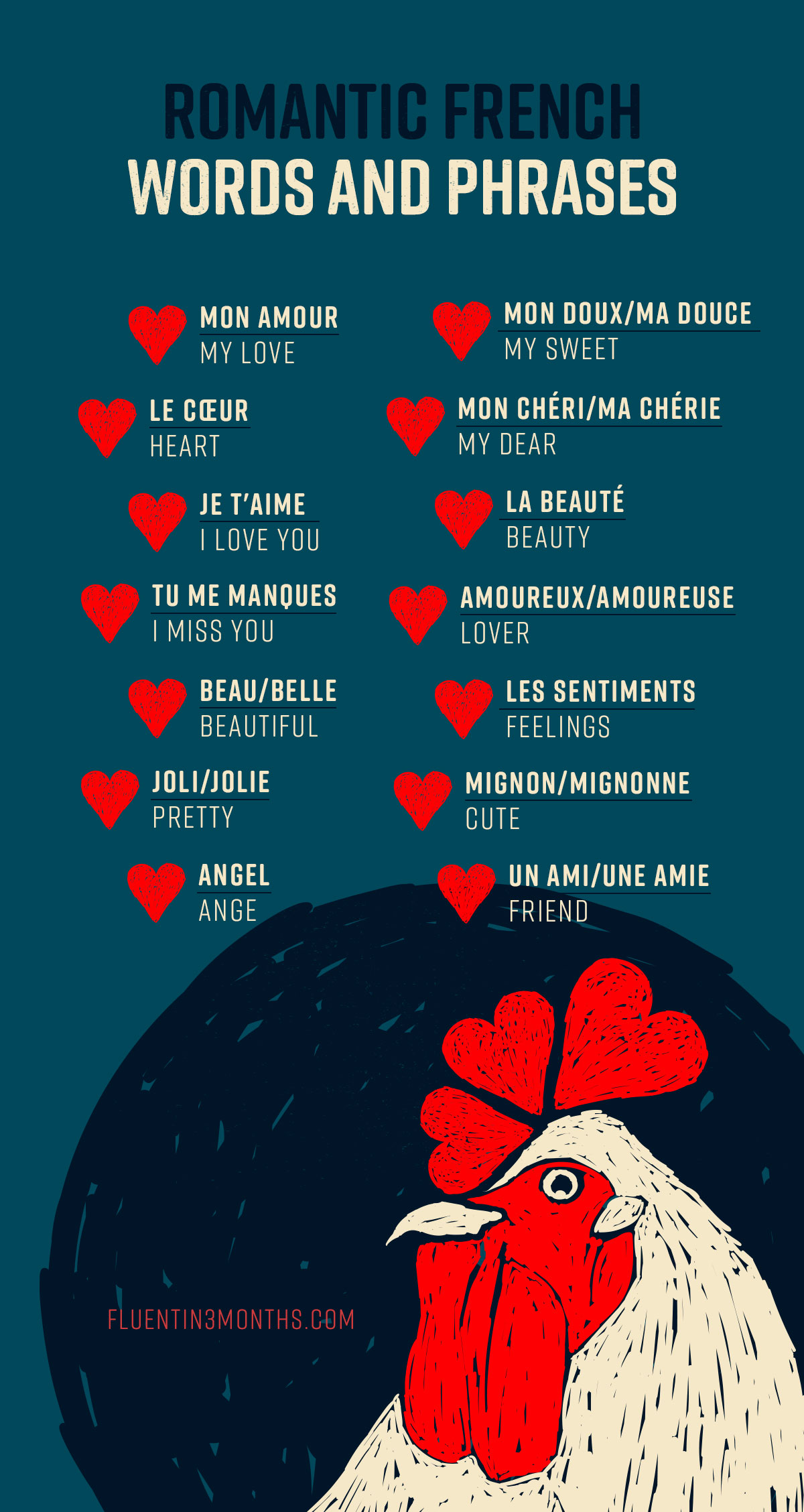
Here’s your quick guide:
- “My love” – mon amour
- “My dear” – mon chéri/ma chérie
- “I love you” – Je t'aime
- “I miss you” – Tu me manques
- “Beautiful” – beau/belle
- “Beauty” – la beauté
- “Pretty” – joli/jolie
- “Cute” – mignon/mignonne
- “Friend” – un ami/une amie
- “Heart” – le cœur
- “Feelings” – les sentiments
- “Lover” – amoureux/amoureuse
- “My sweet” – mon doux/ma douce
- “Angel” – ange
Here's a quick video I made on the topic, so you can hear these words pronounced:
Keep reading for an in-depth overview.
Editor's note: Before we get started, if you’re looking for an online French course, here’s the course we recommend: French Uncovered – Learn French Through the Power of Story, a course with a fascinating new method by Olly Richards. You can try it for free for 7 days!
Before we get into the article, if you are interested in learning French yourself, you should check out my absolute favourite resource for learning French, FrenchPod101.

For all language projects I’ve taken on, this has been by far my favourite resource, since it’s a podcast style learning resource that covers many aspects of the language much better than traditional courses do.
It also tackles the issue of listening comprehension better than literally anything else out there, since its catalogue of lessons eases you in with simple lessons at first that get progressively harder, and you can listen to them for a huge range of topics better suited to your hobbies and interests.
They have a free option for anyone who wants to test them out, based on just their limited recent episodes, but exclusively for Fi3M readers, you can get 20% off if you sign-up for any of their subscriptions, which allow you to access their full catalogue of many hundreds of lessons, using the code FLUENT3.
I highly recommend this to all French learners!!
How to say “My Love” in French
There aren't many French terms of endearment more romantic than mon amour, which means “my love” in French.
Is it ma amour or mon amour? Whether you're speaking to a man or a woman, the term is the same: mon amour.
Mon is the masculine singular form of “my”, and amour is a masculine noun whoever you're speaking to. You also generally use mon instead of ma before a feminine singular word beginning with a vowel or a silent h, as in mon amie.
So if you wanted to say something romantic like “Good morning, my love” in French, you’d say “Bonjour mon amour”.
Another term you're sure to hear often in French-speaking countries is mon chéri (said to men) and ma chérie (said to women). This means “my dear” or “my darling”, and is a more general term than mon amour.
Just like in English, it can be used for other close loved ones besides your romantic partner.
How to say “Beautiful” in French
In English, the word “beautiful” has distinct feminine connotations. In French, both men and women are “beautiful”.
The masculine word for “beautiful” in French is beau (or bel immediately before a masculine singular noun starting with a vowel or a silent h), and the feminine is belle.
The masculine form is usually translated as “handsome” in English when referring to a man. In other instances, both beau and belle can translate as “beautiful”.
For example, a beau pont in French would translate to English as a “beautiful” bridge, not a “handsome” bridge.
Beau and belle aren't much use unless you put them into a sentence. Here are a few sample romantic phrases containing these words:
- “You are beautiful”: Tu es beau (to a man) and Tu es belle (to a woman).
- “Hello, beautiful”: Bonjour mon beau (to a man) and Bonjour ma belle (to a woman). This phrase isn't generally as common in French-speaking countries as it is in English countries.
- “Life is beautiful”: La vie est belle.
How to say “Beauty” in French
This one is easy. The English word for “beauty” comes directly from French: la beauté.
One of the most popular expressions about beauty is that it is in the eye of the beholder. The French translation of this universal phrase is La beauté est dans l'œil de celui qui regarde.
How to say “Pretty” in French
“Pretty” in French is joli for men or jolie for women.
Like “beautiful”, joli/jolie doesn't have to apply only to feminine people and objects. Use joli with a masculine singular noun and jolie with a feminine singular noun; an object's grammatical gender doesn't depend on how masculine or feminine it looks.
A good mnemonic for joli/jolie is to think of the very pretty actress Angelina Jolie.
How to say “Cute” in French
I don't know why, but I find mignon/mignonne, the French word for “cute”, a really, well, cute word.
In France, you can use mignon/mignonne pretty much how you would use “cute” in English: to describe a cute animal, toy, or even a cute guy or girl you like.
In Quebec, mignon/mignonne can mean cute or adorable, and you'll also hear an English borrowing in casual conversation.
There's no rule against using mignon for someone you find attractive, but this informal Quebec alternative will sound familiar:
Cute!
No, really. Cute is a very popular loan word in Quebec, and you can use it just like “cute” in English.
How to say “Sexy” in French
Speaking of loan words, the French language has borrowed the English word “sexy”, and the translation is the same: sexy! You can use it exactly how you would use it in English.
How to say “Heart” in French
The French word for “heart” is le cœur.
There's a real connection between cœur and English “courage”, which came through an older French word for heart. Cordial, accord and the musical sense of chord also connect to Latin cor, meaning heart, though they took different routes into English. Cardio- comes from Greek kardia, and the origin of “core” is uncertain, so don't assume they all came from modern French cœur.
You can still use the heart in “courage” as a mnemonic when you're trying to remember the French word!
A popular term of endearment in English is “my heart”. In French, this translates as mon cœur or sometimes mon petit cœur (“my little heart”).
You can say it to a romantic partner or to a child you're close to, such as a grandchild or niece/nephew. The masculine noun cœur stays the same whoever you're addressing.
How to say “Party” in French
There are a couple of ways to say “party” in French.
As a noun, the “proper” way to say “party” is la fête. For example, a birthday party is une fête d'anniversaire and a Christmas party is une fête de Noël.
Informally in Quebec, you can use the English loan word le party (which itself was originally borrowed from French!).
It's pronounced differently from English though: it sounds more like the 90s slang word “partay”.
You can use le party the same way as the English “party”.
In France, the familiar everyday choices are fête or soirée. Don't turn the Quebec borrowing into a rule that every English “party” becomes la party in French.
Best to just stick with la fête in France.
How to say “Friends” in French
The feelings between friends can vary from a casual liking to platonic intimacy, and all the way to romantic love (consider how many people say they married their best friend). So of course a post about love in French should include the word for friends!
The French word for “a friend” is un ami (for male friends) or une amie (for female friends).
The plural “friends” is les amies (for a group of female friends) and les amis (for a group of male friends or a mixture of both).
What's interesting though is that the word generally used for “a boyfriend” un copain or “a girlfriend” une copine can also commonly mean “friend”.
When you say “my” (mon/ma) before the word then it is more likely to be the more intimate version!
To say “my friend” in French, it's mon ami or mon amie. You can't say ma amie even if your friend is a girl, because the two words will clash on the vowels and sound awkward.
And a romantic language like French must never be awkward!
How to say “Feelings” in French
The general French word for “feelings” is les sentiments (“a feeling” is un sentiment).
In English, “feelings” can be used informally to mean “affectionate” or “romantic” feelings. For example, if you tell someone, “I have feelings for you,” they can infer that it's not just any old feelings, but a feeling of attraction.
This works in French too: J'ai des sentiments pour toi means “I have feelings for you” and can express romantic interest. Context tells the other person which feelings you mean.
These phrases express different kinds of liking, so choose one that matches what you mean:
- Je te trouve très bien – “I think you're really nice” (a positive opinion, not necessarily romantic)
- Je t'aime bien – “I like you” (often friendly rather than romantic, whereas je t'aime means “I love you”. That little bien can make quite a difference!)
- Tu me plais – “I like you” (literally, “You please me”)
How to say “Amazing” in French
You have several good ways to translate “amazing” into French. The best choice depends on whether you mean surprising, impressive or simply wonderful.
For example, “amazing” could translate as étonnant, which translates back to English as “astounding”.
Incroyable and stupéfiant can also work, with meanings close to “incredible” and “staggering”, respectively.
Here are some French words to choose from, depending on the kind of amazement you want to express:
- Incroyable – “incredible” (in my unscientific personal experience, this appears to be the most common way to say “amazing” in French)
- Surprenant – “surprising”
- Étonnant – “astounding”
- Exceptionnel – “exceptional”
- Stupéfiant – “staggering” (I would put this down as one of the rarer translations of “amazing”)
In English, “amazing” usually has positive connotations. It doesn't just mean surprising, it can also mean “surprisingly great” or “fantastic”.
Here are a few ways to express this idea in French:
- Super – “super” (but much more common in French than in English. This can be an adjective – Tu es super! – or an adverb, such as “Tout est super génial!”)
- Génial – “great” (also very common)
- Fantastique – “fantastic”
- Magnifique – “magnificent”
- Merveilleux – “marvellous”
- Extraordinaire – “extraordinary”
How to Say “Hot” in French
You'll have guessed that “hot” is a slang word in English when it describes someone's appearance. Like many slang words, “hot” doesn't translate directly to French.
Trust me on this. Don't ever say il est chaud / elle est chaude to describe a good-looking guy or girl.
It doesn't mean “he/she is hot”. It doesn't even mean “he/she feels hot” when it's a hot day outside (that would be il/elle a chaud).
It can suggest sexual arousal or willingness. In other contexts, being chaud can mean being keen or ready to do something, so listen for the context. It isn't a reliable translation of “good-looking”!
So, what if you want to describe someone as hot-looking in French? Well, sexy, mentioned earlier, is a pretty reliable term that expresses the same thing.
But sometimes you don't want to come right out and use the “S-word”. In France, you can also use the slang word “canon“, which applies equally to a man or a woman: il est canon or elle est canon.
French Terms of Endearment
Besides the French words and phrases listed above, there are other ways to express your love and affection. Here are some favourites, with a couple of playful nicknames that need a bit of context. Ange means “angel”; when you're addressing someone affectionately, use mon ange, “my angel”.
- “My dear” – mon chéri/ma chérie
- “I love you” – Je t'aime
- “I love you, too” – Je t'aime aussi
- “I miss you” – Tu me manques
- “Lover” – amoureux/amoureuse
- “My sweet” – mon doux/ma douce
- “Angel” – ange
- “Sweetie” – mon petit chou
- “My strawberry” – ma fraise (a playful nickname you could invent between yourselves, not an established French term of endearment)
- “My jewel” – mon bijou
- “My bear” – mon ours (a personal nickname that can suggest a grumpy bear; mon nounours, “my teddy bear”, sounds cuddlier)
- “My baby” – mon bébé
By the way, you can learn more cute French words and French nicknames in this article (as well as others from around the world). And if you're planning something romantic, our Valentine's words and phrases have you covered in plenty of languages.
How to Say “Farewell” in French
There are two main ways to say “farewell” in French, and I love them both.
The first is au revoir. It's the everyday word for “goodbye” in French that you'll hear all the time.
But it doesn't simply mean “goodbye”; it's much more eloquent than that. The most accurate translation of au revoir is “until we meet again”. I like this expression. It communicates hope that you'll see each other again one day, even if you're saying au revoir for a long time.
The other word is adieu, which often suggests a long or final parting. It comes from a shortened religious farewell meaning “I commend you to God” (à = “to” and Dieu = “God”). In everyday conversation, au revoir is usually the safer choice if you expect to see someone again.
Whether or not you believe in a deity, you can appreciate that history, but the modern word may sound far more final than a warm “see you later”.
And on that note, au revoir, dear reader, rather than adieu! Until we meet again.


Social