



5 French Writing Exercises to Build Your Skills

Full disclosure: This post contains affiliate links. ?
Writing in French can feel difficult because it asks you to choose vocabulary, grammar and spelling at the same time.
Writing is one of the four essential language skills, and it improves through repeated practice and useful feedback.
You do not need to produce a polished essay every day. A journal entry, a short paragraph or even a careful to-do list can give you something concrete to revise.
The goal is not endless mental endurance. It is to make the task small enough to repeat, then notice what you want to improve.
I studied French at college in the American South. Some of my favourite classes put me beside students who were more experienced and less afraid to take risks.
Feedback from my professors was especially useful. I valued their notes on my homework, even when a page came back covered in corrections or an entire sentence received an incisive “I do not understand”.
They were helping me become a better writer.
After four years, I received a scholarship to work at a digital media company in France. When college ended, I wondered how I would keep progressing without the steady immersion of classroom discussions and professional work.
I still read, write and follow the book market in France. I cannot interact in French every day, but writing gives me a regular connection to the language. A 300-word draft also gives me far more to learn from than a blank page.
These five strategies helped me write more fluidly, but none requires a French degree or a move abroad. If you study independently while working or raising children, scale the exercises to the time you have.
You will make mistakes. Draft first, then use a reliable reference or another person’s feedback to understand the ones that matter.
Choose one strategy for this week, and give yourself a small piece of French writing to return to.
Editor's note: Before we get started, if you’re looking for an online French course, here’s the course we recommend: French Uncovered – Learn French Through the Power of Story, a course with a fascinating new method by Olly Richards. You can try it for free for 7 days!
Strategy #1: Keep a Journal in French
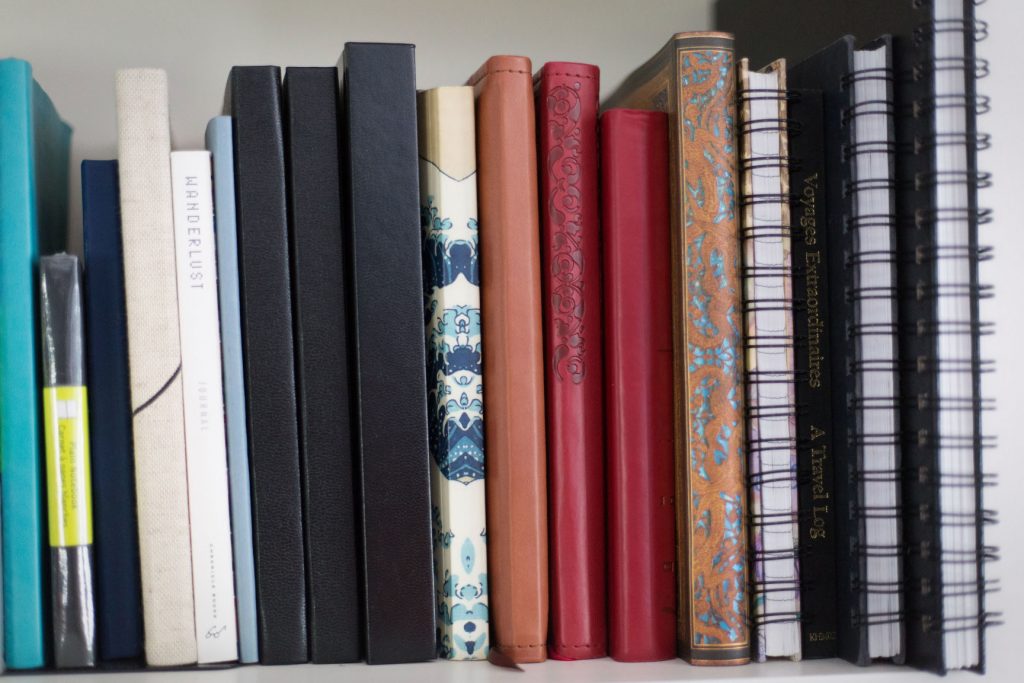
A journal gives you a place to write about daily life without turning every entry into an assignment. Use paper or a digital document, whichever makes it easier for you to keep going.
Make the setup convenient. Keep a working pen with the notebook, or create one easy-to-find file on your computer. The format matters less than reducing the friction between wanting to write and starting.
I recommend dating your entries. Later, you can see how your vocabulary and sentence length have changed, or return to an older topic when you do not know what to write.
If a blank page feels intimidating, begin with three prompts: What happened today? How did I feel? What will I do next?
Write about your mood, activities, reading or weekend plans. Familiar subjects let you practise forms such as the passé composé for completed events and the futur proche for plans without first inventing a complicated story.
This is a draft, not a graded exercise or a formal email. Mark a word you cannot recall and keep moving; you can check it afterwards.
Here is a line from a French journal entry I wrote in 2018:
Caro m’a appris le verbe « klaxonner » quand elle parlait des fêtes après la Coupe du monde.
“Caro taught me the verb klaxonner, ‘to honk’, when she was talking about the celebrations after the World Cup.”
I connected a new verb with my friend Caro and a particular event. That personal association still helps me remember klaxonner. A dictionary can help after the draft, but stopping for every unknown word can break your train of thought.
Strategy #2: Use Simple French Vocabulary
Suppose you want to describe a snowstorm and a frantic trip to the grocery store. You can practise past tenses without reproducing every elaborate expression you would use in English.
This is where circumlocution helps: describe an idea with words you already know when the precise term is missing. You can look for a more exact expression during revision.
Instead of translating an English sentence word for word, ask what the sentence needs to communicate. Then choose a simpler French route.
That may mean dividing one crowded sentence into two. It may also mean replacing an idiom with a plain verb whose grammar you understand.
Simple language is not careless language. It gives you room to check agreement, tense and word order before adding less familiar vocabulary.
For example, instead of forcing “The grandmother made a mad dash for the milk like a football player charging towards the end zone”, write La grand-mère a marché très vite pour aller chercher du lait. (“The grandmother walked very quickly to get some milk.”) The image is less elaborate, but the main action remains clear.

Strategy #3: Try the 5-Word Method
This strategy begins with reading. Constant dictionary checks can make a French book feel like a sequence of interruptions, so choose when to read for flow and when to investigate vocabulary.
Underline or note unfamiliar words and keep reading for a set time or a manageable number of pages. Afterwards, choose five words that seem useful or keep recurring.
Check each word’s meaning, gender or verb pattern, register and a real example sentence. Mix parts of speech. You might choose an adverbial phrase such as avec joie (“joyfully”) or a conjunction such as tandis que (“while” or “whereas”).
Now write a short paragraph using the five items. Do not contort every sentence just to fit them in: if one does not belong, write a separate example and try it again another day.
Strategy #4: Use Online References Carefully
WordReference provides French–English dictionary entries, conjugation tools and community forums. Use dictionary entries to check meanings and grammatical information. Forum answers can illuminate usage, but they are discussions by users rather than an automatic mark of authority, so compare the explanation with the entry and context.
Linguee shows bilingual examples gathered from published texts. It can help you see how a phrase appears in context, but the sources and translations vary in quality. Treat the examples as evidence to compare, not sentences to copy without checking.
Online references work best as part of revision. For feedback on a complete paragraph, ask a teacher, tutor or proficient French speaker what sounds unclear and why. Keep the correction beside your original so you can see the pattern.
Strategy #5: Write To-Do Lists, Book Reviews and Goals in French
This final strategy brings the others into daily life. Once you have tried journalling, circumlocution, the 5-word method and careful reference checks, give French a few small jobs outside a study session.
Write a grocery list in French to retrieve food vocabulary. Summarise a book in three sentences, then add one sentence giving your opinion. A short recurring task is easier to review than a long piece you never revisit.
You can also write your goals: Mon écriture progresse de jour en jour. Je lis énormément. Je me fixe comme objectif de lire quatre livres par mois. (“My writing is improving day by day. I read a great deal. I’m setting myself the goal of reading four books a month.”) Choose one sentence of your own today, then return tomorrow and add another.

Social