


How to Say Friend in French

Full disclosure: This post contains affiliate links. ?
The most common word for “friend” in French is ami. When it refers to a woman, it becomes amie: un ami is a male friend and une amie is a female friend.
French has a few other common choices. Copain and copine are informal words for a friend you spend time with, although mon copain or ma copine can also mean “my boyfriend” or “my girlfriend.” Pote is a more colloquial option, rather like “pal” or “buddy.” Its spelling stays the same, but you say un pote for a male friend and une pote for a female friend.
Having lived in France and Belgium, I’ve made many amis, copains, and potes while speaking French. Now I’m ready to help you do the same! Let’s start with a handy vocabulary list:
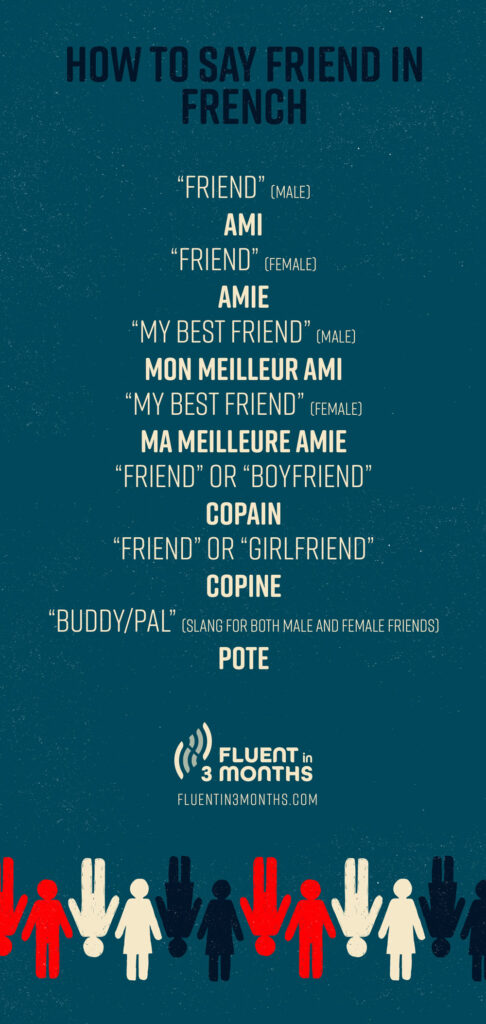
| English | French | Audio |
|---|---|---|
| “Friend” (male) | Ami | |
| “Friend” (female) | Amie | |
| “My best friend” (male) | Mon meilleur ami | |
| “My best friend” (female) | Ma meilleure amie | |
| “Friend” or “boyfriend” | Copain | |
| “Friend” or “girlfriend” | Copine | |
| “Buddy/pal” (colloquial; male or female) | Pote |
Editor's note: Before we get started, if you’re looking for an online French course, here’s the course we recommend: French Uncovered – Learn French Through the Power of Story, a course with a fascinating new method by Olly Richards. You can try it for free for 7 days!
Table of contents
- Ami and Amie: Friend in French
- Amis and Amies: Plural of Friend in French
- Copain and Copine: Friend and Boyfriend/Girlfriend in French
- Pote: A Colloquial Word for Friend in French
- Other Informal Ways to Address Friends in French
- Friendship Phrases in French
- Expressions and Useful Phrases with Friend in French
- Making Friends in France while Speaking French
- Practise Your French With Your New Amis
Ami and Amie: Friend in French
Ami is the most common word for friend in French. Its feminine form is amie. You can use it in all sorts of contexts, both formal and informal. Here are some examples:
- Mon ami Paul vient dîner ce soir. – “My friend Paul is coming over for dinner tonight.”
- Elle est plus qu’une amie, elle est comme une sœur pour moi. – “She’s more than a friend, she’s like a sister to me.”
Amis and Amies: Plural of Friend in French
To make ami and amie plural, add an “-s” to the end. In standard French agreement, amis refers to a group of male friends or a mixed group, while amies refers to an all-female group.
- Je vais sortir avec mes amis Patricia, Victor et Karen ce soir. – “I’m going out with my friends Patricia, Victor and Karen tonight.” (Here, we used amis because the group has two women and a man.)
- Mes amis Victor et Paul aiment bien cuisiner. – “My friends Victor and Paul like cooking.” (Here, we used amis as we’re talking about two men.)
- Elle a invité toutes ses amies à sa fête d’anniversaire. – “She invited all her female friends to her birthday party.” (Here, we used amies because the group has only women.)
Copain and Copine: Friend and Boyfriend/Girlfriend in French
Copain and copine also mean friend. They’re more informal than ami and amie, and often describe friends you spend time with.
Context and the article or possessive before the noun help you tell the meanings apart. Un copain or une copine can mean a friend, while mon copain or ma copine can also mean a boyfriend or girlfriend. The examples below show the difference.
- Mon copain s’appelle Antoine. – “My boyfriend’s name is Antoine.”
- Il vit avec sa copine. – “He lives with his girlfriend.”
- C’est qui ? C’est un copain de Tom ? – “Who is that? Is it one of Tom’s friends?”
- Mes copines viennent me voir demain. – “My friends are coming to see me tomorrow.”
Pote: A Colloquial Word for Friend in French
Pote is a familiar, colloquial word for “friend” in French. Think of it as “pal” or “buddy” in English. The noun can be masculine or feminine, so you can say un pote or une pote.
- Salut, mon pote ! Ça va ? – “Hey buddy! How are you?”
- C’est qui ton meilleur pote ? – “Who’s your best friend?”
- On sort avec les potes ce week-end. – “We’re going out with friends this weekend.”
Other Informal Ways to Address Friends in French
French speakers also use familiar forms of address that aren’t direct synonyms for “friend.” Depending on the relationship and the speaker, these can include frère (“brother”), sœur (“sister”), mec (“guy” or “dude”) and meuf (“woman” or “girl”). Affectionate endearment terms such as loulou, louloute, beau gosse (“handsome guy”) and ma belle (“my lovely” or “my dear”) are more personal, so use them only when they fit the relationship.
| English | French | Audio |
|---|---|---|
| “Bro/brother” (familiar) | Frère | |
| “Sis/sister” (familiar) | Sœur | |
| “Guy/dude” (informal) | Mec | |
| “Woman/girl” (very informal) | Meuf | |
| “Sweetie” (male) | Loulou | |
| “Sweetie” (female) | Louloute | |
| “Handsome guy” | Beau gosse | |
| “My lovely/my dear” (to a woman) | Ma belle |
Friendship Phrases in French
You’ll also need phrases for talking about your friends, introducing them and making plans. Here are some useful ones:
| English | French | Audio |
|---|---|---|
| “We've been friends since…” | On est amis depuis… / On est amies depuis… | |
| “We've known each other since…” | On se connaît depuis… | |
| “We get along well.” | On s’entend bien. | |
| “Let me introduce you to my friend…” | Je te présente mon ami… / Je te présente mon amie… | |
| “We should hang out more often.” | Il faut qu’on se voie plus souvent. | |
| “Want to do something tonight?” | Tu veux faire quelque chose ce soir ? | |
| “I’m going out with my friends tomorrow.” | Je vais sortir avec mes amis demain. | |
| “I'll always be there for you.” | Je serai toujours là pour toi. | |
| “You’re my best friend.” | Tu es mon meilleur ami. / Tu es ma meilleure amie. |
Expressions and Useful Phrases with Friend in French
Let’s move on to describe some of the activities you’d typically do with your friends:
| English | French | Audio |
|---|---|---|
| “To make friends” | Se faire des amis | |
| “To go out with friends” | Sortir avec des amis | |
| “To have a drink with friends” | Prendre un verre avec des amis | |
| “To chat with friends” | Discuter avec des amis | |
| “To get along well with someone” | S'entendre bien avec quelqu'un | |
| “To build a strong friendship” | Construire une amitié solide | |
| “To spend time with friends” | Passer du temps avec des amis | |
| “To stay in touch with friends” | Rester en contact avec des amis | |
| “To be best friends” | Être les meilleurs amis du monde / Être les meilleures amies du monde | |
| “To be friends for life” | Être amis pour la vie / Être amies pour la vie |
Making Friends in France while Speaking French
If you’re taking a French course, moving to France or simply travelling there, knowing the words is only part of making friends. A few social cues will help too.
Choose Tu or Vous for the Situation
When you’re speaking to one person, French gives you a choice between the pronouns tu and vous. Tu is informal, while vous is more formal or creates distance. It’s also the ordinary plural “you.” In professional settings, or when you’re unsure what a new acquaintance expects, start with vous. Among children, students, friends of friends and in many relaxed settings, people may use tu straight away.
You can wait for the other person to suggest On peut se tutoyer ? (“Can we use tu with each other?”), or ask the question yourself. The choice varies with age, setting and relationship, so follow the cue you get rather than treating it as a fixed timeline.
Follow the Other Person’s Greeting Cue
La bise is a cheek-kissing greeting, but it isn’t automatic every time you meet someone. It depends on the relationship, region and situation, and a handshake or a simple bonjour may fit better. If you’re unsure, let the other person take the lead.
Make Every Effort to Speak French
Speaking French gives you more chances to keep the conversation going, and friends may also introduce you to local slang or idioms. Don’t be afraid to make mistakes. They’re a natural part of learning and can even become a source of humour and bonding.
Attend Language Exchange Events or Join Clubs
If starting a conversation with a room full of strangers feels awkward, this video has a few practical ways to get one moving:
Language exchanges and local clubs also give you a reason to see the same people regularly. Try a sports team, book club or cooking class, and you’ll pick up new vocabulary while meeting people who share your interests.
Practise Your French With Your New Amis
Knowing words such as ami and copain is useful, but the real aim is to use them with people. Keep practising with these French resources, and you’ll have more to talk about with your amis, copains and potes!
If you want a structured push towards your first real conversations, take a look at Conversation Countdown.

Social