


How to Say “Friend” in Italian [With Audio Examples]

Full disclosure: This post contains affiliate links. ?
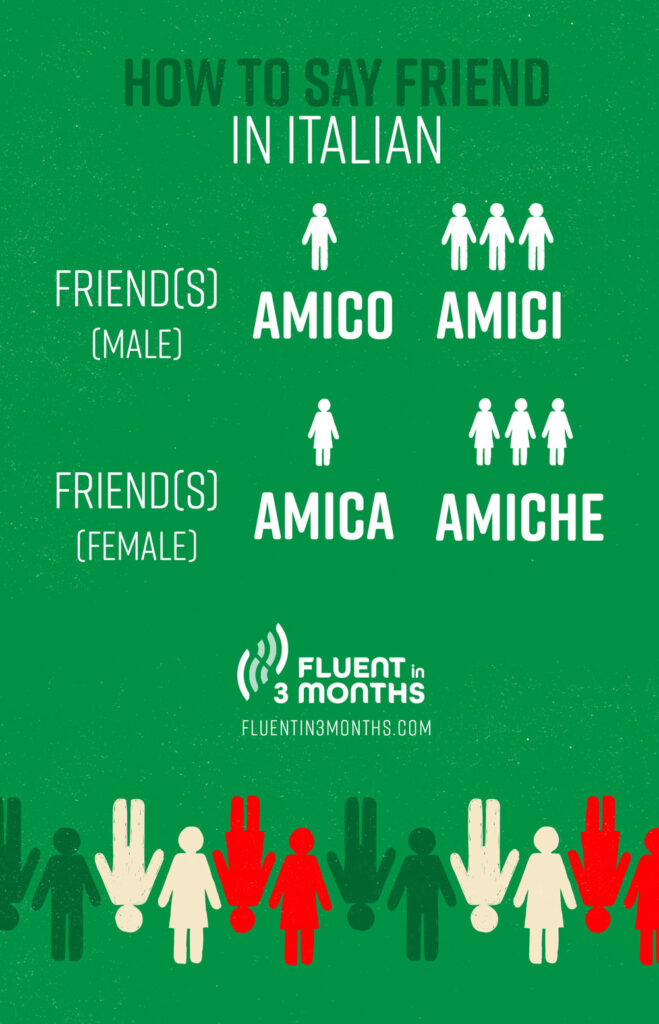
Friend in Italian is amico for a male friend, and amica for a female friend.
But in plural forms, amico becomes amici, and amica becomes amiche.
Those four forms are the starting point. To talk naturally about friendship, you’ll also need the right articles, possessives, everyday expressions and a little register awareness.
In this guide, you’ll learn how to say “friend” in Italian, hear the main forms, use them in sentences and pick up several useful friendship expressions.
Before we get started, if you’re looking for an online Italian course, here’s the course I recommend: Italian Uncovered – Learn Italian Through the Power of Story, a course with a fascinating new method by my friend Olly. You can try it for free for 7 days!
Table of contents
- Friend in Italian: Vocab List
- Origin of the Italian Word for Friend
- How to Say My Friend in Italian
- How to Say Friends in Italian: Plural Forms
- How to Say My Friends in Italian
- Does Amico Change in Formal Italian?
- Friendly and Slang Ways to Address Someone
- Example Sentences with Friend in Italian
- Expressions and Useful Phrases with Friend in Italian
- Practise Your Italian Friendship Vocabulary
Friend in Italian: Vocab List
Amico means a male friend. Its feminine singular, masculine or mixed plural, and feminine plural forms are different. Use the audio to hear each one:
| English | Italian | Audio |
|---|---|---|
| “Friend” (male) | Amico | |
| “Friend” (female) | Amica | |
| “Friends” (plural – group of male friends or group of male and female friends) | Amici | |
| “Friends” (plural – group of female friends) | Amiche |
Articles change too: l’amico and l’amica mean “the friend”, while the plurals are gli amici and le amiche. For “a friend”, use un amico but un’amica. The apostrophe belongs in the feminine form only.
Origin of the Italian Word for Friend
Italian amico comes from Latin amicus, a word related to amare, “to love”. The same Latin root also gave French ami and Spanish and Portuguese amigo. You can see the origin and modern senses in Treccani’s entry for amico.
In amico and amica, stress the middle syllable: a-MI-co and a-MI-ca. The c is hard, like the c in “cat”. In amici, it becomes a “ch” sound: a-MI-ci. The h in amiche keeps the hard sound: a-MI-che.
How to Say My Friend in Italian
To say “my friend”, match the possessive to your friend’s gender: il mio amico for a male friend and la mia amica for a female friend.
The article is part of the normal noun phrase. You can also say un mio amico or una mia amica for “a friend of mine”. As a direct, affectionate address, you may hear the order reversed: amico mio or amica mia.
Amico and amica usually mean a platonic friend, but context matters. In some situations, especially with l’amico or l’amica, the word can euphemistically suggest a romantic partner. Il mio ragazzo and la mia ragazza are clearer everyday choices for “my boyfriend” and “my girlfriend”.
How to Say Friends in Italian: Plural Forms
As explained in our guide to Italian plural nouns, amico becomes amici, while amica becomes amiche.
Use amici for a group of male friends or, in standard Italian, for a mixed-gender group:
- I miei amici Sara e Raffaele sono venuti a trovarmi. “My friends Sara and Raffaele came to visit me.”
- Raffaele e Marco sono i miei amici. “Raffaele and Marco are my friends.”
Use amiche for a group made up entirely of female friends:
- Ho conosciuto le mie amiche Alice e Sara all’università. “I met my friends Alice and Sara at university.”
How to Say My Friends in Italian
I miei amici and le mie amiche mean “my friends”. The possessive and article both agree with the noun: masculine i miei amici, feminine le mie amiche.
The well-known article exception applies to many unmodified singular family terms: mio padre, for example, not il mio padre. It does not apply to amico or amica.
Prepositions may combine with these articles. Compare con il mio amico (“with my male friend”), con la mia amica (“with my female friend”), agli amici (“to the male or mixed friends”) and alle amiche (“to the female friends”). You’ll also see dell’amico and dell’amica for “of the friend”.
Does Amico Change in Formal Italian?
Amico and amica describe the relationship, so the nouns themselves are not formal or informal. What changes is the rest of the sentence: your tone, title and choice of tu or formal Lei.
- Mi sei mancata, amica mia! “I’ve missed you, my friend!” (to a female friend)
- Porta anche i tuoi amici: più siamo, meglio è! “Bring your friends too: the more, the merrier!”
- Ciao mamma! Questa è la mia amica Sara. Lavoriamo insieme. “Hi Mum! This is my friend Sara. We work together.”
In a formal introduction, you can keep amico or amica while using a title or a polite object pronoun:
- Le presento la mia amica e collega, la dottoressa Martin, che parlerà della sua ricerca. “Let me introduce my friend and colleague, Dr Martin, who will speak about her research.”
- Desidero presentarvi il mio amico Marco, un architetto che ha lavorato a molti progetti internazionali. “I’d like to introduce you to my friend Marco, an architect who has worked on many international projects.”
Friendly and Slang Ways to Address Someone
Italian slang and terms of endearment can sound friendly, but they are not simple substitutes for amico. Their use varies by region, age and relationship, so listen to how people around you speak before adopting one.
Zio, frate and fra can work like “dude” or “bro” in some youth speech. Southern compà is a shortened form of compare, a word that can address an old friend; it is not short for compagno. The audio lets you hear each form, but the usage notes matter as much as the sound.
| English | Italian | Audio |
|---|---|---|
| “Dude” or “bro” (youth slang; literally “uncle”) | Zio | |
| “Aunt”; occasionally a playful address (regional or youth slang) | Zia | |
| “Bro” (regional or youth slang; literally “friar”) | Frate | |
| “Bro” (informal clipping) | Fra | |
| “Mate” or “buddy” (southern regional form) | Compà | |
| “Dear” (warm masculine form of address) | Caro | |
| “Dear” (warm feminine form of address) | Cara | |
| “Handsome”; sometimes a playful masculine address | Bello | |
| “Beautiful”; sometimes a playful feminine address | Bella |
Example Sentences with Friend in Italian
Here are the core forms in complete sentences. Notice how articles and adjectives agree with amico, amica, amici or amiche.
| English | Italian | Audio |
|---|---|---|
| “This is my friend, Maria.” | Questa è la mia amica Maria. | |
| “My best friend is Antonio.” |
Il mio migliore amico è Antonio. | |
| “We have many friends in Italy.” | Abbiamo tanti amici in Italia. | |
| “Tonight, I’m going out with my female friends.” | Stasera esco con le mie amiche. | |
| “You are a true friend.” (if speaking to a male friend) | Sei un vero amico. | |
| “You are a true friend.” (if speaking to a female friend) | Sei una vera amica. | |
| “Hi bro, what are you doing tonight?” | Ciao fra, che fai stasera? |
Expressions and Useful Phrases with Friend in Italian
These phrases help you talk about making friends, meeting up and close friendships:
The table gives the infinitive or base expression. Conjugate the verb to match the subject when you build a sentence.
| English | Italian | Audio |
|---|---|---|
| “To make friends” | Fare amicizia | |
| “To go out with friends” | Uscire con gli amici | |
| “To meet up with friends” | Incontrarsi con gli amici | |
| “To get along well with someone” | Andare d'accordo con qualcuno | |
| “To build a strong friendship” | Costruire un'amicizia solida | |
| “To keep in touch with friends” | Mantenere i contatti con gli amici | |
| “To be best friends” | Essere migliori amici | |
| “To be very close friends” (literal translation: to be friends of the heart) | Essere amici del cuore (idiomatic expression) | |
| “To be very close friends” (literal translation: friends for the skin) | Essere amici per la pelle (idiomatic expression) |
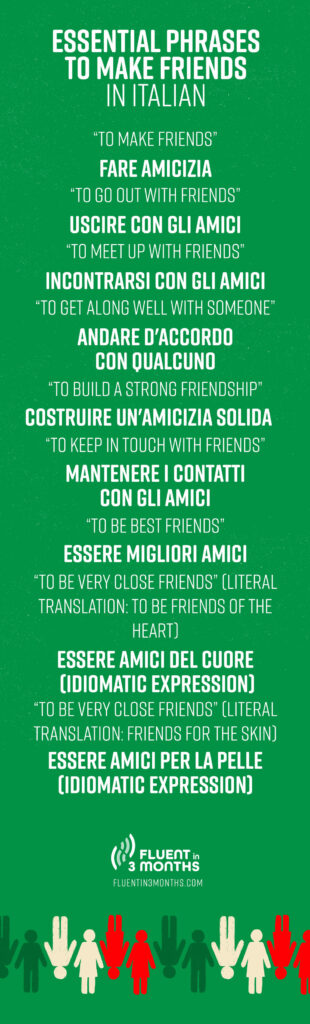
For example, “We are best friends” is siamo migliori amici for a male or mixed group and siamo migliori amiche for an all-female group. The same agreement applies to amici/amiche del cuore and amici/amiche per la pelle.
Practise Your Italian Friendship Vocabulary
Choose one form and one expression, then make a sentence about someone you know. You might write Marco è un mio amico (“Marco is a friend of mine”) or siamo amiche per la pelle (“we are very close friends”, for an all-female pair or group).
As you continue learning Italian, mix vocabulary lists with resources grounded in Italian language and culture. If you want a simple system for saving and reviewing useful forms, try the Vocab Vault.

Social