


33 German Words in English (and a Few Surprising Connections)

Full disclosure: This post contains affiliate links. ?
English has borrowed words from German, translated German compounds, and picked up related forms through Dutch, French and Yiddish. That makes the story more interesting than a simple list of direct loans.
Here are 33 familiar English words with German connections. Each entry tells you which kind of connection it has, so you can separate direct German loans from translations, place names and words that travelled through another language.
Before we get started, if you’re looking for an online German course, here’s the course I recommend: German Uncovered – Learn German Through the Power of Story, a course with a fascinating new method by my friend Olly. You can try it for free for 7 days!
Table of contents
Everyday English Words with German Connections
1. Iceberg
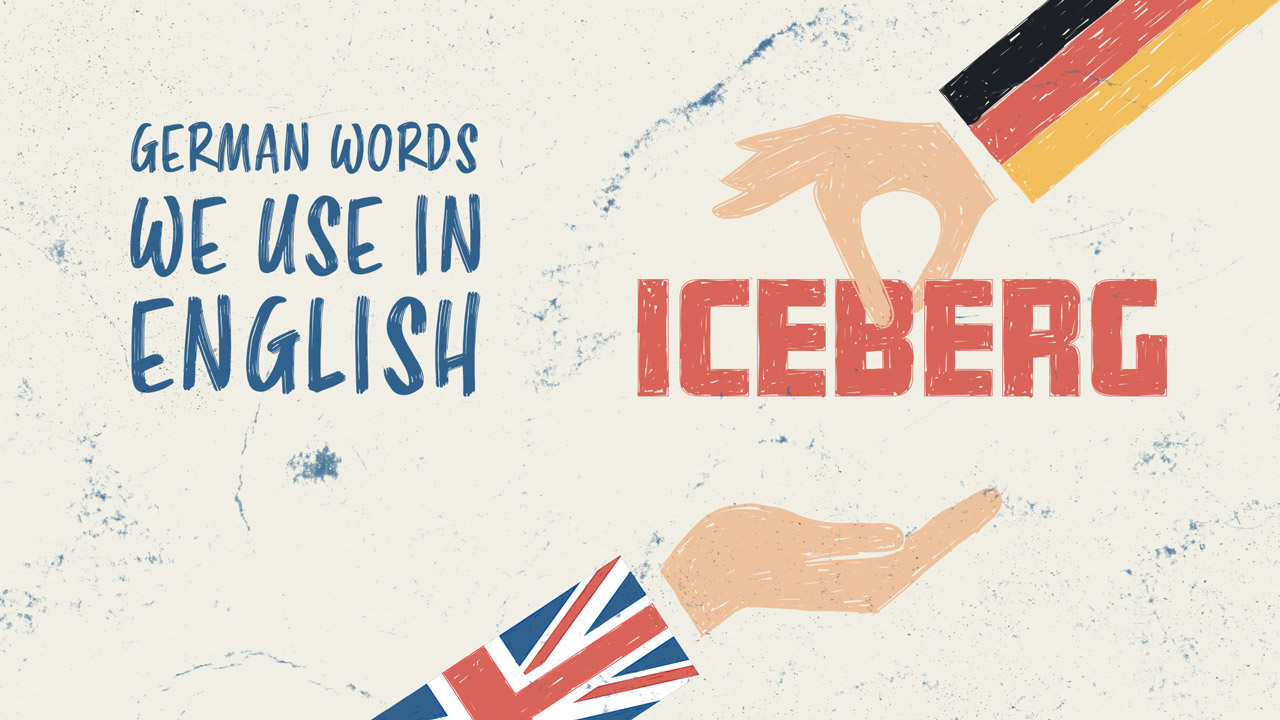
Iceberg is related to German Eisberg, “ice mountain”, but English did not borrow it straight from German. The English word is a partial loan translation of Dutch ijsberg. This is a useful reminder that related Germanic languages can produce very similar compounds.
2. Kindergarten
Kindergarten is a direct German loanword. It combines Kinder, “children”, and Garten, “garden”. The familiar English meaning developed from Friedrich Fröbel’s name for his early-childhood education system.
3. Kitsch
Kitsch came into English from German. In both languages, it can describe art or decoration seen as gaudy, sentimental or in poor taste. The judgement is subjective, so one person’s kitsch may be another person’s favourite ornament.
4. Gesundheit
Gesundheit literally means “health” in German. German speakers can say it after a sneeze, and English speakers, particularly in North America, also use it in that situation.
5. Hamster
English borrowed hamster from German Hamster. The German verb hamstern means to hoard or stockpile, drawing on the animal’s habit of storing food.
6. Zigzag
The connection between zigzag and German Zickzack is real, but the route into English is uncertain. English probably received the form through French, and etymologists have proposed German as one possible source. It is safer to call this a German connection than a direct German loan.
7. Glitz
Glitz reached English through Yiddish rather than directly from Standard German. Yiddish glits, “glitter”, is related to German glitzern, “to sparkle”. English glitzy appeared before the back-formed noun glitz.
8. Gummy Bear
The sweet was created in Germany: Haribo founder Hans Riegel made the company’s first bear-shaped gummy in 1922. English gummy bear mirrors German Gummibärchen, literally “little gummy bear”, so this entry is a loan translation rather than a borrowed German spelling.
9. Noodle
The food sense of English noodle comes from German Nudel. English already had an unrelated word noodle for a head or a foolish person, so the matching modern spellings hide two different histories.
10. Foosball
Foosball, the table game, takes its name from the pronunciation of German Fußball, “football”. In German, Fußball normally means association football itself; table football is Tischfußball.
German Words in Your Food
11. Beer Garden
Beer garden is a loan translation of German Biergarten. In Bavaria, the term traditionally refers to an outdoor drinking area where beer and food are served, though English now uses it more broadly.
12. Frankfurter and Hamburger
Frankfurter and hamburger both come from German place names. A Frankfurter is something associated with Frankfurt, while Hamburger means “of Hamburg” or a person from Hamburg. Those word histories do not settle the disputed question of who invented the modern hamburger sandwich.
13. Deli and Delicatessen
Deli is short for delicatessen. English borrowed delicatessen from German Delikatessen, the plural of Delikatesse, “delicacy”. German had borrowed that family of words from French.
14. Pretzel
English pretzel came from German Brezel. Regional German forms include Bavarian and Austrian Breze or Brezen. The word’s deeper origin is disputed, so neat stories connecting its shape to folded arms should be treated cautiously.
15. Muesli
Muesli comes from Swiss German Müesli, a diminutive related to Mues, “mush” or “purée”. English muesli reflects that Swiss form: the e is part of the word, not a fallback for an unavailable umlaut.
16. Sauerkraut
Sauerkraut is German for “sour cabbage”, from sauer and Kraut. English kept the German compound for the fermented cabbage dish.
17. Schnapps
English schnapps comes from German Schnaps, a general term for a strong alcoholic drink. The English double p and final s are not the standard German spelling.
18. Strudel
English borrowed strudel from German. The German word can mean a whirlpool or eddy as well as the rolled pastry, a reference to its spiral layers. For more food vocabulary, see our guide to food in German.
Dog-Breed Names from German
19. Rottweiler
Rottweiler refers to the German town of Rottweil. The breed name preserves that place connection; it is not a word for a general type of watchdog.
20. Schnauzer
Schnauzer comes from German Schnauze, “snout” or “muzzle”, and is associated with the breed’s prominent whiskers. English uses the German-derived name for the standard, miniature and giant breeds.
21. Dachshund
Dachshund combines German Dachs, “badger”, and Hund, “dog”. In present-day German, Dackel and Teckel are also common names for the breed.
22. German Shepherd
German shepherd translates German Deutscher Schäferhund, literally “German shepherd dog”. This makes it a loan translation rather than a German spelling carried unchanged into English.
23. Affenpinscher
Affenpinscher combines German Affe, “ape” or “monkey”, with Pinscher, a dog-type name. The “monkey” part refers to the breed’s facial appearance.
German Literary, Cultural and Academic Terms
24. Doppelgänger
Doppelgänger literally means “double-goer”. German writer Jean Paul used the earlier form Doppeltgänger in his 1796 novel Siebenkäs. In English, the word first referred to a ghostly double, while modern use also covers an unrelated lookalike.
25. Bildungsroman
Bildungsroman is a novel about a central character’s development or formation. It combines Bildung, “formation” or “education”, and Roman, “novel”. The linking s is a German compound marker called a Fugen-s; it is not simply added to make a word easier to pronounce. Goethe’s Wilhelm Meisters Lehrjahre is widely treated as an early model of the genre.
26. Schadenfreude
Schadenfreude is pleasure at another person’s misfortune. It combines Schaden, “harm” or “damage”, and Freude, “joy”. English adopted the German word without needing to copy German capitalisation in ordinary English prose.
27. Wunderkind
Wunderkind combines Wunder, “wonder”, and Kind, “child”. English uses it for an unusually successful or talented young person, much like “child prodigy”.
28. Leitmotif
Leitmotif, also leitmotiv, came from German Leitmotiv, literally “leading motif”. It first named a recurring musical idea associated with a character, object or theme, and English later extended it to literature, film and everyday discussion.
29. Dasein
Dasein is an ordinary German word for “existence”, built from da, “there”, and sein, “to be”. Philosopher Martin Heidegger did not invent the word, but he gave it a specialised role for the kind of being characteristic of humans. In discussions of Heidegger, translators often leave Dasein untranslated because “existence” does not capture the full technical sense.
30. Blitzkrieg
Blitzkrieg literally means “lightning war”. English adopted it in 1939 for fast military offensives using concentrated and coordinated forces. Historians debate how far it described a formal German doctrine, so it is better treated as a period term and later label than as the name of one settled official strategy.
31. Ur-
English uses the German prefix ur- to mean “original”, “earliest” or “primitive”, especially in academic writing. Examples include urtext for an original text and ursprache for a reconstructed ancestral language. German also uses the prefix in other ways, so it does not carry one identical meaning in every German word.
32. Bauhaus
Bauhaus was the name of the design school Walter Gropius founded in Weimar in 1919. The name combines Bau, “building” or “construction”, and Haus, “house”. English now uses Bauhaus for the school and the design movement associated with it.
33. Zeitgeist
Zeitgeist means the defining spirit or climate of an age. It combines Zeit, “time”, and Geist, “spirit” or “mind”. The term is recorded in German in the work of Johann Gottfried Herder in 1769 and was later strongly associated with Hegel; Hegel did not coin it.
What These German Connections Can Teach You
A borrowed word can keep its German spelling, change shape in English, arrive through another language or be translated piece by piece. Checking that route helps you notice patterns without assuming that every similar-looking word travelled directly from German.
The Digital Dictionary of the German Language is useful for checking German meanings, usage and word history. For English word histories, compare a historical etymology source and note when the route is disputed rather than forcing one tidy answer.
If you want to turn discoveries like these into vocabulary you can actually recall, Vocab Vault gives you a structured system for collecting and practising useful words.

Social