


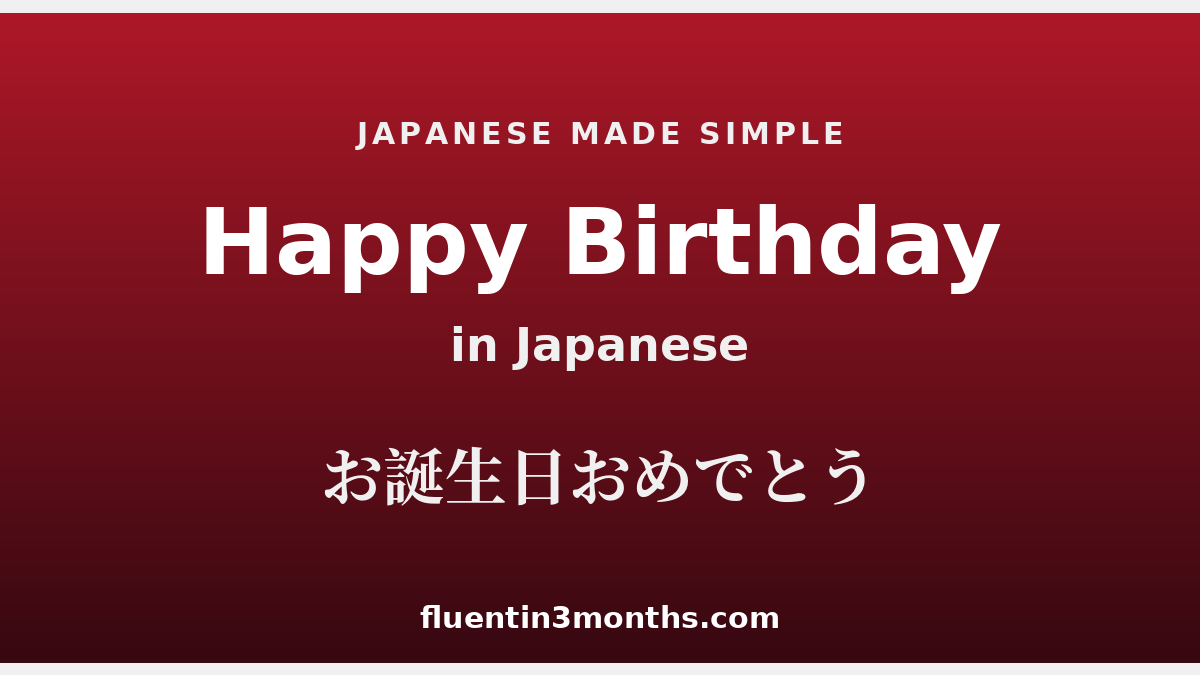
“Happy Birthday” in Japanese: 13 More Useful Phrases

Full disclosure: This post contains affiliate links. ?
The polite way to say “happy birthday” in Japanese is お誕生日おめでとうございます (otanjōbi omedetō gozaimasu). With a close friend, you can shorten it to 誕生日おめでとう (tanjōbi omedetō) or お誕生日おめでとう (otanjōbi omedetō).
This guide explains the register, pronunciation and writing, then gives you 13 more words and phrases for a card or celebration. Romanisation is only a guide, so listen to a Japanese speaker or reliable recording before the birthday arrives.
Table of contents
How to Say “Happy Birthday” in Japanese
- 誕生日おめでとう (tanjōbi omedetō) – “Happy birthday” (casual)
- お誕生日おめでとう (otanjōbi omedetō) – “Happy birthday” (casual, with the honorific prefix o)
- お誕生日おめでとうございます (otanjōbi omedetō gozaimasu) – “Happy birthday” (polite)
The main pieces are:
- お (o) – an honorific prefix used with some nouns, including tanjōbi in this greeting
- 誕生日 (tanjōbi) – “birthday”, from 誕生 (tanjō, “birth”) and 日 (bi here, “day”)
- おめでとう (omedetō) – “congratulations”
- ございます (gozaimasu) – the element that makes this congratulatory expression polite
You can use omedetō for other happy events too. For example, ご結婚おめでとうございます (gokekkon omedetō gozaimasu) congratulates someone politely on a marriage, while 合格おめでとう (gōkaku omedetō) is a casual “Congratulations on passing”.
If you want more first phrases around the greeting, see our guide to saying hello in Japanese.
Casual or Polite? Knowing Which One to Use
Register in Japanese depends on your relationship with the other person and the setting. These are useful starting points:
- With a close friend or family member, 誕生日おめでとう or お誕生日おめでとう fits casual speech.
- With someone you normally address politely, use お誕生日おめでとうございます.
- In a card or message, match the level of Japanese you usually use with that person.
Relationship matters more than a rigid list of roles. If you're unsure, listen to how people in that group address one another and use the polite form until they invite more casual speech.
The Loanword and the Birthday Song
You may also see or hear ハッピーバースデー (happī bāsudē), the Japanese rendering of the English “Happy Birthday”. It appears in decorations, messages and versions of the familiar birthday song.
It doesn't make otanjōbi omedetō obsolete. The Japanese phrase is a direct congratulatory greeting, while the loanword is another option whose use depends on the occasion.
13 More Birthday Phrases and Words to Know
These 13 entries cover congratulations, good wishes and practical party vocabulary:
- おめでとう (omedetō) – “Congratulations” (casual)
- おめでとうございます (omedetō gozaimasu) – “Congratulations” (polite)
- 素敵な一日を (suteki na ichinichi o) – “Have a lovely day”
- 良い一年になりますように (yoi ichinen ni narimasu yō ni) – “I hope the year ahead is a good one”
- 誕生日会 (tanjōbikai) – “birthday party”
- 誕生日プレゼント (tanjōbi purezento) – “birthday present”
- プレゼント (purezento) – “present” or “gift”
- ケーキ (kēki) – “cake”
- ろうそく (rōsoku) – “candle” or “candles”
- 願い事 (negaigoto) – “wish”
- 乾杯 (kanpai) – “Cheers!”
- 年齢 (nenrei) – “age”
- 何歳になりましたか (nansai ni narimashita ka) – “How old are you now?” or “What age did you turn?”
The age question is grammatical, but that doesn't make it appropriate for every person or setting. Ask only when you would comfortably ask the same question in the relationship you have.
To practise these as complete prompts rather than isolated words, see our guide to making effective Anki cards.
How Birthday Age Counting Changed in Japan
Contemporary birthday celebrations in Japan may include cake, candles, presents and a birthday song, but the way age is counted has an older history.
Under 数え年 (kazoedoshi, “counted years”), a baby was counted as one at birth and people added a year at New Year rather than on their individual birth dates. Japan's 1902 age-calculation law established calculation from the date of birth, but counted age remained common in daily life for decades. A further law promoting the use of full-year age came into force in 1950.
Japan also has named longevity celebrations. 還暦 (kanreki) marks 60 years, one full cycle of the traditional sexagenary calendar. Other examples include 古希 (koki) at 70 and 米寿 (beiju) at 88. Families may observe these by full age or counted age, so don't assume one calculation in every case. Our guide to Japanese numbers will help you say the ages themselves.
How to Pronounce お誕生日おめでとう
Japanese rhythm is often described in morae, short timing units. A long vowel occupies two morae, and the moraic n counts as one too.
- お誕生日 (otanjōbi) has six morae: o-ta-n-jo-o-bi. The macron in jō represents the long vowel written じょう.
- おめでとう (omedetō) has five morae: o-me-de-to-o. The final tō is long, written とう.
- ございます (gozaimasu) can be grouped as go-za-i-ma-su for careful practice.
Give the second half of each long vowel its own timing instead of clipping it. In standard Japanese, lexical accent is expressed mainly through pitch rather than the heavy stressed syllable familiar from English, and accent patterns vary between regions. An English spelling such as “JOH-bee” can therefore add the wrong emphasis. Copy a recording phrase by phrase, paying attention to both timing and pitch.
Our JapanesePod101 review explains what its audio-based Japanese lessons offer if you want more listening material.
A Quick Note on the Script
お誕生日おめでとう mixes kanji and hiragana. 誕生日 is written with kanji, while the honorific お and おめでとう are in hiragana. ハッピーバースデー is in katakana because it is a loanword from English.
Those are useful patterns, not absolute rules. Hiragana also writes whole words, and katakana can mark more than loanwords, including sound-symbolic words, emphasis and some plant or animal names. For the wider picture, start with our guide to the Japanese writing systems.
Wish Someone a Happy Birthday in Japanese
For someone you address casually, use 誕生日おめでとう! For a polite message, use お誕生日おめでとうございます! Add their name or one short wish from the list, then check the whole message with a Japanese speaker if the relationship or wording matters.
If you'd like support turning first phrases into conversations, you can learn more about the Fluent in 3 Months Bootcamp.

Social