


50+ Ways to Say “I Love You” in French

Full disclosure: This post contains affiliate links. ?
Je t’aime is the standard way to say “I love you” in French. The confusing part is that je t’aime bien usually means “I like you,” while je t’aime beaucoup often expresses warm friendship or affection rather than a romantic declaration. Context still matters, especially with family and close friends.
We’re going to look at pronunciation, grammar and plenty more ways to express love in French, but first, a little bit about me, your French-speaking guide.
I studied French at university and lived in French-speaking countries for two years. It’s a brilliant language to learn! Once you look beyond details like French grammar and start using it for things you care about, French gets better and better.
When you’re having fun with the language, you tend to speak it better too.
French is often stereotyped as the language of romance, and it certainly gives you plenty of ways to express love and affection.
Allez ! Let’s go!
Editor's note: Before we get started, if you’re looking for an online French course, here’s the course we recommend: French Uncovered – Learn French Through the Power of Story, a course with a fascinating new method by Olly Richards. You can try it for free for 7 days!
Table of contents
3 Good Reasons to Learn How to Say “I Love You” in French
“I love you” introduces you to useful verbs such as aimer (“to love”), adorer (“to adore”) and chérir (“to cherish”). You’ll also learn how French speakers distinguish romantic love, friendship and affection through context and register.
Here are three good reasons to learn je t’aime and other love-related words:
Show appreciation to your loved ones. Many people learn a new language to speak to their partner or family. If you have a French-speaking loved one, these phrases give you several ways to tell them how you feel.
Watch romantic French films. There are plenty of French films about love. Amélie, for example, follows a young woman living in Paris who helps people around her and finds love herself.
Listen to romantic French songs. French songs often explore love and heartbreak. Take Lara Fabian’s song Je t’aime, for example. In the chorus, she sings je t’aime comme un fou, comme un soldat, meaning “I love you like a madman, like a soldier.”
How to Say “I Love You” in French: Master the Basics
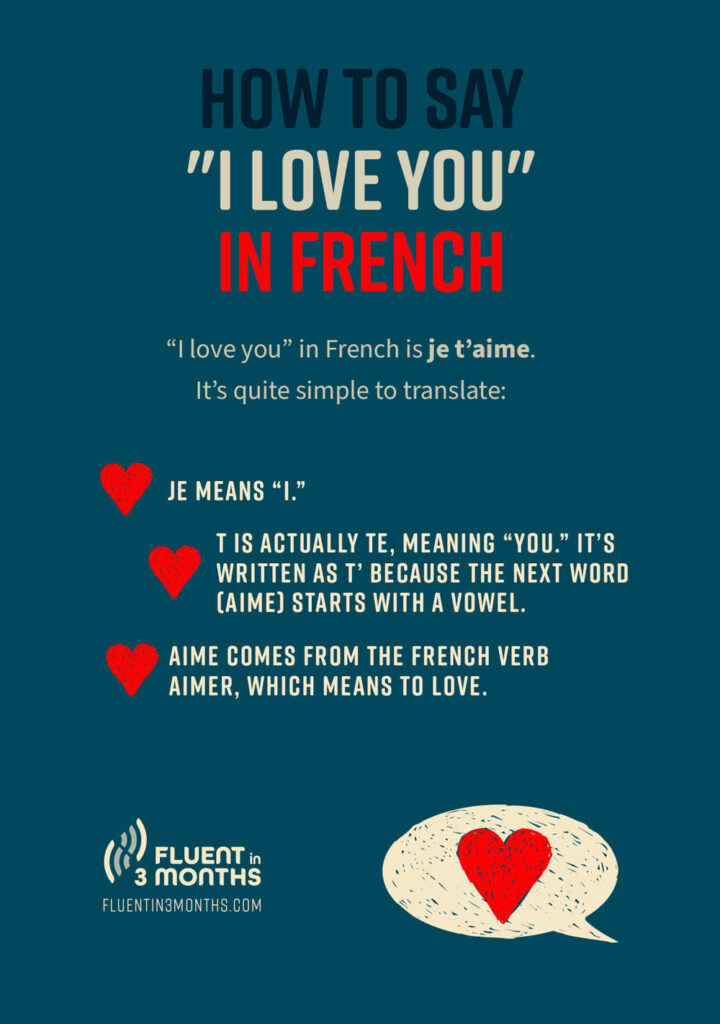
“I love you” in French is je t’aime. The phrase breaks down like this:
- Je means “I.”
- T’ comes from te, the informal singular object pronoun meaning “you.” French drops the e before the vowel sound at the start of aime and replaces it with an apostrophe.
- Aime is the first-person singular form of aimer, “to love” or “to like.”
How to Pronounce Je t’aime
In standard French, je t’aime is pronounced /ʒə t‿ɛm/. The j sounds like the middle consonant in “measure,” and t’aime sounds roughly like “tem.” Say it as one smooth phrase, with the t attached to aime. For more help with the sounds, see our full guide to French pronunciation.
Choose a Phrase by Relationship and Register
There isn’t one fixed ladder from “like” to “love.” A better model is to check three things: your relationship, the setting and the register. Bare je t’aime is the clearest romantic declaration, but it can also express deep love within a family or a close friendship. Je t’aime bien usually signals liking or fondness, while je t’aime beaucoup often sounds warmly affectionate rather than romantic. Slang such as je te kiffe belongs in casual speech, while phrases such as je te chéris sound more literary.
If you need the polite or plural form, replace te with vous: je vous aime. With any of these phrases, your tone and relationship do part of the work.
Add French Terms of Endearment
You can pair je t’aime with one of these French terms of endearment:
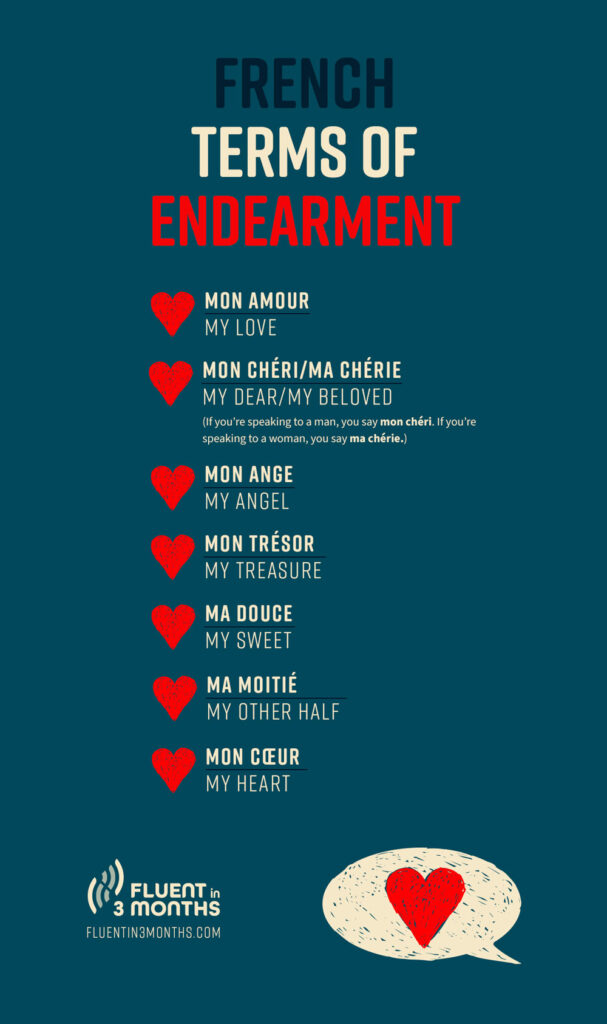
- Mon amour: “My love”
- Mon chéri / ma chérie: “My dear” or “my darling.” Use mon chéri when addressing a man and ma chérie when addressing a woman.
- Mon ange: “My angel”
- Mon trésor: “My treasure”
- Ma douce: “My sweet one,” addressing a woman. This sounds literary or old-fashioned in some contexts.
- Ma moitié: “My other half”
- Mon cœur: “My heart”
50 More Ways to Say “I Love You” in French
The relationship and register notes matter as much as the literal translations. This video gives you a quick spoken introduction before you choose from the full list.
- Je t’aime: “I love you.” This is the clearest romantic declaration, though it can also express deep love for family or a close friend.
- Je t’aime bien: “I like you” or “I’m fond of you.” In a romantic conversation, it usually steps back from “I love you.”
- Je t’adore: “I adore you” or “I love you.” Its force depends on context: it can express passionate love or warm affection.
- Je te kiffe: “I’m really into you” or “I really like you.” This is very informal slang, so keep it for casual speech.
- Je suis amoureux de toi / Je suis amoureuse de toi: “I’m in love with you.” A male speaker says amoureux; a female speaker says amoureuse.
- Je t’aime très fort: “I love you very much.” This is warm and natural with partners, family and close friends.
- Tu es l’amour de ma vie: “You are the love of my life.”
- Je t’aime de tout mon cœur: “I love you with all my heart.”
- Je t’aime à la folie: “I love you madly.”
- Je t’aime aujourd’hui plus qu’hier et bien moins que demain: “I love you more today than yesterday and much less than tomorrow.” This adapts a line by French poet Rosemonde Gérard.
- Mon amour pour toi est éternel: “My love for you is eternal.”
- Je t’aime pour toujours: “I love you forever.”
- Mon cœur est à toi: “My heart is yours.”
- Tu es mon âme sœur: “You are my soulmate.” Âme sœur describes someone whose feelings and outlook closely match your own.
- Je suis fou de toi / Je suis folle de toi: “I’m crazy about you.” A male speaker says fou; a female speaker says folle.
- Je suis dingue de toi: “I’m crazy about you.” This is informal.
- Tu es ma raison de vivre: “You are my reason for living.”
- Je t’aime infiniment: “I love you infinitely.” This has a poetic tone.
- Je ne peux pas vivre sans toi: “I can’t live without you.”
- Tu es la meilleure chose qui me soit arrivée: “You are the best thing that has happened to me.”
- Je t’aime plus que tout au monde: “I love you more than anything in the world.”
- Tu es mon trésor: “You are my treasure.”
- Je t’aimerai toujours: “I will always love you.”
- Tu me rends heureux / Tu me rends heureuse: “You make me happy.” A male speaker says heureux; a female speaker says heureuse.
- Tu me manques: “I miss you.” French puts the person being missed in the subject position, so the structure is closer to “you are missing from my life” than the English word order.
- Tu es parfait comme tu es / Tu es parfaite comme tu es: “You are perfect the way you are.” Use parfait when addressing a man and parfaite when addressing a woman.
- Je suis tombé amoureux de toi / Je suis tombée amoureuse de toi: “I’ve fallen in love with you.” A male speaker uses tombé amoureux; a female speaker uses tombée amoureuse.
- Tu es le meilleur / Tu es la meilleure: “You are the best.” Use le meilleur for a man and la meilleure for a woman.
- Je t’aime profondément: “I love you deeply.”
- Je suis à toi: “I am yours.” This is intimate and can sound dramatic, so context matters.
- Ton amour est le cadeau le plus précieux: “Your love is the most precious gift.”
- Tu es ma personne préférée: “You’re my favourite person.” This is modern and informal.
- J’adore passer du temps avec toi: “I love spending time with you.”
- Je veux faire ma vie avec toi: “I want to build my life with you.”
- Tu me complètes: “You complete me.” This is understandable but deliberately dramatic, much like the English phrase.
- Je t’aime chaque jour davantage: “I love you more each day.”
- Mon cœur bat pour toi: “My heart beats for you.”
- Tu es mon soleil: “You are my sunshine,” or literally, “You are my sun.”
- Tu es mon soleil dans la nuit: “You are my sun in the night.” This is poetic rather than an everyday set phrase.
- Je te chéris: “I cherish you.” This sounds literary or formal.
- Avec toi, je me sens complet / Avec toi, je me sens complète: “With you, I feel complete.” A male speaker says complet; a female speaker says complète.
- Tu me rends fou / Tu me rends folle: “You drive me crazy.” A male speaker says fou; a female speaker says folle.
- Tu es la seule personne qui compte pour moi: “You are the only person who matters to me.”
- Toi et moi, c’est pour la vie: “You and me, we’re together for life.” This is casual and affectionate.
- Mon amour pour toi est incommensurable: “My love for you is immeasurable.” This sounds elevated and literary.
- Je veux vieillir avec toi: “I want to grow old with you.”
- Tu es la lumière de ma vie: “You are the light of my life.”
- Tu es tout pour moi: “You are everything to me.”
- Tu es ma moitié: “You are my other half.”
- Tu illumines ma vie: “You light up my life.”
Show Your Love in French
Start with the phrase that fits your relationship and the moment. You might say je t’aime très fort to someone close, listen for the words in Lara Fabian’s Je t’aime, or try one of the more poetic lines in a card.
For more French beyond this list, have a look at Benny’s Language Hacking French.

Social