



Language Immersion: 3 Lessons from Starting Over

Full disclosure: This post contains affiliate links. ?
Living in another country does not automatically teach you its language.
I learned that six months into my stay in Spain, when I still had barely any Spanish to show for it. What changed things was not the location but how I used the language around me. You can also create that kind of immersion at home.
In this guest post, Jeremy shares what went wrong during one move abroad and the three habits that helped him the next time.
Over to you, Jeremy!
“I’m going to be honest, Jeremy.” My boss looked me in the eyes as I sat down in her office.
I tried to force a smile, but the mood in the room stopped me.
“Conversations like these are my least favourite thing to do,” she continued.
My throat sank into my stomach as I waited for what came next.
Like many travellers, I had a long list of places I wanted to visit and things I wanted to do. Getting fired in another country was not one of them.
A note from the Fluent in 3 Months team before we get started: You can chat away with a native speaker for at least 15 minutes with the “Fluent in 3 Months” method. All it takes is 90 days. Tap this link to find out more.

“You’re Just… Not Yourself”
I was 22, fresh out of university and ready to take on the world. I had booked a one-way ticket to Israel, where I had landed my dream job as a counsellor for a high school study-abroad programme.
Not only was I losing that job, I was also losing my accommodation because room and board were part of my contract.
My boss told me I was not acting like myself.
Something was wrong, and other people had noticed it before I did.
For the next ten minutes, my boss laid out what she had seen: I had not made any new friends since I arrived. I lacked excitement. I was too quiet. I had learned very little usable Hebrew.
Finally, I faced what was happening.
I felt as though I had hit rock bottom.
I was on the other side of the world.
I had no job, no nearby family who could help me and no idea what to do.
How I Became a VietNomad
Moving again would not be enough. I needed to change how I learned.
Three months later, in late 2013, I found myself on another one-way flight. This time, I was going to Vietnam.
Immersing yourself in life in another country is not easy, so I wanted to change my approach rather than assume the move itself would be enough.
I arrived without any Vietnamese. I soon learned that Vietnamese is tonal, as are Chinese and Thai.
I had never learned a tonal language before, but I started anyway.
For part of the trip, I had no mobile phone or internet and lived on roughly US$5 a day. Almost nobody around me used English, so Vietnamese became part of everyday life.
Ten months later, I was a guest on a Vietnamese reality TV show. You can see a clip later in this article.
At the time, I would roughly place my Vietnamese around A2. I could communicate basic needs, but my pronunciation and tones needed work. I could not yet write confidently, and I had not studied the alphabet systematically. I did not own a textbook or take formal lessons. What I did have was a willingness to try again after my experience in Israel.
On the show, I began to see why my first attempt at immersion had gone badly. I had lost confidence, become lonely and eventually experienced depression. Being surrounded by Vietnamese made me pay attention to the support and habits I had been missing.
After 25 days in the mountains of Vietnam with very little English, I came away with three lessons about making immersion more useful.
Immersion Tip 1: Build a Support System
One reason I learned so little Hebrew in Israel was that I was isolated. I had no teacher, accountability partner or schedule. I lost sight of my goal and my confidence. Frankly, I was lonely.
A teacher or another kind of support system can help you keep practising and notice your progress.
Listening, reading and studying all have a place in immersion. Regular interaction gives you a different kind of practice: you have to understand another person and make yourself understood in real time.
Look for people who can offer conversation, feedback, accountability and encouragement.
A private tutor is one option. If you hire one, choose an online language teacher carefully. A good teacher can explain both language and cultural context, and should take your goals seriously.
If classroom learning does not suit you, build a varied circle: local friends, other newcomers and fellow language learners can each offer a different perspective.
No one person will understand every part of your experience. Some people can help with the language and local context; others may recognise homesickness, culture shock or the strain of starting again.

I needed friends who could be patient with me while I adjusted.
On the reality show, I was often the least experienced Vietnamese speaker in the conversation. That was uncomfortable, but it also meant I could learn from everyone around me.
I often did not know what was happening. I was unfamiliar with the culture and struggled to communicate my thoughts while everyone else on the show had spoken Vietnamese throughout their lives.
I was still learning basics such as colours and shapes. At times the other participants became impatient, and I felt alone in the experience.
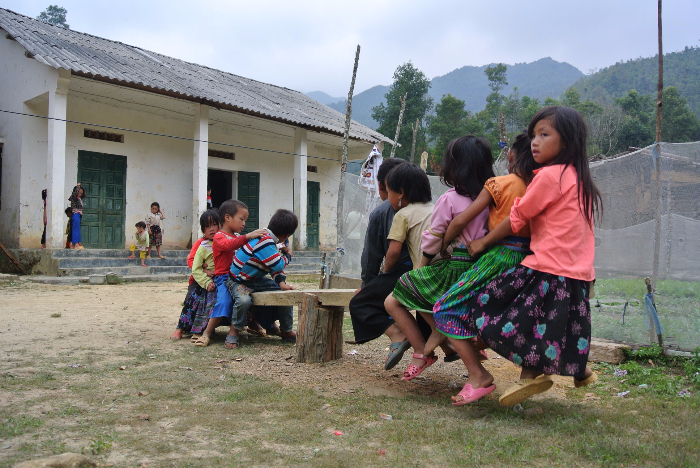
During a homestay in a Hmong village, I made friends who were patient, playful and generous with their help.
Some of the children were especially willing to play, repeat things and help me practise. Their patience made it easier to keep trying.
Immersion Tip 2: Bring a Beginner’s Curiosity
Learning another language gives you permission to be a beginner again. That can be freeing when you approach it with curiosity.
If you expect yourself to communicate like an adult native speaker, every mistake can feel embarrassing. If you accept that you are learning, mistakes become information.
Mixing up “right” and “left” or “Thursday” and “Friday” does not make you unintelligent. It means those words are not yet automatic.
For the first few days in the Hmong village, I felt helpless and depended heavily on other people. Spending time with the children helped me stop judging myself and become more appreciative and curious.
I focused on practical language, asked questions and forgave myself for mistakes.
Language learners benefit from people who care, are willing to help and have the patience to let them finish a thought.
Ask when you do not understand, but respect the other person’s time. If you forget the word for “cup”, ask again or make a note to review it later. There is no need to manufacture an embarrassing situation to make a word memorable.
Take breaks too. Several shorter sessions may be more useful than forcing yourself through hours of exhausted practice. Immersion can be as intense as you choose, so make it sustainable.
You will not understand everything, and that is fine. Stay curious. Ask questions. With someone’s help, repeat short phrases you understand and listen for feedback on how they sound. This turns mimicry into focused pronunciation practice rather than guesswork.
I got along well with the children because play made conversation easier. My Vietnamese was still far behind theirs, but they were excited to include me and teach me words.
Immersion Tip 3: Write About Your Experience

Immersion gives you plenty to process. A short journal can help you record what happened and choose what to review.
Write down a few useful words, one interaction that went well and one thing you want to try differently tomorrow.
This is a practical learning routine, not a substitute for mental-health care. If immersion is making you feel persistently low or overwhelmed, seek support and change the plan.
My clearest memories from this period are often the ones I recorded in a journal.
You can also write in your target language. A sentence or two is enough when you are a beginner. Then ask a friend, host or teacher to help you correct it.
On the reality show, I was required to write in my diary every night. I was supposed to write about the drama and love story, including who I liked and who made me jealous. Instead, I also used it to practise Vietnamese reading and writing.
I wrote a play-by-play of the day and tried to use some of the new words I had heard. My sentences were usually short and not always grammatically correct, but I improved with regular feedback. Revisiting the day also helped me remember vocabulary.
Those words came with stories because I met them in daily life. That personal context gave me extra cues when I tried to recall them. If you want another way to build those cues, try using an imaginative association.
I knew many of the words would come up again, so choosing a handful to review made sense.
If you dislike writing, keep a photo journal or record short videos instead. The useful part is taking a few minutes to notice what you learned and what you want to practise next.
Bonus Tip: You Don’t Have to Go on Reality TV
My experience was unusual. You can find immersion through study abroad, work, travel, a homestay or an adult immersion programme, but none of those options guarantees progress on its own.
What if you cannot afford to travel?
You can still create an immersion environment at home. For example, you can turn your phone into a language-immersion tool, follow media you genuinely enjoy and arrange regular conversations. Start with one or two changes you can maintain.
Keep Going, but Change What Isn’t Working
I still think about my time in Israel. I was lonely and felt at an all-time low. Once, I woke up in an alley covered in someone else’s hummus.
In Vietnam, persistence mattered, but so did changing my approach: I built relationships, stayed curious and reviewed what I was learning.
By spring 2015, I was living in Saigon, also known as Ho Chi Minh City.
My Vietnamese helped me take part in several local TV shows, compete in a Vietnamese TV competition and perform stand-up comedy in Vietnamese, where I won a cash prize.
Speaking Vietnamese opened those opportunities, alongside the relationships and circumstances that put me there.
I kept learning because I changed the conditions around me rather than repeating the same plan.
Immersion can be demanding. Keep your goal, but adjust the method, ask for support and step back if the situation is harming you. Progress does not require you to endure an unsafe or unhealthy experience.
About the author: Jeremy Ginsburg is a writer and performer who was living in Vietnam when this guest post was first published in 2015. This article recounts his experience at that time.

Social