


Months of the Year in Spanish (with Audio)

Full disclosure: This post contains affiliate links. ?
The 12 Spanish month names are close to their English equivalents, but using them naturally means learning more than the list. You’ll also need the right stress, lowercase spelling and a few simple patterns for dates.
Once those patterns are familiar, you can talk about birthdays, travel plans, appointments and anything else on your calendar.
If you want a clear structure for putting your Spanish into practice, take a look at the Fluent in 3 Months Bootcamp. It’s a 90-day programme with weekly coaching calls, a private community and a focus on speaking from day one.
Table of contents
The Months of the Year in Spanish: los meses del año
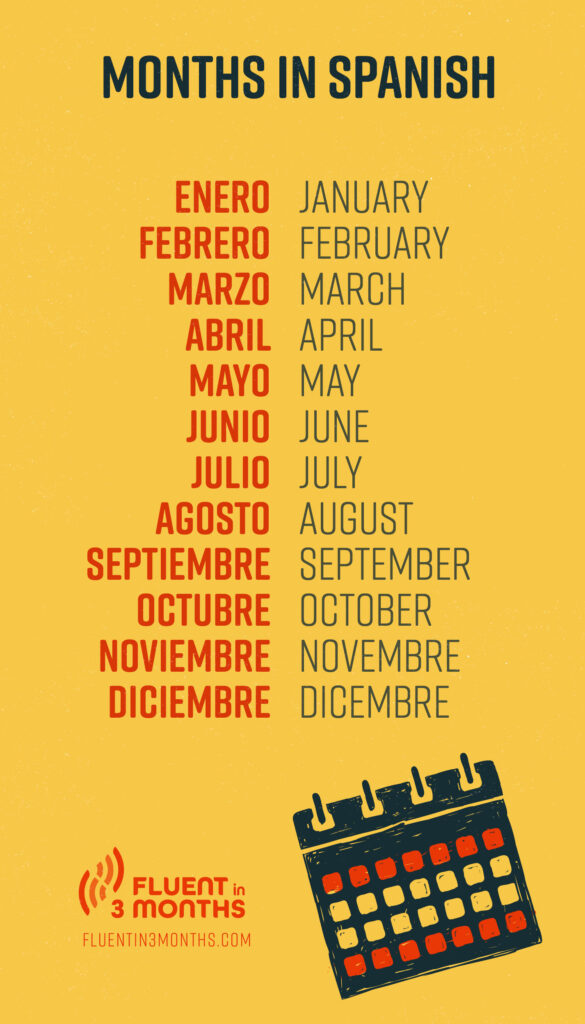
Here are the Spanish months in calendar order. They normally begin with a lowercase letter:
- enero: “January”
- febrero: “February”
- marzo: “March”
- abril: “April”
- mayo: “May”
- junio: “June”
- julio: “July”
- agosto: “August”
- septiembre: “September”
- octubre: “October”
- noviembre: “November”
- diciembre: “December”
You may also see setiembre, an accepted spelling and pronunciation of septiembre. Septiembre remains the more useful form to learn first.
Spanish spelling gives you strong clues to pronunciation, but it doesn’t make every accent sound identical. The table uses broad IPA rather than a narrow transcription of one speaker. In particular, the z in marzo and the c in diciembre sound like /s/ across most of Latin America and parts of Spain, but like /θ/, the sound in English “think”, in accents of Spain that distinguish these sounds. The sound written y in mayo and the sound written j in junio and julio also vary by region.
| English | Spanish | Broad IPA | Audio |
|---|---|---|---|
| January | enero | /eˈneɾo/ | |
| February | febrero | /feˈbɾeɾo/ | |
| March | marzo | /ˈmaɾso/ or /ˈmaɾθo/ | |
| April | abril | /aˈbɾil/ | |
| May | mayo | /ˈmaʝo/ | |
| June | junio | /ˈxunjo/ | |
| July | julio | /ˈxuljo/ | |
| August | agosto | /aˈgosto/ | |
| September | septiembre | /sepˈtjembɾe/ | |
| October | octubre | /okˈtubɾe/ | |
| November | noviembre | /noˈbjembɾe/ | |
| December | diciembre | /diˈsjembɾe/ or /diˈθjembɾe/ |
Use the recordings to hear one speaker, then listen for regional differences when you hear the same months in conversation.
Seasons in Spanish
The four common season names are useful alongside the months:
- la primavera: “spring”
- el verano: “summer”
- el otoño: “autumn” or “fall”
- el invierno: “winter”
These words are lowercase too. Remember that the calendar seasons are reversed between the northern and southern hemispheres, while many tropical places are described more naturally through rainy and dry periods. Don’t assume that verano refers to the same months everywhere.
How to Use Spanish Months in Dates and Sentences
For a full date, put the day before the month and join the parts with de:
el + day + de + month + de + year
For example, el 5 de mayo de 2026 means “May 5, 2026”. Spanish normally uses cardinal numbers for dates. For the first day of a month, you’ll hear both el uno de mayo and el primero de mayo, with preferences varying by region and context.
A month on its own often follows en, as in viajo en octubre (“I’m travelling in October”). A range uses de… a…: trabajo de junio a agosto (“I work from June to August”). Writing the month as a word also avoids the ambiguity of all-numeric dates, whose order can vary between systems.
| English | Spanish | Audio |
|---|---|---|
| “When is your birthday?” | ¿Cuándo es tu cumpleaños? | |
| “My birthday is in February.” | Mi cumpleaños es en febrero. | |
| “What is your favourite month?” | ¿Cuál es tu mes favorito? | |
| “My favourite month is June because I like summer.” | Mi mes favorito es junio porque me gusta el verano. | |
| “Do you have plans for the summer holidays?” | ¿Tienes planes para las vacaciones de verano? | |
| “In August, I’m going to visit my friend in Mexico.” | En agosto, voy a visitar a mi amigo en México. | |
| “What is the weather like in winter in Colombia?” | ¿Cómo es el clima en invierno en Colombia? | |
| “It depends on the region and the altitude.” | Depende de la región y de la altitud. |
FAQ on Spanish Months
What is “month” in Spanish?
“Month” is mes. It’s masculine, so “a month” is un mes and “the month” is el mes. The plural is meses, as in los meses del año (“the months of the year”).
Are Spanish months masculine or feminine?
The month names are masculine nouns. You can see that agreement in este marzo (“this March”) or un agosto lluvioso (“a rainy August”). You don’t normally need an article when you simply say en marzo (“in March”).
Are Spanish months capitalised?
Spanish month names normally begin with a lowercase letter, as do days of the week and seasons. Use a capital when punctuation requires it or when the month is part of an official name, historical commemoration or festivity.
- Hace calor en julio. “It’s hot in July.”
- Cinco de Mayo is the name of a commemoration, so Mayo is capitalised.
- Plaza de Mayo is a proper name for the square in Buenos Aires.
Practise Spanish Months in Context
Pick three dates that matter to you, say each one aloud and then use its month in a second sentence. A birthday, your next trip and an appointment are enough to practise the full pattern without memorising disconnected examples.
For the words that sit around these dates, use our guide to Spanish numbers and the fuller article on seasons in Spanish. You can also browse our favourite Spanish resources or our other Spanish articles.

Social