



CzechClass101 Review: Is It the Best Way to Learn Czech?

Full disclosure: This post contains affiliate links. ?
What is CzechClass101?
CzechClass101 is part of the Innovative Language family, built to get you understanding and speaking Czech from the very first lesson. Audio and video lessons taught by native speakers are its main feature.
- what it’s for:
- First contact with Czech, listening practice, vocabulary, pronunciation (the ř sound and consonant clusters), the alphabet and diacritics, and phrases and conversation material
- languages:
- Czech
- level:
- Absolute Beginner to Advanced
+ PROS
- Loads of native-speaker audio with line-by-line playback, exactly what Czech’s consonant clusters need
- Takes the ř sound seriously, with a dedicated pronunciation pathway and a free alphabet guide
- A guided, CEFR-aligned learning path, so there’s no guessing where to begin
- A deep beginner library, including the clever conjugation-with-gestures series
- Excellent for vocabulary, with the Core 2000 and phrase-friendly flashcards
- Genuinely affordable, with a free tier and a 60-day guarantee
- CONS
- Grammar is taught incidentally, so the seven cases and verb aspect need a companion grammar resource
- Content thins sharply above B1, with very little Upper Intermediate material
- Too much English in some lessons
- No single path to follow beyond the core tracks
- The mobile app doesn’t have all the best features
Quick Fire Review
A brilliant audio-and-vocabulary engine for Czech that solves the scary pronunciation and carries you to conversational level; pair it with a grammar resource for the seven cases, and expect thin material past B1. 4.1/5.
Czech has one of the scariest reputations in Europe, and it comes with a party trick to prove it: “Strč prst skrz krk” (“stick a finger through your neck”) is a fully grammatical Czech sentence without a single vowel in it. Add ř, a sound that exists in no other language and that Czech children themselves can take until age six or seven to master, and you can see why plenty of learners take one look and quietly pick Spanish instead. The twist is that the sounds are only where Czech sounds impossible. The real wall sits in the grammar: seven cases that reshape nearly every noun, adjective, pronoun and numeral in a sentence, verbs that come in matched pairs, and three genders deciding which of the many declension patterns a word follows. The US Foreign Service Institute puts Czech in Category III, at roughly 1,100 classroom hours to professional working proficiency, about double what it quotes for French, Spanish or Italian.
Czech does hand you one genuine gift in return, though: the spelling is phonetic. Once you can read its diacritics, every word tells you exactly how to say it, with none of English’s “through, though, tough” chaos. So the honest one-line summary of the language is this: brutal grammar bolted onto consistent, learnable spelling.
I’ve reviewed the Innovative Language “101” family across more than a dozen languages now, including RussianPod101 for Czech’s big Slavic cousin with a case system of its own, and SpanishPod101 down at the friendlier end of the difficulty scale. Czech is also personal for me: back in 2009 I spent three months learning it in Prague, in the early days of this blog, so I know first-hand which parts of the language look terrifying and turn out to be fine, and which parts quietly eat your study hours.
So the question I want to answer here is a specific one: does CzechClass101 deal with the things that genuinely make Czech hard, and how far can it actually carry you?
What Makes Czech So Hard to Learn (and What a Course Has to Handle)
Before we get to the platform, let’s lay out what a Czech learner is really up against. These are the yardsticks I’ll measure CzechClass101 against.
1. Consonant clusters with no vowels. That “strč prst skrz krk” sentence works because Czech lets r (and l) act as the core of a syllable, a trick English simply doesn’t have. It’s the standard example Czech teachers reach for, and it explains why the language sounds impossible long before it is impossible. Your ear and mouth need training on clusters that look like typing errors, and a good course has to supply loads of native audio to do it.
2. The ř sound. A trilled r and the sound of ž produced at the same time, and found in no other language on Earth. Native kids can take until six or seven to nail it, and it turns up in everyday words like řeka (river) and tři (three), so there’s no dodging it.
3. Seven grammatical cases. Nominative, genitive, dative, accusative, vocative, locative, instrumental. They apply to nouns, adjectives, pronouns and even numerals, across 14 or more noun patterns plus common irregular stem changes. Where English says “a book” every time, Czech gives you kniha, knihy, knize and more depending on what the book is doing in the sentence. This, and honestly this alone, is the wall.
4. Verb aspect. Nearly every Czech verb comes in two versions, one for an ongoing or repeated action (imperfective) and one for a completed action (perfective), and picking the right one isn’t optional. It changes the meaning of the sentence the way tense does in English.
5. Three genders driving everything. Masculine (further split into animate and inanimate), feminine and neuter, and the gender decides which of those declension patterns a noun follows. Get the gender wrong and every ending downstream of it goes wrong too.
6. The redeeming feature: completely consistent spelling. Czech uses the Latin alphabet, 42 characters in all, with three diacritics doing the extra work: the čárka marks a long vowel, the háček softens a consonant, and the kroužek is the little circle that only ever sits on ů. One sound, one letter. Once you can read the diacritics, you can pronounce any Czech word correctly on sight, which is a luxury learners of English or French can only dream about.
Keep those six in mind. Here’s how CzechClass101 stacks up.
Getting Started with CzechClass101
Like the rest of the 101 family, CzechClass101 is built around short audio and video lessons taught by native speakers, organised into level-based pathways: Absolute Beginner, Beginner, Intermediate, Upper Intermediate and Advanced.
Signing up is painless. You create a free lifetime account with just an email (no card needed), pick your level, and you’re in. New accounts also get a 7-day Premium trial, so you can test the paid features before spending anything.
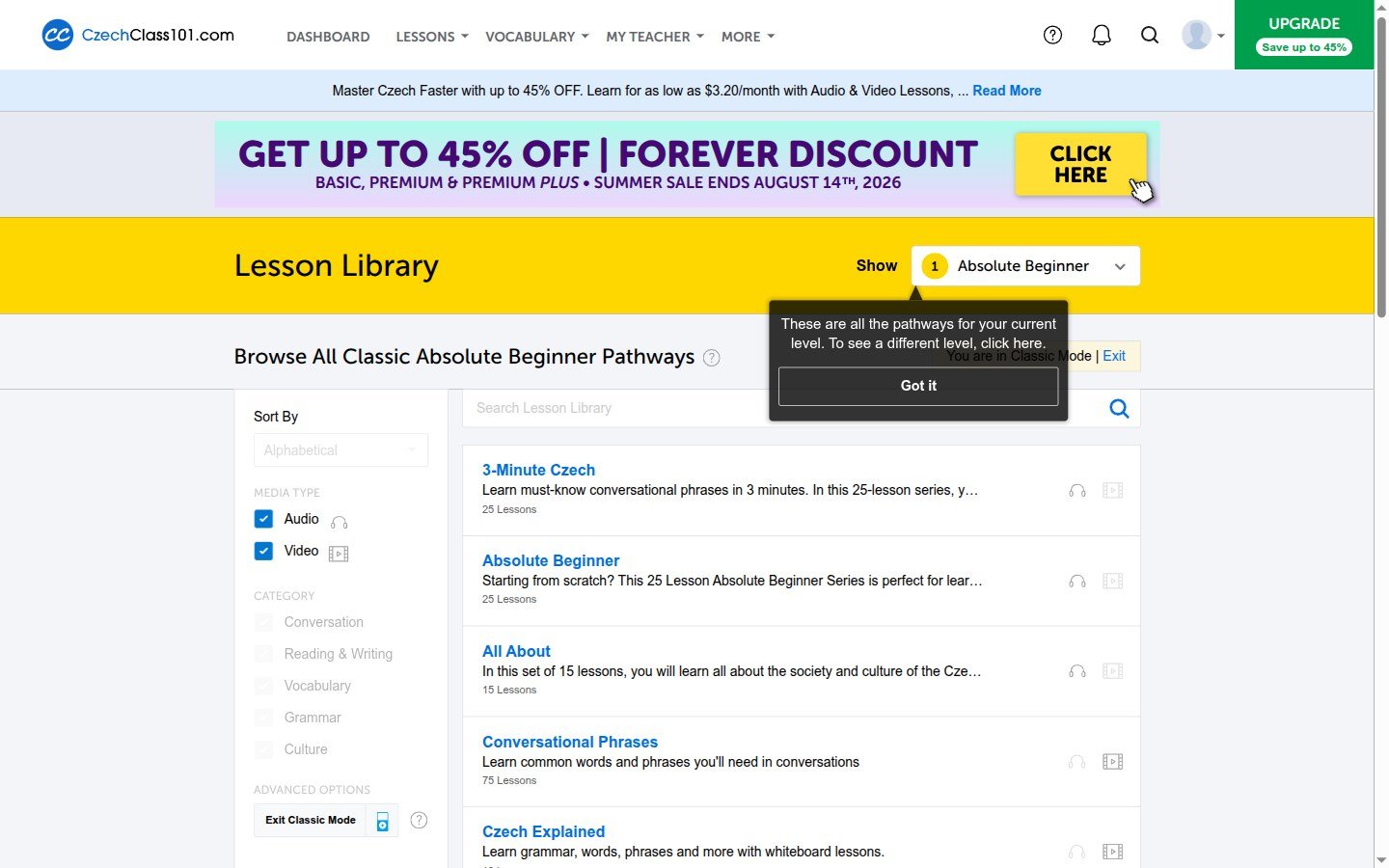
Your dashboard then hands you a learning pathway for your level, so you’re never staring at a wall of lessons wondering where to start. The core routes are mapped to the CEFR levels too: “Level 1 Czech” is 29 lessons with 24 assessments, aligned to CEFR A1, and it sits alongside loads of themed beginner pathways, from a 50+ lesson Survival Phrases course to task-based mini-series like “Can Introduce Yourself” and “Can Talk About Your Hobbies”. At Absolute Beginner level alone there are 28 pathways to work through, which is a genuinely generous starting library for a smaller language.

Pronunciation and the Alphabet: Where CzechClass101 Is Strongest
Remember that Czech’s fearsome sounds are the part of the language that’s actually solvable, and this is exactly where CzechClass101 puts its effort.
The site’s free Czech alphabet page walks through all 42 characters with pronunciation notes for each letter and diacritic, and it takes ř head-on rather than waving at it: “ř is pronounced by pressing the tip of the tongue on the palate, while the rest of the tongue is free to vibrate.” That’s a real articulatory description, the kind of concrete instruction most courses never give you, and there’s a free downloadable practice-sheets PDF to go with it.
Beyond the alphabet page there’s a dedicated Pronunciation pathway at Absolute Beginner level, and because every lesson in the course is built on native-speaker recordings, with slowed-down, line-by-line playback on the paid tiers, those vowel-free consonant clusters get drilled into your ear the way they need to be: by hearing them, over and over, at natural and then slow speed.
And here’s where Czech’s phonetic spelling pays off in practice. Front-load the sound system in your first few weeks with these tools and the pronunciation battle is largely won, because from then on every new word you meet on the page tells you exactly how to say it. Of all six challenges on my list, the scary-sounding ones are the ones CzechClass101 handles best.
Inside a CzechClass101 Lesson
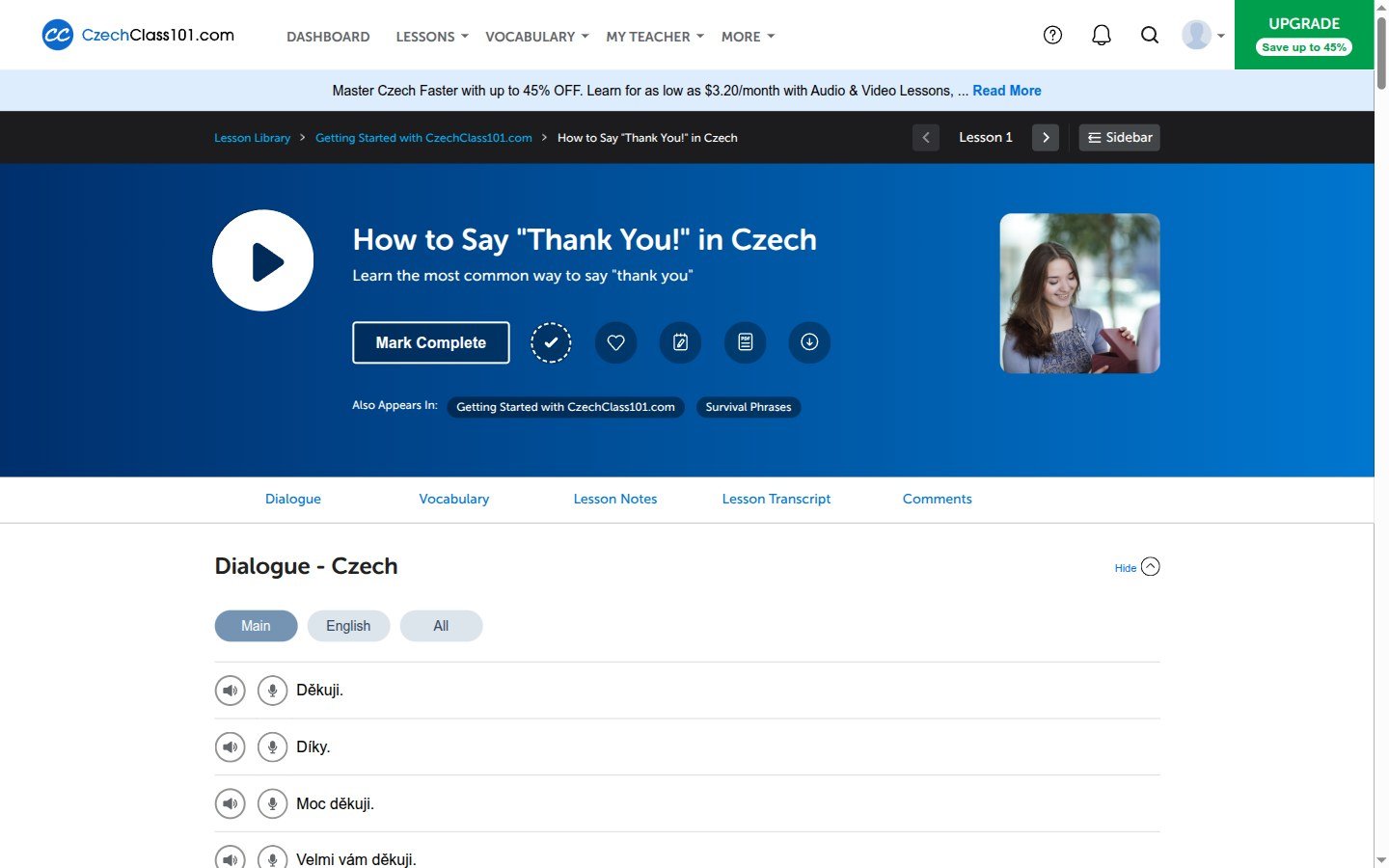
A typical lesson is short (most run 3 to 15 minutes) and follows a consistent shape: a native dialogue, a slow line-by-line breakdown, vocabulary with natural-then-slow pronunciation, a grammar point, and a cultural note. You get the audio, the full scripted dialogue, a vocab list, and downloadable lesson notes as a PDF.
There’s one series here I haven’t seen elsewhere in the 101 family and want to flag: “Fast Czech Conjugation with Gestures”, a 10-lesson pathway that teaches verb forms through movement and visuals. It sounds gimmicky and it’s actually rather clever, because tying endings to a physical gesture gives your memory a second hook, and Czech verb endings need every hook they can get.
Now the honest part. Browsing the whole lesson library, the framing is overwhelmingly phrase-first and task-based: “Can Ask About Well-being”, “Can Introduce Yourself”, conversation topics, survival situations. What you won’t find is the case system built up as its own deliberate, sequenced syllabus. You’ll hear correct endings in every dialogue, and some of it will sink in through sheer exposure, but nobody sits you down and teaches you the declension tables, when the genitive fires, or how to choose between a perfective and imperfective verb. For a language where seven cases are the central difficulty, that’s the single most important thing to know before you subscribe: CzechClass101 will give you a brilliant ear and a big phrase bank, and you should pair it with a dedicated grammar resource (a Czech grammar workbook or a structured textbook) from early on. Treat the two as a team, with CzechClass101 supplying the audio and vocabulary and the grammar book supplying the system, and you’ve got a genuinely solid setup. Rely on CzechClass101 alone and the cases will stay fuzzy.
The Study Tools
On a Premium plan, the lessons are wrapped in a familiar set of study tools:
- Spaced-repetition flashcards and a personal word bank, where you save words straight from any lesson. With Czech’s declensions, saving whole phrases rather than bare words is the smart move, and the tools let you do exactly that.
- Line-by-line audio, the feature that earns its keep most for a consonant-cluster language.
- Multiple-choice assessments dotted through the pathways to check a section has actually gone in.
- The Czech Core 2000, a frequency-ranked list of the 2,000 most useful words, as a ready-made vocabulary backbone.

The Mobile App
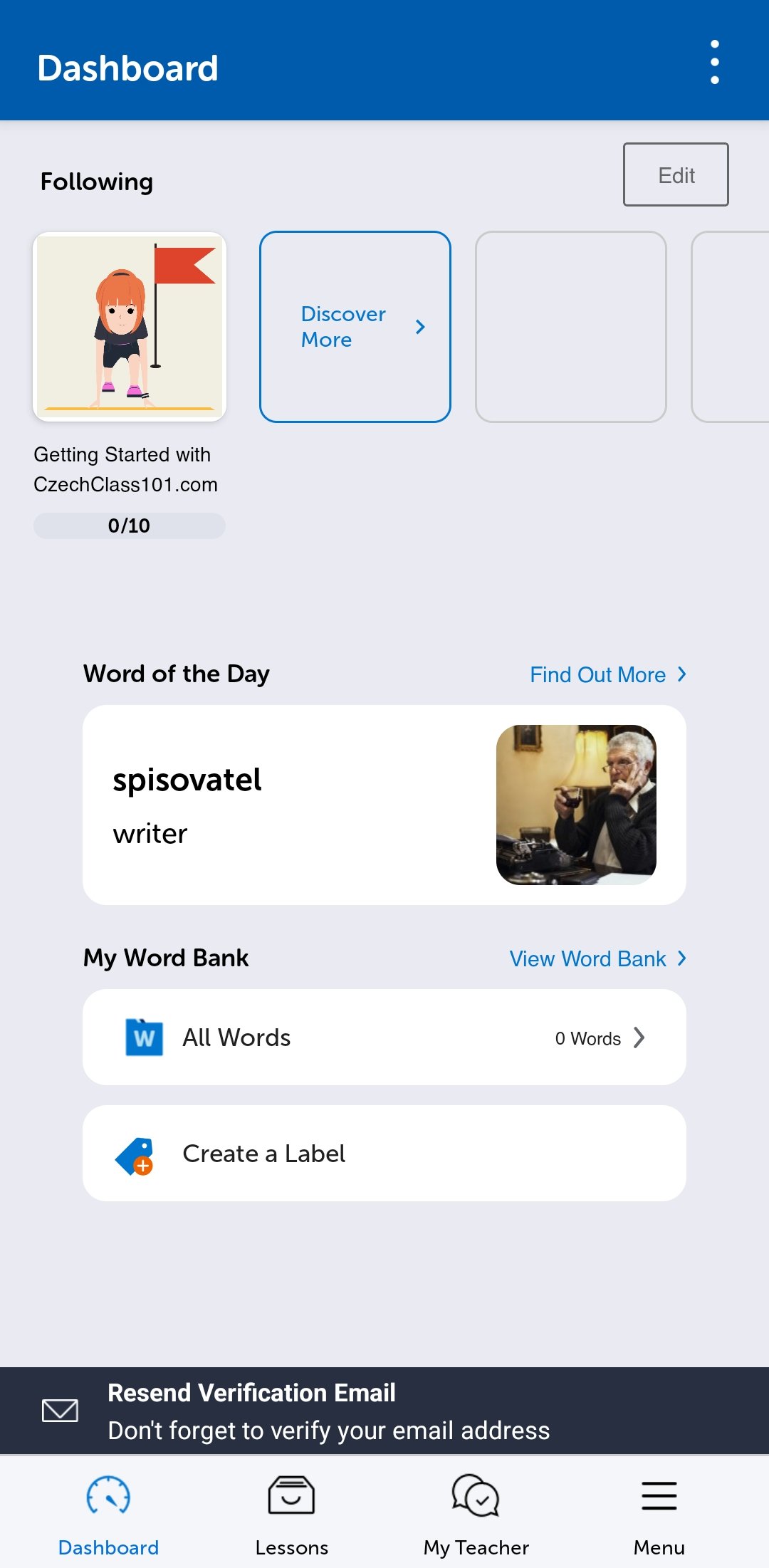
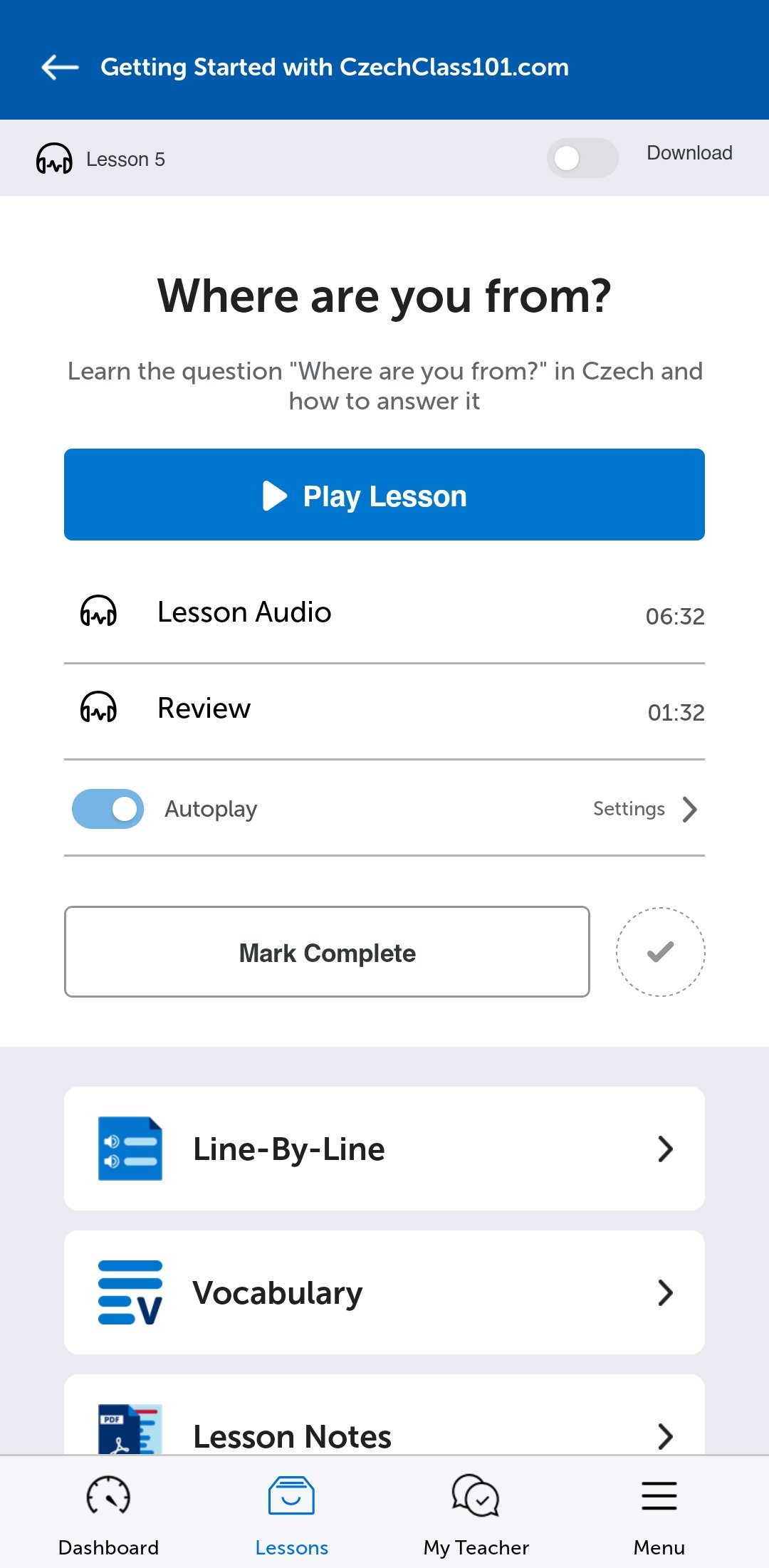
CzechClass101 shares one app with the whole Innovative Language family (it’s called “Innovative Language Learning”; you pick Czech after installing). It syncs with your account, so a lesson finished on your laptop shows as done on your phone, and you can download lessons for offline listening, which suits the podcast-style format perfectly. It’s well rated too, sitting at 4.4 out of 5 on Google Play across more than 42,000 reviews.
The usual family caveats apply: the app is gated by your subscription tier just like the website, some users report freezing and crashing that has persisted across updates, and a few of the best study features live more comfortably in the browser. The workaround is the same one I use elsewhere: pull the site up in your phone’s browser when you want the full experience.
What Other Czech Learners Say
I dug through the independent reviews to test my own take, and the pattern is consistent.
The praise: learners call it extremely useful for extra listening practice, with natural dialogues that explain the grammar, vocabulary and cultural context alongside the audio, and the family’s real-native-speaker recordings get the usual love compared with the robotic text-to-speech some rivals lean on.
The criticism centres on one theme: depth. The most common warning from Czech learners specifically is that you’ll likely run out of material too quickly if you make it your only resource, and my own dig through the lesson library confirms it with numbers. Absolute Beginner has 28 pathways and Beginner has 15, but Intermediate drops to 8, and Upper Intermediate has exactly one pathway on the entire site, the 25-lesson core track and nothing else. Advanced looks healthier at 11 pathways until you open them and find mostly “Top 10 Czech Writers” and “Top 10 Czech Cities” cultural lists, which are pleasant listening but won’t build your grammar. Even the core tracks thin out: Level 1 gives you 5 hours 35 minutes of material, while Level 4 gives you 1 hour 7 minutes. Learners also mention too much English inside the lessons, no single obvious path once you’re past the curated levels, and a platform that can be confusing to find your way around. The recurring verdict, which I share, is that it’s best used as a strong supplement rather than a standalone course.
Pricing and Plans
CzechClass101 runs the same four-tier structure as the rest of the family:
| Plan | Roughly… | What you get |
|---|---|---|
| Free | Free forever | The 50+ lesson Survival Phrases course, the first 3 lessons of every pathway, Word of the Day, 100+ vocab lists, the app, plus a 7-day Premium trial |
| Basic | ~$4/mo | Everything free + access to all lessons and in-depth PDF lesson notes |
| Premium | ~$5–10/mo | Everything in Basic + line-by-line audio, flashcards, word bank, assessments, and the Czech Core 2000 |
| Premium PLUS | ~$13–23/mo | Everything in Premium + your own teacher, hand-graded assessments and a personalised study plan |
A few honest notes on the pricing. The headline per-month figures are based on the longest (24-month) plan, so the real price depends on the billing period you pick; check the checkout before you commit. Innovative also runs a more-or-less permanent discount (often around 45% off), so you should rarely pay the “full” list price. There’s a 60-day money-back guarantee, which takes the risk out of trying Premium. One difference from some of the bigger 101 languages: there’s currently no one-off Lifetime option for Czech, so it’s subscriptions only. Expect the usual upsell banners nudging you up the tiers; mildly annoying, easy to ignore.
For most people, Premium is the sweet spot: that’s the tier with the flashcards, the line-by-line audio and the Core 2000. Premium PLUS only makes sense if you specifically want a teacher checking your work, though given how thin the upper levels are, a good independent tutor may serve you better at that stage anyway.
Pros and Cons
Pros
- Loads of native-speaker audio with line-by-line playback, exactly what Czech’s consonant clusters demand.
- Takes ř seriously, with a real articulatory explanation, a dedicated pronunciation pathway and a free 42-character alphabet guide.
- A guided, CEFR-aligned learning path, so you’re never guessing what to study next.
- A genuinely deep beginner library, with 28 pathways at Absolute Beginner alone, plus the clever conjugation-with-gestures series.
- Excellent for vocabulary, with the Core 2000 and flashcards built for saving whole phrases.
- Genuinely affordable, with a usable free tier and a 60-day guarantee.
Cons
- Grammar is taught incidentally, not systematically. The cases, verb aspect and gender never get a built-up syllabus, so for Czech you need a dedicated grammar resource alongside it. I’d call this non-negotiable rather than optional.
- The catalogue falls off a cliff above B1: Upper Intermediate has a single pathway, exactly where a seven-case language needs the most support.
- Advanced content is mostly cultural trivia lists, not grammar-building material.
- Too much English in the lessons for some learners’ taste.
- No single path to follow beyond the core tracks, and the platform can be confusing to move around.
- The app is gated and a touch lighter than the full website.
Who CzechClass101 Is (and Isn’t) For
It’s a brilliant fit if you’re starting Czech from zero and want to reach comfortable conversational level; if you learn well by ear and want Czech in your headphones on the commute; if the pronunciation is what’s been scaring you off, because that’s the part this course genuinely solves; or if you’re heading to Prague or Brno and want practical, modern phrases rather than textbook stiffness.
It’s less ideal if you’re past B1 and hunting for material to push towards real fluency, or if you want one resource that will drill the case system into you. In both situations, use CzechClass101 for listening and vocabulary and pair it with a proper grammar workbook, and add a tutor once the upper-level material runs dry.
The Verdict
CzechClass101 is at its best exactly where Czech looks worst. It floods your ears with native audio for those vowel-free clusters, it explains ř properly instead of hoping you’ll pick it up, and it cashes in Czech’s one great mercy, the phonetic spelling, by teaching you the alphabet and diacritics free of charge. The beginner library is deep and well organised, and it will take you from zero to holding real conversations more pleasantly than any textbook.
The honest limits are just as clear. The grammar that makes Czech genuinely hard is absorbed by exposure rather than taught as a system, and the material thins dramatically past B1, with a single Upper Intermediate pathway on the whole site. So my advice is to use it for what it’s brilliant at: make it your audio and vocabulary engine for the first year or two, run a grammar workbook alongside it from day one, and plan for a tutor or native materials beyond that.
My rating: 4.1 out of 5.
If you want to give it a go, you can start with CzechClass101 here. That link also carries our reader discount, applied for you automatically at checkout, so you won’t be paying full list price. Set up a free account, spend a week with the pronunciation pathway, and see if Czech stops sounding impossible.

Social