


DanishClass101 Review: Can You Really Learn Danish by Ear?

Full disclosure: This post contains affiliate links. ?
What is DanishClass101?
DanishClass101 is part of the Innovative Language family, built to get you understanding and speaking Danish from the very first lesson. Audio and video lessons taught by native speakers are its main feature.
- what it’s for:
- First contact with Danish, listening comprehension, pronunciation (the stød, the soft d and Danish's swallowed sounds), vocabulary, and phrases and conversation material
- languages:
- Danish
- level:
- Absolute Beginner to Advanced
+ PROS
- A dedicated pronunciation pathway, with the stød getting its own named lesson
- Loads of native-speaker audio, exactly what a learn-by-ear language demands
- Line-by-line playback and a voice recorder for the soft d and swallowed endings
- A guided, CEFR-aligned learning path, so there’s no guessing where to begin
- Danish’s easy grammar means light grammar teaching costs you little here
- Genuinely affordable, with a free tier and a 60-day guarantee
- CONS
- Too much English in the lessons, especially at beginner level
- The library is beginner-heavy and thins out fast past intermediate
- Uneven pathway structure, so pick your track deliberately
- Best as a supplement, so pair it with a textbook past intermediate
- The mobile app doesn’t have all the best features
Quick Fire Review
Purpose-built ear training for the hardest thing about Danish, its pronunciation, with line-by-line audio and a stød lesson by name; pair it with a meatier resource past intermediate. 4.1/5.
Danish plays a trick on you. On paper it looks like one of the easiest languages an English speaker can take on: the grammar is light, the word order feels familiar, and written Danish is so close to Norwegian that the two can happily read each other’s newspapers. Then a Dane opens their mouth, and half the letters you so carefully learned simply don’t turn up. Danish is spelled one way and swallowed another, to the point that even Swedes and Norwegians, who read it comfortably, famously struggle to follow it in conversation. This is a language you can’t learn from the page; you have to learn it by ear.
The US Foreign Service Institute agrees with the “easy on paper” half: Danish sits in Category I, the easiest tier for English speakers, at roughly 600 classroom hours, the same band as French and Spanish. Yet plenty of learners will tell you it takes noticeably longer than its Category I siblings in practice, and that gap is entirely the listening wall. The grammar was never the problem.
I’ve reviewed the Innovative Language “101” family across more than a dozen languages now (you might have seen my GermanPod101 review, covering Danish’s big Germanic cousin, or my SpanishPod101 one), and most of the Fluent in 3 Months team have leaned on these courses for their own language missions. The format is the same everywhere: short, graded audio and video lessons taught by native speakers, which on the face of it is exactly the right shape of tool for a language that has to be learned by ear.
So the question I really want to answer is a specific one: does DanishClass101 actually train your ear for the Danish that Danes speak?
What Makes Danish Different (Hard Out Loud, Easy on Paper)
Before we get to the platform, let’s be honest about what a Danish learner is actually up against. These five challenges, plus one big consolation, are the yardstick I’ll measure DanishClass101 against.
1. The stød. Danish’s most famous feature is a little glottal catch, a creak in the voice, that isn’t written anywhere in the spelling yet can be the only thing separating two words. Hun (she) and hund (dog) sound identical apart from the stød. There’s no letter for it and no spelling rule to lean on; you just have to know it’s there, which means you have to have heard it, many times, from people who use it properly.
2. The soft d. Textbooks routinely tell you det bløde d is “like the th in this”. It isn’t. Your tongue tip sits low near your bottom front teeth while the body of the tongue bunches and pulls back, with no friction at all, and to an English ear the result lands somewhere between a dark “l” and a swallowed “w”. The written description and what your mouth actually does barely match, so this is another skill you pick up by ear and imitation, never from a rule on a page.
3. Swallowed endings. Danish is famous, even among Scandinavians, for dropping and mumbling the ends of its words in connected speech. The gap between how a sentence is spelled and how it actually comes out is unusually wide for a Germanic language, which is why learners who read Danish comfortably can still be completely lost in a Copenhagen café.
4. A huge vowel inventory. Danish has one of the biggest collections of vowel sounds in Europe, commonly counted at 20 or more depending on how you treat the diphthongs. Several have no clean English equivalent, and without targeted listening practice they blur into one another.
5. The numbers. From 50 upwards, Danish counts in twenties. Halvtreds, the word for 50, is a fossilised phrase meaning “half-third-times-twenty”, which works out as two and a half twenties. Compound numbers also run in the opposite order to English, so femoghalvtreds is “five-and-fifty”, meaning 55. It’s regularly called the hardest counting system in Europe, and it’s usually a learner’s first “wait, what?” moment with the language.
6. The consolation: the grammar really is easy. Danish verbs don’t change for person or number at all; er covers “am”, “is” and “are” in a single word. There are only two noun genders, and about three-quarters of nouns take the same one, which is a far lighter load than German’s three genders or the full conjugation tables of French or Spanish. Basic word order is subject-verb-object, just like English, with the same inversion habit English half-remembers from its own questions. Hold on to this point, because it’s the crux of the whole review: Danish’s real obstacle is your ear. The rules themselves are some of the friendliest in Europe, so a Danish course lives or dies on how well it trains your listening.
Keep those six in mind. Here’s how DanishClass101 stacks up.
Getting Started with DanishClass101
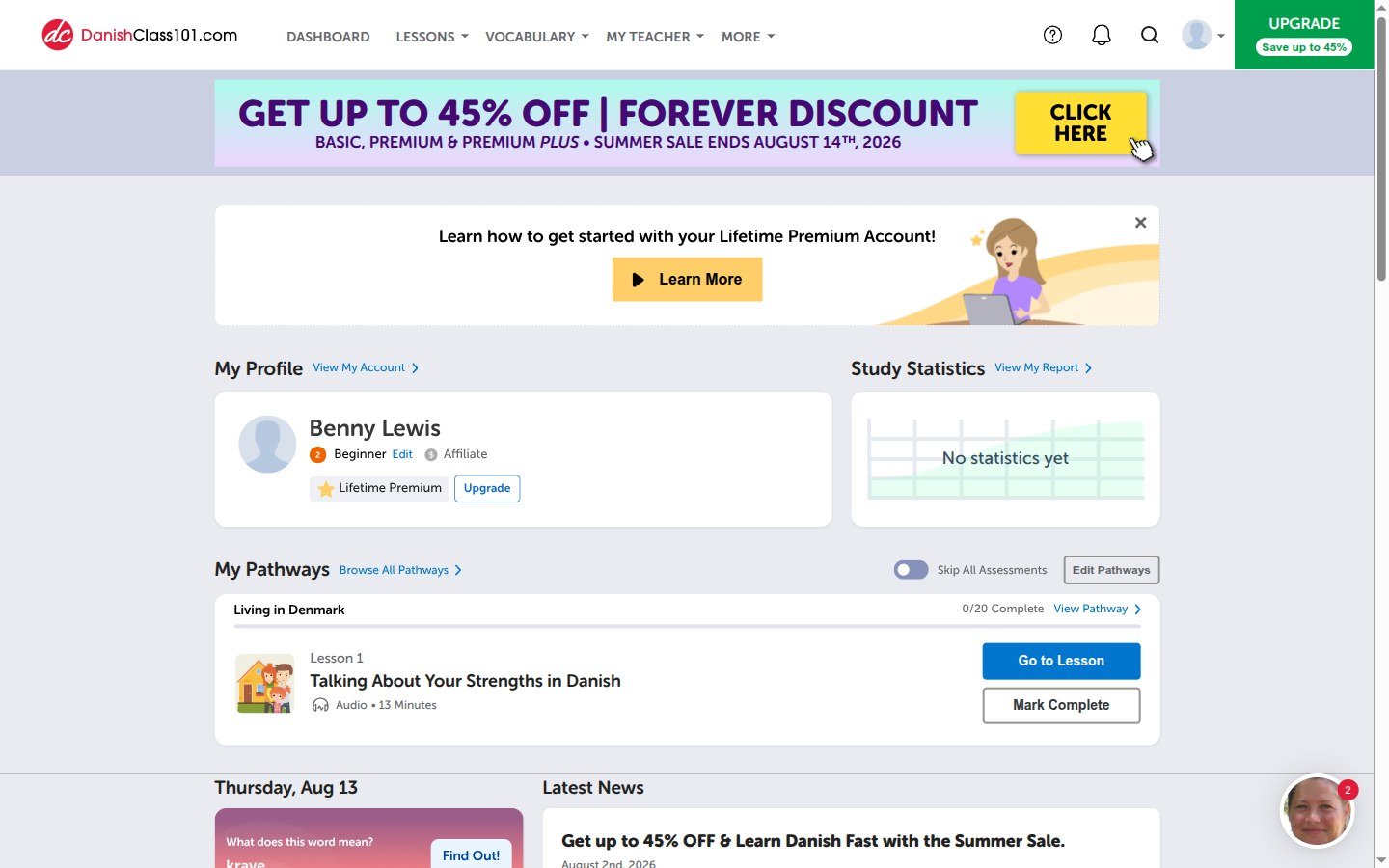
Signing up is painless. You create a free lifetime account with just an email address (no card needed), pick your level, and you’re in. Not sure where you sit? Start at Absolute Beginner and move up later. New accounts also get a 7-day Premium trial, so you can test the paid features before committing to anything.
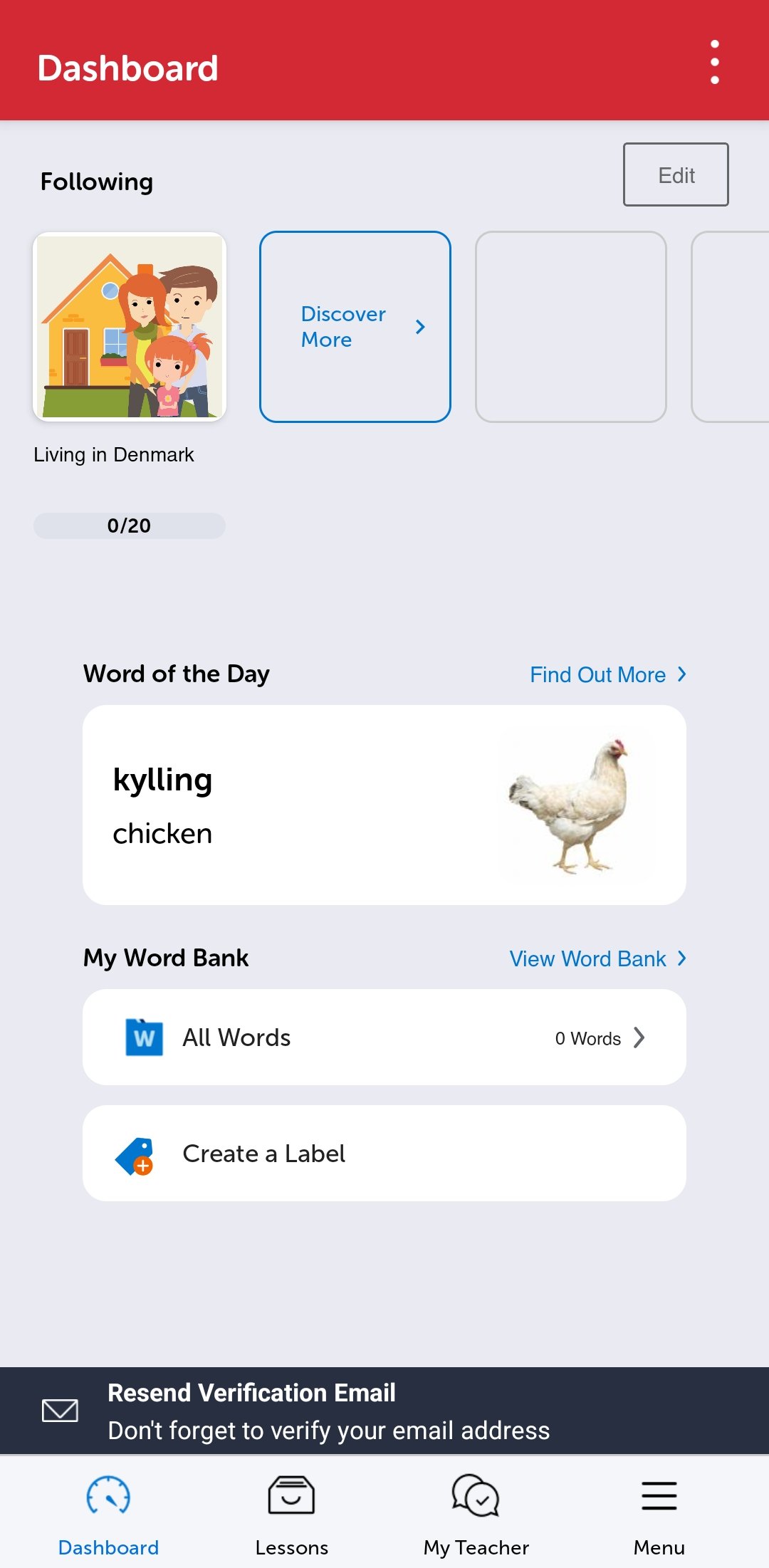
Once inside, your dashboard hands you a learning pathway for your level rather than dumping you into a pile of lessons. The core route is the “Level N Danish” track, mapped to the CEFR levels employers and exams actually use: Level 1 is a 30-lesson pathway aligned to A1, and the series runs all the way up to a Level 5 track at C1. Around that spine sit dozens of themed pathways, from survival phrases to culture series.
How It Handles the Pronunciation (the Whole Game for Danish)
This is the section that decides the review, and it’s where DanishClass101 genuinely delivers.
There’s a dedicated five-lesson pronunciation pathway in the Absolute Beginner tier that goes straight at the hard parts by name: the consonants, the vowels and diphthongs, regional accents, common pronunciation mistakes, and, best of all, a lesson called “Stress and Stød in the Danish Language”. Most resources wave at the stød in a footnote; here it gets a named lesson treating it as the learnable, hearable feature it is, with native audio to copy.
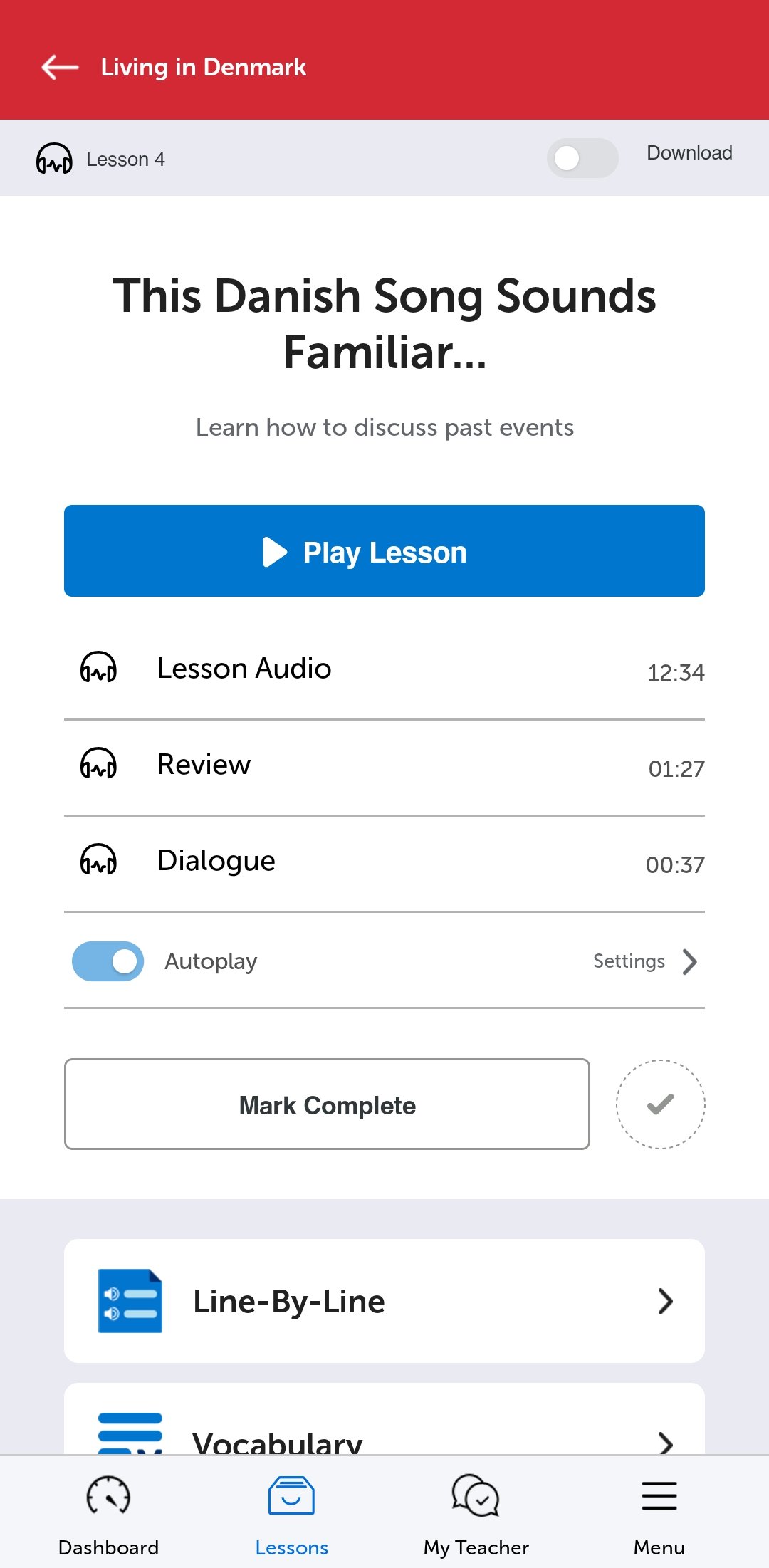
The deeper tools carry it on from there. On the paid tiers, every lesson’s dialogue can be played line by line: the same sentence in natural Danish, in a phonetic breakdown, and in English translation, so you can isolate the exact syllable that’s tripping you up and loop it. Premium also includes a voice recorder that plays your attempt back against the native speaker’s. For something like the soft d, where the textbook description actively misleads you, hearing your own recording next to the real thing is about the only honest feedback you can get short of a patient Danish friend. And slowed-down audio runs right through the platform, which for a language that mumbles its endings is loads more useful than it sounds.
In other words, the course’s answer to “Danish must be learned by ear” is built in rather than bolted on. Of all the challenges on my list, the pronunciation wall is the one DanishClass101 is best equipped to knock down.
Inside a DanishClass101 Lesson
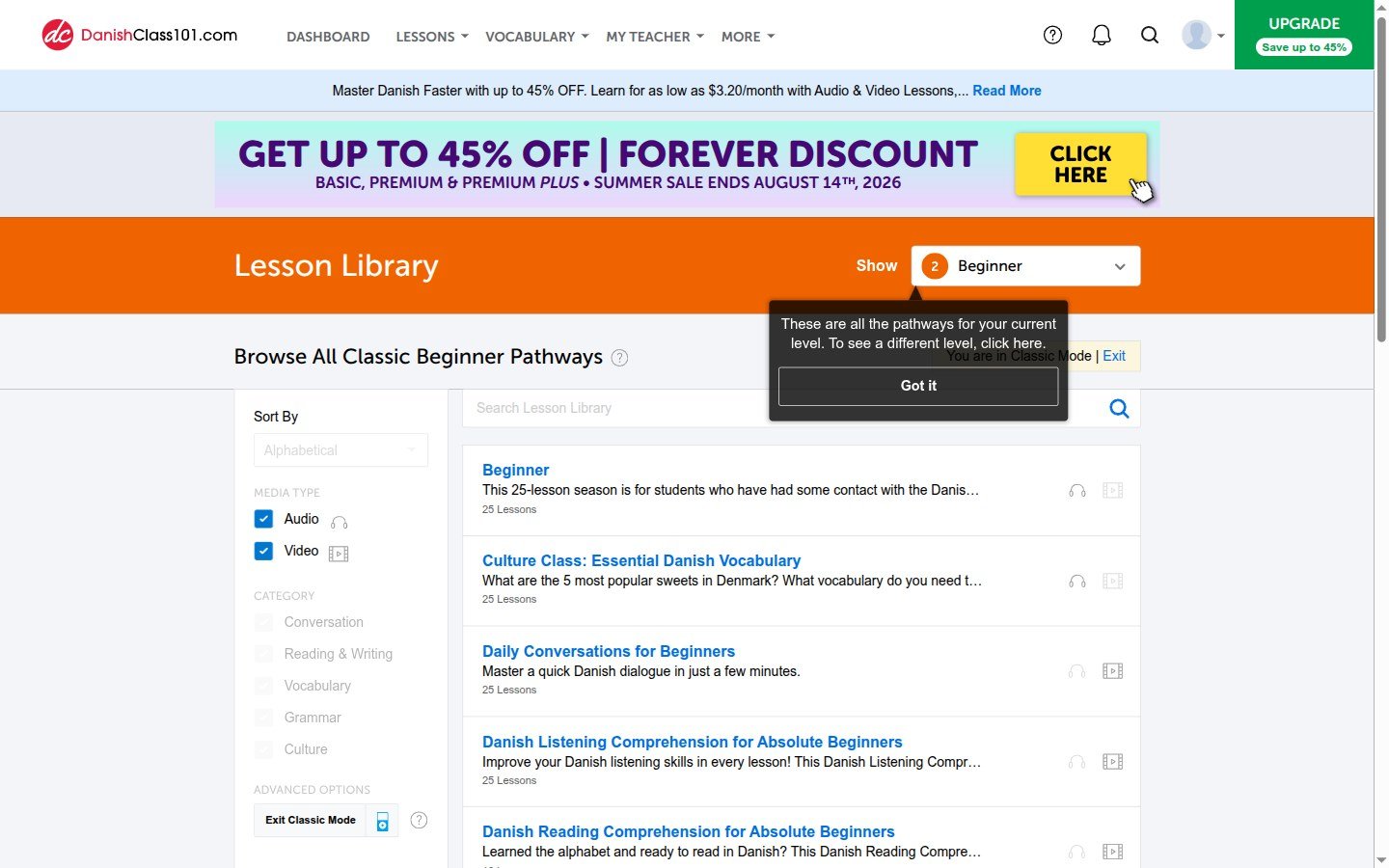
A typical lesson is short (most run 3 to 15 minutes) and follows a consistent shape: a native dialogue, a slow line-by-line breakdown, vocabulary with natural-then-slow pronunciation, a grammar point, and a cultural note. You get the audio, the full scripted dialogue, a vocab list, and downloadable lesson notes as a PDF.
That dialogue-first format suits Danish unusually well. Swallowed endings and the stød are absorbed through repeated exposure to real speech, and hearing the same line at full speed, then slowed, then broken down, is precisely how the spelling-versus-sound gap closes. Even the grammar-light approach, my standard caveat for this whole family of courses, costs you less here than it would in Russian or German, because Danish simply doesn’t have much grammar to drill.
The honest downside is the amount of English: the hosts spend a fair chunk of each lesson explaining in English, especially in the beginner tiers, so your minutes of actual Danish are lower than the runtime suggests. It tapers as you climb the levels, and the workaround is the dialogue-only playback, which strips a lesson down to just the Danish. Use it early and often.
The Study Tools
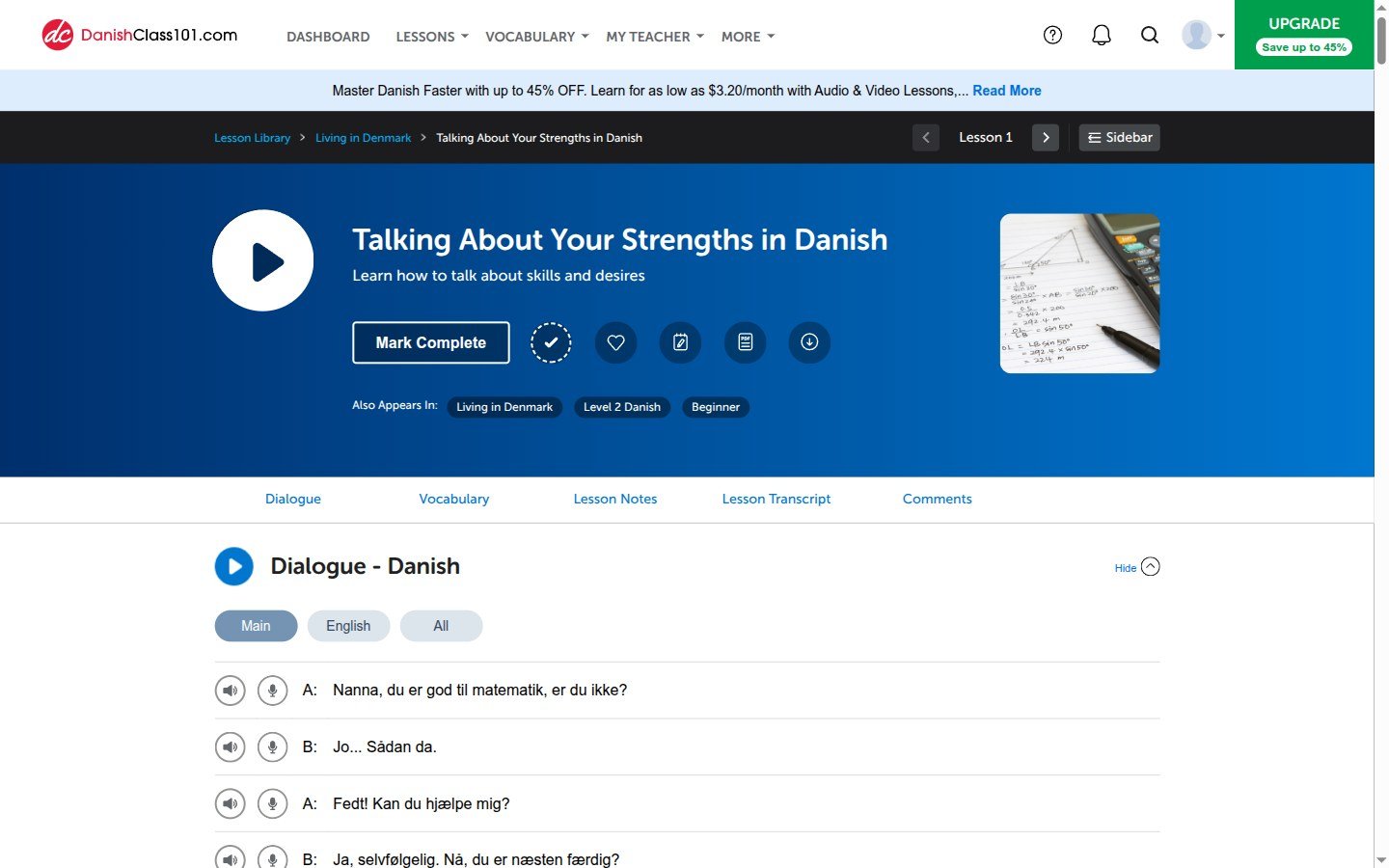
On a Premium plan, the lessons are wrapped in a solid set of study tools:
- Spaced-repetition flashcards and a personal word bank, where you save words straight from any lesson, with the audio and example sentences filled in for you.
- A Grammar Bank collecting the course’s grammar points in one place (a light job in Danish, but handy for the quirks like word order after “ikke”).
- Multiple-choice assessments to check a section has actually gone in.
- The voice-recorder pronunciation tool, the standout feature for this particular language.
- The Danish Core 2000, a ready-made backbone of the 2,000 most useful words and phrases.

The Mobile App
DanishClass101 shares one app with the whole Innovative Language family (it’s called “Innovative Language Learning”; you choose Danish after installing). It syncs with your account, so a lesson you finish on your laptop shows as done on your phone, and you can download lessons for offline listening on the commute. It’s well rated too, sitting at 4.7 out of 5 across tens of thousands of reviews; The Guardian’s line, quoted on the listing, is “This is always my first port of call when starting a new language.”
Two caveats. Some users report the app freezing or crashing around particular updates (the developer does respond and fix, but it happens), and as with the rest of the family, a few of the best study features live more comfortably in the browser. The workaround is the same one I use elsewhere: pull the site up in your phone’s browser when you want the full experience.
What Other Danish Learners Say
Danish is one of the smaller lines in the Innovative family, so there’s less learner chatter about it than for the Spanish or Japanese courses, but the independent reviews that exist form a clear pattern, and it matches what I found in the library myself.
The praise: loads of value at an affordable price, and genuinely strong for listening comprehension, which happens to be exactly the skill Danish demands most. The Premium extras get singled out as the useful ones: the flashcards, word bank and grammar bank all auto-fill with audio, translations and example sentences, so building a review routine takes no setup.
The criticism is worth being upfront about. The English-heavy lessons come up again, and so does the structure: some pathways are tidy, well-sequenced tracks, while others are closer to a loose topic grab-bag (“Lessons for Your Flight to Denmark” sits in the library alongside the core CEFR tracks), so it pays to pick your pathway deliberately rather than trusting every recommendation. The biggest one, though, is depth. The library is heavily weighted towards beginners: by my own count, the Absolute Beginner tier has roughly three times as many pathways as Intermediate, Upper Intermediate is thin, and a chunk of the Advanced material is culture listicles rather than core conversation work. Even the flagship track shows it, with the Level 5 pathway running shorter than Level 1. The most thorough independent review, at All Language Resources, rates it 4.0 out of 5 and calls it better as a supplementary resource, and on the depth point I think that’s fair.
Pricing and Plans
DanishClass101 runs the same four-tier structure as the rest of the family:
| Plan | Roughly… | What you get |
|---|---|---|
| Free | Free forever | The first 3 lessons of every pathway, Word of the Day, 100+ vocab lists, the app, plus a 7-day Premium trial |
| Basic | ~$4/mo | Everything free + access to all lessons and in-depth PDF lesson notes |
| Premium | ~$5–10/mo | Everything in Basic + line-by-line audio, flashcards, word bank, the Grammar Bank, assessments, the voice recorder, and the Danish Core 2000 |
| Premium PLUS | ~$13–23/mo | Everything in Premium + your own teacher, hand-graded assessments and a personalised study plan |
A few honest notes on the pricing. The headline per-month figures are based on the longest (24-month) plan, so the real price depends on the billing period you pick; check the checkout before you commit. Innovative also runs a more-or-less permanent discount (often around 45% off), so you should rarely pay the “full” list price. There’s a 60-day money-back guarantee, which takes the risk out of trying Premium.
For most people, Premium is the sweet spot: it’s the tier with the line-by-line audio and the voice recorder, which for Danish are the whole point. One Danish-specific note though: given how the library thins past intermediate, I’d think twice before the 24-month commitment here; a shorter billing period covers the ground the course is strongest on.
Pros and Cons
Pros
- A dedicated pronunciation pathway, with the stød getting its own named lesson.
- Loads of native-speaker audio, exactly what a learn-by-ear language demands.
- Line-by-line playback and a voice recorder, the right tools for the soft d and Danish’s swallowed endings.
- A guided, CEFR-aligned learning path, so you’re never guessing what to study next.
- Danish’s easy grammar means the course’s light grammar teaching costs you less here than it would in most languages.
- Genuinely affordable, with a usable free tier and a 60-day guarantee.
Cons
- Too much English in the lessons, especially at the beginner levels.
- The library is beginner-heavy and thins out fast past intermediate.
- Uneven pathway structure, with tidy CEFR tracks sitting next to loose topic collections.
- Speaking and writing practice is light below the top tier.
- The app misses a few of the site’s best features and has drawn some reliability complaints.
Who DanishClass101 Is (and Isn’t) For
It’s a brilliant fit if you’re starting Danish from zero or working through the lower intermediate levels; if you learn well by ear and want Danish in your headphones on the commute; or if your main frustration is that spoken Danish sounds nothing like what you read, because ear training is precisely what this course does best.
It’s less ideal if you’re already a solid intermediate heading for advanced territory, where the library gets thin, or if you want one resource to carry you all the way to fluency. In that case, use DanishClass101 as your listening-and-pronunciation engine and pair it with a textbook or a Danish conversation partner for the depth.
The Verdict
DanishClass101 gets the most important thing right: it takes seriously the fact that Danish has to be learned by ear. The dedicated pronunciation pathway attacks the stød and the soft d by name, the line-by-line audio and voice recorder are exactly the right tools for a language whose spelling keeps secrets from you, and the easy Danish grammar means the course’s traditional weak spot barely stings here. What holds it back is depth: this is a beginner-heavy library that thins out fast past intermediate, so it’s a brilliant way in and a weaker way up. Start here, train your ear properly, and plan to add a meatier resource once you’re conversational.
My rating: 4.1 out of 5.
If you want to give it a go, you can start with DanishClass101 here. That link also carries our reader discount, applied for you automatically at checkout, so you won’t be paying full list price. Set up a free account, play a dialogue line by line, and see if learning Danish by ear clicks for you.

Social