

DutchPod101 Review: Is It the Best Way to Learn Dutch?

Full disclosure: This post contains affiliate links. ?
What is DutchPod101?
DutchPod101 is part of the Innovative Language family, built to get you understanding and speaking Dutch from the very first lesson. Audio and video lessons taught by native speakers are its main feature.
- what it’s for:
- First contact with Dutch, listening practice, vocabulary, pronunciation (the guttural g and the ui/eu/ij vowels), and phrases and conversation material
- languages:
- Dutch
- level:
- Absolute Beginner to Advanced
+ PROS
- Loads of native-speaker audio, exactly what Dutch’s spelling-versus-sound traps need
- A dedicated pronunciation series for the guttural g and the ui/eu/ij vowels
- A voice-recorder tool that compares you against the native audio
- A guided, CEFR-aligned learning pathway, so there’s no guessing where to begin
- Deep, varied beginner and intermediate content with a 2,000-word core
- Genuinely affordable, with a free tier and a 60-day guarantee
- CONS
- Too much English inside the lessons, especially at the lower levels
- Grammar is taught incidentally, so word order and de/het need a companion resource
- Upper intermediate and advanced content is noticeably thinner
- Upsell banners and marketing emails
- The mobile app doesn’t have all the best features
Quick Fire Review
A brilliant audio-and-vocabulary engine for Dutch that trains your ear past the guttural g and the misleading spelling; pair it with a grammar reference for the word order, and expect thinner content at advanced level. 4.2/5.
Dutch has a reputation as one of the easiest languages an English speaker can pick up, and on paper it earns it. The US Foreign Service Institute puts it in Category I, around 600 hours to professional working proficiency, in the same easy band as French and Spanish, and it’s usually rated easier than German (no case system, and vocabulary that sits close to English). Read a Dutch sentence on the page and half of it looks like English wearing a light disguise: water is water, huis is house, goed is good. Then a Dutch person opens their mouth, or the sentence grows a second clause, and the disguise comes off fast.
I’ve reviewed the Innovative Language “101” courses across more than a dozen languages now (you might have seen my SpanishPod101 and JapanesePod101 reviews), and most of the Fluent in 3 Months team have leaned on these podcasts for their own language missions. So I know the family formula well: short native-speaker audio lessons, guided pathways, and study tools wrapped around them.
With Dutch, though, the danger isn’t a grammar wall like Russian’s or a writing system like Japanese’s. It’s that Dutch looks so easy on the page that you skate along reading comfortably, and then real spoken Dutch undoes everything your eyes told you. So the question I really want to answer is a specific one: does DutchPod101 handle the things that actually trip up a Dutch learner’s ear?
What Makes Dutch Different (and Where a Course Has to Earn Its Keep)
Before we get to the platform, let’s be honest about what a Dutch learner is actually up against. These are the traps hiding behind that friendly Category I label, and they’re the yardstick I’ll measure DutchPod101 against.
1. The guttural g. The famous one. The Dutch hard g (and ch) is a fricative made with friction at the back of the throat, and it has no equivalent in English at all; there’s simply no reference sound for you to reach for. It’s rare across the world’s languages too, which is why “Dutch sounds like you’re clearing your throat” is the most common complaint from new learners. Try gracht (canal) or the city name Utrecht and you’ll meet it twice in one breath.
2. The vowels English doesn’t have: ui, eu and ij. Dutch has a cluster of vowel sounds with no close English match, and ui (as in huis, house) is regularly named by learners as the hardest single sound in the language. Then there’s ij, which an English eye wants to read as “ee-jay” but which actually sounds roughly like English “eye”. This is exactly the trap I mean: a word that looks perfectly decodable from English spelling habits produces a sound that isn’t in English.
3. Final consonants that change on you. Dutch systematically pronounces the voiced consonants b, d and g at the end of a word as p, t and k. So heb (I have) is spoken “hep”, even though it’s spelled with a b. It’s a tidy rule once you know it, but it quietly undermines your trust that Dutch spelling equals Dutch sound, right after the vowels already did.
4. Word order that reshuffles itself. Dutch is a verb-second language like German: the main verb sits in the second slot of the sentence, so the moment anything other than the subject leads, everything inverts. “Morgen ga ik naar Amsterdam” is literally “Tomorrow go I to Amsterdam”. Then in subordinate clauses the verbs jump all the way to the end of the clause. English never makes you do either of these, so “easy” Dutch still forces a genuine rewiring of how you build sentences.
5. De or het? You just have to know. Dutch has two definite articles, de and het, and which noun takes which is essentially arbitrary. Roughly two-thirds of nouns take de and the rest take het, but unlike French or Spanish gender there’s very little in a word’s meaning or shape to guide you. Each one has to be memorised with its noun.
6. Diminutives everywhere. Almost any Dutch noun can take a diminutive ending (-je, -tje, -pje and friends): huisje is a little house, kopje a little cup. The Dutch use them constantly, well beyond literal smallness, for softening, affection and informality. The rules are learnable, but it’s a whole expressive layer English doesn’t have, and here’s the kicker: a diminutive always takes het, whatever article the original noun had.
Keep those six in mind. Here’s how DutchPod101 stacks up.
Getting Started: Where to Begin with DutchPod101
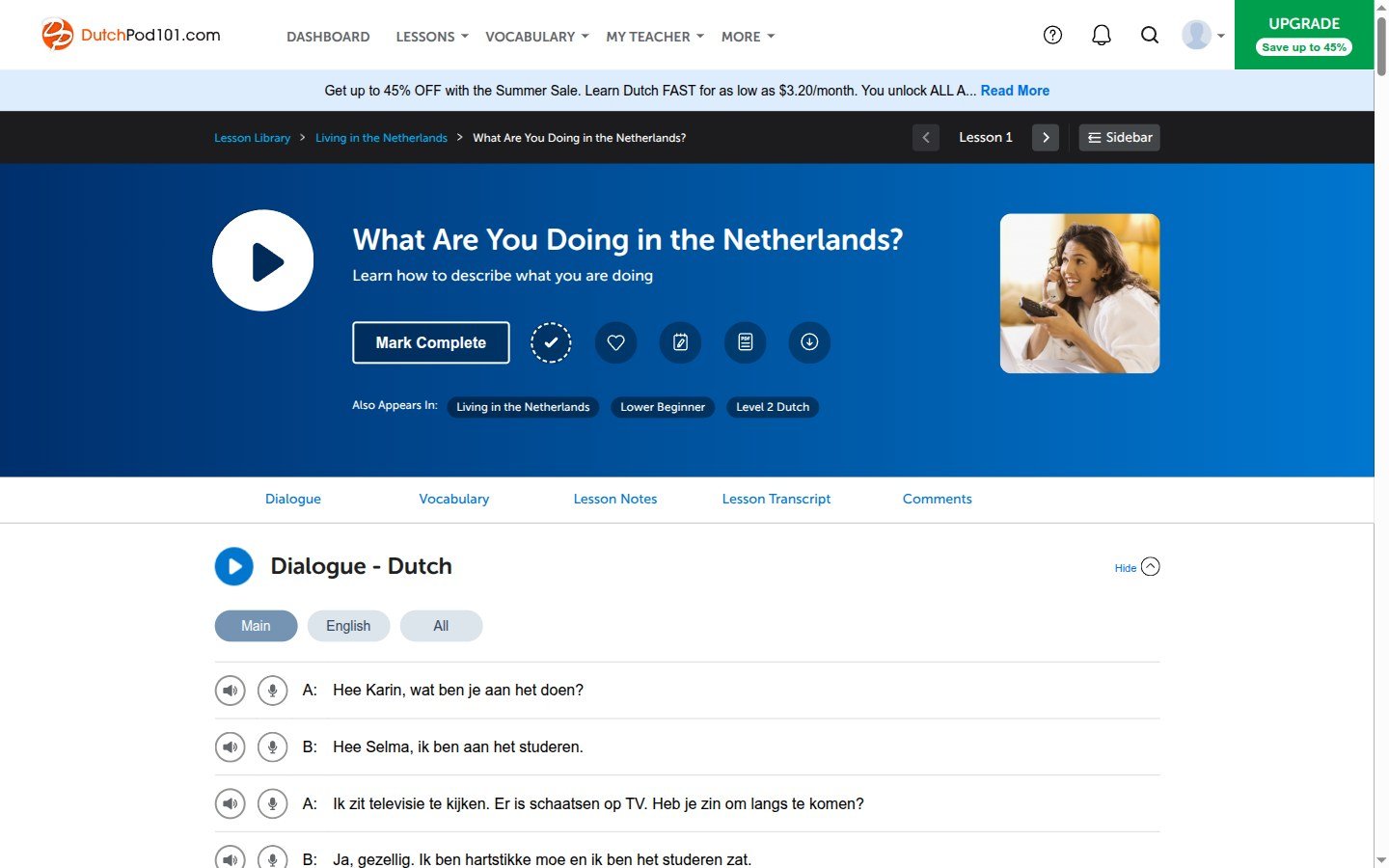
Like the rest of the 101 family, DutchPod101 is built around short audio and video lessons taught by native Dutch speakers, organised into level-based pathways: Absolute Beginner, Beginner, Intermediate, Upper Intermediate and Advanced.
Signing up is painless. You create a free lifetime account with just an email (no card needed) and pick your level. Not sure where you sit? Start at Absolute Beginner and move up later. New accounts also get a 7-day Premium trial, so you can try the paid features before committing to anything.
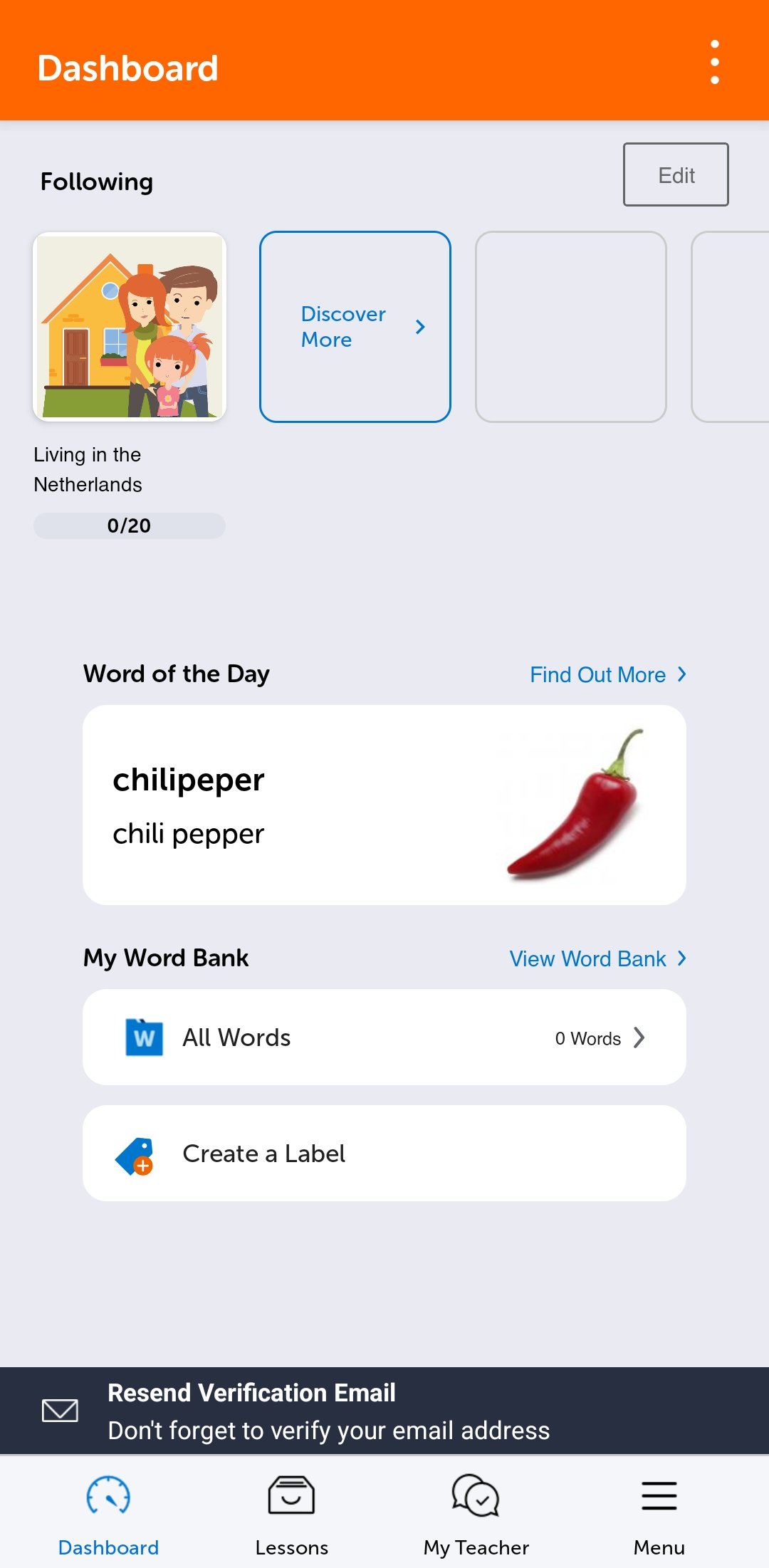
Once you’re in, your dashboard hands you a learning pathway for your level, so you’re not left staring at hundreds of lessons wondering where to start. The core pathways are mapped to CEFR levels: the “Level 1 Dutch” track is 51 lessons aligned to A1, and the five flagship level pathways together add up to around 200 core lessons. Beyond the main route there are loads of themed pathways at the lower levels, from a 60-lesson Survival Phrases course to a 121-lesson Core Words and Phrases series and a whiteboard-style “Dutch Explained” grammar strand.

How It Handles the Dutch Sounds (No New Alphabet, Thankfully)
Dutch uses the same Latin alphabet as English, so there’s no script to learn and no “master the writing system” phase. That’s genuinely good news, but it means all of the course’s pronunciation effort has to go where the real trouble lives: the sounds themselves.
DutchPod101 has a short, purpose-built pronunciation series: five audio lessons, about 40 minutes in total, all at Absolute Beginner level. Two lessons cover the vowels (one of them is charmingly titled “Are You Practicing for an Opera or Learning Your Dutch Vowels?”), which is where the ui, eu and ij problem gets tackled; one covers the consonants, which is where the guttural g lives; one covers word stress; and one runs through the alphabet and its letter combinations. It’s compact rather than exhaustive, but it’s aimed at exactly the sounds on my list, which is more than most Dutch resources bother to do.
The heavier lifting happens inside the ordinary lessons. Because everything is built on native-speaker recordings, with line-by-line audio playback on the paid tiers, you learn that heb sounds like “hep” and that ij sounds like “eye” the only way anyone actually can: by ear, with the spelling in front of you so the two finally link up. On Premium there’s also a voice-recorder tool that records you and plays your attempt back against the native audio, which is spot-on for a sound like the hard g that you can’t check against anything in English. Of all the challenges on my list, the sound system is the one DutchPod101 is best built to solve.
Inside a DutchPod101 Lesson
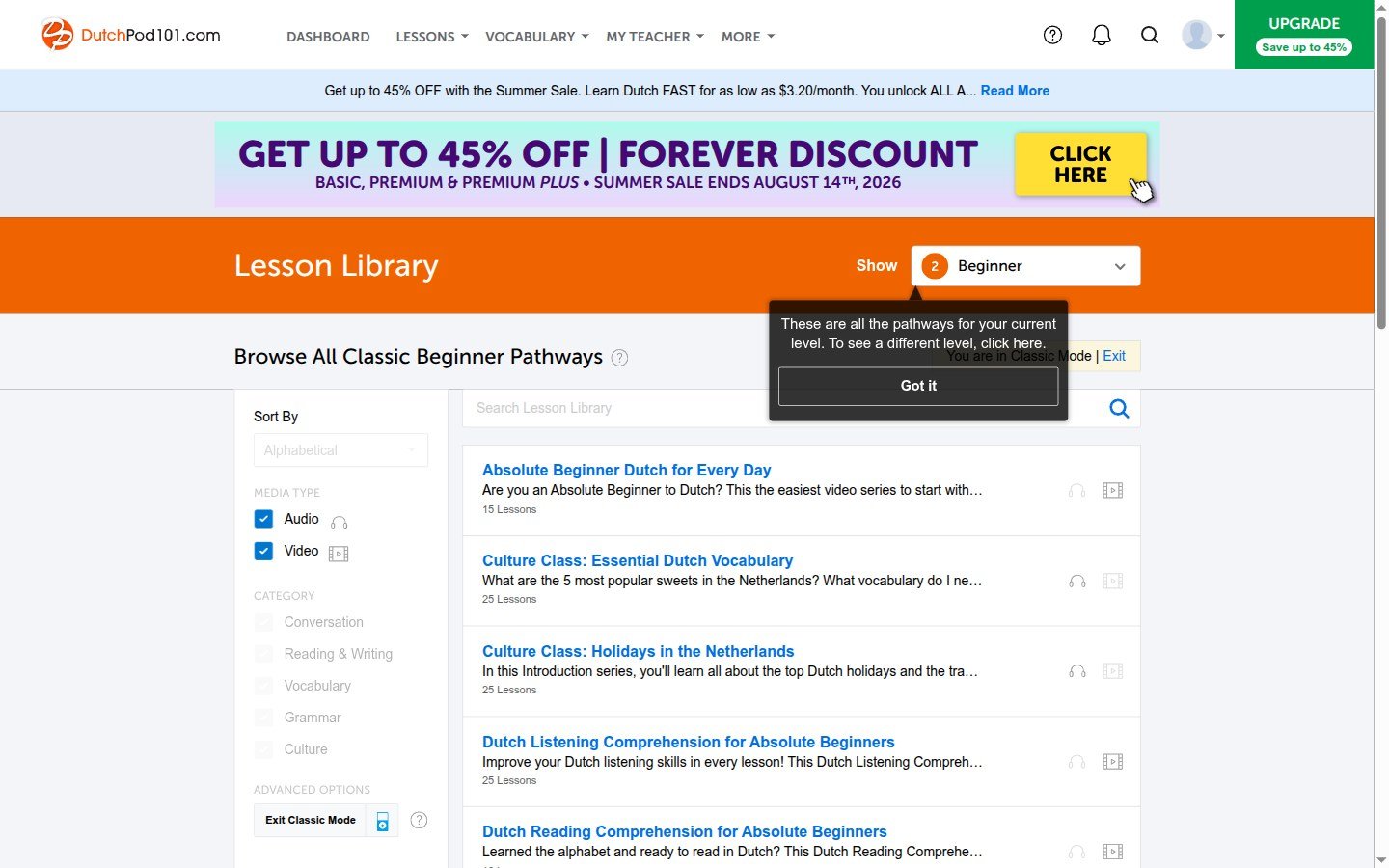
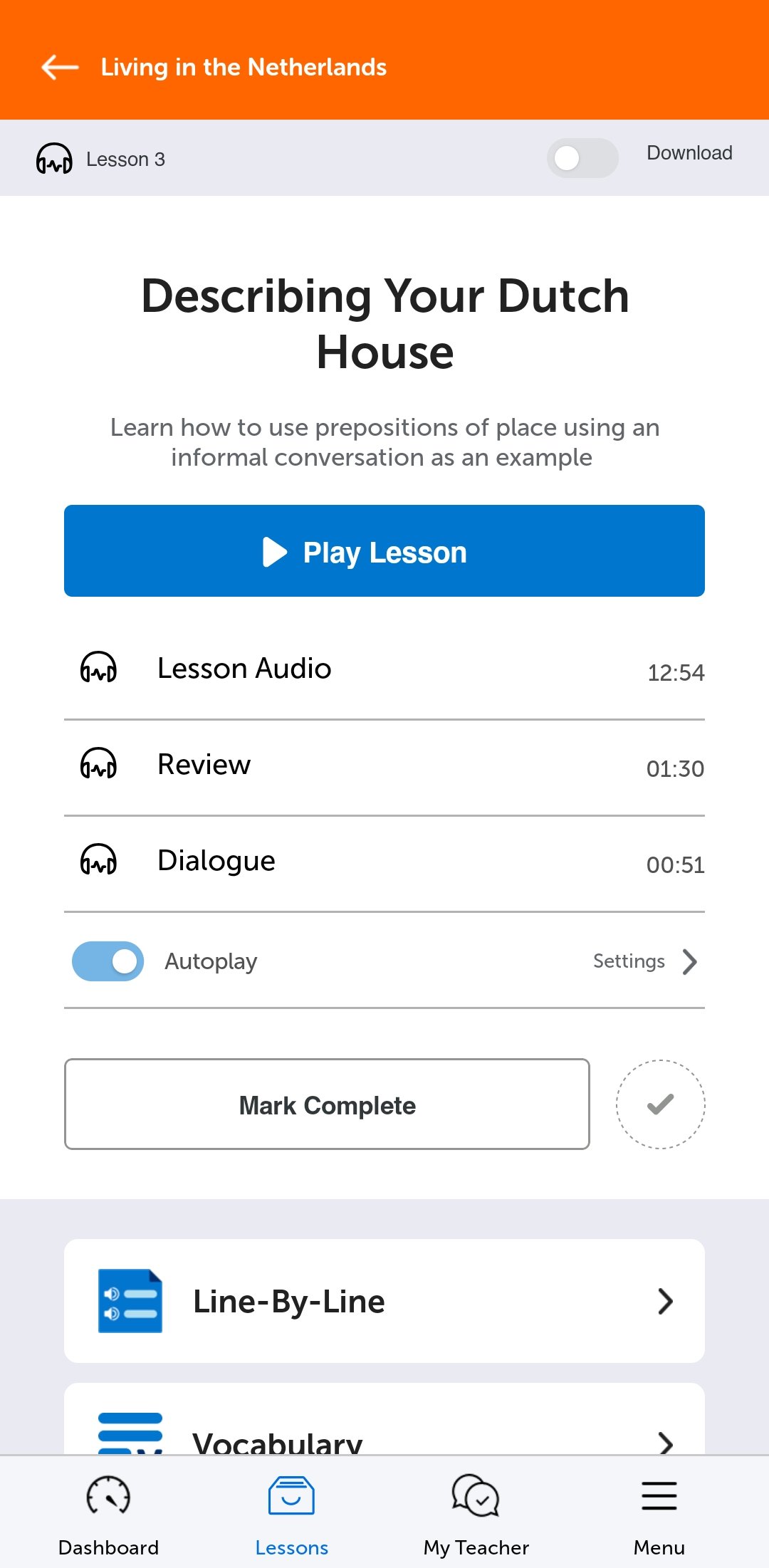
A typical lesson is short (most run 3 to 15 minutes) and follows a consistent shape: a native dialogue, a slow line-by-line breakdown, vocabulary with natural-then-slow pronunciation, a grammar point, and a cultural note. You get the audio, the full scripted dialogue, a vocab list, and downloadable lesson notes (a PDF) that unpack the grammar and context.
This dialogue-first format suits several of Dutch’s quirks well. Diminutives are best absorbed the way the Dutch actually use them, sprinkled through real conversation, rather than drilled as a suffix table. The same goes for the article problem: hearing de fiets and het huis over and over inside dialogues builds the “that just sounds right” instinct that is honestly the only way anyone learns de versus het.
Where the format is weaker is the rule-based grammar. The verb-second word order and the verb-to-the-end subordinate clause pattern are taught as they happen to come up inside a dialogue, not built up as a deliberate, sequenced syllabus. You’ll hear correct Dutch word order hundreds of times, which trains your instinct over the long run, but if you want the system laid out explicitly, and with word order this different from English most learners do, you’ll want a grammar reference alongside. This is the standard, honest caveat for the whole 101 family, and it holds for Dutch too: brilliant for input, lighter on systematic grammar.
The Study Tools
On a Premium plan, the lessons are wrapped in a solid set of study tools:
- Spaced-repetition flashcards and a personal word bank, where you save words straight from any lesson, ideal for hammering home vocabulary and each noun’s de or het.
- A Grammar Bank collecting the course’s grammar points in one place, searchable by level, with examples and links back to the lessons that used each point. Independent reviewers single this out as one of the platform’s genuinely useful extras.
- Multiple-choice assessments to check a section has actually gone in.
- The voice-recorder pronunciation tool, the standout feature for Dutch’s throat sounds and vowels.
- 2,000 core words and phrases as a ready-made vocabulary backbone, and with Dutch’s generous overlap with English, this list moves fast.
Not every extra earns its place; reviewers find the slideshow and some quiz features closer to padding than practice. The flashcards, word bank and grammar bank are the tools that pull real weight.

The Mobile App
DutchPod101 shares one app with the whole Innovative Language family (it’s called “Innovative Language Learning”; you choose Dutch after installing). It syncs with your account, so a lesson you finish on your laptop shows as done on your phone, and you can download lessons for offline listening on the commute.
The shared app is well rated overall, at 4.7 out of 5 across tens of thousands of App Store ratings, though reviews of the Dutch experience specifically run more mixed: plenty of learners love having the whole structured course in their pocket, while the recurring complaints are about reliability, things like audio getting stuck on loading or the app misbehaving after an update. The usual family caveat applies too: the app is gated by your subscription tier just like the website, and a few of the best study features live more comfortably in the browser. The workaround is the same one I use elsewhere: pull the site up in your phone’s browser when you want the full experience.
What Other Dutch Learners Say
I dug through independent reviews and learner write-ups to test my own take against other people’s. A few clear patterns came up.
The praise is consistent. Learners rate it as brilliant listening practice above all, with natural dialogue-based lessons that fold grammar, vocabulary and culture into the same short episode. It has one of the most extensive lesson libraries of any Dutch resource, the topics are modern and practical rather than stale textbook fare, the instructors are native Dutch speakers, and the free tier asks for no card, so trying it costs nothing but an email address.
The criticism is worth being upfront about. The most common gripe is that there’s too much English spoken in the lessons, especially at the lower levels; it does taper off as you climb. Reviewers also find the platform confusing to find your way around, with recommended pathways that aren’t always the best route, which is why several suggest pairing it with a structured textbook rather than using it alone. The advanced library is thinner than the beginner one (more on that below), real feedback on your speaking and writing sits behind the top tier, and expect a steady stream of marketing emails once you’ve signed up. None of that sinks the platform, but it’s the honest shape of it.
Pricing and Plans
DutchPod101 runs the same four-tier structure as the rest of the family:
| Plan | Roughly… | What you get |
|---|---|---|
| Free | Free forever | The Survival Phrases course, the first 3 lessons of every pathway, Word of the Day, 100+ vocab lists, the app, plus a 7-day Premium trial |
| Basic | ~$4/mo | Everything free + access to all lessons and in-depth PDF lesson notes |
| Premium | ~$5–10/mo | Everything in Basic + line-by-line audio, flashcards, word bank, the Grammar Bank, assessments, the voice-recorder tool, and the 2,000 core words |
| Premium PLUS | ~$13–23/mo | Everything in Premium + your own teacher, hand-graded assessments and a personalised study plan |
A few honest notes on the pricing. The headline per-month figures are based on the longest (24-month) plan, so the real price depends on the billing period you pick; check the checkout before you commit. Innovative also runs a more-or-less permanent discount (often around 45% off), so you should rarely pay the “full” list price. There’s a 60-day money-back guarantee, which takes the risk out of trying Premium. Expect the usual upsell banners nudging you up the tiers; mildly annoying, easy to ignore.
For most people, Premium is the sweet spot: that’s the tier with the flashcards, the line-by-line audio and the voice recorder, which are precisely the tools Dutch’s ear-versus-eye problem calls for. Premium PLUS only makes sense if you specifically want a teacher checking your work.
Pros and Cons
Pros
- Loads of native-speaker audio, exactly what you need for a language whose spelling keeps misleading your English-trained eyes.
- A dedicated pronunciation series targeting the guttural g, the ui/eu/ij vowels and Dutch word stress head-on.
- A voice-recorder tool that compares you against native audio, the right tool for sounds English gives you no reference for.
- A guided, CEFR-aligned learning pathway, so you’re never guessing what to study next.
- Deep, varied beginner and intermediate content, which is where a Dutch learner spends most of the road to fluency anyway.
- Genuinely affordable, with a usable free tier and a 60-day guarantee.
Cons
- Too much English inside the lessons, especially at the lower levels.
- Grammar is taught incidentally, so the word-order system and de/het need a companion resource.
- Upper intermediate and advanced content is noticeably thinner than the beginner library.
- Upsell banners and marketing emails crop up around the platform.
- The app is gated and a touch lighter than the full website.
Who DutchPod101 Is (and Isn’t) For
It’s a brilliant fit if you’re starting Dutch from zero or working through the intermediate levels, and you want your ear trained by real native audio rather than by guesswork from the page; if you learn well by listening and want Dutch in your headphones on the commute; or if you want practical, modern conversational Dutch for a move to Amsterdam, Rotterdam or Antwerp rather than exam drills. As a bonus, Dutch opens a side door to Afrikaans, which descends from it and remains largely mutually intelligible.
It’s less ideal if you’re already sitting at a strong upper intermediate level and hunting for deep advanced material, because that’s where the library thins out, or if you want a single resource that drills grammar mechanics and gives you heavy speaking practice. In those cases, use DutchPod101 for listening and vocabulary and pair it with a grammar reference and a conversation partner.
The Verdict
DutchPod101 does the most important thing right: it takes Dutch’s real problem seriously. Dutch doesn’t need a course that congratulates you for reading it, because reading it is the easy part. It needs a course that trains your ear past the guttural g, the ui vowel and the spelling that says heb while the speaker says “hep”, and an audio-first course with line-by-line playback and a voice recorder is the right shape of tool for that job.
Where it falls short of its best sister courses is the top end. The upper intermediate library is thin and the advanced pathways lean more towards light cultural topics than serious C1 material, so I can’t quite give it the family’s usual score. Mind you, that ceiling matters less for Dutch than it would for most languages: this is a Category I language with a fraction of the climb of Japanese or Arabic, and the genuinely deep beginner-to-intermediate content covers most of the distance a typical learner needs to travel.
My rating: 4.2 out of 5.
If you want to give it a go, you can start with DutchPod101 here. That link also carries our reader discount (the near-permanent Innovative deal is applied for you at checkout), so you won’t be paying full list price. Set up a free account, take it for a spin, and see if Dutch finally starts sounding the way it’s actually spoken, not the way it reads.

Social