



FilipinoPod101 Review: Is It the Best Way to Learn Filipino?

Full disclosure: This post contains affiliate links. ?
What is FilipinoPod101?
FilipinoPod101 is part of the Innovative Language family, built to get you understanding and speaking Filipino from the very first lesson. Audio and video lessons taught by native speakers are its main feature.
- what it’s for:
- First contact with Filipino, listening practice, vocabulary, pronunciation, the verb focus system, and everyday Taglish conversation material
- languages:
- Filipino
- level:
- Absolute Beginner to Advanced
+ PROS
- The best dedicated Filipino course out there, with around 215 hours of lessons
- Loads of native-speaker audio, exactly what a listening-heavy language demands
- A clear, concise Grammar Bank covering the focus system and the ang/ng/sa markers
- No new script or tones, so you’re into real dialogues from day one
- A guided learning path plus flexible themed pathways
- Genuinely affordable, with a free tier and a 60-day guarantee
- CONS
- Content thins hard past intermediate, so advanced learners will outgrow it
- No dedicated reading and writing practice track
- The guided pathway leans on phrases and audio, so use the Grammar Bank deliberately
- A fair amount of English inside the lessons
- The mobile app doesn’t have all the best features
Quick Fire Review
The best dedicated audio course for Filipino, with brilliant native audio and a clear Grammar Bank for the focus system; pair it with a grammar guide and conversation practice past intermediate. 4.2/5.
Filipino might be the friendliest-looking language in Asia. It uses the Latin alphabet, the spelling is phonetic (what you see is genuinely what you say), there are only five vowel sounds and no tones, and the vocabulary is stuffed with words you already own: Spanish loanwords for the numbers, the days of the week and half the household, and English loanwords all through modern speech. If your mental image of learning an Asian language involves months of memorising a script before you can read a menu, Filipino is a lovely surprise.
That soft landing is only half the story, though. The hours you save on script and pronunciation go straight into the grammar, because Filipino verbs work unlike anything an English speaker has met before. The US Foreign Service Institute puts Filipino in Category III, at roughly 1,100 classroom hours to professional working proficiency, more than double what Spanish or French asks of you. The alphabet isn’t the reason. The verbs are.
One naming note before we go on, because it confuses loads of beginners: Filipino is the standardised national language of the Philippines, built on Tagalog (the language of Manila) and officially topped up with extra letters and loanwords from the country’s many other languages. For a learner the distinction barely matters; study “Tagalog” and Filipino speakers understand you perfectly, and FilipinoPod101, like virtually every course, teaches Tagalog-based Filipino under the Filipino label. I’ll say “Filipino” throughout.
I’ve reviewed the Innovative Language “101” courses across more than a dozen languages now (you might have seen my SpanishPod101 and JapanesePod101 reviews, and the Spanish one is surprisingly relevant here, given how much Spanish is hiding inside Filipino), and most of the Fluent in 3 Months team have leaned on these podcasts for their own language missions. So the question I want to answer is a specific one: does FilipinoPod101 handle the parts of Filipino that are genuinely different, or does it coast on the easy bits?
What Makes Filipino Different
Before we get to the platform, here’s what a Filipino learner is actually up against. These are the yardsticks I’ll measure FilipinoPod101 against.
1. The verb focus system. This is the heart of Tagalog grammar and the single biggest structural difference from English. Filipino verbs don’t just conjugate for tense; they conjugate for which noun the sentence is about: the actor, the object, the location or the beneficiary. Affixes like um-, mag-, -in, -an and i- mark that “focus”, and switching the affix reshuffles the whole sentence around a different noun. To an English speaker, an object-focus verb like ininom (“was drunk by someone”) looks like passive voice, but for Filipinos it’s the everyday, unmarked way to talk rather than a special construction. There’s no shortcut here; you have to rebuild your instinct for what a verb even does.
2. The ang, ng and sa markers. Three small particles do the heavy grammatical lifting. Ang marks whichever noun is in focus (whether it’s the doer or the thing done to), ng marks the non-focus actor or object, and sa handles location, direction and indirect objects. English speakers keep trying to map these onto subject-object word order, and it doesn’t work; the marker tells you the role, not the word’s position in the sentence.
3. Reduplication. Filipino repeats syllables or whole roots to change meaning: to intensify, to pluralise, or to signal that something is about to happen or is in progress. English does nothing like this, so it’s a genuinely new mental category, not just a new rule to memorise.
4. Po and opo. Two tiny politeness words with a big job. They get dropped into sentences routinely with elders, with strangers, and often with foreigners as a default respect marker, and the register logic takes real getting used to, because English leans on completely different tools for politeness.
5. Taglish. Everyday spoken Filipino, especially in Manila, switches into English constantly, sometimes mid-sentence. That’s brilliant news for your vocabulary (a chunk of it is just English), but it’s also disorienting: there’s no textbook rule for when the switch happens, and a course that only teaches “pure” Filipino leaves you unprepared for how people actually talk.
6. The soft landing. And the honest counterweight to all of the above: the phonetic spelling, the familiar alphabet, the five vowels, no tones, and all those Spanish and English loanwords mean vocabulary comes fast and pronunciation is low-stress. The challenge in Filipino is concentrated almost entirely in the grammar and the listening.
Keep those in mind. Here’s how FilipinoPod101 stacks up.
Getting Started with FilipinoPod101
Like the rest of the 101 family, FilipinoPod101 is built around short audio and video lessons taught by native speakers, organised into level-based pathways: Absolute Beginner, then Levels 1 to 3 (Level 1 lines up with CEFR A1 and Level 3 with roughly B1), then Advanced.
Signing up is painless. You create a free lifetime account with just an email (no card needed), pick your level, and new accounts get a 7-day Premium trial so you can test the paid features before spending anything.
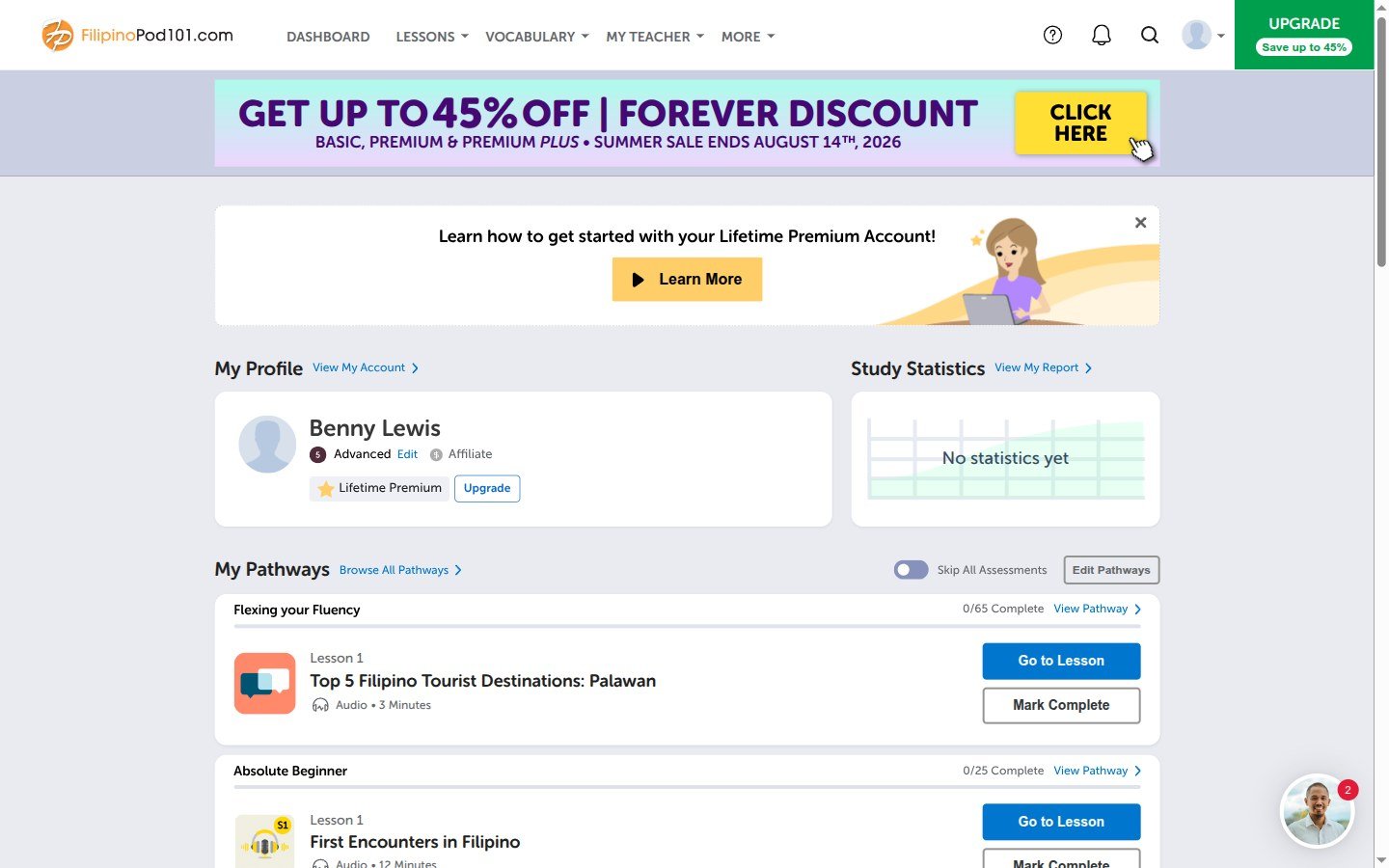
The library itself holds around 215 hours of lessons, which Innovative cheerfully markets as “the largest Filipino lesson library in the world”. That claim says as much about how thin the competition is for Filipino as it does about the library, mind you, but it’s still a genuinely substantial amount of material, and new lessons keep arriving weekly. Once you’re in, your dashboard hands you a learning pathway for your level, with dozens of themed pathways (travel, relationships, culture) running alongside the core route.
Pronunciation, and How It Handles the Focus System
Here’s a small luxury: unlike its Japanese, Korean or Arabic siblings, FilipinoPod101 doesn’t need a script module at all. Filipino is written in the same alphabet you’re reading now and pronounced the way it’s spelled, so from lesson one the ear-training goes straight into real words. The pronunciation side is a clear strength: every lesson is voiced by native speakers, there’s a searchable dictionary with audio for every word (including slowed-down playback), and listen-and-repeat practice is built into the lessons, with all the audio and transcripts downloadable for offline study.
The focus system is the part I wanted to scrutinise, because it’s where a Filipino course earns its keep. The good news: the material exists and it’s well made. FilipinoPod101’s own blog has dedicated articles walking through verb conjugation and the actor-focus versus object-focus affixes, the lessons deal directly with formality and how to address people properly (the po and opo territory), and the grammar bank, a Premium feature that’s recently been expanded, gets described by one independent reviewer as “wonderfully concise and clear”.
The honest caveat: FilipinoPod101 follows the house pattern of the whole 101 family, which is phrases and audio first, with grammar as a supporting reference rather than the spine of the course. I couldn’t confirm that the guided beginner pathway drills the focus system into you early as a first-class topic, the way a purpose-built Tagalog grammar guide would. So my advice is to use the grammar bank deliberately: when a dialogue throws an unfamiliar verb form at you, go and look the affix up rather than assuming the pathway will circle back and explain it. The explanations are there and they’re good; you just have to be the one who reaches for them.
Inside a FilipinoPod101 Lesson
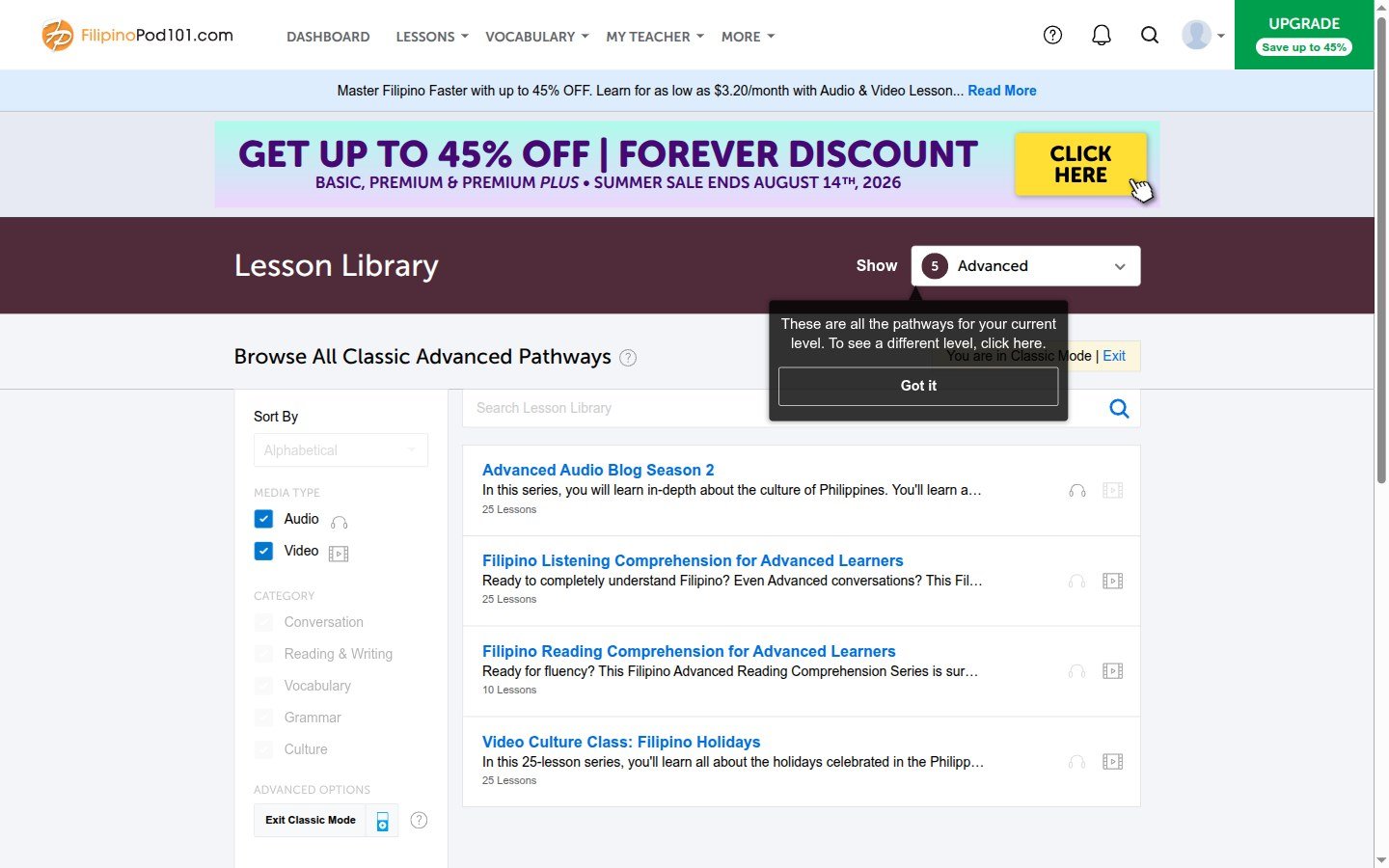
A typical lesson is short (most run 3 to 15 minutes) and follows a consistent shape: a native dialogue, a slow line-by-line breakdown, vocabulary with natural-then-slow pronunciation, a grammar point, and a cultural note. You get the audio, the full scripted dialogue, a vocab list, and downloadable lesson notes as a PDF.
This dialogue-first format suits Filipino’s quirks better than you might expect. The ang, ng and sa markers are exactly the kind of thing you absorb through hundreds of heard examples rather than a table, and the cultural notes carry the po and opo register in context, which is how it actually needs to be learned. Even the much-criticised amount of English inside the lessons has a silver lining for this particular language: real Filipino conversation is shot through with English anyway, so hearing the two woven together is closer to the streets of Manila than a purist course would be. That said, some learners find the English scaffolding heavier than they’d like, and it’s a fair complaint at the upper levels, where you want to be pushed.
The Study Tools
On a Premium plan, the lessons are wrapped in a solid set of study tools:
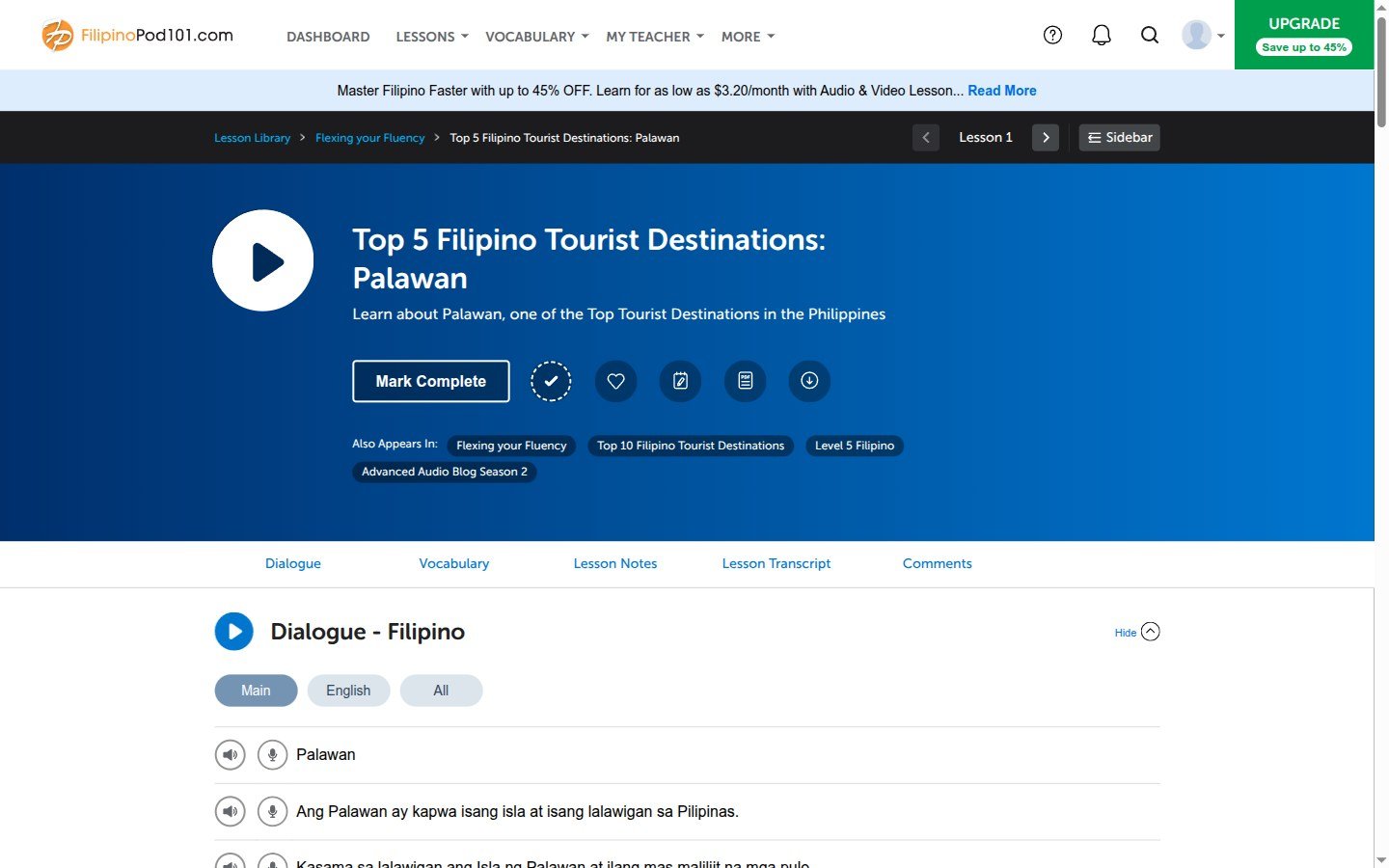
- Spaced-repetition flashcards and a personal word bank, where you save words straight from any lesson. With so many Spanish and English loanwords, your deck fills with quick wins early on.
- The Grammar Bank, collecting the course’s grammar explanations in one place. For Filipino this is the tool that matters most; it’s where the focus-system and marker explanations live.
- Multiple-choice assessments to check a section has actually gone in.
- A voice-recorder tool that records you and plays your attempt back against the native audio.
- 2,000 core words and phrases as a ready-made vocabulary backbone.

The Mobile App
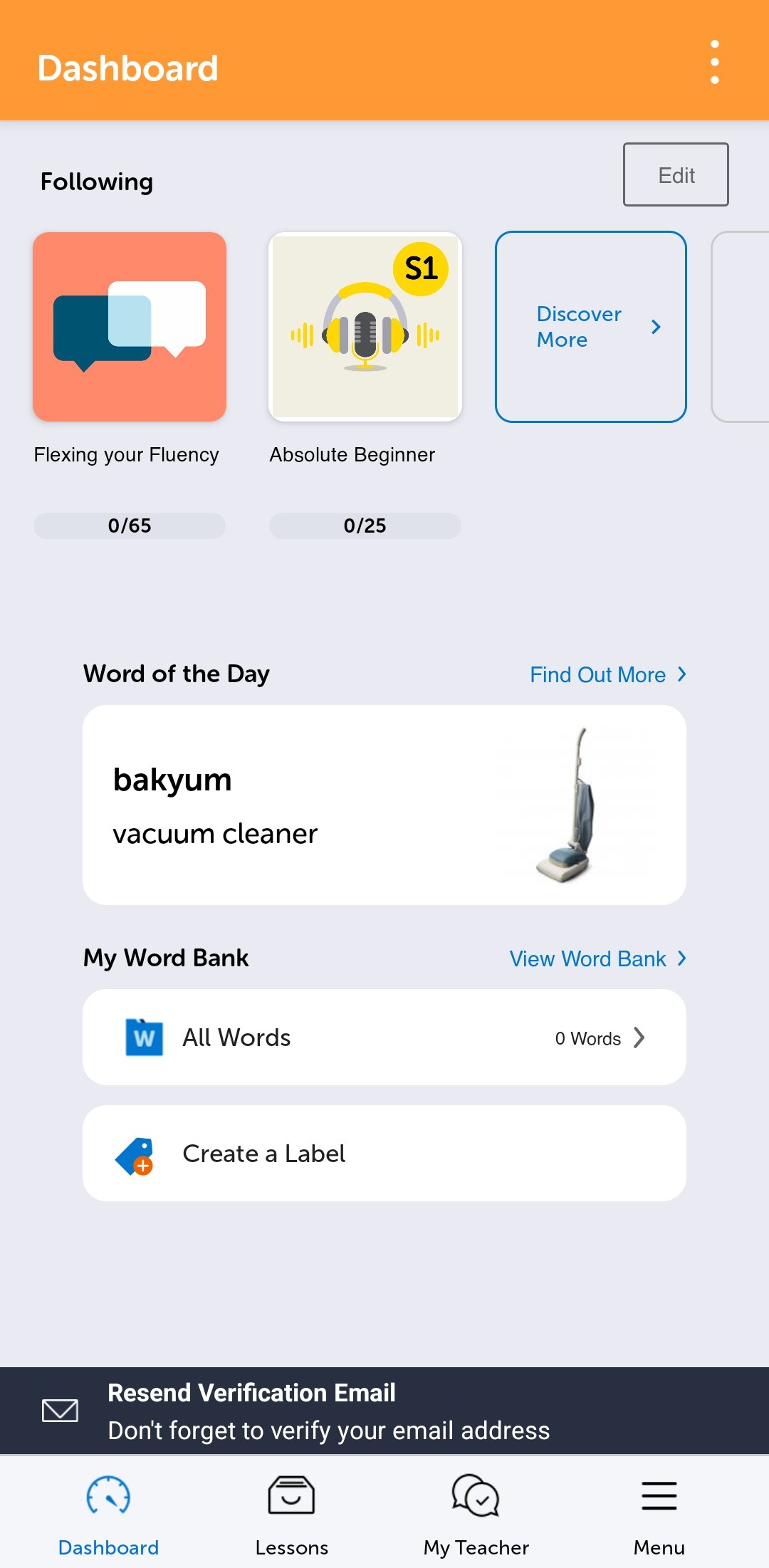
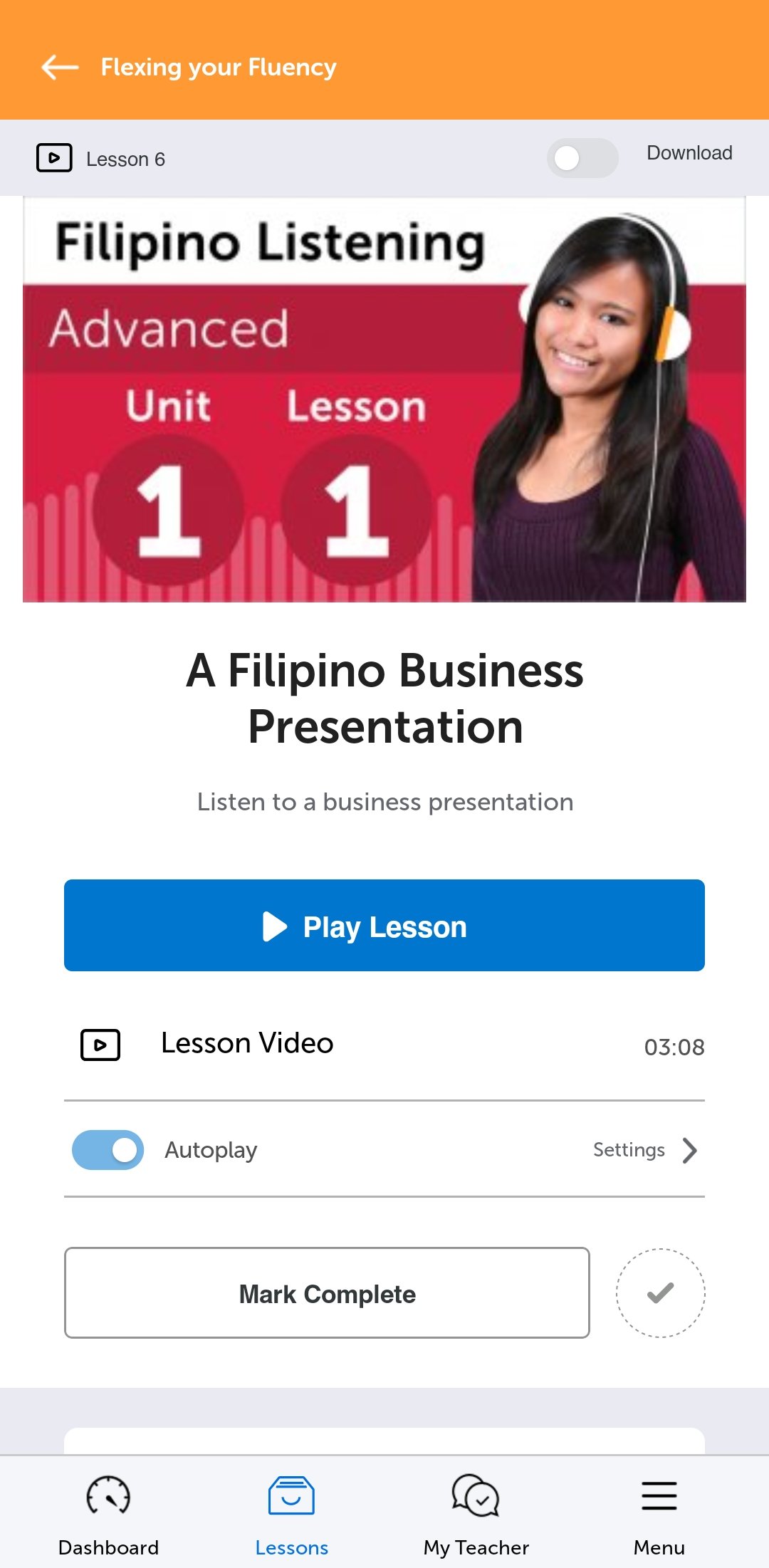
FilipinoPod101 shares one app with the whole Innovative Language family (it’s called “Innovative Language Learning”; you pick Filipino after installing). It syncs with your account, so a lesson you finish on your laptop shows as done on your phone, and you can download lessons for offline listening on the commute, which suits the audio-heavy nature of the course well. It’s well rated too, at 4.7 out of 5 across tens of thousands of App Store ratings.
The usual family caveat applies: the app is gated by your subscription tier just like the website, and it’s lighter than the full site, with some of the best study tools living more comfortably in the browser. One independent review of the shared app summed it up as an impressive amount of material that lacks structure, which matches my experience of the family’s apps generally. The workaround is the same one I use elsewhere: pull the site up in your phone’s browser when you want the full experience.
What Other Filipino Learners Say
I dug through the independent reviews of FilipinoPod101 to test my own take against other people’s. One honest note on sourcing first: the online discussion volume for Filipino learning is small compared to Spanish or Japanese, so the picture below comes from review sites that actually tested the course rather than from forum threads.
The praise is consistent. Reviewers agree it’s the best dedicated audio and video resource that exists for Filipino, in a field with very few serious competitors. The native-speaker audio gets singled out for building listening comprehension and everyday conversational skill, the recently expanded grammar bank is well regarded, the flexible topic-based pathways get credit for keeping study interesting, and the pricing is seen as genuinely reasonable.
The criticism clusters around three things, and they come up independently across reviewers rather than being one person’s gripe. First, the content thins significantly past intermediate; one comparison site that has tested more than ten of the Pod101 courses concluded that most of the material targets beginner and sometimes intermediate level, and recommends it as a supplementary tool rather than a standalone course, while another flags “fewer resources for learners beyond upper-intermediate level”. Second, there’s no dedicated reading and writing practice track; this is a conversational and listening course first. Third, the site itself can be confusing, with two reviewers separately noting that the recommended lesson order isn’t always sensible and it’s easy to get lost in the library. Add the familiar family niggles (a fair amount of English in the lessons, upsell banners, and a Premium PLUS tier some feel is pricey for what it adds) and that’s the honest shape of it.
Pricing and Plans
FilipinoPod101 runs the same four-tier structure as the rest of the family:
| Plan | Roughly… | What you get |
|---|---|---|
| Free | Free forever | The first 3 lessons of every pathway, Filipino Word of the Day, 100+ vocab lists, the app, plus a 7-day Premium trial |
| Basic | ~$4/mo | Everything free + access to all lessons and in-depth PDF lesson notes |
| Premium | ~$5–10/mo | Everything in Basic + line-by-line audio, flashcards, the word bank, the Grammar Bank, assessments, the voice-recorder tool, and the 2,000 core words |
| Premium PLUS | ~$13–23/mo | Everything in Premium + your own native Filipino teacher, hand-graded assignments and personalised guidance |
A few honest notes on the pricing. The headline per-month figures are anchored to the longest (24-month) plan, so shorter billing periods cost noticeably more per month; check the checkout before you commit. Innovative also runs a more-or-less permanent discount (often around 45% off the list price), so you should rarely pay “full” price. There’s a 60-day money-back guarantee, which takes the risk out of trying Premium. Expect the usual banners nudging you up the tiers; mildly annoying, easy to ignore.
For most people, Premium is the sweet spot: it’s the tier with the Grammar Bank, and for Filipino specifically that’s the feature I’d least want to study without.
Pros and Cons
Pros
- The best dedicated Filipino course out there, with around 215 hours of lessons in a field where serious options are scarce.
- Loads of native-speaker audio, exactly what a language this listening-heavy demands.
- A clear, concise Grammar Bank covering the focus system and the ang/ng/sa markers.
- No script module needed, so you’re into real dialogues from day one.
- A guided learning path plus flexible themed pathways, so you’re never guessing what to study next.
- Genuinely affordable, with a usable free tier and a 60-day guarantee.
Cons
- Content thins hard past intermediate, so advanced learners will outgrow it.
- No dedicated reading and writing practice track.
- The guided pathway leans on phrases and audio first, so you have to reach for the grammar explanations deliberately.
- A fair amount of English inside the lessons, and the site’s recommended lesson order can be confusing.
- Premium PLUS is pricey relative to what it adds for most learners.
Who FilipinoPod101 Is (and Isn’t) For
It’s a brilliant fit if you are starting Filipino from zero and want native audio in your ears from day one; if you’re learning for a trip, a partner or family in the Philippines and everyday conversation is the goal; if you learn well by ear and want lessons on the commute; or if you’ve done some Spanish and want to watch a surprising amount of your old vocabulary come back to life.
It’s less ideal if you’re already at a solid intermediate level and need material that stretches you, or if you want a course that drills the focus system step by step as its main act, or if reading and writing Filipino properly matters to you. In those cases, use FilipinoPod101 as your listening and vocabulary engine and pair it with a dedicated grammar guide and real conversation practice.
The Verdict
FilipinoPod101 gets the fundamentals right for this particular language. Filipino’s challenge is concentrated in the listening and the grammar, and this course floods your ears with native audio, teaches the politeness register in context, reflects the Taglish reality of how Filipinos actually speak, and keeps clear, well-written grammar explanations within reach. It’s also, honestly, the only dedicated Filipino course of this size that exists, and it would hold its own even in a crowded field. The gaps are real: the material thins past intermediate, there’s no literacy track, and the focus system rewards learners who go looking for the explanations rather than waiting to be walked through them. As the core of a beginner-to-intermediate Filipino mission, though, it’s excellent value.
My rating: 4.2 out of 5.
If you want to give it a go, you can start with FilipinoPod101 here. That link also carries our reader discount (the near-permanent Innovative deal is applied for you at checkout), so you won’t be paying full list price. Set up a free account, take it for a spin, and see if learning Filipino by ear clicks for you.

Social