


HebrewPod101 Review: Can It Teach You to Read Without Vowels?

Full disclosure: This post contains affiliate links. ?
What is HebrewPod101?
HebrewPod101 is part of the Innovative Language family, built to get you understanding and speaking Modern Hebrew from the very first lesson. Audio and video lessons taught by native speakers are its main feature.
- what it’s for:
- First contact with Modern Hebrew, listening practice, vocabulary, the Hebrew alphabet and niqqud, pronunciation (the guttural sounds), and phrases and conversation material
- languages:
- Hebrew
- level:
- Absolute Beginner to Advanced
+ PROS
- Teaches the Hebrew alphabet and niqqud properly, with no transliteration crutch
- Loads of native-speaker audio, exactly what a script with unwritten vowels demands
- A gesture-based conjugation series that makes the root-and-pattern verb system stick
- A dedicated pronunciation guide for the guttural sounds English doesn’t have
- Brilliant, comprehensive lesson-notes PDFs, all downloadable
- Genuinely affordable, with a free tier and a 60-day guarantee
- CONS
- Advanced content is thinner and less organised than the beginner levels
- The grammar reference is weak, so the binyanim need a companion resource
- Almost no live speaking practice, even the top tier’s teacher feedback is written
- Too much English chit-chat in some lessons
- The mobile app doesn’t have all the best features
Quick Fire Review
A brilliant audio-first course for Modern Hebrew that teaches the alphabet and niqqud properly and trains your ear for the unwritten vowels; pair it with a tutor for speaking practice. 4.2/5.
Modern Hebrew asks something of a learner that almost no European language does: you have to learn it with your ears before the written page will cooperate. Standard written Hebrew (newspapers, street signs, novels, text messages) leaves the vowels off entirely. The dots and dashes that mark them, the niqqud, only appear in children’s books, prayer books, poetry and learner materials. A fluent reader fills the vowels in from context and from already knowing the words, which means the usual beginner comfort of “read it out slowly and you’ll get there” doesn’t exist. Add a right-to-left script, and a word-building system where vocabulary grows out of three-letter roots (the root k-t-v gives you katav, “he wrote”, mikhtav, “a letter”, and miktava, “a writing desk”), and you can see why the US Foreign Service Institute files Hebrew under Category III: roughly 1,100 classroom hours, harder than French or Italian, though still only half the climb of Arabic or Japanese.
I’ve reviewed the Innovative Language “101” courses across more than a dozen languages now, including ArabicPod101 (Hebrew’s root-based, vowel-dropping Semitic cousin) and SpanishPod101 at the friendlier end of the difficulty scale, and the Fluent in 3 Months team has leaned on this family of podcast courses for years. Hebrew makes a particularly interesting test case for the format, because a language you have to learn ear-first should, in theory, be a perfect match for a course built almost entirely on native-speaker audio.
So the question I want to answer is a specific one: does HebrewPod101 handle the things that genuinely make Hebrew hard, starting with a script that keeps its vowels to itself?
What Makes Hebrew So Different (and What a Course Has to Get Right)
Before we get to the platform, let’s be honest about what a Hebrew learner is actually up against. These six challenges are the yardstick I’ll measure HebrewPod101 against.
1. A script that leaves the vowels out. The Hebrew alphabet is an abjad: 22 letters, essentially all consonants. In learner materials the niqqud points show you the vowels, but real-world Hebrew drops them, so the word on the page is a consonant skeleton and you supply the rest. Native readers manage because they already know what the words sound like, and that’s the whole trick for a learner too: get the sounds into your ear first, and the unvowelled script starts to make sense. It’s the reverse of how you’d learn French or German, where the page carries you from day one. Any Hebrew course lives or dies on how seriously it takes this.
2. Reading right to left. Less scary than it sounds, but it’s real friction in the first weeks: your eyes track the wrong way, handwriting feels backwards, and even typing and digital text behave differently. You adjust, but a course should ease you through it rather than pretend it isn’t there.
3. The root-and-pattern system (the shoresh). Hebrew words are built from a root of three (occasionally four) consonants slotted into patterns. From k-t-v you get words for writing, letters and desks; verbs run through seven pattern families called binyanim. Nothing in a Romance or Germanic language prepares you for this. Once it clicks it becomes a vocabulary superpower, because you start recognising the root inside every new word, but a course has to actually teach the system rather than hand you isolated words and hope.
4. The guttural sounds. Het (ח), ayin (ע) and the Israeli resh (ר) have no real English equivalent, and the resh is closer to a French r than anything an English speaker produces by default. Plenty of modern Israelis merge some of the historic gutturals in everyday speech, but the letters stay distinct on the page, and the sounds serious learners aim for stay distinct too. You need lots of native audio and honest pronunciation training here.
5. Gender runs right through the verbs. In Hebrew, gender isn’t confined to nouns and adjectives. Second and third person verbs in the past and future tenses change with the gender of the person involved, so “you wrote” is a different word depending on whether you’re talking to a man or a woman. That’s a layer of conjugation European languages simply don’t have, and it needs deliberate practice.
6. Modern versus Biblical Hebrew. Same alphabet, overlapping roots, but a real gap in verb system, syntax and a good slice of vocabulary. HebrewPod101 is a Modern Hebrew (Ivrit) course through and through: brilliant if your goal is conversations in Tel Aviv, but if you’re after Biblical Hebrew for scripture study, the alphabet and root system will carry over while much of the rest won’t, so you’d want a dedicated resource for that.
Keep those six in mind. Here’s how HebrewPod101 stacks up.
Getting Started: Where to Begin with HebrewPod101
Like the rest of the 101 family, HebrewPod101 is built around short audio and video lessons taught by native speakers, organised into level-based pathways from Absolute Beginner up to Advanced.
Signing up is painless: a free lifetime account with just an email address, no card needed, and new accounts get a 7-day Premium trial. Once you’re in, you pick a level and the dashboard hands you a learning pathway, so you’re never staring at a huge library wondering where to start. The core pathways map to the CEFR levels too: “Level 1 Hebrew” is a 30-lesson track aligned to A1, and the ladder runs up to a “Level 5 Hebrew” C1 track. The Absolute Beginner tier is by far the richest, with a couple of dozen pathways covering everything from survival phrases to full conversational series, and that depth-at-the-bottom shape matters for what I’ll say later about the advanced end.

The Alphabet, the Niqqud and the Sounds English Doesn’t Have
This is the section that matters most for Hebrew, and it’s where HebrewPod101 earns most of its score. Plenty of courses quietly park you on transliteration forever; this one has a real script curriculum.
The flagship is “Hebrew Alphabet Made Easy”, a 21-part series (20 short video lessons plus a practice worksheet) that the site claims can have you reading and writing Hebrew in under 100 minutes. The claim is cheeky, but the structure underneath it is genuinely sound: letters arrive in small groups, the niqqud vowel points are taught explicitly alongside the consonants rather than skipped, and the final review lessons have you reading real Hebrew text (excerpts from Ecclesiastes, no less) as a capstone. That’s a proper “learn the actual script” course, and given challenge number one above, it’s exactly what a Hebrew learner needs first. There’s also a “One-Minute Hebrew Alphabet” series, 44 quick-hit lessons, as a faster, repetition-heavy reinforcement track.
Pronunciation gets the same treatment. The “Ultimate Hebrew Pronunciation Guide” is a 10-lesson series framed squarely around the sounds that don’t exist in English, which means the gutturals get targeted practice instead of a shrug. And on the paid tiers there’s the family’s voice-recorder tool, which records you and plays your attempt back against the native audio, spot-on for training het and ayin until they stop feeling impossible.
The real surprise, though, is “Fast Hebrew Conjugation with Gestures”: a 10-lesson series that drills verb conjugation using physical gestures as memory cues. I haven’t seen this on the other 101 sites, and it’s a clever answer to a genuinely Hebrew problem, because the binyan patterns are abstract until something makes them stick. A gesture per pattern is a simple, slightly silly, effective way to do that.
Inside a HebrewPod101 Lesson
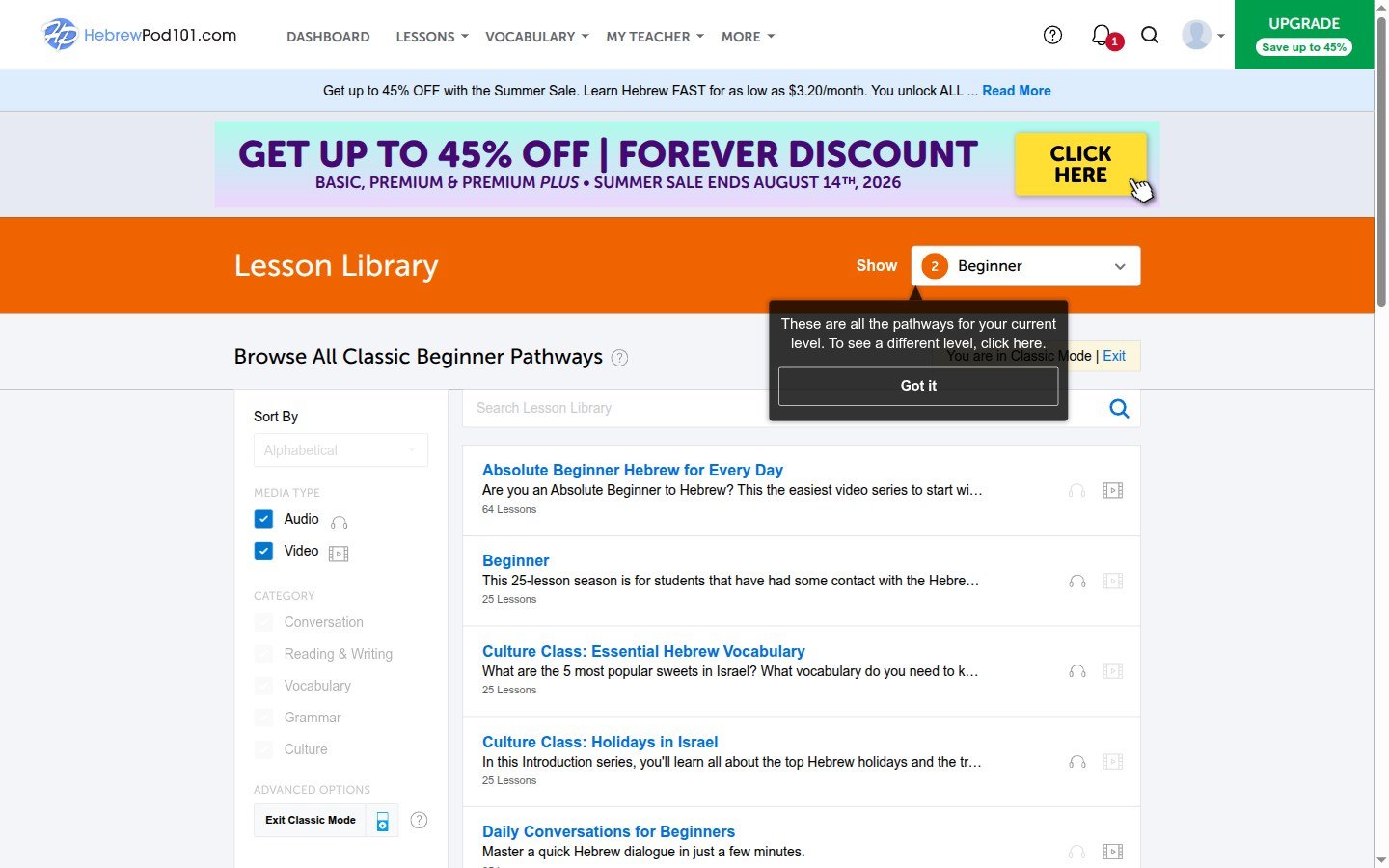
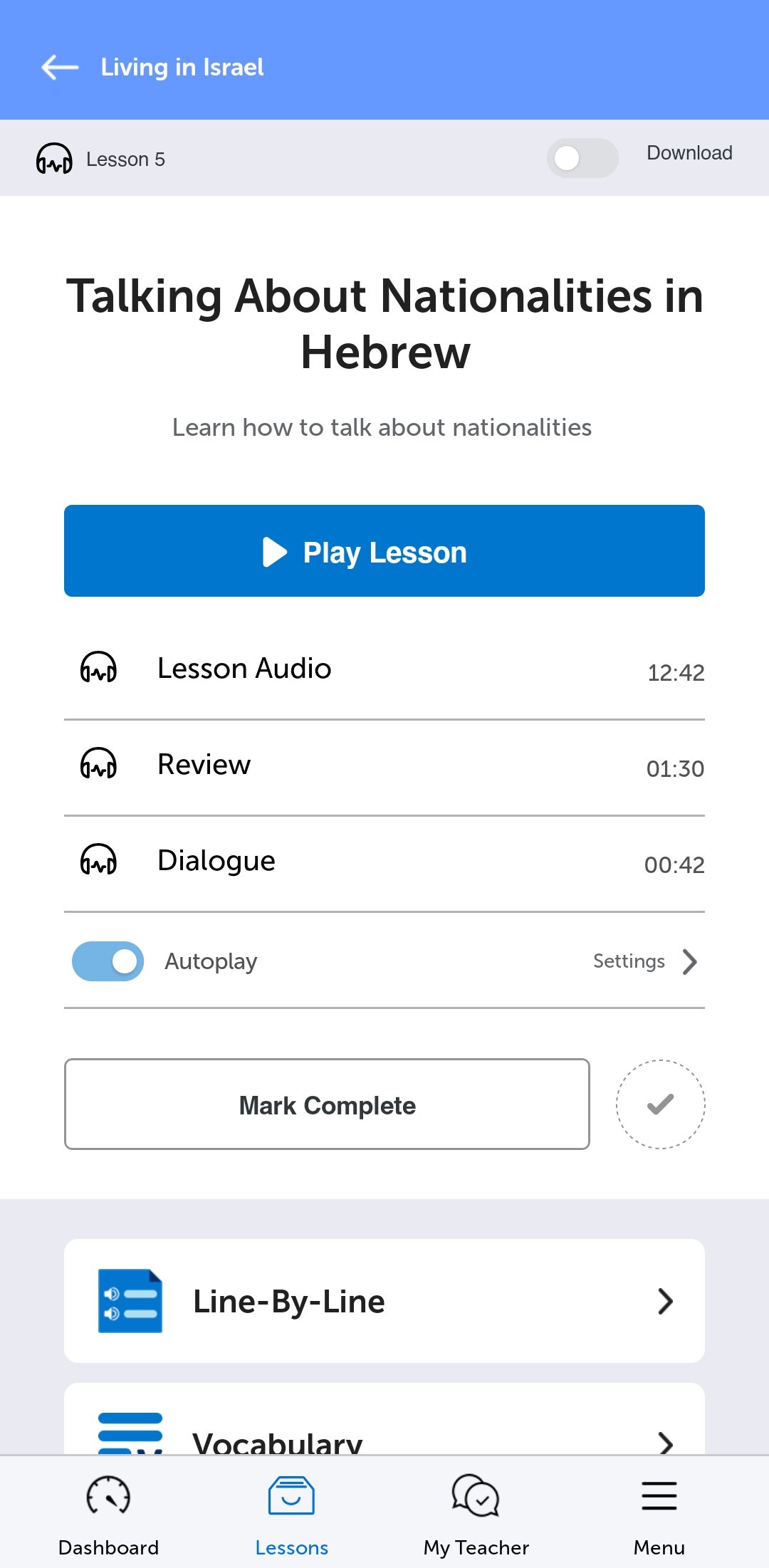
A typical lesson is short (most run around 10 to 12 minutes) and follows a consistent shape: a native dialogue, a slowed line-by-line breakdown, a vocabulary list with audio for every word, a grammar point and a cultural note. You get the full transcript, and the downloadable lesson-notes PDFs are among the most comprehensive I’ve seen from any course, unpacking the grammar and context properly. Everything is downloadable, too, so the material you’ve studied stays yours to keep offline.
The dialogue-first format suits Hebrew’s ear-first nature well. You hear vocabulary in context, at natural speed and then slowly, and the root system starts revealing itself through repeated exposure long before you could recite a binyan table.
Two honest caveats. First, the hosts’ English banter around the dialogues can grate; it sounds scripted at times, and at higher levels you want more Hebrew and less chat. The fix is built in, mind you: the line-by-line and vocab-only audio tracks skip straight to the Hebrew. Second, the standalone grammar reference is thin, closer to a summary page than a proper explanation of the binyanim, gender agreement and the rest. That’s consistent with the whole family’s method (practical phrases in context over grammar drilling), but for a language with this much systematic morphology, you’ll want a grammar book or reference site alongside it.
The Study Tools
On a Premium plan, the lessons are wrapped in a solid toolkit:
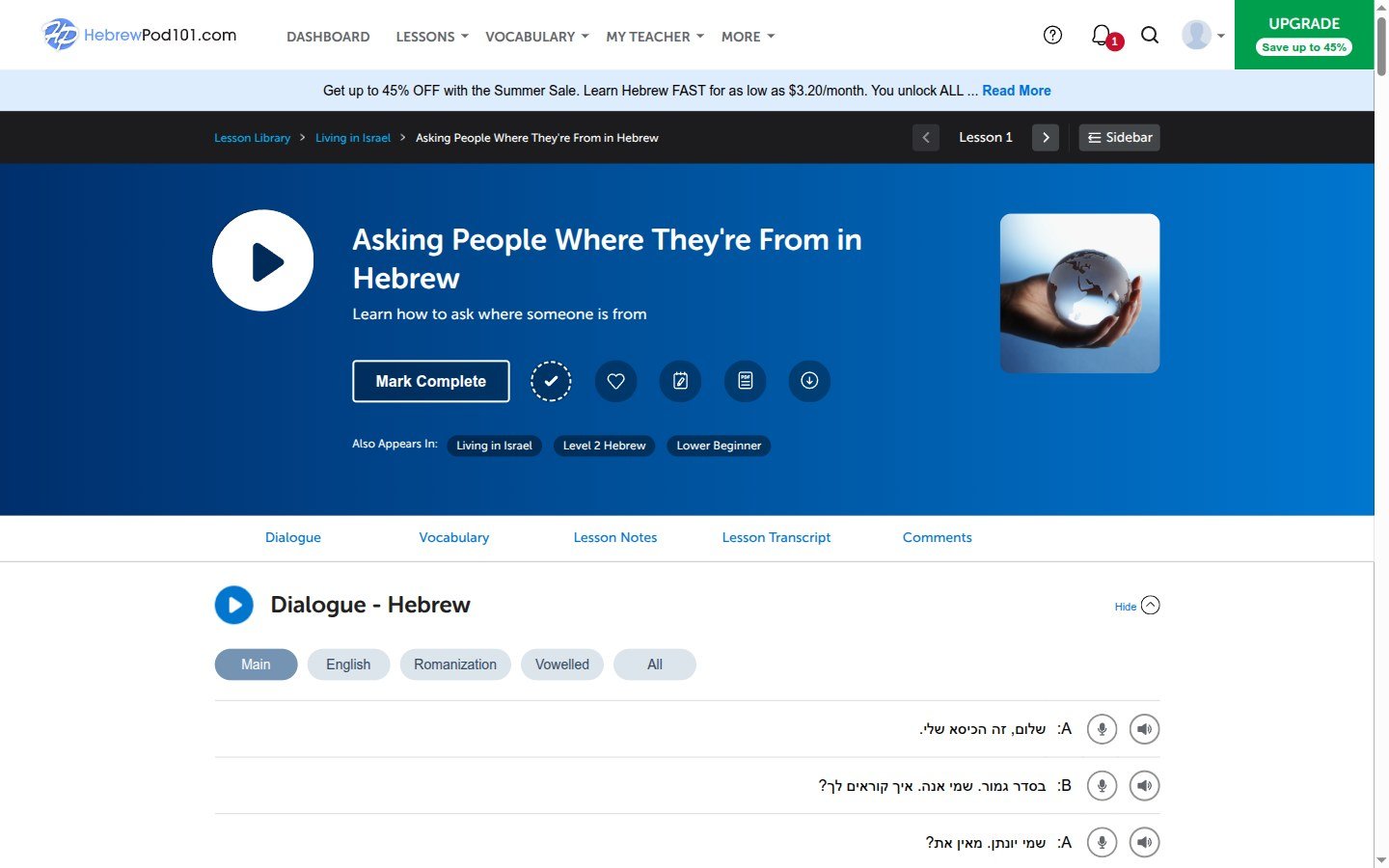
- Spaced-repetition flashcards and a personal word bank, where you save words straight from any lesson, ideal for hammering home roots and their families.
- Line-by-line audio for working through dialogues at your own pace.
- Multiple-choice assessments to check a section has actually gone in.
- The pronunciation tools, recording you against native audio, the best-matched feature for the guttural sounds.
- A 2,000-word Hebrew core vocabulary as a ready-made backbone (free accounts get a smaller starter list).

The Mobile App
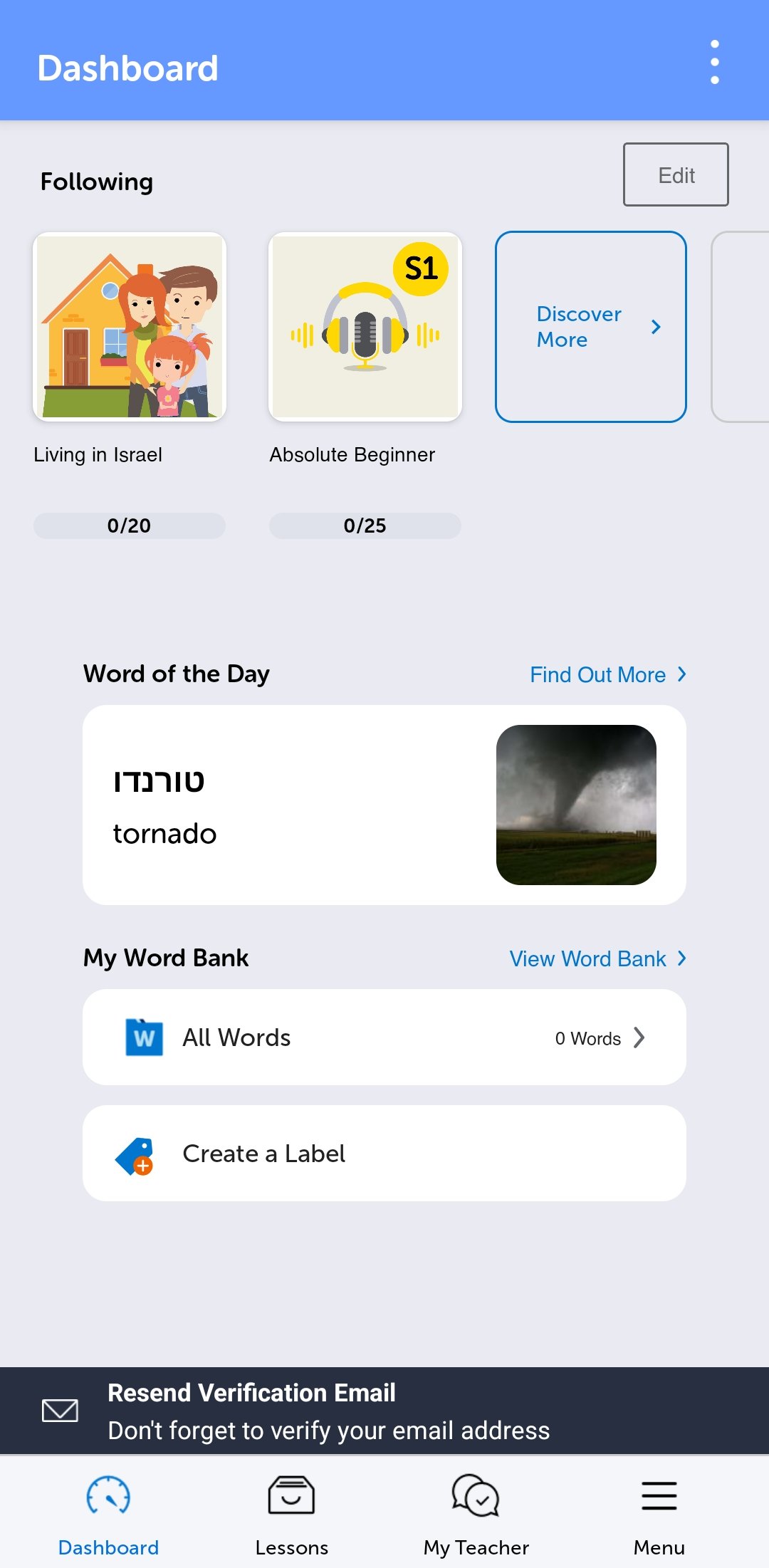
HebrewPod101 shares one app with the whole Innovative Language family (you install “Innovative Language 101” and choose Hebrew). It syncs with your account, lessons download for offline listening, and it’s well rated, sitting at 4.7 out of 5 from around 34,000 ratings on the App Store. Reviewers praise the instructors and the depth of material, with some grumbles at the edges about occasional crashes after updates.
The usual family caveat applies: the app is gated by your subscription tier just like the website, and some of the best study features live more comfortably in the browser. The workaround is the same one I suggest for its sister courses: open the site in your phone’s browser when you want the full toolset.
What Other Hebrew Learners Say
I went through the independent reviews to test my own take, and the pattern is unusually consistent.
The praise: one long-term Hebrew learner who reviews courses for a living calls it without doubt the best online course available for Hebrew at the beginner and intermediate levels, singling out the learning pathways for bringing order to a big catalogue and the lesson-notes PDFs for their depth. Another hands-on reviewer scored it 8.6 out of 10, praising the vocabulary-first approach, the free “100 Most Common Words” resource, the way culture is woven into the audio, and lesson lengths that respect your time. The fact that you can download everything you’ve paid for gets warm mentions too.
The criticism is worth being upfront about. The advanced content is noticeably thinner and less consistently organised than the beginner levels, so the course is strongest as your route from zero to solid intermediate. The video quality varies: the main host Yaara’s videos get called some of the best Hebrew video content anywhere, while others are narrated slideshows. The grammar reference is weak, as I said above. And the biggest structural gap: there’s almost no live speaking practice. Even the top tier’s 1-on-1 teacher access is written feedback through a messaging system rather than live conversation. For a language you learn by ear and mouth, that’s a real hole, and it’s why I’d pair this course with a tutor on a platform like italki once you have your footing. No course will make you fluent by itself, and this one is honest input and vocabulary machinery rather than a conversation partner.
Pricing and Plans
HebrewPod101 runs the same four-tier structure as the rest of the family:
| Plan | Roughly… | What you get |
|---|---|---|
| Free | Free forever | The first 3 lessons of every pathway, vocab resources, Word of the Day, the app, plus a 7-day Premium trial |
| Basic | ~$4/mo | Everything free + access to all audio and video lessons and the in-depth PDF lesson notes |
| Premium | ~$5–10/mo | Everything in Basic + flashcards, word bank, line-by-line audio, assessments, the pronunciation tools, and the 2,000-word Hebrew core |
| Premium PLUS | ~$13–23/mo | Everything in Premium + your own teacher, hand-graded assessments and a personalised study plan |
A few honest notes on the pricing. The headline per-month figures are anchored to the longest (24-month) plan, so the real price depends on the billing period you pick; check the checkout before you commit. Innovative also runs a more-or-less permanent discount (often around 45% off list), so you should rarely pay the “full” price. And there’s a 60-day money-back guarantee, which takes the risk out of trying Premium properly.
For most people, Premium is the sweet spot: that’s the tier with the flashcards, the pronunciation tools and the full lesson features. Premium PLUS only makes sense if you want written feedback from a teacher, and given that its teacher access isn’t live conversation, I’d sooner put that money towards a real tutor.
Pros and Cons
Pros
- A proper script curriculum that teaches the alphabet and the niqqud vowel points, with real Hebrew text as the capstone, instead of leaning on transliteration.
- Loads of native-speaker audio, exactly what an ear-first language with unwritten vowels demands.
- The gesture-based conjugation series, a genuinely clever tool for making the binyan patterns stick.
- A dedicated pronunciation guide targeting the guttural sounds English doesn’t have, plus a voice-recorder tool to drill them.
- Brilliant lesson-notes PDFs, all downloadable, so your study material stays yours.
- Genuinely affordable, with a usable free tier and a 60-day guarantee.
Cons
- Advanced content is thinner and patchier than the beginner levels, so it’s best as a zero-to-intermediate course.
- The grammar reference is weak, and Hebrew’s morphology deserves better; budget for a grammar companion.
- Almost no live speaking practice, even at the top tier, where teacher feedback is written rather than spoken.
- English banter pads some lessons (the vocab-only audio track is the escape hatch).
- The app is gated and a touch lighter than the full website.
Who HebrewPod101 Is (and Isn’t) For
It’s a brilliant fit if you’re starting Modern Hebrew from zero and want the script, the sounds and a big practical vocabulary built properly from day one; if you learn well by ear and want Hebrew in your headphones on a commute; or if you’ve tried app-style gamified courses and want something with real dialogues and depth behind it.
It’s less ideal if you’re already at a strong intermediate level and hungry for advanced material, if you want a rigorous grammar syllabus, or if your goal is Biblical Hebrew. And whoever you are, plan on adding real conversation practice with a tutor or exchange partner, because output is the one thing this course barely touches.
The Verdict
HebrewPod101 gets the most important thing about Hebrew right: it respects the ear-first nature of the language. It teaches the actual script and the niqqud properly instead of hiding behind transliteration, it floods you with native audio so the unwritten vowels stop being frightening, it targets the guttural sounds head-on, and the gesture-based conjugation series is a genuinely original answer to the root-and-pattern system. The weaknesses are real but manageable: a thin advanced tier, a grammar reference that needs a companion, and next to no live speaking, which you should be outsourcing to a human anyway.
My rating: 4.2 out of 5.
If you want to give it a go, you can start with HebrewPod101 here. That link also carries our reader discount (Innovative’s near-permanent deal is applied for you at checkout), so you won’t be paying full list price. Set up a free account, run through the alphabet series, and see if learning Hebrew by ear clicks for you.

Social