



ItalianPod101 Review: Is It the Best Way to Learn Italian?

Full disclosure: This post contains affiliate links. ?
What is ItalianPod101?
ItalianPod101 is part of the Innovative Language family, built to get you understanding and speaking Italian from the very first lesson. Audio and video lessons taught by native speakers are its main feature.
- what it’s for:
- First contact with Italian, listening practice, vocabulary, pronunciation (the double consonants and the rolled R), and phrases and conversation material
- languages:
- Italian
- level:
- Absolute Beginner to Advanced
+ PROS
- Outstanding native audio, exactly what Italian’s double consonants and rolled R need
- A proper pronunciation guide covering the vowels, the soft and hard c and g, and stress
- A guided learning path, so there’s no guessing where to begin
- Excellent for vocabulary, with frequency-ranked word lists and brilliant flashcards
- Genuinely thorough lesson-notes PDFs
- Genuinely affordable, with a free tier and a 60-day guarantee
- CONS
- Grammar is taught incidentally, so the subjunctive, gender agreement and formal Lei need a companion resource
- Too much English in some lessons, especially the older ones
- Light on speaking and writing practice below the top tier
- Upsell banners and marketing emails
- The mobile app doesn’t have all the best features
Italian has a lovely reputation for being one of the easier languages an English speaker can pick up, and that reputation is earned. The US Foreign Service Institute files it in Category I, its friendliest group, alongside Spanish and French, and reckons you can reach professional working proficiency in around 600 class hours. That’s a quarter of what Japanese or Korean demand. It’s a Romance language, it uses the same alphabet you’re reading now, and it’s spelled almost exactly as it sounds.
So a review of an Italian course has to ask a slightly different question than my Korean or Japanese ones did. With Korean, the challenge is survival: can the course get you reading a new alphabet and untangling honorifics? With Italian, the baseline is already gentle. The real question becomes: if Italian is this approachable to begin with, what does a course actually need to add?
I’ve been reviewing the Innovative Language “101” courses for a while now (you might have seen my SpanishPod101 and JapanesePod101 reviews), and the rest of the Fluent in 3 Months team and I have leaned on these podcasts for our own language missions. ItalianPod101 is the Italian member of that family. Let’s see whether it earns its keep.
What Makes Italian Different (Even Though It’s “Easy”)
Italian being approachable doesn’t mean it’s effortless. It just means the difficulties are concentrated in a few specific spots rather than spread across the whole language. Here are the five things that genuinely trip up English speakers, and they’re the yardstick I’ll measure ItalianPod101 against.
A useful way to think about them: two of these are “ear” problems (you can only fix them by hearing native speakers, over and over), and three are “grammar” problems (you fix them by understanding a rule and then drilling it). Hold that split in mind, because it turns out to matter a lot for how well this particular course serves you.
1. Gendered nouns, and the agreement that cascades from them. Every Italian noun is masculine or feminine, and that gender ripples outward through the whole sentence. Il libro rosso (the red book) but la casa rossa (the red house): the adjective itself changes to agree. The articles are fiddlier than English too. There are several ways to say “the” (il, lo, la, i, gli, le) and “a” (un, uno, una, un’), and which one you use depends on the noun’s gender and its first letter. This is a grammar problem, and it’s the first real wall.
2. Verb conjugation, and then the subjunctive. Italian verbs come in three families based on their ending: -are (parlare, to speak), -ere (credere, to believe) and -ire (dormire, to sleep), each with its own set of endings. That part is learnable. The genuine wall is the subjunctive (congiuntivo), a verb mood that’s all but extinct in English but alive and constant in Italian. It’s triggered every time you think, hope, doubt or want something: Penso che lui sia italiano (“I think he is Italian”) uses sia, not the everyday è. The subjunctive is the single thing Italian teachers most often name as the place motivated learners stall.
3. Double consonants, which actually change the meaning. Italian distinguishes single from double consonants in both spelling and sound, holding the doubled one noticeably longer. English never does this (we spell “butter” with two t’s but don’t pronounce it any differently), so English ears often can’t hear the difference at all. And it matters, because it’s the only thing separating completely different words: pala (shovel) versus palla (ball), sete (thirst) versus sette (seven), capello (a hair) versus cappello (a hat). This is an ear problem, and a sneaky one.
4. The rolled R. Italian has two R sounds. The single tap in caro (dear) is easy: it’s the same flick most English speakers already make in the middle of “butter”. The trilled double R in carro (cart) or birra (beer) is the famous rolled R, and it’s the one sound English simply doesn’t have. The two aren’t interchangeable either, since caro and carro are different words. Pure ear-and-mouth problem.
5. The formal Lei. Italian has two words for “you”: tu for friends and peers, and the formal Lei for strangers, elders and professional settings. The twist that catches English speakers out is that Lei takes third-person verbs, the same forms you’d use for “she”. So “Do you speak Italian?” is Tu parli italiano? informally, but Lei parla italiano? formally, conjugated as though you were asking about someone else entirely. A grammar problem, though a milder one these days, as Italy drifts towards tu in most casual settings.
Keep those five in mind, sorted into the two “ear” challenges and the three “grammar” ones. Here’s how ItalianPod101 stacks up against them.
Getting Started with ItalianPod101
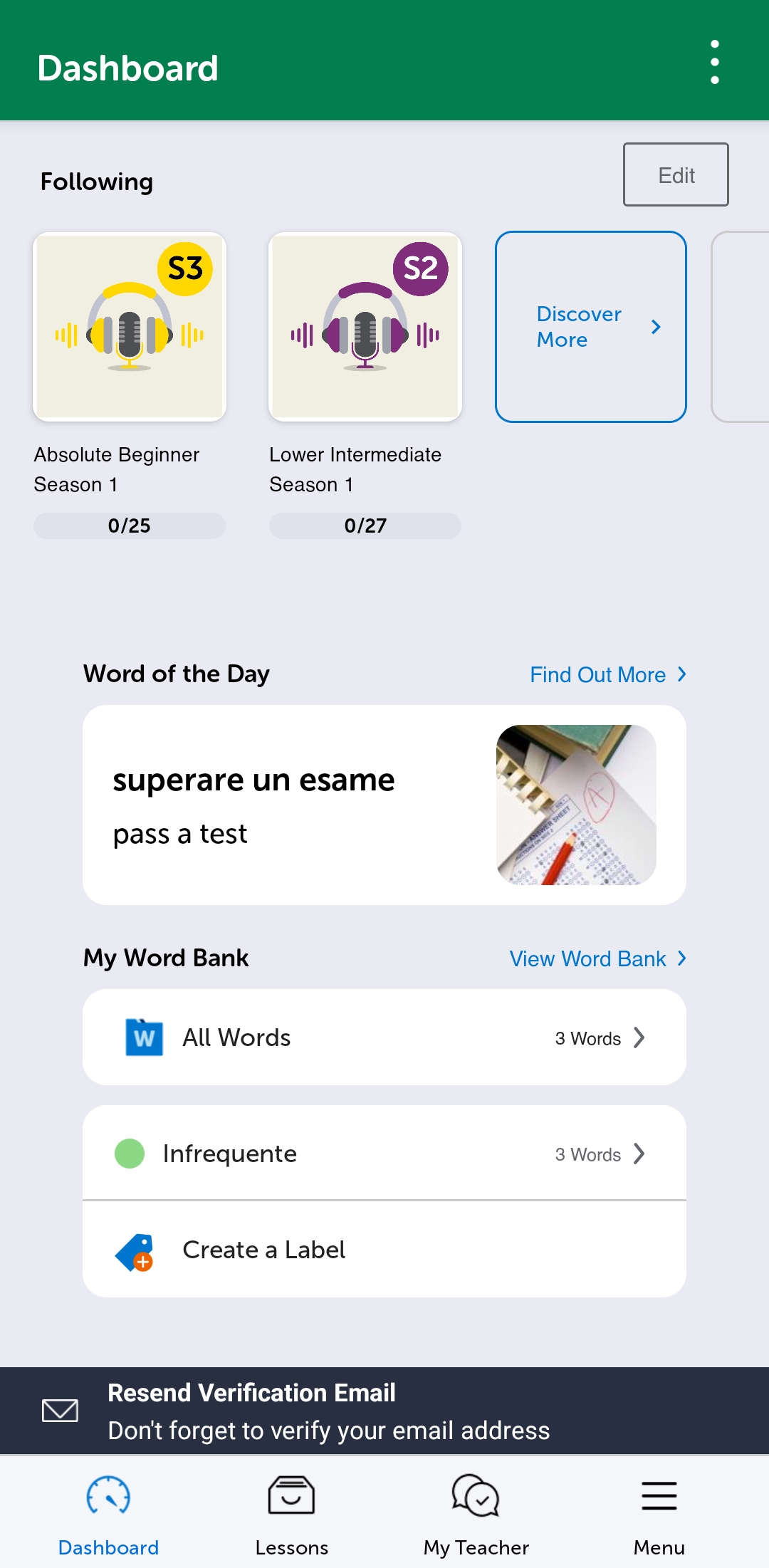
Like the rest of the 101 family, ItalianPod101 is built around audio and video lessons taught by native speakers, organised into level-based pathways: Absolute Beginner, Beginner, Intermediate, Upper Intermediate and Advanced.
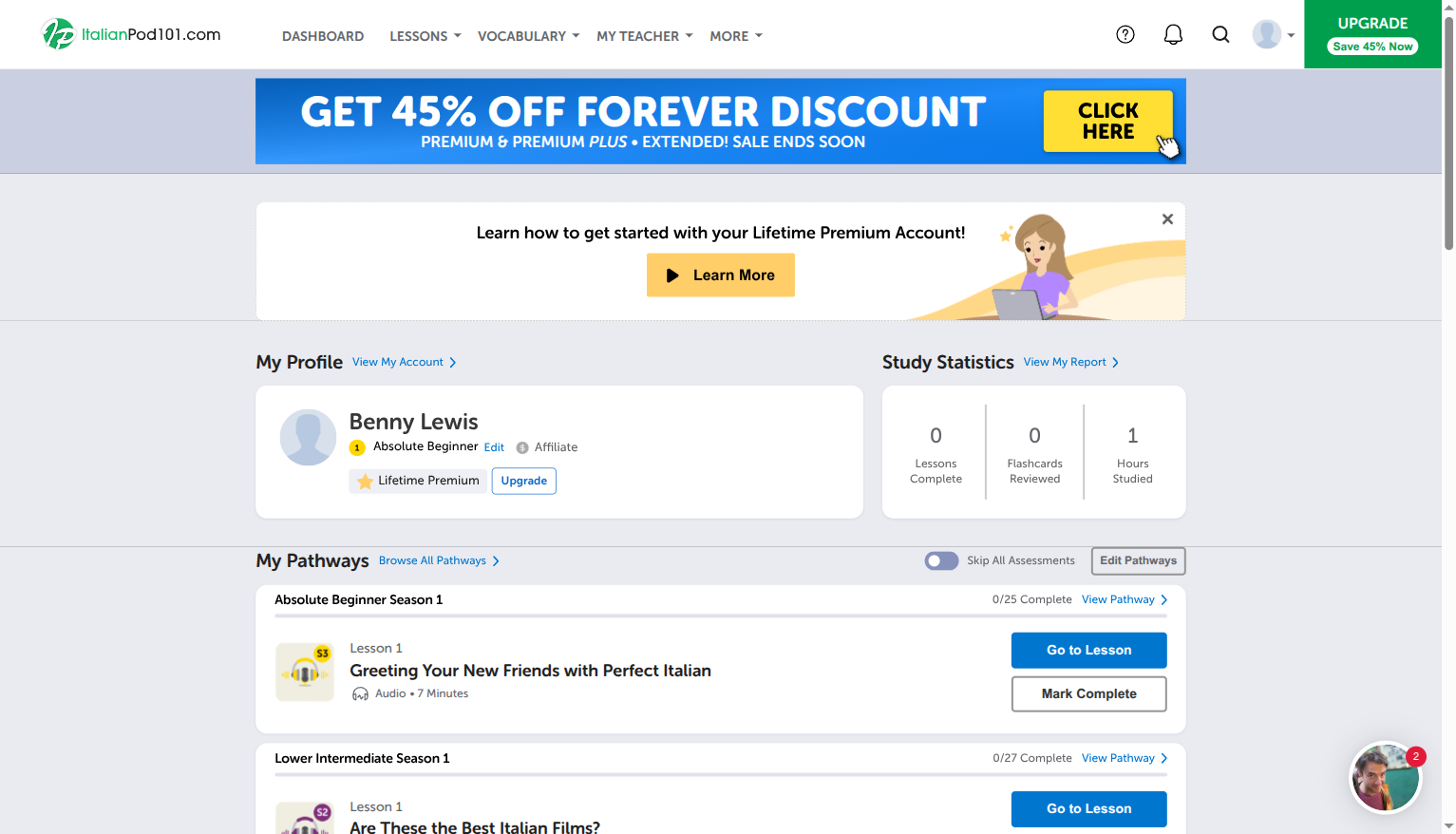
Signing up is painless. You create a free lifetime account with just an email (no card needed) and pick your level. Not sure where you sit? Choose Absolute Beginner; you can move later. New accounts also get a 7-day Premium trial, so you get a proper taste of the paid features before committing to anything.
Once you’re in, your dashboard hands you a learning path for your level, so you’re not left staring at a library of a thousand lessons wondering where to start. That guided pathway is one of the platform’s real strengths. The flagship absolute-beginner pathway alone runs to a full course’s worth of short lessons with built-in assessments, and it’s organised around things you can actually do (introduce yourself, order at a restaurant) rather than abstract grammar units.
The Pronunciation Side: Where ItalianPod101 Shines
Remember those two “ear” problems, the double consonants and the rolled R? This is exactly where an audio-first course should pull ahead of a textbook or a tapping app, and ItalianPod101 does.
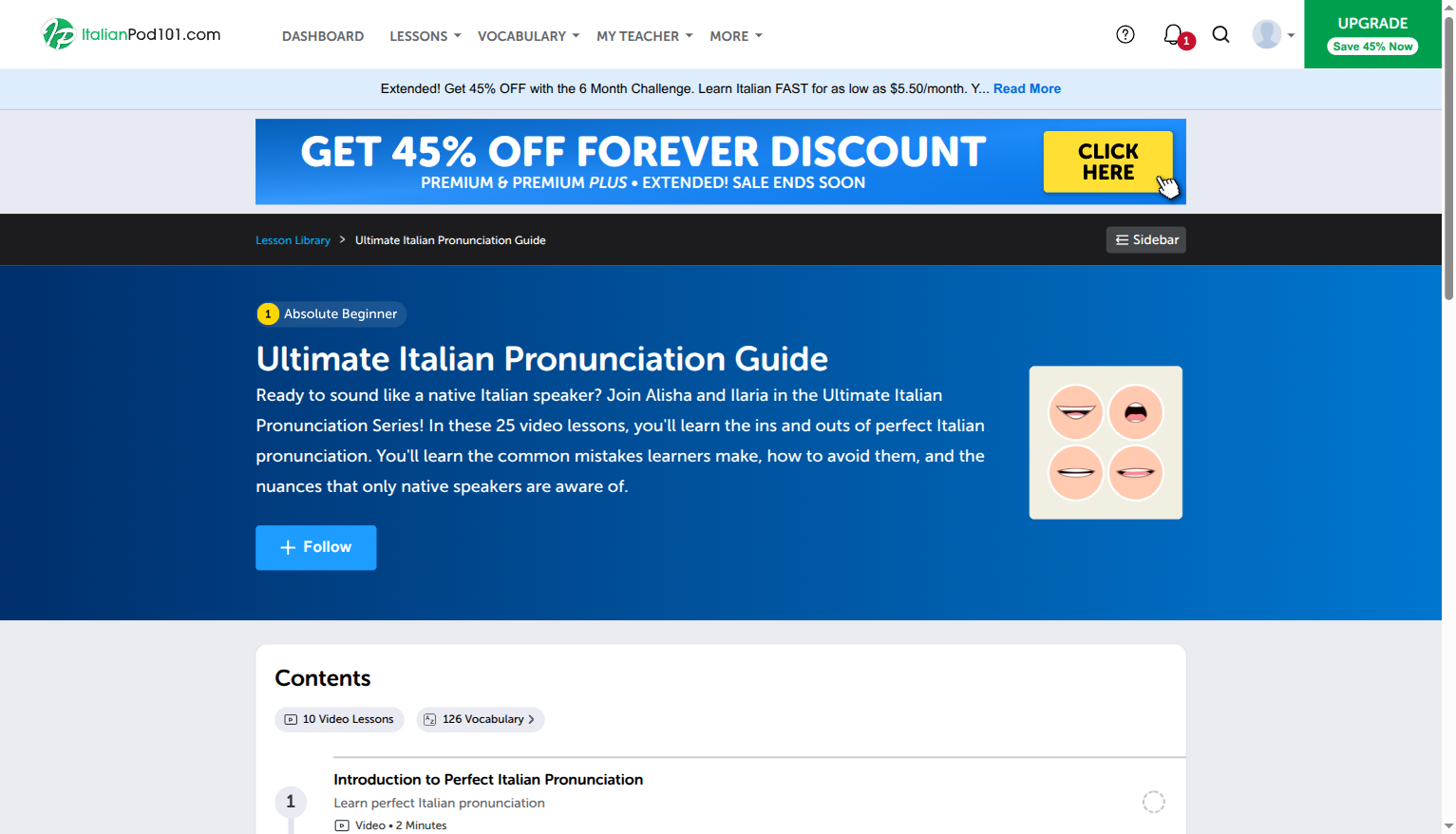
There’s a dedicated “Ultimate Italian Pronunciation Guide”, a short series of video lessons that works through the Italian sound system: the vowels (including the open and closed versions of e and o that textbooks gloss over), the consonants that don’t exist in English, diphthongs, and the stress rules that tell you which syllable to lean on. Because Italian is so close to phonetic, getting the sound system straight early pays off fast: once you know the rules, you can read almost any Italian word aloud correctly on sight. That includes the one genuinely non-obvious spelling rule, where c and g go soft before e and i (cibo, gelato) but stay hard elsewhere (casa, gatto), which the guide covers.
The double consonants and the rolled R are the sort of thing you can only fix by ear, and this is the format for it: every lesson is built on native-speaker recordings with slowed-down, line-by-line playback, so you actually hear the held ll in palla and the trill in birra instead of squinting at a description on a page. If pronunciation is your worry, ItalianPod101’s core strength lands right where Italian needs it.
Inside an ItalianPod101 Lesson
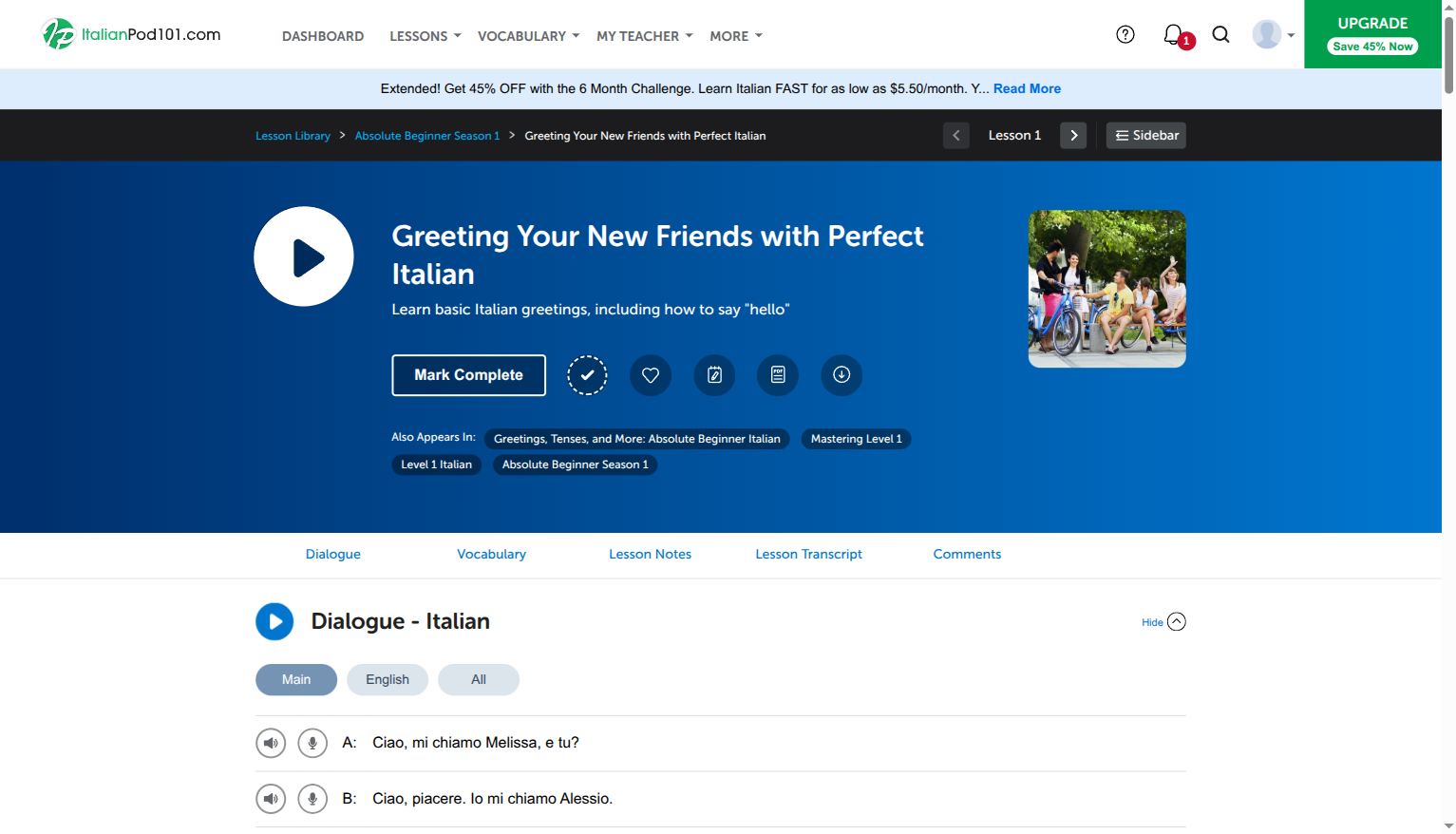
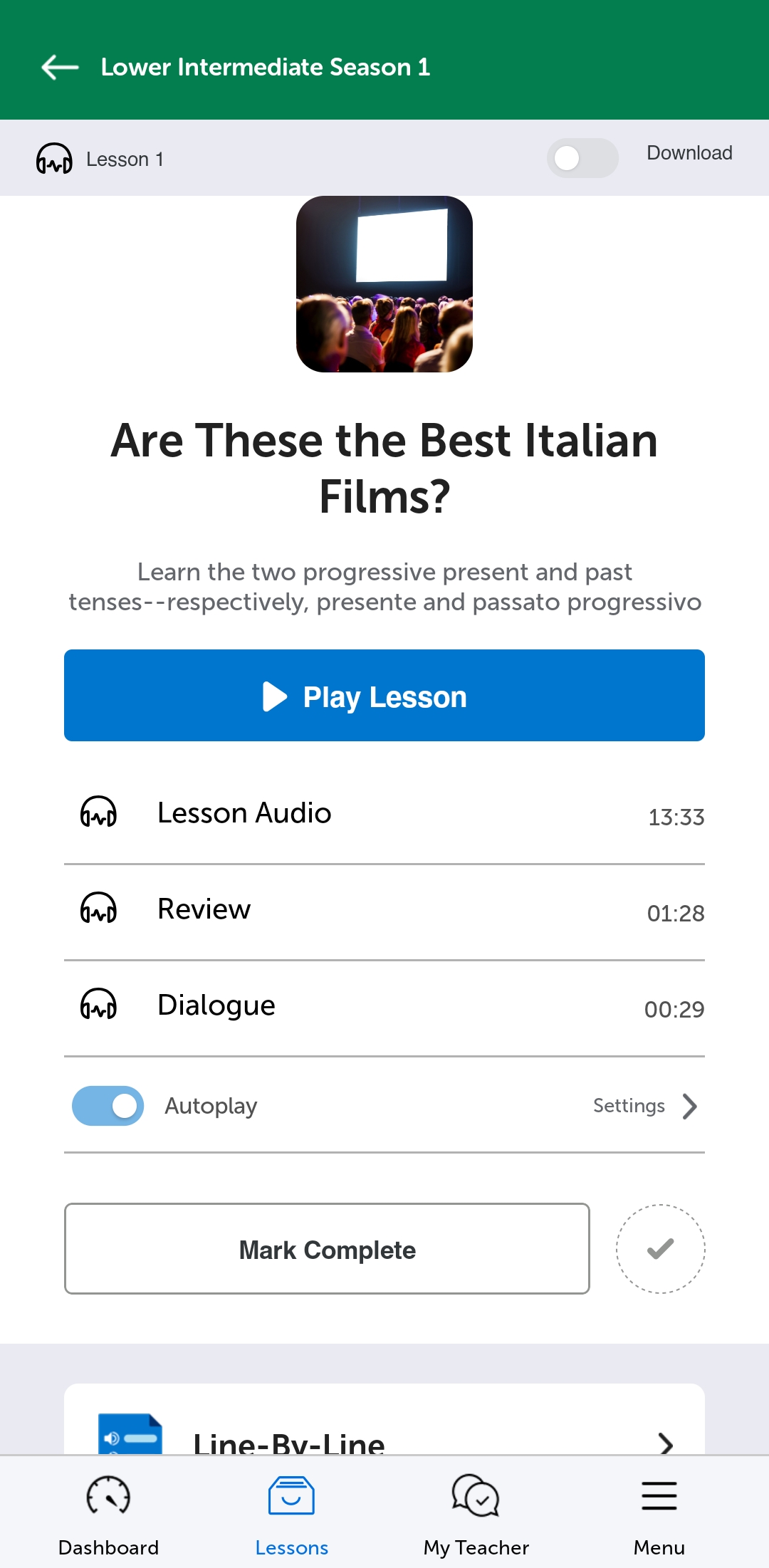
A typical lesson is short (most run 3 to 15 minutes) and follows a consistent shape: a native dialogue, a slow breakdown, vocabulary with natural-then-slow pronunciation, a grammar point, and cultural context. You get the audio, the full scripted dialogue, a vocab list, and downloadable lesson notes (a PDF) that dig into the grammar and culture. Those PDF notes are quietly one of the best things on the platform; reviewers who’ve worked through plenty of these courses single them out as some of the most thorough lesson notes around.
The dialogue-first approach is well suited to drip-feeding the things Italian throws at you in context. You hear tu and Lei used in real situations instead of as an abstract table, gendered nouns turn up attached to their articles (which is exactly how you should learn them), and the recurring cultural segments are a natural home for when each register is appropriate.
The Study Tools
On a Premium plan, the lessons are wrapped in a solid set of study tools:
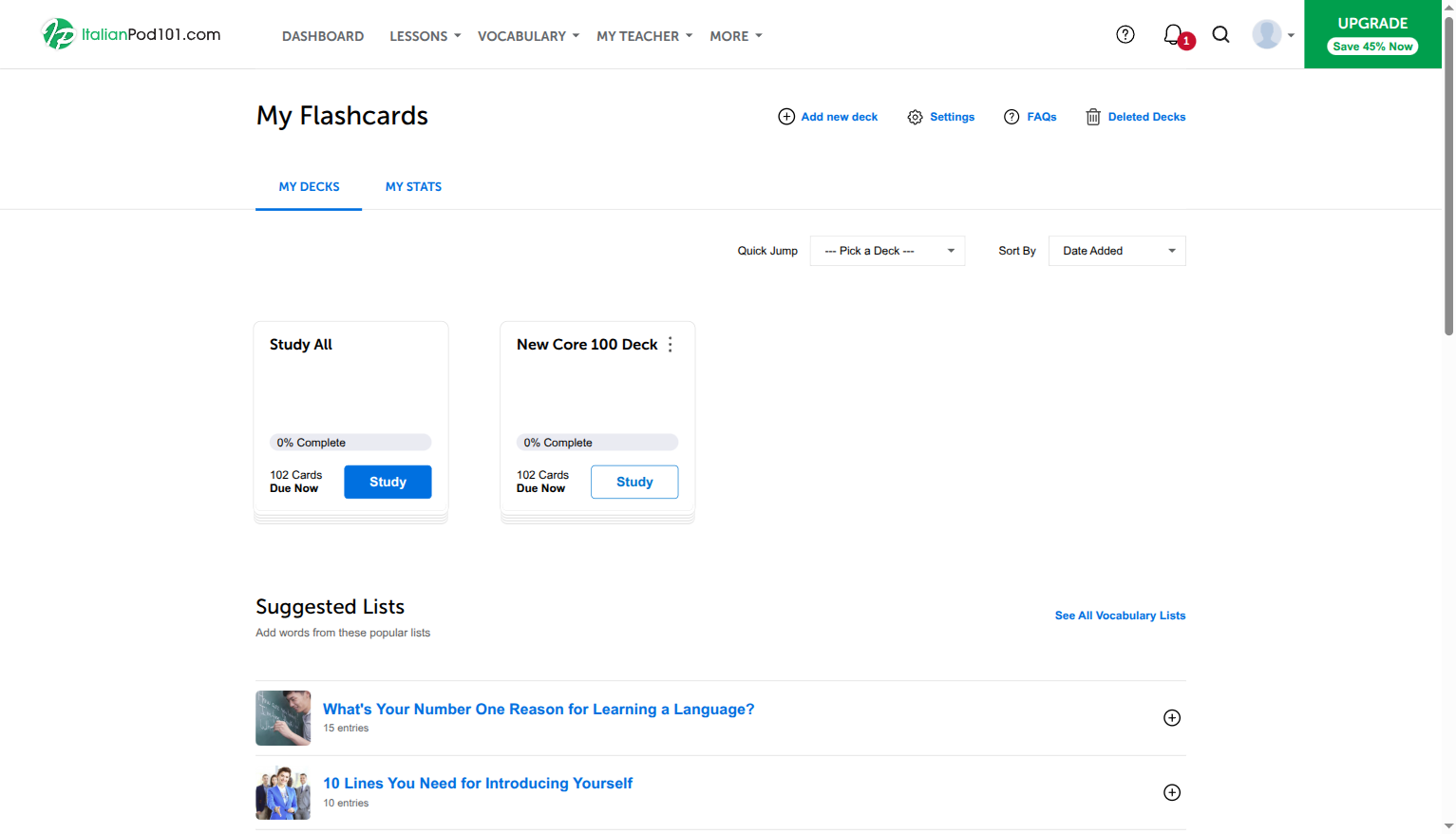
- Spaced-repetition flashcards and a personal word bank, where you add words straight from any lesson, which is perfect for hammering home vocabulary (more on why that matters below).
- A grammar bank collecting the grammar points in one place.
- Multiple-choice assessments to check you’ve actually absorbed a section.
- A pronunciation tool that records you and lets you compare against the native audio, handy for testing your rolled R against the real thing.
- 2,000 core words and phrases, ranked by frequency, as a ready-made vocabulary backbone.
There’s also a neat “Fast Italian Conjugation with Gestures” series that drills the most common verbs in the present tense, all three conjugation groups plus the awkward irregulars like essere and avere, using physical gestures as memory hooks. It’s a clever way to get the high-frequency verbs to stick.
The Mobile App
There’s an Innovative Language app that syncs with your account, so lessons you finish on your laptop show as done on your phone. It’s clean and handy for listening on the go, which is exactly how loads of people use these courses, as a podcast for the commute.
The same caveat applies as on the other 101 courses, though: the app is a slightly stripped-back version of the website. You can’t always follow your structured study path inside the app, and some of the best web features aren’t fully there. The workaround is the same one I use elsewhere: pull the site up in your phone’s browser when you want the full experience.
What Other Italian Learners Say
I dug through a stack of reviews and Italian-learning forums to double-check my own take. A few clear patterns came up, and they line up neatly with the “ear versus grammar” split.
The praise is consistent. The native-speaker audio is the thing nearly everyone rates highly: clear, professional, and easy to learn from on the move. Learners also single out the vocabulary breadth and the supporting tools (the frequency-ranked word lists, the flashcards, those thorough PDF lesson notes), and many appreciate how much Italian culture gets woven through the lessons rather than left as an afterthought. It’s well rated on both app stores, with independent review sites landing a notch lower but still firmly positive.
The criticism bears directly on Italian’s specific challenges:
- The biggest, most consistent complaint is too much English chit-chat, especially in the older and higher-level lessons. You can spend a fair chunk of a lesson listening to two hosts talk about Italian rather than listening to Italian. The fix is simple: focus on the dialogue and vocab segments.
- The grammar coverage is light and a bit scattered. This is the important one for Italian. Reviewers note the grammar is taught incidentally through dialogue instead of systematically, and the heavier grammar (the kind Italian leans on) isn’t drilled the way a dedicated grammar course would. That’s fine for vocabulary and listening, but Italian’s three “grammar” challenges (gender agreement, the subjunctive, the formal Lei) are exactly the parts that reward structured, deliberate teaching.
- There’s no real speaking practice or feedback outside the top Premium PLUS tier. You can record yourself against the native audio, but you won’t get a human correcting your output unless you pay for the teacher.
- Like the other 101 sites, there are upsell banners around the platform, and the headline prices are tied to the longest plan, so read the checkout carefully (more on that next).
The summary the reviews back up is this: ItalianPod101 is a brilliant listening-and-vocabulary engine, not a one-stop grammar bible. Most people get the best results pairing it with a dedicated grammar resource (a workbook like Italian Grammar in Practice, or Coffee Break Italian for another audio angle) for the subjunctive and the trickier agreement rules, and adding actual speaking practice, whether that’s lessons on italki or working through my own Language Hacking Italian book, which is built around speaking from day one. That’s simply how the strongest learners use it.
Pricing and Plans
ItalianPod101 runs the same four-tier structure as the rest of the family:
| Plan | Roughly… | What you get |
|---|---|---|
| Free | Free forever | First 3 lessons of every series, Survival Phrases, Word of the Day, 100+ vocab lists, the app, plus a 7-day Premium trial |
| Basic | ~$4/mo | Everything free + access to all lessons and in-depth lesson notes |
| Premium | ~$5–10/mo | Everything in Basic + flashcards, word bank, line-by-line audio, assessments, grammar bank, pronunciation tool, 2,000 core words |
| Premium PLUS | ~$13–23/mo | Everything in Premium + your own teacher, hand-graded assessments and personalised guidance |
A few honest notes on the pricing. The headline per-month figures are based on the longest (24-month) plan, so the actual price depends on the billing period you pick: choose a shorter plan and the monthly rate climbs, so always check the checkout before you commit. Innovative also runs a more-or-less permanent discount, and the exact size varies over time, so you should rarely if ever pay the “full” list price; the sign-up link at the end of this review applies the current one automatically. And as above, you’ll get a fair few upsell banners nudging you towards the higher tiers, mildly annoying but easy to ignore. There’s a 60-day money-back guarantee, which takes the risk out of trying Premium.
For most people, Premium is the sweet spot: that’s the tier where the flashcards, pronunciation tool and full lesson features live. Premium PLUS only makes sense if you specifically want a teacher checking your work, and on that front several reviewers felt it over-promised, so go in with clear expectations.
Pros and Cons
Pros
- Outstanding native audio, which is exactly what Italian’s double consonants and rolled R demand: these are problems you can only solve by ear.
- A proper pronunciation guide that covers the vowels, the soft/hard c and g rule, and stress, getting you reading Italian aloud correctly fast.
- A guided learning path so you’re never guessing what to study next.
- Excellent for vocabulary, with frequency-ranked word lists and strong flashcard tools.
- Genuinely thorough PDF lesson notes, repeatedly singled out by reviewers.
- Affordable, with a usable free tier and a 60-day guarantee.
Cons
- Grammar is taught incidentally, not systematically, which is the weak spot for Italian’s subjunctive, gender agreement and formal Lei. Pair it with a grammar resource.
- Too much English chat in some lessons, especially older ones.
- No real speaking feedback below the top tier.
- Upsell banners crop up around the platform.
- The app is a lighter version of the full website.
Who ItalianPod101 Is (and Isn’t) For
It’s a brilliant fit if you’re a beginner who wants a clear, guided path into Italian; someone who learns well by ear and wants Italian in your headphones on the commute; a traveller, food-and-culture lover or opera fan who wants real, usable Italian with cultural context; or anyone who wants to build a big vocabulary and a solid accent fast.
It’s less ideal if you want a single resource that drills grammar mechanics above all else, and Italian’s hardest bits (the subjunctive especially) are grammar-shaped. In that case, use ItalianPod101 for vocabulary, listening and pronunciation, where it’s at its best, and bolt on a grammar-focused companion for the rest.
The Verdict
ItalianPod101 does the most important thing right: it plays to exactly where Italian needs the most help. Italian’s two “ear” challenges, the double consonants and the rolled R, are precisely the sort of thing that only loads of native audio can fix, and that’s the platform’s core strength. It teaches the sound system properly, builds vocabulary better than almost anything else out there, and the guided path means you always know what’s next.
Where it’s lighter is grammar, and since a few of Italian’s real walls (the subjunctive, gender agreement, the formal Lei) are grammar-shaped, you’ll want to pair it with a dedicated grammar resource and something for speaking practice. But as the audio-and-vocabulary core of your Italian study, it’s hard to beat for the price.
My rating: 4.5 out of 5.
If you want to give it a go, you can start with ItalianPod101 here. That link lands you on a page with Innovative’s discount already applied, so you won’t pay the full list price. Set up a free account, take it for a spin, and see if learning Italian by ear clicks for you.

Social