



PortuguesePod101 Review: Is It the Best Way to Learn Portuguese?

Full disclosure: This post contains affiliate links. ?
What is PortuguesePod101?
PortuguesePod101 is part of the Innovative Language family, built to get you understanding and speaking Brazilian Portuguese from the very first lesson. Audio and video lessons taught by native speakers are its main feature.
- what it’s for:
- First contact with Brazilian Portuguese, listening practice, vocabulary, pronunciation (the nasal vowels and the Brazilian sound shifts), and phrases and conversation material
- languages:
- Portuguese (Brazilian)
- level:
- Absolute Beginner to Advanced
+ PROS
- Commits clearly to Brazilian Portuguese, with consistent native audio, so you avoid mixing variants
- Loads of native audio, exactly what the nasal vowels and Brazilian sound shifts need
- A guided learning path, so there’s no guessing where to begin
- Strong lesson-notes PDFs and grammar explanations, which matters for ser/estar and the subjunctive
- Excellent for building vocabulary, helped along by Portuguese’s generous cognates
- Genuinely affordable, with a free tier and a 60-day guarantee
- CONS
- Too much English chit-chat in some lessons
- Light on speaking and writing practice unless you pay for the top tier
- Advanced content thins out, so it’s best as a route to intermediate
- Barely covers European Portuguese (it’s a Brazilian course)
- The mobile app doesn’t have all the best features
Quick Fire Review
A brilliant audio-and-vocabulary engine for Brazilian Portuguese that trains your ear for the nasal vowels and Brazilian sound shifts; pair it with conversation practice for speaking. 4.4/5.
Here’s some good news if you’re thinking about learning Portuguese: it’s one of the friendliest languages an English speaker can pick. The US Foreign Service Institute files it in Category I, its easiest tier, alongside Spanish, French and Italian, and reckons you can reach professional working proficiency in around 600 class hours. That’s a quarter of what Korean or Japanese demand. The Latin alphabet is already familiar, a huge chunk of the vocabulary overlaps with English, and the spelling is far more consistent than French.
Portuguese doesn’t ask a course to haul you over a mountain of characters and tones, so the real question is subtler: does it handle the specific things that still trip English speakers up, the nasal vowels, ser versus estar, the subjunctive, and the very first decision every Portuguese learner faces? If a language is this approachable, a course earns its keep by nailing those, not by padding out the easy bits.
I’ve been working through the Innovative Language “101” courses for a while (you might have seen my SpanishPod101 and JapanesePod101 reviews), and the rest of the Fluent in 3 Months team and I have leaned on these audio courses for our own language missions. PortuguesePod101 is the Portuguese member of that family. Let’s see how it measures up.
What Makes Portuguese Different (and Where a Course Has to Earn Its Keep)
Portuguese being “easy” doesn’t mean it’s effortless. These are the things that genuinely catch English speakers out, and they’re the yardstick I’ll measure PortuguesePod101 against.
1. Which Portuguese? Brazilian or European. This is the very first decision, and it’s not optional. Brazilian and European Portuguese are mutually intelligible on paper but sound strikingly different out loud, and they differ in everyday grammar too. Brazilians say você for “you” and estou falando for “I’m speaking”; in Portugal it’s often tu and estou a falar. European Portuguese swallows its unstressed vowels (so menino comes out closer to “m’NEE-n'”), which makes it noticeably harder to follow by ear. Pick one and stick with it, because a course that teaches one variant while feeding you audio from the other will confuse you at exactly the wrong moments.
2. Nasal vowels and the Brazilian sound shifts. This is the real pronunciation wall. Portuguese has nasal vowels English simply doesn’t have, the -ão in não, pão and coração, the ã in irmã, the -em in bem. They’re produced through the nose, not by tacking an “n” on the end. On top of that, Brazilian Portuguese runs a set of consistent sound shifts that are invisible on the page: dia sounds like “JEE-ah”, noite like “NOY-chee”, Rio like “HEE-oh”, and a final -l turns into “w” (Brasil = “bra-ZEE-oo”). These are completely regular once you know them, but you have to hear them, which is exactly where an audio course should shine.
3. Ser vs estar, two verbs for “to be”. The classic Romance-language hurdle. Portuguese splits “to be” into ser (permanent, defining: Eu sou irlandês, “I am Irish”) and estar (temporary, situational: Estou cansado, “I’m tired right now”). Pick the wrong one and the meaning changes: ela é bonita means she’s beautiful, ela está bonita means she looks lovely today. English never forces this choice, so it takes repeated exposure before it clicks.
4. The subjunctive (and it’s everywhere). English speakers barely notice the subjunctive in their own language. In Portuguese it’s mandatory in ordinary, everyday speech, for wishes, doubts and emotions: Espero que ele venha (“I hope he comes”). A good course can’t bury it in the advanced section, because you’ll hear it from day one in real conversation.
5. Gendered nouns and false friends. Every noun is masculine or feminine, and that gender ripples out to articles and adjectives (o livro interessante, a casa interessante), so the smart move is to learn each noun with its article. And while Portuguese hands English speakers thousands of free cognates (English “-tion” words become “-ção”: nation → nação), it also lays a few traps: puxar means pull, not push; pretender means to intend, not to pretend; assistir means to watch.
Keep those five in mind. Here’s how PortuguesePod101 stacks up against them.
Getting Started: Where to Begin with PortuguesePod101
Like the rest of the 101 family, PortuguesePod101 is built around short audio and video lessons taught by native speakers, organised into level-based pathways: Absolute Beginner, Beginner, Intermediate, Upper Intermediate and Advanced.
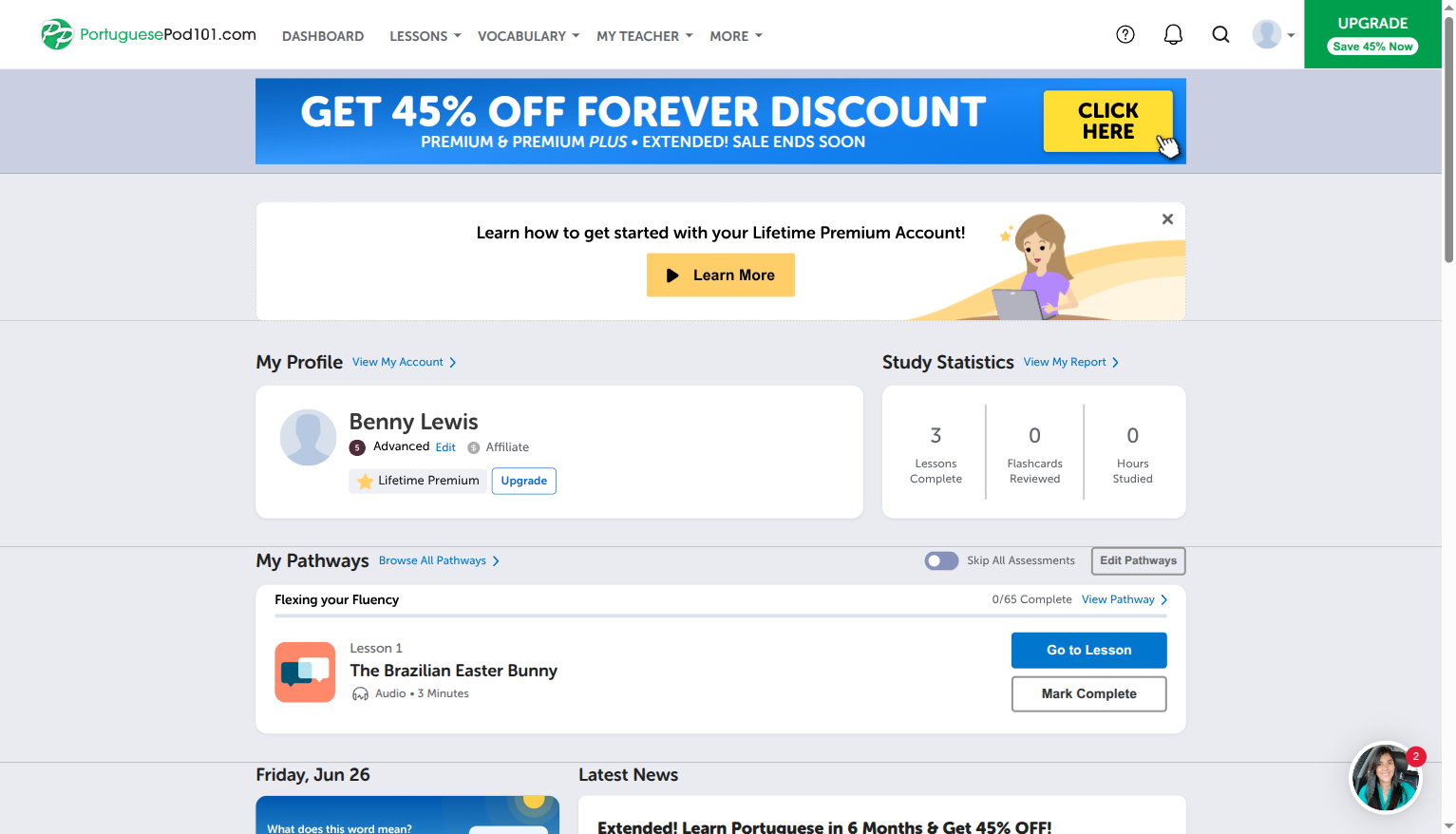
Signing up is painless. You create a free lifetime account with just an email (no card needed) and pick your level. Not sure where you sit? Start at Absolute Beginner; you can move up whenever you like. New accounts also get a 7-day Premium trial, so you can try the paid features before committing to anything.
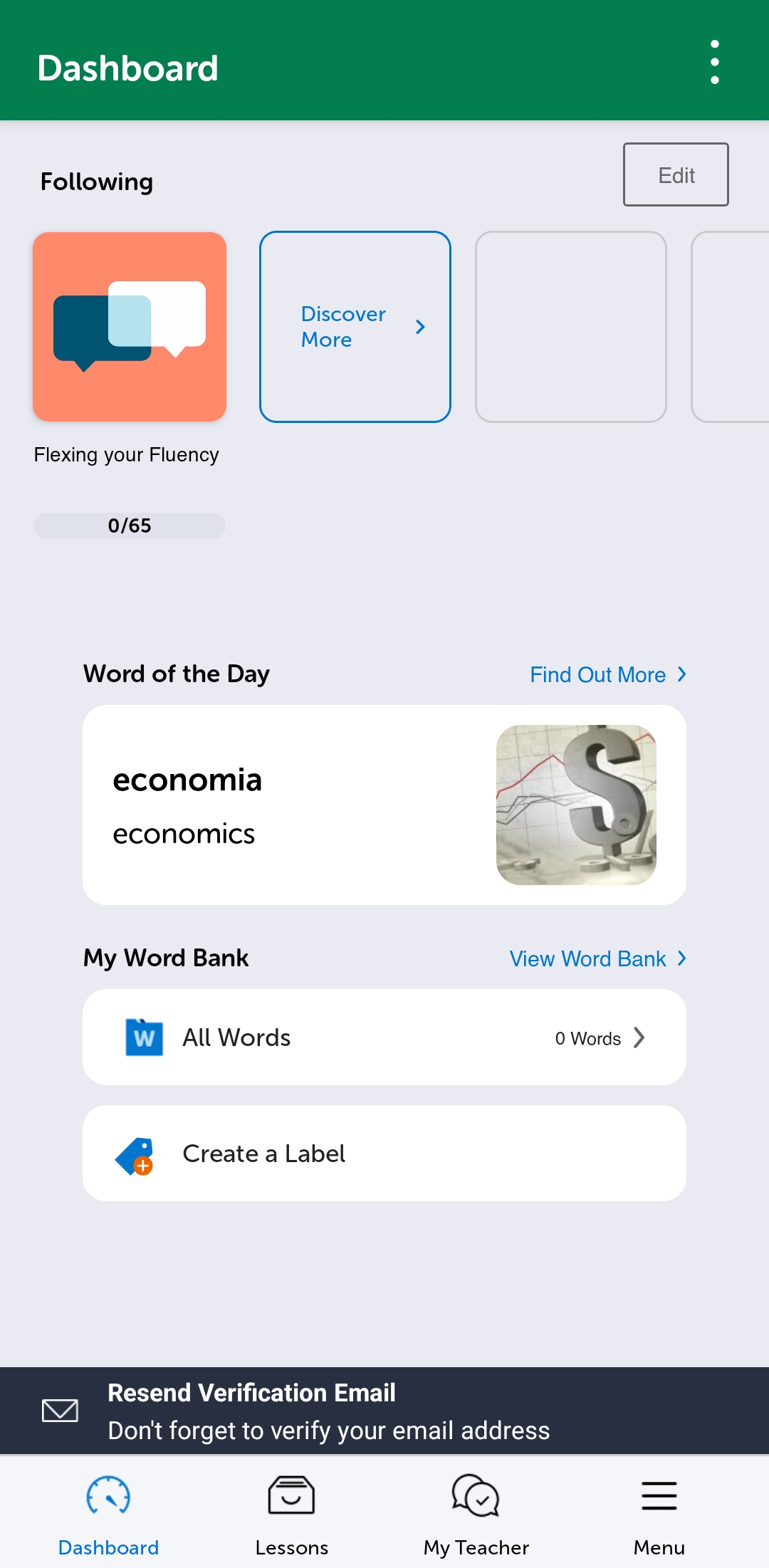
Once you’re in, your dashboard hands you a guided learning path rather than dumping you in front of a library of a thousand lessons. The flagship beginner track is literally called “Can Do Brazilian Portuguese for Absolute Beginners” and runs to a set of short, task-based lessons (“Can Introduce Yourself”, “Can Order at a Restaurant”, and so on). That guided pathway is one of the platform’s genuine strengths.
Which Portuguese Does It Teach?
This is the section that matters most for Portuguese: PortuguesePod101 is, overwhelmingly, a Brazilian Portuguese course. The flagship pathway is named for Brazilian Portuguese, the situational lessons are full of Brazil (“Lessons for Your Flight to Brazil”, “Riding a Taxi in Brazil”), and the instructors and audio are Brazilian throughout.
There is some European Portuguese content, mainly a Portugal-focused Survival Phrases series, but it’s a small supplementary track, not a parallel course. So if your goal is European Portuguese, to move to Lisbon, say, this isn’t the right primary tool, and I’d point you towards a Portugal-specific resource like Practice Portuguese instead. If you’re learning for Brazil, or you simply want the most widely spoken variant (Brazil has the lion’s share of the world’s Portuguese speakers), it’s a brilliant fit.
That clarity works in your favour. The biggest beginner mistake in Portuguese is accidentally mixing the two variants; because PortuguesePod101 commits to Brazilian and keeps its audio consistent, you sidestep that trap as long as you go in knowing which one you’re getting.
Does It Handle the Pronunciation?
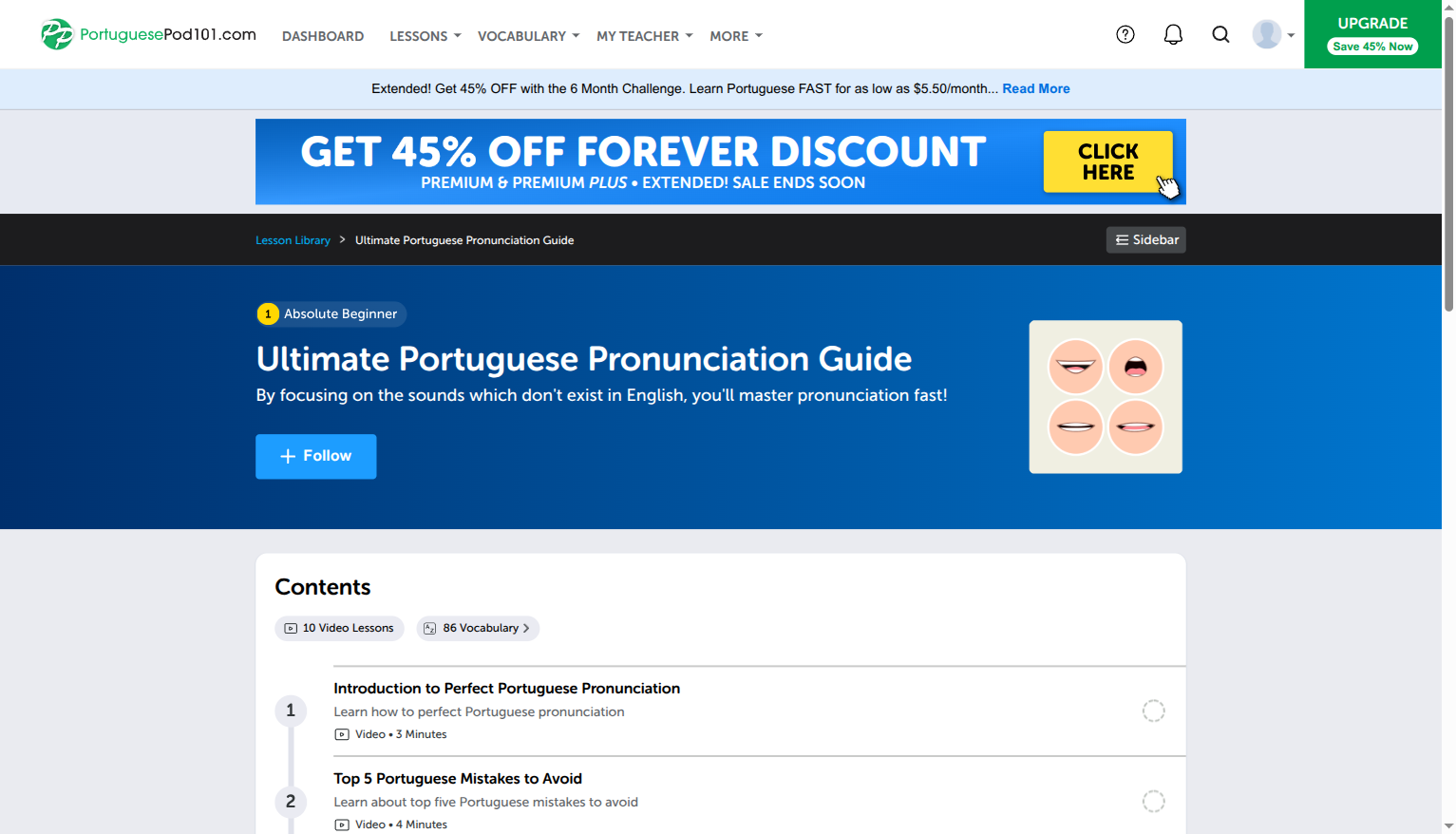
This is where the audio format pays off. Because every lesson is built on native-speaker recordings with slowed-down, line-by-line playback (a Premium feature), you actually hear those nasal vowels and Brazilian sound shifts in action. The dia → “JEE-ah” and Rio → “HEE-oh” changes are the kind of thing no written explanation fully prepares you for; you absorb them by ear, which is the only way they ever really stick. There’s also a dedicated “Ultimate Portuguese Pronunciation Guide” series to walk through the rules explicitly.
The one honest caveat, which I’ll come back to in the learner-feedback section, is that some lessons spend more time than you’d like with the hosts chatting in English. For pronunciation specifically, the trick is to lean on the dialogue and vocabulary segments, where the native audio actually lives.
Inside a PortuguesePod101 Lesson
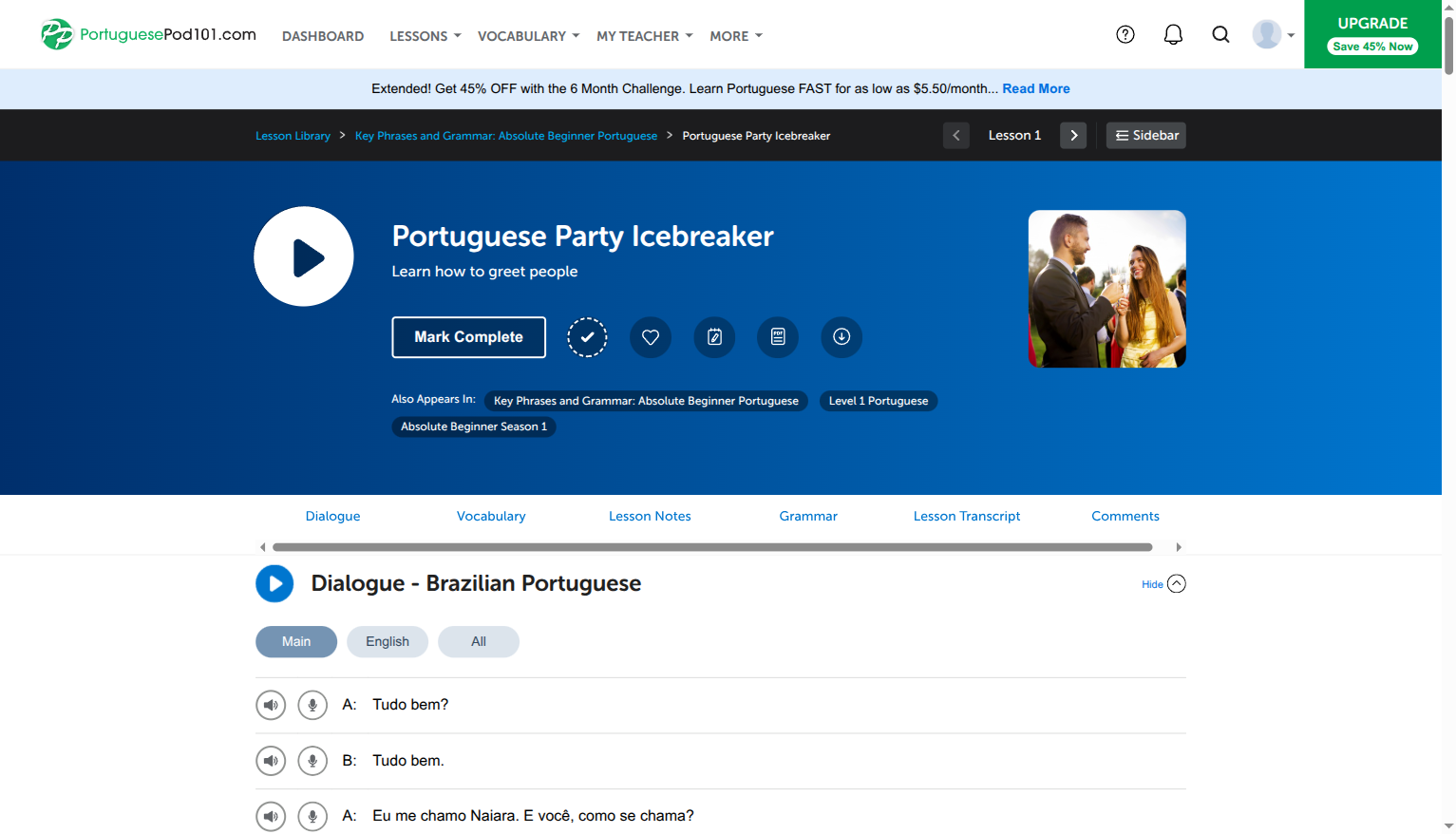
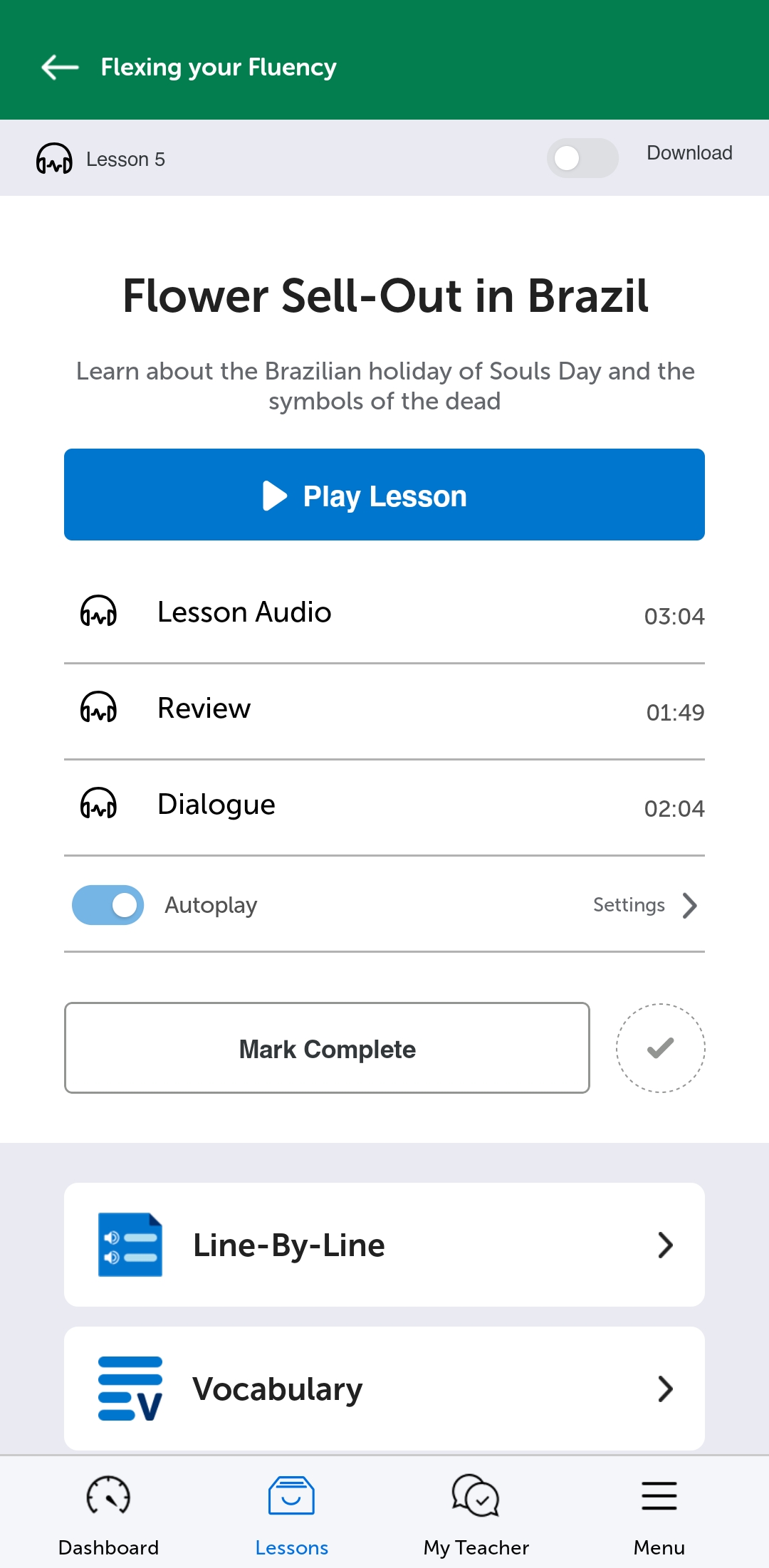
A typical lesson is short (most run 3 to 15 minutes) and follows a consistent shape: a native dialogue, a slow breakdown, vocabulary with natural-then-slow pronunciation, a grammar point, and a culture note. You get the audio, the full scripted dialogue, a vocab list, and downloadable lesson notes (a PDF) that unpack the grammar and cultural context.
That format suits Portuguese’s quirks well. The dialogue-first approach drip-feeds ser vs estar and the subjunctive in context, so you meet them as natural speech rather than as abstract grammar tables, which is by far the easiest way to internalise them. The lesson-note PDFs are where the grammar gets properly explained, and reviewers consistently rate those grammar breakdowns as one of the course’s stronger points.
The Study Tools
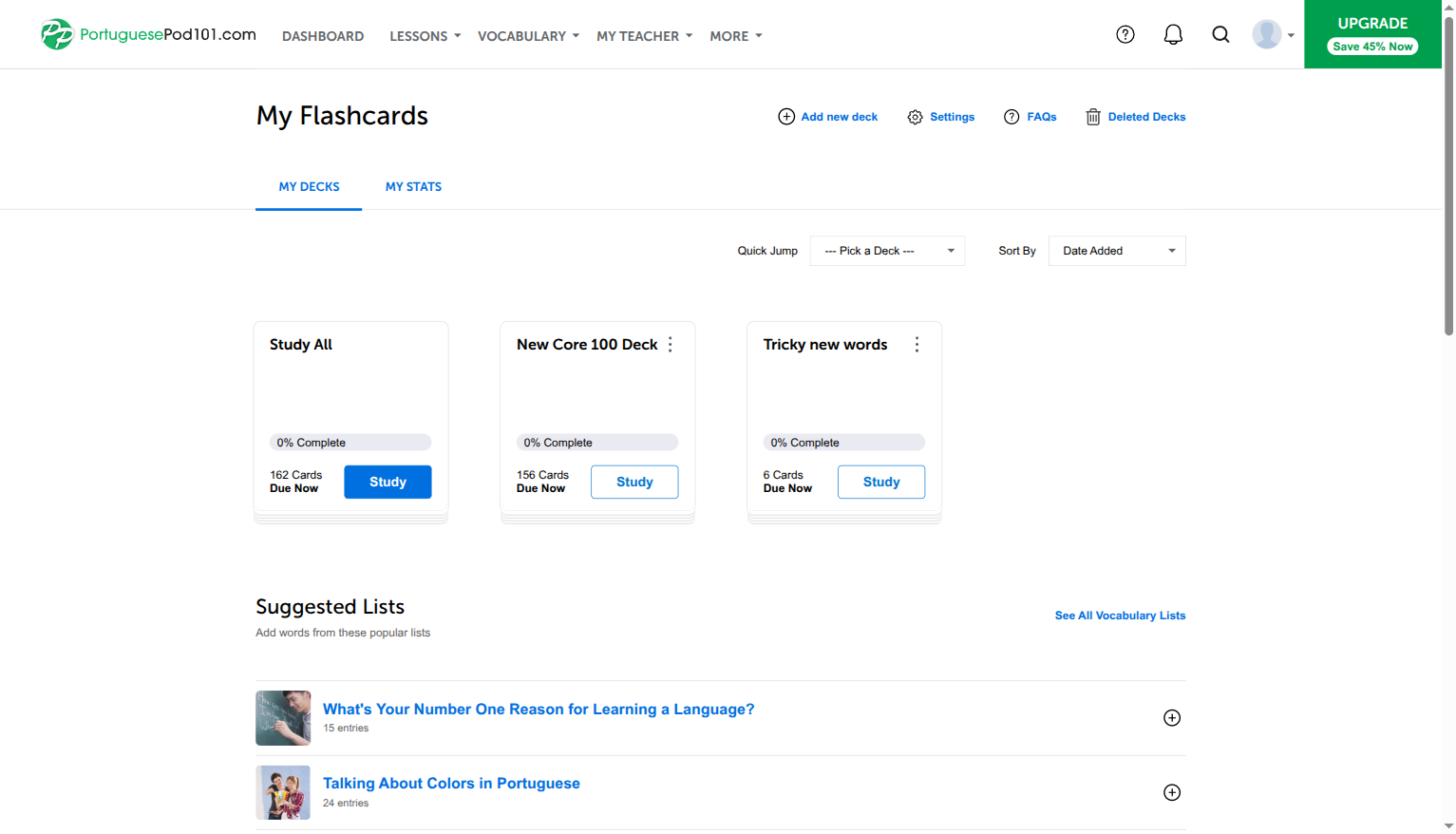
On a Premium plan, the lessons are wrapped in a solid set of study tools:
- Spaced-repetition flashcards and a personal word bank, where you add words straight from any lesson, perfect for hoovering up Portuguese’s generous supply of English-friendly cognates.
- A grammar bank that gathers the grammar points in one place.
- Multiple-choice assessments to check a section has actually gone in.
- Line-by-line audio for working through a dialogue one line at a time.
- 2,000 core words and phrases as a ready-made vocabulary backbone.
Premium also includes a voice recorder: you record yourself saying a line and play it back against the native track to hear how close you got. Handy for those nasal vowels, though it’s you comparing yourself by ear, not graded feedback. Actual speaking practice, with a teacher reviewing your pronunciation, sits on the top Premium PLUS tier rather than standard Premium. For loads of learners that’s fine (you’re here mainly for input and vocabulary), but if structured speaking feedback is your priority, factor that in.
The Mobile App
There’s an Innovative Language app that syncs with your account, so a lesson you finish on your laptop shows as done on your phone. It’s clean and handy for listening on the go, which is exactly how loads of people use these courses: as a podcast for the commute.
The same caveat applies as on the other 101 courses, though: the app is a slightly stripped-back version of the website. You can’t always follow your full structured study path inside it, and some of the best web features aren’t completely there. The workaround is the one I use elsewhere: pull the site up in your phone’s browser when you want the full experience.
What Other Portuguese Learners Say
I went through a stack of independent reviews and learner forums to double-check my own take, and a few clear patterns came up.
The praise is consistent. Reviewers single out the interactive audio dialogues as the platform’s strongest feature, the lessons are short, engaging and easy to make a daily habit of. The grammar explanations and lesson notes get repeated credit for being thorough and beginner-friendly. And the sheer breadth of content and the clear beginner-to-intermediate progression mean you’re rarely stuck for what to study next. Independent scores land in the “good, not flawless” band, and it’s well reviewed by independent sites like All Language Resources and Langoly.
The criticism is just as consistent:
- The most common complaint is too much English in some lessons. The hosts can spend a fair while chatting in English around relatively little Portuguese, especially in older or higher-level material. The fix is simple, but real: focus on the dialogue and vocab segments.
- Speaking and writing practice are thin unless you go up to Premium PLUS. There’s no speech-recognition drilling, so the platform is much stronger for input (listening, reading, vocab) than for forcing output.
- It tapers off at the top end. Content is richest from absolute beginner through intermediate and gets sparser at advanced levels, so it’s best thought of as a tool to get you to intermediate rather than all the way to mastery.
- Upsell banners crop up around the platform, nudging you towards higher tiers. Mildly annoying, easy to ignore.
The framing the reviews converge on (and I agree with) is that PortuguesePod101 is a first-rate listening-and-vocabulary engine rather than your one-and-only resource. Pair it with conversation practice (a tutor on italki is the usual recommendation) and you’ve got a genuinely strong setup. That’s simply how most people get the best out of it.
Pricing and Plans
PortuguesePod101 runs the same four-tier structure as the rest of the family:
| Plan | Roughly… | What you get |
|---|---|---|
| Free | Free forever | First 3 lessons of every series, Survival Phrases, Word of the Day, 100+ vocab lists, the app, plus a 7-day Premium trial |
| Basic | ~$4/mo | Everything free + access to all lessons and in-depth lesson notes |
| Premium | ~$5–10/mo | Everything in Basic + flashcards, word bank, line-by-line audio, assessments, grammar bank, 2,000 core words |
| Premium PLUS | ~$13–23/mo | Everything in Premium + your own teacher, hand-graded work and personalised speaking guidance |
A few notes on the pricing. The headline per-month figures are based on the longest (24-month) plan, so the real price depends on the billing period you pick, check the checkout. Innovative also runs a more-or-less permanent discount (the exact amount varies), so you should rarely if ever pay the “full” list price. There’s a 60-day money-back guarantee, which takes the risk out of trying Premium.
For most people, Premium is the sweet spot: that’s the tier where the flashcards, assessments and full lesson features live. Premium PLUS only makes sense if you specifically want a teacher checking your speaking and written work, which, given how light the standard tiers are on output practice, is a more tempting upgrade for Portuguese than it might be elsewhere.
Pros and Cons
Pros
- Commits clearly to Brazilian Portuguese, with consistent native audio, so you avoid the classic beginner trap of mixing variants.
- Loads of native audio, exactly what Portuguese’s nasal vowels and Brazilian sound shifts demand.
- A guided learning path so you’re never guessing what to study next.
- Strong grammar notes, which matters for ser/estar and the subjunctive.
- Excellent for building vocabulary, helped along by Portuguese’s generous cognates.
- Properly affordable, with a usable free tier and a 60-day guarantee.
Cons
- Some lessons lean too heavily on English chit-chat around the Portuguese.
- Light on speaking and writing practice unless you pay for Premium PLUS.
- Content thins out at advanced levels, best as a route to intermediate.
- Barely covers European Portuguese, it’s a Brazilian course, full stop.
- The app is a lighter version of the full website.
Who PortuguesePod101 Is (and Isn’t) For
It’s a strong fit if you’re a beginner who wants a clear, guided path into Brazilian Portuguese; someone who learns well by ear and wants Portuguese in your headphones on the commute; a traveller heading to Brazil who wants real, usable phrases with cultural context; or anyone who wants to build a big vocabulary fast on a budget.
It’s less ideal if you want European Portuguese (look elsewhere for your main resource), if you need heavy structured speaking practice without paying for the top tier, or if you’re already advanced and want rich C1-level material.
The Verdict
PortuguesePod101 does the most important thing right: it takes Portuguese’s actual challenges seriously rather than coasting on the language being “easy”. It commits clearly to Brazilian Portuguese and keeps its audio consistent, it floods your ears with the native sound you need to crack the nasal vowels and Brazilian shifts, it slips ser/estar and the subjunctive in through real dialogue, and it builds vocabulary brilliantly. It’s not a do-everything course, the output practice is light and it tails off at the advanced end, but as the audio-and-vocabulary core of your Brazilian Portuguese study, paired with some conversation practice, it’s hard to beat for the price.
My rating: 4.4 out of 5.
If you want to give it a go, you can start with PortuguesePod101 here. Set up a free account, take it for a spin, and see if learning Portuguese by ear clicks for you. Going through that link applies a discount automatically, so you won’t pay the full list price.

Social