


How to Say Sorry in French [with Audio]

Full disclosure: This post contains affiliate links. ?
How do you say “sorry” in French? The best choice depends on the situation. Désolé(e), excusez-moi and pardon cover many everyday apologies, but they do not have exactly the same job.
Use désolé(e) to express regret, excusez-moi to get someone’s attention or apologise politely, and pardon for a brief “sorry” or “excuse me”. Below, you’ll also learn how gender agreement and tu/vous change what you write.
Editor's note: Before we get started, if you’re looking for an online French course, here’s the course we recommend: French Uncovered – Learn French Through the Power of Story, a course with a fascinating new method by Olly Richards. You can try it for free for 7 days!
Table of contents
- Quick Summary: Different Words for Sorry in French
- How to Say Sorry in French (with Audio)
- The Basics of Saying “Sorry” in French
- Adding Sincerity When Saying Sorry in French
- How to Say “Excuse Me” in French
- How to Say Sorry in a Professional Context in French
- How to Say “It’s My Fault” in French
- How to Say “I’m Sorry for Your Loss” in French
- False Friends: “Apology” vs Apologie
- How to Ask for Forgiveness in French
- Practise Saying Sorry in French
Quick Summary: Different Words for Sorry in French
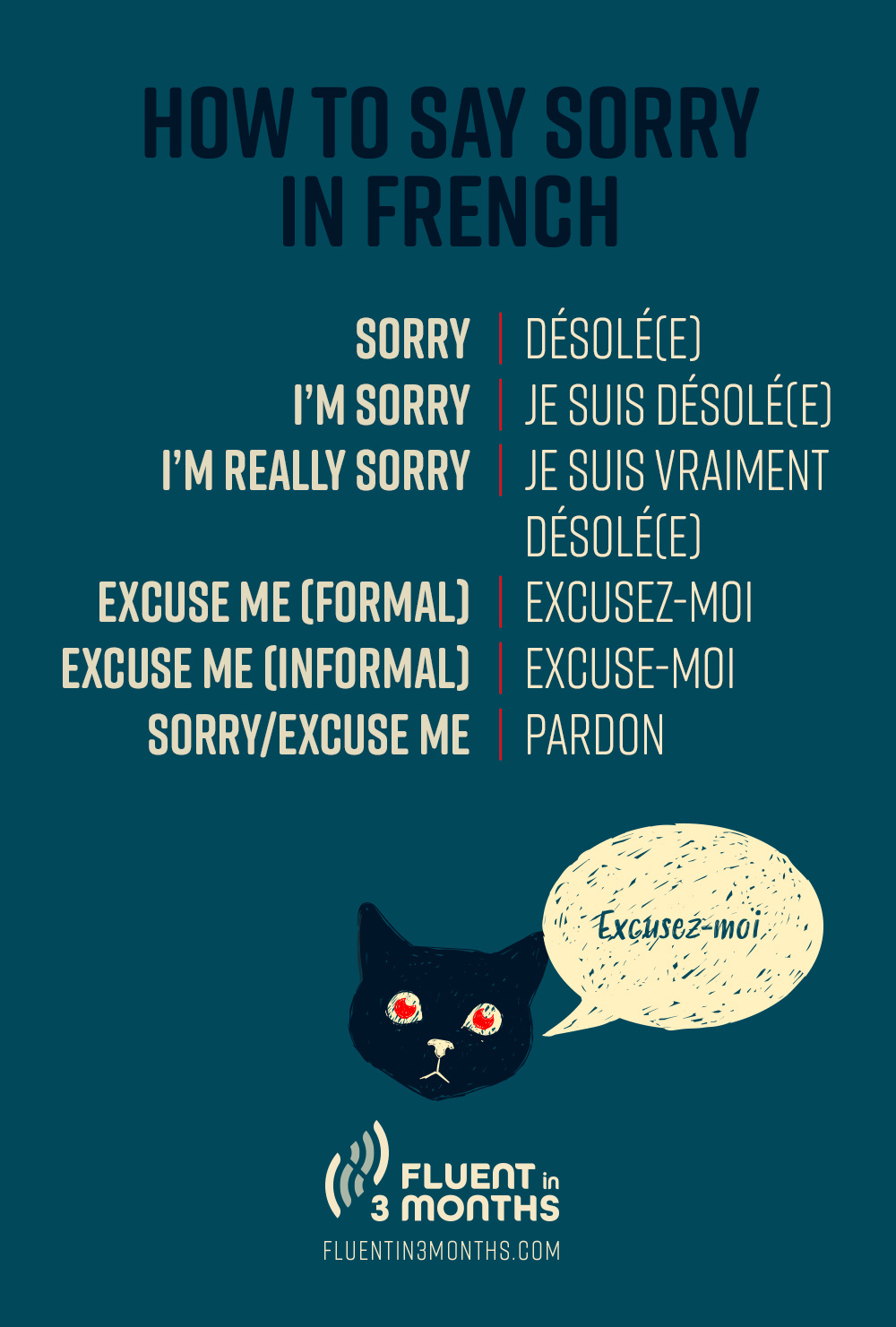
Start with these six forms:
- Désolé / Désolée : “Sorry”
- Je suis désolé(e) : “I’m sorry”
- Je suis vraiment désolé(e) : “I’m really sorry”
- Excusez-moi : “Excuse me” for one person addressed as vous, or for more than one person
- Excuse-moi : “Excuse me” for one person addressed as tu
- Pardon : “Sorry”, “excuse me” or “pardon?”
The notation désolé(e) is a compact teaching shortcut. In real writing, choose the ending that agrees with the subject: désolé, désolée, désolés or désolées.
How to Say Sorry in French (with Audio)
| English | French | Audio |
| “Sorry” | Désolé / Désolée | |
| “I’m sorry” | Je suis désolé(e) | |
| “I’m really sorry” | Je suis vraiment désolé(e) | |
| “Excuse me” (vous or plural) | Excusez-moi | |
| “Excuse me” (tu) | Excuse-moi | |
| “Sorry” or “Excuse me” | Pardon |
In standard French, désolé(e) is /de.zɔ.le/; the written gender and number endings do not change this pronunciation. Excusez-moi is /ɛk.sky.ze mwa/, while excuse-moi is /ɛk.skyz mwa/. Pardon is /paʁ.dɔ̃/, with a nasal final vowel rather than a separate n sound. Use the recordings as your main model and the IPA as a check.
The Basics of Saying “Sorry” in French
Je suis désolé(e) works for many ordinary apologies, such as being late or forgetting an appointment. Désolé(e) on its own is shorter and common in conversation. In standard written French, the adjective agrees with the speaker or speakers; use the agreement that fits how you refer to yourself.
- Je suis désolé, j’ai oublié notre rendez-vous. “I’m sorry, I forgot our appointment.”
- Désolée, je suis en retard. “Sorry, I’m running late.”
Adding Sincerity When Saying Sorry in French
Add vraiment for “really”, sincèrement for “sincerely” or tellement for “so”. They add different shades of meaning, so choose the one you intend rather than treating them as interchangeable intensifiers.
- Je suis vraiment désolé(e) de t’avoir fait attendre. “I’m really sorry I kept you waiting.”
- Je suis sincèrement désolé(e). Je ne me suis pas rendu compte qu’il était si tard. “I’m sincerely sorry. I didn’t realise it was so late.”
- Je suis tellement désolé(e) pour ce qui s’est passé. “I’m so sorry about what happened.”
How to Say “Excuse Me” in French
Excusez-moi can get someone’s attention, soften an interruption or make a polite apology. It uses the vous form, so it addresses one person formally or more than one person. Use excuse-moi with one person you address as tu. Pardon is a concise choice after a small bump, when moving past someone, or when asking someone to repeat themselves. Our guide to French subject pronouns explains tu and vous in more detail.
- Excusez-moi, pourriez-vous me dire où se trouve le Louvre ? “Excuse me, could you tell me where the Louvre is?”
- Excuse-moi, je t’ai coupé la parole. “Sorry, I interrupted you.”
- Pardon, je peux passer ? “Excuse me, may I get through?”
How to Say Sorry in a Professional Context in French
Je suis désolé(e) and excusez-moi also work in professional settings. Veuillez m’excuser and nous vous prions de nous excuser are more formal and suit written messages. A useful apology names the problem and, when appropriate, explains what will happen next.
- Veuillez m’excuser pour cette erreur dans mon e-mail. “Please excuse me for this error in my email.”
- Nous vous prions de nous excuser pour la gêne occasionnée. “We apologise for the inconvenience caused.”
How to Say “It’s My Fault” in French
C’est ma faute means “it’s my fault”. Use it when you genuinely accept responsibility; it can follow désolé(e) but does not replace an explanation or repair when the situation calls for one.
- C’est ma faute, je me suis trompé(e). “It’s my fault; I was mistaken.”
- Désolé(e), c’est ma faute. “Sorry, it’s my fault.”
How to Say “I’m Sorry for Your Loss” in French
For a bereavement, use mes condoléances, toutes mes condoléances or the more formal je vous présente mes sincères condoléances. Condoléances is always plural. Match toi or vous to the relationship and keep the message simple if you do not know the person well.
- Je vous présente mes sincères condoléances. “Please accept my sincere condolences.”
- Je suis là pour toi en cette période difficile. “I’m here for you during this difficult time.”
- Je suis désolé(e) d’apprendre le décès de ton oncle. Mes pensées t’accompagnent, toi et ta famille. “I’m sorry to hear about your uncle’s death. My thoughts are with you and your family.”
False Friends: “Apology” vs Apologie
Apologie does not normally mean “an apology”. It means a defence, justification or strong praise of someone or something. For an apology, French commonly uses the plural expression des excuses: présenter ses excuses means “to apologise” or “to offer one’s apologies”, and s’excuser means “to apologise”.
- Ce texte fait l’apologie de la violence. “This text glorifies violence.”
- Je vous présente mes excuses pour avoir manqué votre appel. “I apologise for missing your call.”
- Il s’est excusé d’avoir perdu le document important. “He apologised for losing the important document.”
How to Ask for Forgiveness in French
Asking someone to forgive you is stronger than a routine pardon. Use pouvez-vous… ? with vous, est-ce que tu peux… ? with tu, or the direct familiar imperative pardonne-moi. An apology can ask for forgiveness, but it does not oblige the other person to grant it.
- Pouvez-vous me pardonner d’avoir été absent(e) hier ? “Can you forgive me for being absent yesterday?”
- Est-ce que tu peux me pardonner d’avoir oublié ton anniversaire ? “Can you forgive me for forgetting your birthday?”
- Pardonne-moi, je ne voulais pas te blesser. “Forgive me; I didn’t mean to hurt you.”
Practise Saying Sorry in French
Choose one phrase for a small interruption, one for a real apology and one for a formal message. Say each with the audio, then adapt an example to something you might need. You can continue with these core French words.

Social