


Spanish Irregular Verbs: The Ultimate Guide [with Charts]

Full disclosure: This post contains affiliate links. ?
Are Spanish irregular verbs giving you a headache?
Spanish verbs give you a lot to learn, especially when you meet irregular forms. But many of those forms fall into patterns, so you don't have to treat each one as an unrelated word.
In this article, we will look specifically at irregular verbs in Spanish. Here’s what we’ll cover:
If you want a clear structure for putting your Spanish into practice, take a look at the Fluent in 3 Months Bootcamp. It’s a 90-day programme with weekly coaching calls, a private community and a focus on speaking from day one.
Table of contents
Don’t be put off if you’re a complete beginner: I won't assume much if any existing knowledge of Spanish grammar.
Ready? ¡Vamos! (“Let’s go!”)
What Are Irregular Verbs in Spanish?
To understand the difference between regular and irregular verbs, it helps to take a closer look at how verbs work in English. They usually follow a pretty simple pattern. I'll illustrate it with the verb “to walk”.
To use “to walk” in the present tense, you simply stick a pronoun in front of it: “I walk” or “they walk”. The one exception is the third-person singular form (he/she/it), which has an “s” on the end: “he/she/it walks“.
So far, so simple. Other tenses are just as easy: for the present continuous tense, you stick an “-ing” on the end of the verb and combine it with the present tense of the verb “to be”, as in “he is walking”. Or you can put an “-ed” on the end of the verb to make it past tense: “I walked”. These aren't the only tenses, of course, but the point is that the different forms of the verb “to walk” are made using some simple, consistent patterns that can be applied to many other verbs:
- walk, walks, walked, walking
- help, helps, helped, helping
- play, plays, played, playing
- climb, climbs, climbed, climbing
And so on.
Most English verbs follow this simple pattern; as such, they're known as regular verbs.
But then, there are verbs like “to speak”.
This word doesn't follow the pattern above; its past-tense version is not “speaked” but “spoke”. Similarly, “to buy” becomes “bought”, not “buyed”, and “to throw” becomes “threw”, not “throwed”. These are just a few of the many, many English verbs that don't play by the normal rules. These are the irregular verbs.
Spanish is similar. There are some basic patterns that most verbs – the regular verbs – follow, but there are also many irregular exceptions. If you want to communicate effectively in Spanish, you need to learn which verbs are irregular, and what their irregularities are.
But before we get deeper into the verbs that break the rules, let's review those rules.
A Quick Recap of Spanish Regular Verbs
Remember that Spanish verbs (regular or irregular) can be divided into three categories, based on the ending of their infinitive form:
- “-ar” verbs, such as hablar (to speak), cantar (to sing), and bailar (to dance)
- “-er” verbs, such as deber (to owe), correr (to run), and comprender (to understand)
- “-ir” verbs, such as vivir (to live), existir (to exist), and ocurrir (“to happen”)
The regular present indicative forms in each case are shown below. This guide uses tú and vosotros; some regions use vos with different forms.
| hablar | deber | vivir | |
|---|---|---|---|
| yo (I) | hablo | debo | vivo |
| tú (you, singular informal) | hablas | debes | vives |
| él/ella/usted (he/she/you, singular formal) | habla | debe | vive |
| nosotros (we) | hablamos | debemos | vivimos |
| vosotros/vosotras (you, plural informal) | habláis | debéis | vivís |
| ellos/ellas/ustedes (they, masculine or general/they, feminine/you, plural; formal in Spain, formal or informal in Latin America) | hablan | deben | viven |
(In everyday modern usage, vosotros is mainly associated with Spain; Latin America uses ustedes for the plural “you”.)
Hopefully you've spotted some of the patterns. For example, the first-person singular forms all end with -o, and the second-person singular forms all end with -s.
You'll spot similar patterns in other tenses. For example, first-person plural (“we”) endings in the simple tenses finish in “-mos”, before any attached pronouns:
- corremos – we run
- corrimos – we ran
- correremos – we will run
- corríamos – we were running
I won't go into depth here about all the different patterns and regularities you can find in Spanish verbs. Just remember this when you hear that a single Spanish verb can have almost 100 different forms. It's not as scary as it sounds: learn to spot the patterns, and it'll drastically reduce the amount of memorisation that you need to do.
Even irregular verbs retain useful patterns. In simple tenses, the first-person plural ending is still -mos. In the present indicative, most first-person singular forms end in -o, with exceptions such as soy, voy, doy, estoy, sé and he.
Bear this in mind as we explore the wild and wonderful world of Spanish irregular verbs. Always be on the lookout for the shortcuts that will make everything easier to learn.
The 10 Most Common Spanish Irregular Verbs
Unfortunately, while most Spanish verbs are regular, irregular verbs also tend to be the common verbs that get used most often.
Here are 10 common Spanish irregular verbs to start with. The list is a practical selection, not a corpus-based frequency ranking:
- ser – “to be”
- haber – auxiliary “to have”
- estar – “to be”
- tener – “to have”
- ir – “to go”
- saber – “to know”
- dar – “to give”
- hacer – “to do, to make”
- poder – “can, to be able to”
- decir – “to say”
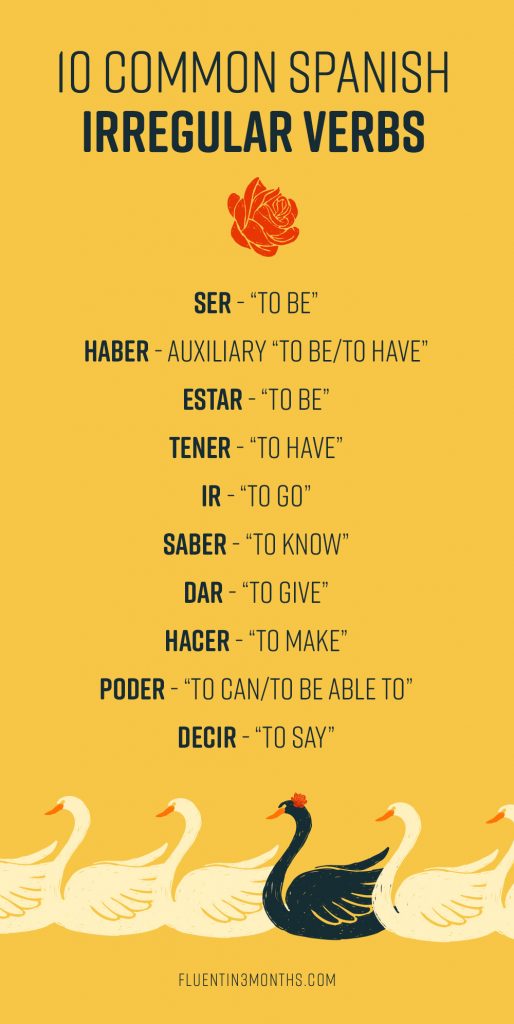
A correction to the infographic: haber is the auxiliary “have” in forms such as “have eaten”; use ser or estar for “be”, depending on the sentence. For poder, read “can” or “to be able to”, not “to can”. Frequent use can also help preserve irregular forms over time, rather than simply making a verb more likely to become irregular.
But let's think about English irregular verbs again for a second. There are many of them – but sometimes you find groups of words which all follow the same pattern, like “blow, blew”, “throw, threw”, and “know, knew”.
If you remember that these words all go together, you can learn them as a single unit.
Thankfully, Spanish irregular verbs can often be grouped like this too. So let's look at the most important groups to learn.
The Spanish Irregular Verbs by Category: Stem-Changing Verbs
One useful group to learn is the stem-changing verbs. Their shared patterns can make memorisation easier.
The “stem” of a verb is the part you get when you remove the infinitive suffix (that is, the -ar, -er, or -ir) from the infinitive form. So the stems of hablar, deber, and vivir are habl-, deb-, and viv-.
For regular present indicative forms, remove the infinitive suffix and add an ending like -o or -as. Some otherwise regular verbs also need spelling changes in other forms to preserve their sound.
Many verbs, however, are more complicated. I’ll show you with an example.
Here are the present indicative forms of cerrar (“to close”). Pay close attention to the stem:
- cierro – I close
- cierras – you (s.) close
- cierra – he/she closes
- cerramos – we close
- cerráis – you (pl.) close
- cierran – they close
Do you see what's going on?
In the first, second, third, and sixth forms, the vowel in the stem changes from e to ie. Other than that, everything is as normal – the endings are what you would expect if the verb was regular.
It might seem confusing that the stem only changes in four of the six verb forms. To understand why this is the case, focus on the -amos/-áis forms. The stem is unstressed: in both of these cases, the stress goes on the second syllable.
For present-tense diphthong-changing verbs such as cerrar, the stem changes in the yo, tú, él/ella, and ellos/ellas forms, where the stem vowel is stressed. Some -ir verbs also have stem changes in unstressed forms in other tenses and moods.
As a memory aid, you can picture the stressed vowel “opening up” into two sounds. That may help you remember which forms change, but it isn't a physical explanation and doesn't mean every stressed e or o becomes a diphthong.
To understand why the stem's vowel is stressed in some verb forms and unstressed in others, see this detailed explanation of accents and word stress in Spanish.
Types of Stem-Changing Verbs in Spanish
There are three main types of stem-changing verbs in Spanish.
There are also a few weird ones which don't fit into those three main categories, but we’ll talk about them later in the post. I'll start with the categories.
First of all, you have verbs which change an e to an ie. We've already seen cerrar above, which follows this pattern. Some of the most important similar verbs are:
- acertar – to get right, guess correctly
- advertir – to advise, warn
- atender – to attend to
- atravesar – to cross
- calentar – to warm/heat (up)
- cerrar – to close
- comenzar – to begin
- confesar – to confess
- consentir – to consent
- convertir – to convert
- defender – to defend
- descender – to descend
- despertarse – to wake up
- divertirse – to have fun, enjoy oneself
- empezar – to begin, start
- encender – to light
- encerrar – to enclose, encircle
- entender – to understand
- fregar – to scrub
- gobernar – to govern
- helar – to freeze
- hervir – to boil
- mentir – to lie
- negar – to deny
- nevar – to snow
- pensar – to think
- perder – to lose
- preferir – to prefer
- recomendar – to recommend
- remendar – to mend
- sentar(se) – to sit down
- sentir – to feel
- sugerir – to suggest
- tropezar – to stumble, trip
Secondly, verbs which change an o to a ue. For example, here's colgar (“to hang”) in the present tense:
- cuelgo – I hang
- cuelgas – you (s.) hang
- cuelga – he/she/it hangs
- colgamos – we hang
- colgáis – you (pl.) hang
- cuelgan – they hang
Here are some more examples from this category:
- absolver – to absolve
- acordarse (de) – to remember
- almorzar – to eat lunch
- aprobar – to approve
- cocer – to boil, to cook
- colgar – to hang
- conmover – to move (emotionally)
- contar – to count, to tell
- costar – to cost
- demoler – to demolish
- demostrar – to prove, demonstrate
- devolver – to return (an object)
- disolver – to dissolve
- doler – to hurt
- dormir – to sleep
- encontrar – to find
- envolver – to wrap
- llover – to rain
- moler – to grind
- morder – to bite
- morir – to die
- mostrar – to show
- mover – to move (an object)
- poder – to be able to
- probar – to prove, sample, test
- promover – to promote
- recordar – to remember
- remover – to stir, move about; also to remove or dismiss in appropriate contexts
- resolver – to resolve
- retorcer – to twist
- revolver – to mix, shake
- rogar – to beg, pray
- soler – to be accustomed to, to usually be/do
- sonar – to sound, ring
- soñar – to dream
- torcer – to twist
- tostar – to toast
- tronar – to thunder
- volar – to fly
- volver – to return (from somewhere)
The third common category of stem-changing verb is that of verbs that change an e to an i. For example, corregir (“to correct”):
- corrijo – I correct
- corriges – you (s.) correct
- corrige – he/she corrects
- corregimos – we correct
- corregís – you (pl.) correct
- corrigen – they correct
Here's the list you should learn:
- colegir – to deduce
- competir – to compete
- conseguir – to get, obtain
- corregir – to correct
- decir – to say
- despedir – to dismiss, fire, say goodbye to
- elegir – to elect
- freír – to fry
- gemir – to groan, moan
- impedir – to impede
- medir – to measure
- pedir – to ask for, order
- perseguir – to follow, pursue, persecute
- repetir – to repeat
- reír(se) – to laugh
- seguir – to follow, continue
- servir – to serve
- sonreír(se) – to smile
- vestir(se) – to get dressed
And finally, here are the weird stem-changing verbs that don't quite fit into the above categories.
First, the verb oler (“to smell” – either to smell an object, such as a flower, or to emit an odour). This might look like an o to ue stem-changing verb, but when the stem changes, you must add an “h” to the beginning:
- huelo – I smell
- hueles – you smell
- huele – he/she/it smells
- olemos – we smell
- oléis – you (pl.) smell
- huelen – they smell
(The added h in huelo and the other forms above is silent in standard pronunciation.)
Second, the verb jugar is the main example of the u to ue pattern; related verbs follow the same pattern:
- juego – I play
- juegas – you (s.) play
- juega – he/she/it plays
- jugamos – we play
- jugáis – you (pl.) play
- juegan – they play
Third, two useful examples of verbs that change an “i” to an “ie” are adquirir (to acquire) and inquirir (to inquire). So in the first-person singular they're adquiero and inquiero, respectively. Can you figure out the other five present-tense forms of adquirir and inquirir? Hopefully by now it should be easy.
Spanish Verbs With an Irregular “yo” Form
I told you earlier that decir (“to say”) is an e to i stem-changing verb. But it’s not only that. Decir is also one of several verbs with a non-standard yo form.
Remember that yo means “I”. “I say” is (yo) digo, which isn't what you'd expect if you followed the rules above.
To be clear, here are all six present-tense forms of decir:
- digo – I say
- dices – you (s.) say
- dice – he/she says
- decimos – we say
- decís – you (pl.) say
- dicen – they say
As you can see, the first form uses the weird -go suffix. The rest of the forms proceed as normal, subject to the stem changes that I already explained.
Several other common Spanish verbs have an irregular first-person singular form in the present indicative. Many retain regular forms elsewhere; some, like decir, also change their stem. The exceptions below need additional attention.
For each verb below, I'll give the infinitive, the irregular first-person singular form and the second-person singular form. The first group has no e/ie, o/ue or e/i vowel change, but it isn't a claim that only yo is irregular. Oír also has y in oyes, oye and oyen; ir and estar need the warning after the list.
Irregular “yo” form with no stem change
- conocer – “to know” – yo conozco, tú conoces
- dar – “to give” – yo doy, tú das
- hacer – “to do, make” – yo hago, tú haces
- poner – “to put” – yo pongo, tú pones
- salir – “to leave, to go out” – yo salgo, tú sales
- traer – “to bring” – yo traigo, tú traes
- ver – “to see” – yo veo, tú ves
- oír – “to hear” – yo oigo, tú oyes
- saber – “to know” – yo sé, tú sabes
- ir – “to go” – yo voy, tú vas
- estar – “to be” – yo estoy, tú estás
- caber – “to fit” – yo quepo, tú cabes
- lucir – “to shine, to show off” – yo luzco, tú luces
- valer – “to be worth” – yo valgo, tú vales
Two of those need a warning. Ir and estar are more irregular than the rest of the list, since their other forms aren’t what a regular verb would give you either. Ir goes voy, vas, va, vamos, vais, van, which is a long way from the infinitive, so learn both verbs as whole sets rather than treating each one as a funny yo form bolted onto a regular verb.
Irregular “yo” form with a stem change
- decir – “to say” – yo digo, tú dices
- tener – “to have” – yo tengo, tú tienes
- venir – “to come” – yo vengo, tú vienes
Ser
It's time to look at the biggest and baddest of all Spanish irregular verbs: ser, which means “to be”.
Like its English counterpart, ser is highly irregular – and not just in the first-person singular. Here are the six present-tense forms of ser:
- soy – I am
- eres – you (s.) are
- es – he/she/it is
- somos – we are
- sois – you (pl.) are
- son – they are
I recommend learning these forms early and practising them in short sentences. Ser is very common, so you'll have plenty of chances to use it.
Haber
Another highly irregular (and important) verb is haber. The dictionary might tell you that haber means “to have”, but this doesn't paint the full picture.
To say “I have a dog” in Spanish, you'd say “tengo un perro”. Tengo, as we saw above, is the irregular first-person singular form of tener, and tener is the normal way to say “have” in this sense in Spanish.
So where does haber come in?
Think of an English sentence like “I have eaten”. The word “have” is doing something different here. It doesn't mean ownership or possession, which is what tener is for.
Here, “have” helps form the present perfect. In “I have eaten”, it links a past action to the present context; it doesn't express possession.
This is the primary function of haber in Spanish: it's used in compound tenses, like the “have” in “I have eaten”.
Here's how it's conjugated (and I'll stick with “eaten”, comido, as my example):
- he comido – I have eaten
- has comido – you (s.) have eaten
- ha comido – he/she/it has eaten
- hemos comido – we have eaten
- habéis comido – you (pl.) have eaten
- han comido – they have eaten
There’s one more use of haber that you may meet early on: hay, meaning “there is” or “there are”. Hay un problema means “there is a problem”, while hay muchos problemas means “there are many problems”. Notice that hay doesn’t change between the two, making this one of the rare occasions when Spanish asks less of you than English.
Hay is impersonal, so there’s no yo or tú form to learn. It’s simply hay, and you’ll hear it constantly.
The End of the Beginning
This might seem like a lot, but you don’t need to learn everything now.
For one thing, if you still haven’t got a solid grasp of regular verb endings, you should work on that before worrying too much about irregular endings. If you need help with these, take a look at Benny’s post on the three main Spanish tenses.
When you feel ready, come back to these irregular endings, and, as always, don’t be afraid to make mistakes! If you forget which verbs are irregular, and say something like yo sabo instead of yo sé, people will still understand what you mean.
In fact, mistakes like “yo sabo” are common among children who are learning Spanish as their first language – which just goes to show, it doesn’t always come naturally even to native speakers!
Meeting irregular verbs repeatedly in reading and listening can help, especially when you also recall and use the forms yourself. The opening ten are common starting points; some verbs in the longer lists are less frequent, so choose the ones you need instead of memorising every list at once.
If you want to keep going, the two hardest-working verbs in the language get their own guide in our look at ser vs estar, and once the present tense feels solid you can move on to the three most important Spanish tenses. To hear these verbs in real sentences rather than on a chart, you can sign up for SpanishPod101. If you’d rather know what you’re getting first, we’ve written a full SpanishPod101 review.
When you’d rather be using these verbs than conjugating them, come and join the Fluent in 3 Months Bootcamp, where you get 90 days to reach a 15-minute conversation with a native speaker. You'll make mistakes along the way. Context often helps people understand, and asking for a correction gives you another chance to practise.

Social