



Here’s why other countries think you’re weird

Full disclosure: This post contains affiliate links. ?
One of the main reasons I travel so much is that I find it fascinating to see how different people are across different cultures.
For new travellers, some of these differences can make people from other countries seem completely weird or just plain rude.
Simple things you take for granted as being done in a standard way – like checking into a hotel, greeting a shopkeeper, or ordering food in a restaurant – can have completely different cultural norms from what you're used to, sometimes leaving you to wonder: “What is wrong with those people?”
Today I wanted to share a few anecdotes I've heard from travellers encountering the weird ways other cultures do seemingly standard stuff. I'll emphasize how funny some of these differences can be, especially when you look at them from both perspectives rather than critique them as “wrong”.
We'll start with a story my friend Derek Sivers told me about the way hospitality is done in India.
A note from the Fluent in 3 Months team before we get started: You can chat away with a native speaker for at least 15 minutes with the “Fluent in 3 Months” method. All it takes is 90 days. Tap this link to find out more.
A confused Indian in Finland

Derek (in his own words):
In India, you'll notice that hotels feel over-staffed.
There will be 5 uniformed men standing in the driveway, waiting to open the door of the occasional arriving taxi. There will be 2 men next to them whose job is just to open the door to the lobby. Inside the lobby, there will be a dozen men and women there to greet you and point you in the direction you're already walking.
They will insist on carrying your bag for you, even if it's just a little backpack. Politely declining seems to shock and frustrate them. Once you check in, there will be one or two people to walk you to the elevator, press the button for you and bring you to your room, then guide you around your regular little hotel room, showing you where the bed, TV, and toilet is, and how the AC remote control works.
I guess it's a sign of low cost of labor, especially when you find out it's cheaper to hire a car with a full-time driver to drive you everywhere, than it is to rent a car and drive it yourself.
So I was having lunch with a successful Indian businessman one day, and mentioned my observation of the over-staffed hotels. Even though he's a worldly guy, he was sincerely surprised.
“Really? You think so?” He thought about it for a bit, then said something fascinating:
“Actually I had the opposite experience. I was flown to Helsinki Finland once for a conference. They put me up at a nice high-class Hyatt hotel.
I take the taxi from the airport to the hotel, the taxi driver drops me at the door, and there I stand, alone! Nobody around to help me with my bags!
I wondered if perhaps the hotel has gone out of business.
I walk into the lobby, and again, empty! I was starting to get worried until I saw a woman behind the counter at the other end of the lobby.
I tell her my name, she checks me in, then gives me my room key, and tells me to have a nice night. I thought what kind of nonsense is this?
How can a hotel have no staff? Am I just supposed to find the room by myself?
I eventually did, but thought it was outrageous, and mentioned it to the conference organizers the next day. They laughed and assured me that's how things are done there. So strange.”
—
Derek's story shows that the weirdness of a country is completely a matter of perspective. From a western perspective, the idea of someone pushing our elevator buttons for us and telling us precisely where inside the bathroom we'll find the toilet is ridiculous. It's too much. But for Derek's friend, the absence of this sort of hospitality left him feeling neglected.
I really appreciate this story, because I distinctly remember arriving in India last month and experiencing exactly what Derek described.
I had just arrived in India, flying in from Indonesia at around 11pm at night. I was exhausted. All I wanted to do was get the key to my hotel room and faceplant into the pillow.
But that's not what happened. Instead I did indeed have to “endure” the local hospitality, complete with a tour of my room and instructions on how to use the phone. The whole time I was mentally begging the attendant to please leave please leave please leave! and I was left overwhelmed and a little agitated by what I considered to be an excessive and over-the-top greeting for simple hotel accommodation in Mumbai.
Something similar happened to me in Singapore, when the attendant of my rented room listed out and pointed out literally every item in the apartment. “You have 2 forks (shows me the forks), 2 spoons, (shows me the spoons)” and on and on and on until she had covered literally everything we had, right down to the two curtains and two curtain ties. I shit you not.
Luckily we weren't tired or jetlagged during this particular adventure, so we took it in good humour!
“Weird” restaurant culture
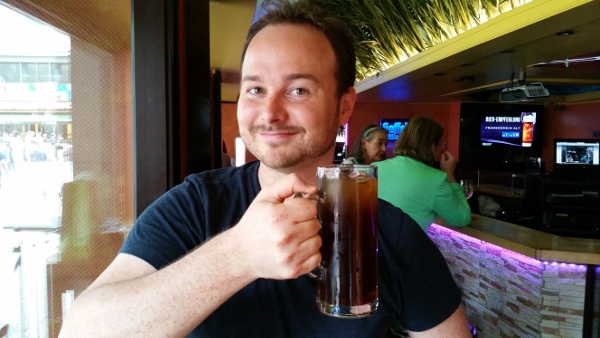
Asking “how are you?”
One of the first conversations I ever had with an American was about how confused she was, from a US perspective, about “something” she was “doing wrong” in restaurants as she travelled through Europe. She told me she kept getting strange looks from people, but couldn't figure out why.
Ten minutes into lunch with her, I knew exactly why. She would say “Hello, how are you?” enthusiastically to waiters or waitresses whenever they came to they table. And OF COURSE they would give her strange looks as a response. I say “of course” because I benefit here from the European perspective, which screams: Why would she want to know how they are doing?? They just met her!
In Europe, we don't do that. Questions like “How are you?” are reserved for friends or people who you genuinely want to know how they are doing and what's going on in their life. If you're a European just doing your job at the restaurant where you work, having a customer who's a total stranger ask how you're doing is just plain weird.
And this is of course a completely different perspective from that of North America, where it's polite and friendly to ask the question as pretty much a universal greeting!
Beating around the bush
In another example, a Canadian reader told me she was in Berlin in a Starbucks, and wanted to Instagram her coffee. Suddenly the German waiter came up to her while she was getting ready to take the photo and said “Please don't take photos in our café. Thanks.”
She was horrified by his rudeness!
Of course, in Germany saying that is perfectly reasonable, as Germans tend to be more direct and don't “beat around the bush” when giving bad news. But in Canada, the norm is to “sandwich” something so “blunt” with pleasantries.
A sensible Canadian waiter would have said, “Hi there, how are you? Everything OK with your mocha? Anyway, no biggie, and I'm really sorry to disturb you, but unfortunately we have a policy of not allowing photos to be taken in our café. I hope you don't mind! And I'm so sorry about this. Thanks again for coming to Starbucks and enjoy your drink!”
To Europeans like me, this is a mindbogglingly verbose and roundabout way of saying something much simpler.
I, again, can relate to the European perspective here, and I've gotten into trouble with some American friends and colleagues for not sandwiching my bluntness! I actually sometimes ask an American teammate to “edit” my emails to American companies to soften my language after I once learned the hard way when a very innocent email I sent nearly ended an important business arrangement.
What counts as bad service or good service depends on which side of the pond you're from
One of my funniest interactions with North American vs European differences was when I used Yelp to find a restaurant in Berlin, and I read a 2 star restaurant review that went something like this:
“….so, I get here and sit down, and then nobody came over to me. I waited several minutes and the waiters just ignored me! I glared at them the entire time and they didn't flinch. I couldn't believe it, and I finally had to actually raise my arm and wave them over to give my order! Then, after I finally ordered my food, it took over 20 entire minutes for the food to arrive. When I was finished, no one brought the check and I had to ask for it myself!”
To me, this review is hilarious because from a European perspective, this is an example of perfectly good service!
For my confused American friends, let me explain.
In Europe, the whole experience of eating in a restaurant is that the waitstaff bothers you as little as possible. Meals tend to be a very slow process, and part of the restaurant experience is that you get the table to yourself and call the waiters over when you need them. They expect that if you want something, you'll tell them. Otherwise, they'll let you sit there, undisturbed, for hours on end, reading your book and pondering whatever you ponder! So for me, calling waiters over in obvious gestures and waiting 20 minutes for food is completely normal.
Whereas in North America, good service requires that waiters and waitresses double check that you have everything you need as often as possible. They're supposed to anticipate your needs, for example by bringing you the bill before you even have to ask.
I can also attest after spending a lot of time in America that the food just gets prepared way faster there. I don't know how they do it. In comparison, restaurants in the UK and Europe are tortoise slow. An American I know actually commented to a British person once, “You know how food is really slow to come out in the UK?” …and he had no idea what she was talking about.
Food service in America is completely different to Europe. Kitchens are well-oiled machines where turnover is as important as quality. And it's not just “fast food” that's fast – it's all restaurants! For my American friends, 15 minutes is a long time to wait for food in a restaurant. Anything over 20 minutes is an outrage.
But on the other side of the pond, 20 or even 30 minutes of waiting for your food to arrive is totally normal!
Now try to imagine the American restaurant experience from the eyes of a foreigner.
This means that Europeans in North America feel very rushed and pestered in U.S. restaurants. I can imagine a European Yelp review of an American restaurant saying something like this:
“… this restaurant is in too much of a hurry. They made the food in a hurry, slamming it on my table 5 minutes after I ordered. After that, my waitress wouldn't leave me alone! Every 5 minutes she'd annoy me with another question, interrupting an intimate conversation or asking me how my food was while I was chewing! And they brought my bill before I asked for it, basically telling me to hurry up and get out!”
When I'm in America I have to remember not to wave down a waiter/waitress whenever I need something, as this is considered quite rude of the customer (as an American who used to wait tables confirms every time I do it). I have to try not to get frustrated when they interrupt me every 5 minutes to ask how my food is. And I still can't get used to my bill getting slapped down on the table with a waitress saying “whenever you're ready hon!” since it feels like I'm getting kicked out.
That's a formula for unfortunately misplaced Yelp reviews if there ever was one!
And then there's the whole tipping thing. I'm not even going to try to explain it – so I'll just refer you to this article instead!
An Indian on car horns in America
Okay, last story (but I could go on and on!)
When westerners first get to many Asian countries, the endless car horns can make it seem like everyone has road rage. Because they do indeed honk their horns all the time.
But it does not mean the same thing as it does when people do it in the west, where it usually means something like “Move out my way, asshole!” or “I don't like that thing you did just there and this is my way of informing you of that fact!”
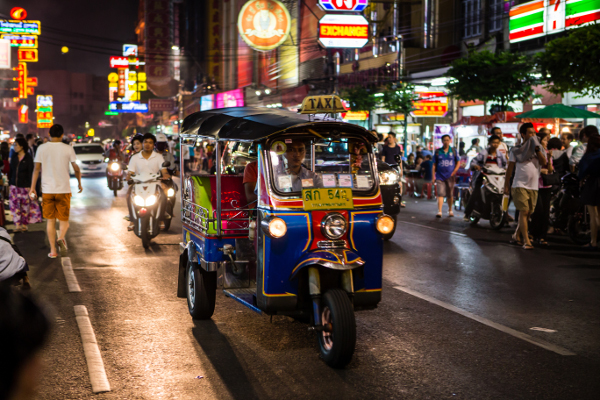
On the contrary. In many Asian countries, like Thailand and Indonesia and certainly India, it's simply their way of indicating they are doing something, like turning or passing you. So it's actually an important part of second-by-second communication on the road.
To wrap up, Derek tells us another story he heard from an Indian on this subject:
“I commented to a young programmer in Bangalore India on the cacophony of the ever-beeping horns of every car, truck, and scooter on the roads there. Again, he felt the opposite.
He had just been flown to America for his first time for some consulting work, and said, “Here I was. Chicago! America! It was even rush hour when I arrived. But in the taxi from the airport to my hotel…. silence!
Hundreds of cars, but none of them making a sound! It was eerie! Like a funeral!
Why so silent? What's wrong? It was hard for me to sleep that night with all that spooky silence.”
From my many years of travelling, I've learned to appreciate these cultural differences (or at least try). By looking at my own culture retrospectively, I've been able to make cultural adjustments with Parisians, I've broken through cultural stereotypes to get to know Germans, Dutch, Japanese, Egyptians, Chinese, and many other cultures… and I've picked up quite a few new habits myself!
I suggest you give it a try the next time you travel, and try to imagine how your ways might seem “weird” from the outside perspective.
Share your own funny cultural observations that would seem totally normal from the opposite perspective in the comments below or over on Facebook.

Social