


12 Chinese Zodiac Signs: Discover and Talk About Your Birth Year in Chinese

Full disclosure: This post contains affiliate links. ?
Chinese zodiac calendars are hard to miss around Chinese New Year. The scroll calendars I have collected show all twelve animals, the year's dates and, quite often, a business advert along the bottom.
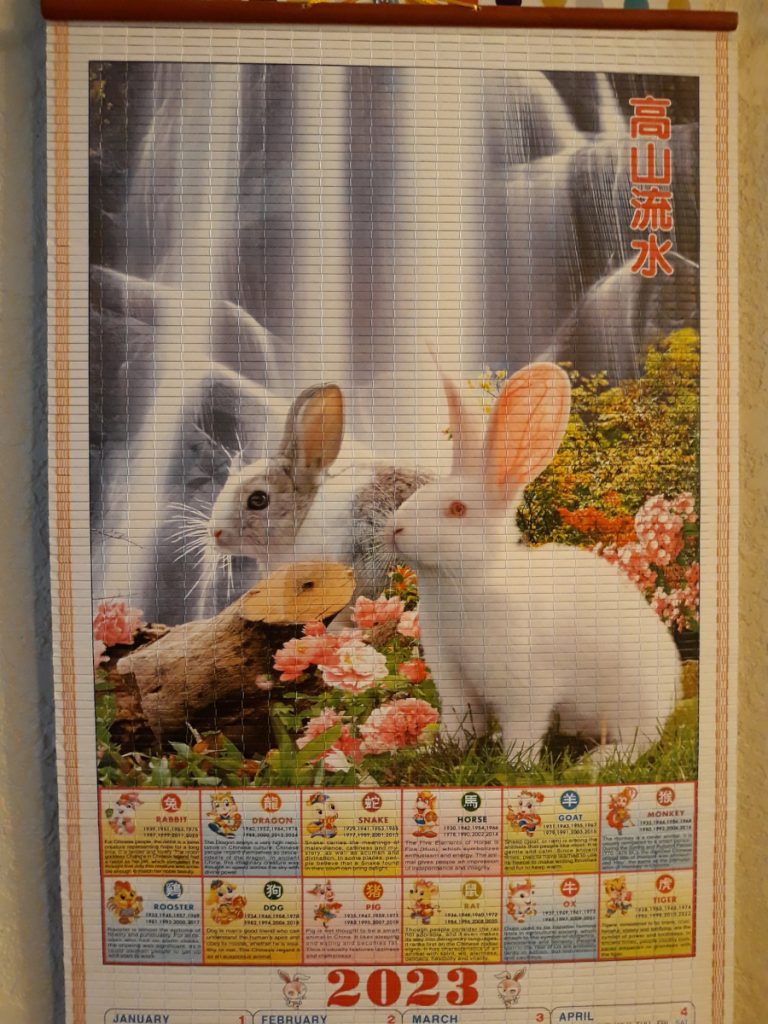
Your birth year is associated with one of those animals in a repeating twelve-year cycle. Zodiac animals also appear in stories, decorations, fortune-telling and popular descriptions of personality or compatibility, but those interpretations vary by source, region and family. They are traditions and modern popular beliefs, not facts about somebody's character.
This guide will help you find the animal for your birth year, learn the Mandarin names and talk about both the Chinese and Western zodiacs without treating folklore as a rulebook.
Table of contents
- What Are the Twelve Chinese Zodiac Animals?
- Find Out Your Chinese Zodiac Sign
- What About Zodiac Traits and Blood Types?
- What About Zodiac Elements and Attributes?
- Talk About Your Western Zodiac Sign
- Discussing Your Zodiac Signs in Chinese
- Phrasebook for Zodiac Sign Conversations
- Vocabulary Related to the Chinese Zodiac
- Chinese New Year Traditions
- How Do the Chinese Zodiac Signs Affect Me?
What Are the Twelve Chinese Zodiac Animals?
The animal cycle is paired with the twelve Earthly Branches, or 地支 (dìzhī), an old system used to mark years and other units of time. Sources from the Qin and Han periods already connect branches with animals, although the exact origin of the system is still debated.
The Great Race, in which the Jade Emperor gives the animals their order after a contest, is one well-known folk tale about the cycle. I learnt a version of it at elementary school, but it is a story told in several forms rather than a historical account of how the zodiac began.
The order is rat, ox, tiger, rabbit, dragon, snake, horse, goat, monkey, rooster, dog and pig. The sequence then starts again every twelve years. Related cycles are also used in places including Vietnam, Korea and Japan, with some animals or stories differing by tradition. You can compare the Japanese zodiac here.
Find Out Your Chinese Zodiac Sign
The standard Mandarin word for the zodiac cycle is 生肖 (shēngxiào). A person's animal sign can also be called their 属相/屬相 (shǔxiàng). This term links an animal with the Earthly Branch of the year in which someone was born; it does not literally mean “born resembling”.
For ordinary calendar use, the animal year changes at Chinese New Year, not on 1 January. Some fortune-telling systems instead use 立春 (Lìchūn), “Start of Spring”, as the boundary. If your birthday falls in January or early February, check a reliable Chinese calendar for your exact birth date and be clear about which convention you are using.
Here are the twelve signs with their Mandarin names and recent Gregorian years. Each listed year starts on Chinese New Year, so the January and February caveat still applies.
Rat
Chinese: 鼠 (shǔ)
Recent years: 1972, 1984, 1996, 2008, 2020, 2032
Earthly Branch: 子 (zǐ)
鼠 can refer to a rat or a mouse, so English-language lists do not always choose the same label.
Ox
Chinese: 牛 (niú)
Recent years: 1973, 1985, 1997, 2009, 2021, 2033
Earthly Branch: 丑 (chǒu)
牛 is a broad word for cattle, which is why this sign may be translated as ox, cow or bull.
Tiger
Chinese: 虎 (hǔ)
Recent years: 1974, 1986, 1998, 2010, 2022, 2034
Earthly Branch: 寅 (yín)
Rabbit
Chinese: 兔 (tù)
Recent years: 1975, 1987, 1999, 2011, 2023, 2035
Earthly Branch: 卯 (mǎo)
Vietnamese tradition uses a cat where the Chinese cycle uses a rabbit, a good reminder that “the Asian zodiac” is not one uniform system.
Dragon
Chinese: 龙/龍 (lóng)
Recent years: 1964, 1976, 1988, 2000, 2012, 2024
Earthly Branch: 辰 (chén)
Snake
Chinese: 蛇 (shé)
Recent years: 1965, 1977, 1989, 2001, 2013, 2025
Earthly Branch: 巳 (sì)
Horse
Chinese: 马/馬 (mǎ)
Recent years: 1966, 1978, 1990, 2002, 2014, 2026
Earthly Branch: 午 (wǔ)
Goat
Chinese: 羊 (yáng)
Recent years: 1967, 1979, 1991, 2003, 2015, 2027
Earthly Branch: 未 (wèi)
羊 covers sheep and goats, so either English animal name may appear.
Monkey
Chinese: 猴 (hóu)
Recent years: 1968, 1980, 1992, 2004, 2016, 2028
Earthly Branch: 申 (shēn)
Rooster
Chinese: 鸡/雞 (jī)
Recent years: 1969, 1981, 1993, 2005, 2017, 2029
Earthly Branch: 酉 (yǒu)
鸡/雞 means chicken, and the English zodiac label is commonly “rooster”.
Dog
Chinese: 狗 (gǒu)
Recent years: 1970, 1982, 1994, 2006, 2018, 2030
Earthly Branch: 戌 (xū)
Pig
Chinese: 猪/豬 (zhū)
Recent years: 1971, 1983, 1995, 2007, 2019, 2031
Earthly Branch: 亥 (hài)
What About Zodiac Traits and Blood Types?
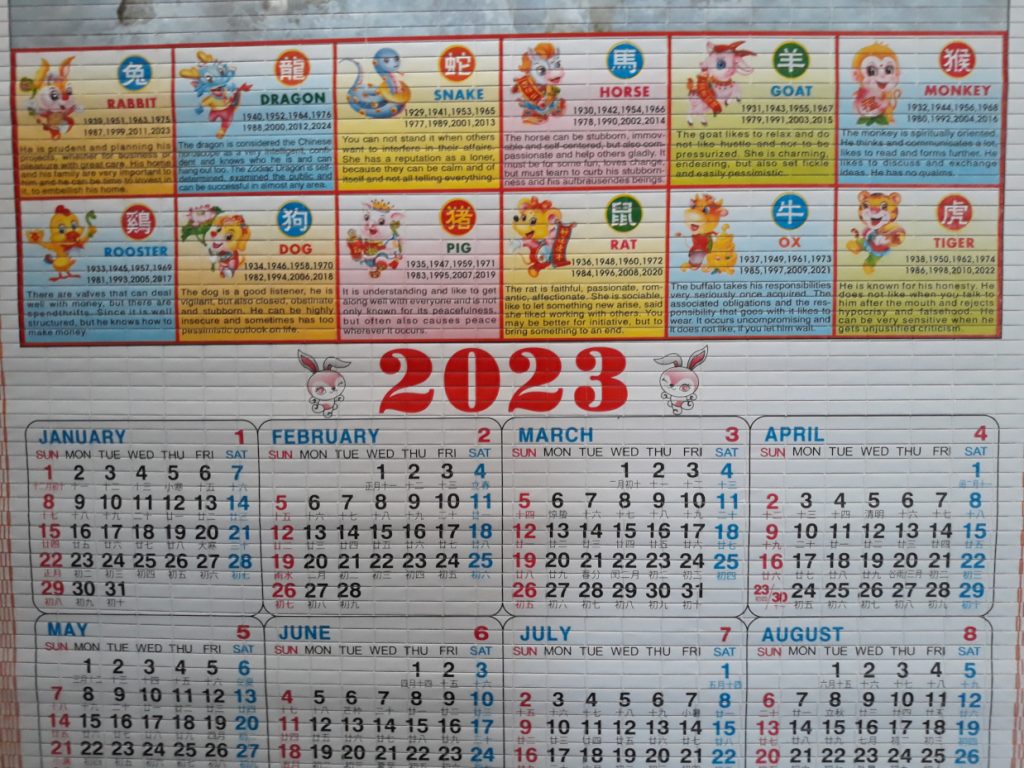
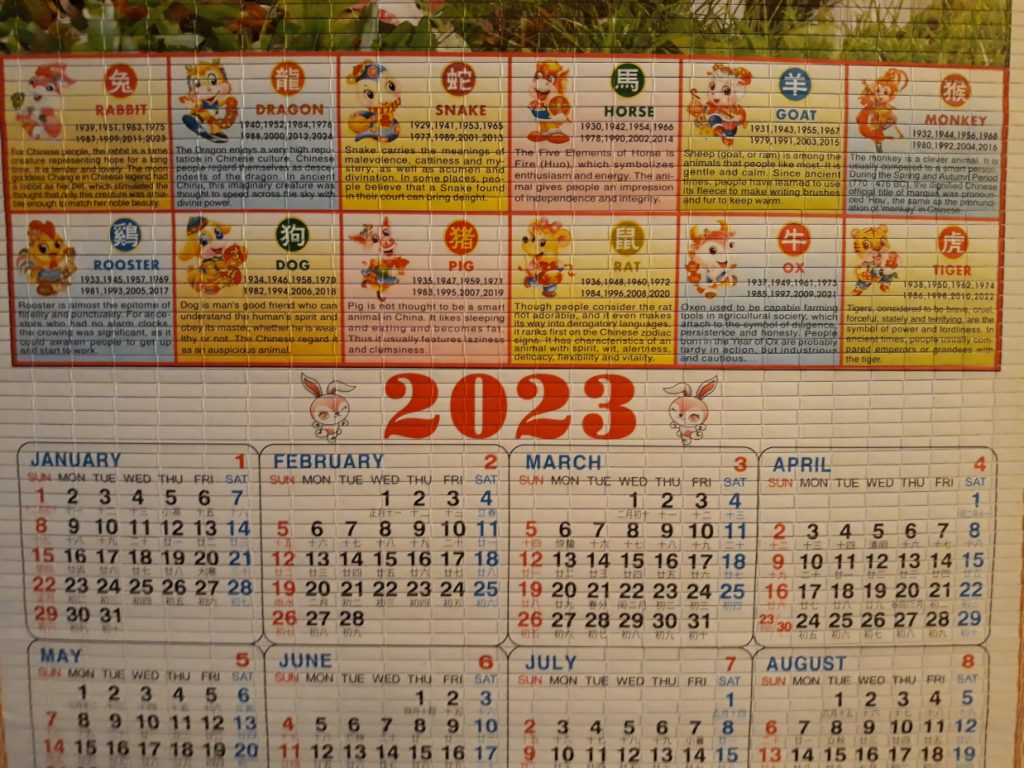
Calendars, websites and fortune-tellers often assign personality traits, lucky colours, numbers or compatible partners to each sign. These lists are not standard. Two calendars can describe the same rabbit in completely different ways, as I found with my own “Scroll Calendar of the Rabbit” and “Scroll Calendar of the Horse”. One called the rabbit “tender and lovely”, while the other called it “prudent and planning”.
Blood-type personality theories are another modern popular belief in parts of East Asia. There is no sound basis for saying that a blood type makes a zodiac trait stronger or weaker, so it is better to recognise these ideas as conversation topics rather than use them to judge a person.
What About Zodiac Elements and Attributes?
The zodiac animal is only one part of the traditional calendrical system. A year also has a Heavenly Stem, and the ten stems are associated with yin or yang and one of the five phases, 五行 (wǔxíng): wood, fire, earth, metal and water. Combining ten stems with twelve branches produces a sixty-year cycle.
The animal's Earthly Branch alternates between yang and yin: rat is yang, ox is yin, tiger is yang, and so on. Folk explanations sometimes connect this alternation with an animal's toes, claws or hooves, but the underlying pattern comes from the branches themselves.
A quick way to identify the phase attached to a modern Gregorian year label is to look at its final digit, once you have accounted for the Chinese New Year boundary:
- 0 or 1: metal, 金 (jīn)
- 2 or 3: water, 水 (shuǐ)
- 4 or 5: wood, 木 (mù)
- 6 or 7: fire, 火 (huǒ)
- 8 or 9: earth, 土 (tǔ)
For example, the Chinese calendar year beginning in 2026 is a fire-horse year. This naming system is an attested calendrical convention; claims that it determines somebody's fate are matters of belief.
Talk About Your Western Zodiac Sign
In everyday Mandarin, 星座 (xīngzuò) commonly means a Western star sign, while 生肖 (shēngxiào) refers to the twelve-year animal cycle. You can ask 你是什么星座?/你是什麼星座? (Nǐ shì shénme xīngzuò?), “What is your star sign?”
The names below use common Mainland Mandarin forms first. Taiwan and Hong Kong use some different names, so you may also encounter 宝瓶座/寶瓶座 for Aquarius, 室女座 for Virgo and 人马座/人馬座 for Sagittarius.
Capricorn
摩羯座 (Mójiézuò)
Aquarius
水瓶座 (Shuǐpíngzuò)
Pisces
双鱼座/雙魚座 (Shuāngyúzuò)
Aries
白羊座 (Báiyángzuò)
Taurus
金牛座 (Jīnniúzuò)
Gemini
双子座/雙子座 (Shuāngzǐzuò)
Cancer
巨蟹座 (Jùxièzuò)
Leo
狮子座/獅子座 (Shīzǐzuò)
Virgo
处女座/處女座 (Chǔnǚzuò)
Libra
天秤座 (Tiānchèngzuò)
Scorpio
天蝎座/天蠍座 (Tiānxiēzuò)
Sagittarius
射手座 (Shèshǒuzuò)
Discussing Your Zodiac Signs in Chinese
Here is a short, natural exchange in simplified Chinese:
You:
可欣,你属什么?
Kěxīn, nǐ shǔ shénme?
“Kexin, what is your zodiac animal?”
Kexin:
我属鼠。你呢?
Wǒ shǔ shǔ. Nǐ ne?
“I'm a rat. And you?”
You:
我属马。今年是我的本命年。
Wǒ shǔ mǎ. Jīnnián shì wǒ de běnmìngnián.
“I'm a horse. This year is my zodiac year.”
Kexin:
你信生肖运势吗?
Nǐ xìn shēngxiào yùnshì ma?
“Do you believe in zodiac fortunes?”
You:
我觉得当作文化话题很有意思。
Wǒ juéde dàngzuò wénhuà huàtí hěn yǒuyìsi.
“I think they're interesting as a cultural topic.”
Phrasebook for Zodiac Sign Conversations
The usual question 你属什么?/你屬什麼? can indirectly reveal somebody's age, because the same sign returns every twelve years. It is common in some settings, but use a broader question when age feels too personal.
- 你的生肖是什么?/你的生肖是什麼? (Nǐ de shēngxiào shì shénme?) – “What is your zodiac animal?”
- 你属什么?/你屬什麼? (Nǐ shǔ shénme?) – “What is your zodiac animal?” in a shorter, everyday form
- 我属鼠。/我屬鼠。 (Wǒ shǔ shǔ.) – “I'm a rat.”
- 今年是什么生肖年?/今年是什麼生肖年? (Jīnnián shì shénme shēngxiào nián?) – “Which zodiac year is this year?”
- 明年是羊年。 (Míngnián shì yángnián.) – “Next year is the Year of the Goat.”
- 今年是我的本命年。 (Jīnnián shì wǒ de běnmìngnián.) – “This year is my zodiac year.”
- 你相信生肖配对吗?/你相信生肖配對嗎? (Nǐ xiāngxìn shēngxiào pèiduì ma?) – “Do you believe in zodiac compatibility?”
- 你是什么星座?/你是什麼星座? (Nǐ shì shénme xīngzuò?) – “What is your Western star sign?”
Vocabulary Related to the Chinese Zodiac
These terms will help you recognise the difference between the calendar system and the fortune-telling ideas built around it:
- 生肖 (shēngxiào) – zodiac animal; the twelve-animal cycle
- 属相/屬相 (shǔxiàng) – a person's zodiac animal
- 地支 (dìzhī) – Earthly Branches
- 天干 (tiāngān) – Heavenly Stems
- 本命年 (běnmìngnián) – a year with the same zodiac animal as your birth year
- 阴阳/陰陽 (yīnyáng) – yin and yang
- 五行 (wǔxíng) – the five phases: wood, fire, earth, metal and water
- 星座 (xīngzuò) – constellation; commonly, a Western star sign
- 运势/運勢 (yùnshì) – fortune or prospects
- 算命 (suànmìng) – fortune-telling; to tell fortunes
- 预测/預測 (yùcè) – to predict; forecast
- 六合 (liùhé) and 三合 (sānhé) – traditional compatibility groupings used in some fortune-telling systems
Chinese New Year Traditions
The zodiac animal becomes especially visible around Chinese New Year, on calendars, red envelopes, stamps, toys and decorations. Customs differ across China and across Chinese communities worldwide, so there is no single checklist that every family follows.
When I taught world cultures to middle-school students, we explored Chinese New Year through calligraphy, food and decorations. The students were especially keen on dragon dances, lanterns and fireworks. Those classroom activities were introductions to particular traditions, rather than a claim that everybody celebrates in the same way.
If you want to use some Mandarin during the celebrations, our guide to Chinese New Year greetings explains what to say and when.
How Do the Chinese Zodiac Signs Affect Me?
Your zodiac animal gives you a useful route into Chinese vocabulary, stories, art and seasonal traditions. Some people take zodiac fortunes or compatibility seriously, some enjoy them casually, and others do not believe in them at all. Follow the person you are speaking with instead of assuming what the tradition means to them.
Stories about the animals also vary. The Jade Rabbit is linked with the moon goddess Chang'e, for example, while different Great Race tales explain the animals' order in different ways. Treat these as living folklore, where variation is part of the subject.
Practise by finding your sign, saying 我属……/我屬…… (Wǒ shǔ…), and asking a willing conversation partner what they call theirs. For a wider start in Mandarin, Language Hacking Mandarin builds practical conversations from the beginning.
新年快乐!/新年快樂!
Xīnnián kuàilè!
Happy New Year!

Social