


How to Read Chinese: A Beginner’s Guide to Characters and Pinyin

Full disclosure: This post contains affiliate links. ?
Reading Chinese becomes much less confusing once you stop looking for an alphabet. Chinese text is built from characters, and those characters combine into words without spaces between them. Your job is to learn how to recognise the useful chunks.
This guide focuses on reading modern Chinese with Standard Mandarin pronunciation. The examples use simplified characters, but the same reading method applies if you are learning traditional characters: learn the sound system, notice components, study characters inside words, and read material at your level.
Most modern Chinese you meet online and in everyday print runs horizontally from left to right. Vertical text is still used in some books, signs, calligraphy and traditional layouts; those columns are normally read from top to bottom, with columns ordered from right to left.
If simplified and traditional forms are new to you, read our introduction to simplified Chinese characters first. Then come back here for the practical reading process.
A note from the Fluent in 3 Months team before we get started: You can chat away in Chinese for at least 15 minutes with the “Fluent in 3 Months” method. All it takes is 90 days. Tap this link to find out more.
How Do You Read Chinese Writing?
Use two tracks at the same time. Pinyin teaches you how Standard Mandarin sounds; characters teach you how Chinese words look. Pinyin is a bridge, not a replacement for the script.
- Learn the Mandarin initials, finals and tones through pinyin.
- Learn common characters inside whole words, not as isolated symbols.
- Use character components as clues to meaning or sound.
- Practise segmenting an unspaced sentence into words.
- Read short, level-appropriate texts and gradually remove pinyin support.
Start with Pinyin
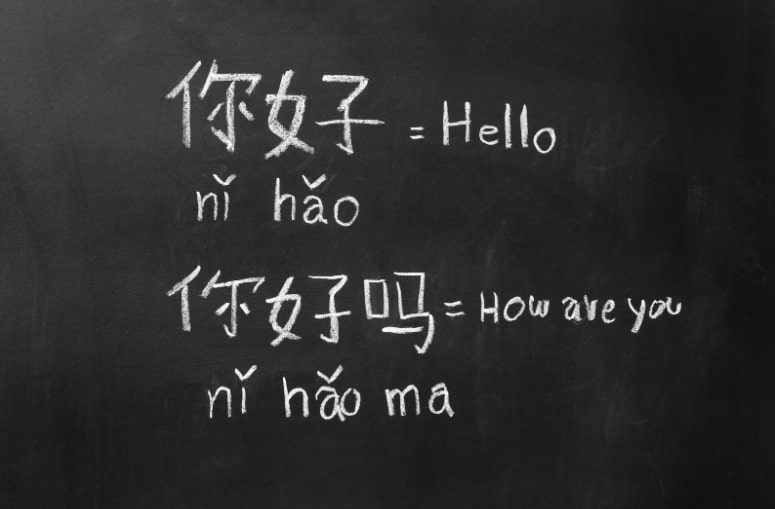
Hanyu Pinyin is the official Latin-letter system for spelling Standard Mandarin pronunciation. It is not a one-to-one transliteration of Chinese characters, and it is not a Chinese alphabet.
For example, 汉字 means “Chinese characters” or “Chinese script”. Its pinyin is hànzì: hàn has a fourth-tone mark, and zì does too. Pinyin can also show a neutral syllable without a tone mark, as in 朋友 (péngyou, “friend”).
Pinyin describes pronunciation, not meaning. Several characters can share the same pinyin, while one character can have different readings in different words. Context tells you which word and reading make sense.
Keep pinyin visible while you are learning a word, then cover it and read the characters again. If your eyes jump straight to the Latin letters every time, pinyin has stopped being a bridge and started hiding the text you want to learn.
How to Read Chinese Characters
Most Chinese characters correspond to one spoken syllable and often to one morpheme, the smallest unit that carries meaning. That is a useful starting model, not an exception-free law. Some characters have several readings, and 儿 can mark erhua without forming a separate syllable.
A word may contain one character, such as 人 (rén, “person”), or several, such as 朋友 (péngyou, “friend”) and 图书馆 (túshūguǎn, “library”). Learn the word as your main unit and use its characters as memory anchors.
Break Down the Characters
Many characters contain components that provide clues. A radical is primarily the component used to index the character in a dictionary; it often overlaps with a semantic component. In a phonosemantic character, another component normally provides the sound clue.
Take 洋 (yáng, “ocean”). The water component 氵suggests the semantic area, while 羊 (yáng, “sheep”) supplies the pronunciation clue. In 妈 (mā, “mother”), 女 suggests meaning and 马 (mǎ) gives an approximate sound. Historical sound change means phonetic components will not always match the modern pronunciation or tone exactly.
Component shapes can change with their position:
- 火 (huǒ, “fire”) can appear as 灬 at the bottom, as in 热 (rè, “hot”).
- 水 (shuǐ, “water”) often appears as 氵on the left, as in 河 (hé, “river”).
- 心 (xīn, “heart”) appears at the bottom of 想 (xiǎng, “think; want”) and as 忄on the left of 快 (kuài, “fast”).
Dictionary radical systems are not all identical. Mainland China's modern table specifies 201 main radicals and 99 variants, while many traditional dictionaries use the older 214-radical system. Learn enough to look up an unfamiliar character; you do not need to memorise a whole table before you start reading.
Visual mnemonics can help with forms such as 口 (kǒu, “mouth”), 门 (mén, “door”), 三 (sān, “three”) and 女 (nǚ, “woman”). Treat your mnemonic as a memory device, not automatically as the character's true historical origin.
Break Down the Words and Sentences
Chinese separates sentences and clauses with punctuation, but normally does not put spaces between words. Reading therefore involves word segmentation: deciding which neighbouring characters belong together.
Compounds become easier when you recognise their parts:
- 四月 (sìyuè, “April”) combines 四 (sì, “four”) and 月 (yuè, “month”).
- 前男友 (qián nányǒu, “ex-boyfriend”) combines 前 (“former/before”), 男 (“male”) and 友 (“friend”).
- 女孩儿 (nǚháir, “girl”; also “daughter” in some contexts) combines 女 (“female”) and 孩儿 (háir, “child”).
- 星期日 (xīngqírì, “Sunday”) combines 星期 (xīngqí, “week”) and 日 (rì, “day”).
- 火车 (huǒchē, “train”) combines 火 (“fire”) and 车 (“vehicle”), a word shaped by the history of steam trains.
Now consider 我今天坐火车去北京。(Wǒ jīntiān zuò huǒchē qù Běijīng., “I'm taking the train to Beijing today.”) A learner-friendly segmentation is 我 / 今天 / 坐 / 火车 / 去 / 北京. Recognising 火车 as one word stops you from trying to translate “fire” and “vehicle” separately.
Words also resolve pronunciation. 行 is háng in 银行 (yínháng, “bank”) but xíng in 行吗 (xíng ma, “is that okay?”). A dictionary entry for an isolated character cannot replace the surrounding word.
For a short passage, make four passes:
- Read once for the general situation without looking anything up.
- Mark likely word boundaries and recurring character groups.
- Look up only the words that block the main meaning.
- Read again, then listen to matching audio if the resource provides it.
Types of Chinese Characters
The traditional “six writings” classification describes how characters were formed or used. It is useful background, but you do not need to master it before reading. The English labels and the analysis of individual characters can also vary between sources.
- Pictographs (xiàngxíng): 人 (rén, “person”) is a standard example.
- Simple indicatives (zhǐshì): 上 (shàng, “up; above”).
- Semantic compounds (huìyì): 休 (xiū, “rest”), traditionally analysed through 人/亻 (“person”) and 木 (“tree”).
- Phonosemantic compounds (xíngshēng): 河 (hé, “river”), with semantic 氵and phonetic 可.
- Phonetic loans (jiǎjiè): 来 (lái, “come”), whose graph originally represented wheat and was borrowed for a similar-sounding word.
- Derivative cognates (zhuǎnzhù): traditionally illustrated with 老 (lǎo, “old”) and 考 (kǎo, “examine”). This is the most debated of the six categories.
For day-to-day learning, phonosemantic characters give the most practical payoff. Ask two questions: “Which component hints at the semantic family?” and “Which component might hint at the sound?” Then confirm the whole word in a dictionary, because neither clue is a guarantee.

Tools to Help You Read Chinese
A good reading tool should help you return to the sentence quickly. Use it to identify word boundaries, check pronunciation and confirm meaning, rather than translating every character one by one.
Wenlin
Wenlin is desktop software for macOS and Windows. Its current free and paid editions combine Chinese dictionaries with text reading and editing tools. You can point to words for lookup, inspect components, compare simplified and traditional forms, and work with pasted Chinese text.
Wenlin is especially useful if you want detailed character information on a larger screen. Check the current edition and operating-system requirements before installing it.
MDBG Chinese Dictionary
MDBG is a browser-based Chinese-English dictionary. It accepts searches by Chinese, pinyin or English, supports simplified and traditional forms, and offers character, component, radical-and-stroke and text-annotation tools.
Paste a sentence into its word-by-word lookup when you are unsure where one word ends and the next begins. Treat automatic segmentation and translation as a first pass, then check any surprising result in context.
Pleco
This Fi3M Pleco walkthrough shows the basic tap-and-look-up reading workflow. The interface has changed since the video was recorded, so use the current product page for today's feature and compatibility details.
Pleco is a Chinese dictionary app for iOS and Android. The free base app includes dictionary search, basic audio and a light document-reading function. Paid add-ons include OCR, fuller document reading, flashcards and stroke-order diagrams.
Use handwriting input or camera OCR when you cannot copy a character. For digital text, selecting or pasting the whole word is usually faster and gives a more reliable meaning than looking up one character at a time.
Browser Pop-up Dictionaries
A pop-up dictionary lets you hover over an unfamiliar word without leaving the page. Zhongwen for Chrome currently shows pinyin and English definitions for simplified and traditional text and can save a word list.
Browser extensions can request access to the pages you visit. Review the permissions and privacy information yourself, and turn the extension off when you are not using it.
Graded Reading Tools
Instead of sending native text through a general translator, start with material written for learners. Du Chinese provides levelled stories and articles with word lookup, translations, grammar notes and audio. Mandarin Bean provides free graded lessons from beginner to advanced, with simplified or traditional display, pinyin, translations and teacher-recorded audio.
Choose a text where you can follow the main idea before looking anything up. If every line needs several dictionary searches, move down a level and build reading speed there.
Flashcards
Flashcards are useful for retaining words you have already met, but isolated-character cards can create the illusion that you know how the character behaves in a sentence. Put the whole word on the front and add one short example on the back.
Anki is a flexible spaced-repetition option. Our guides explain how to make useful Anki cards, and Anki Power Up is available if you want more help with an Anki-based workflow.
Books and Graded Readers
Children's books are written for children who already speak Chinese, so the vocabulary is not automatically easy for an adult beginner. A graded reader controls the language more deliberately.
Mandarin Companion publishes graded Chinese readers at several levels. Look for a sample and check how much you can understand before buying a book. If you want a course book alongside your reading practice, see Language Hacking Mandarin.
You can also apply the same method to a parallel text: read the Chinese first, mark the words you think you know, consult the translation, and return to the Chinese. Our guide to learning a language through reading has more ways to work with books without turning every page into a dictionary exercise.
For a simple daily routine, choose a passage of 100 to 300 Chinese characters. Read for the gist, segment the words, look up the few that block meaning, and reread with audio. Save no more than five useful words for review. Fifteen focused minutes of that process will teach you more about reading than memorising disconnected character lists.
When you are ready for the next step, build your base with these essential Chinese words and review Mandarin tones. Then return to a short text and put both skills to work.

Social