


150+ Japanese Words and Phrases You Need to Start Speaking Now

Full disclosure: This post contains affiliate links. ?
Are you ready to start speaking Japanese, right now?
Even if you just thought about learning Japanese today, you can start speaking from Day 1!
Whether you are learning Japanese to prepare for travel to Japan, or for a language exchange, it’s a good idea to learn Japanese essential words and phrases to get the ball rolling. I’ve got your back with this list to help you get started!
Editor's note: Before we get started, if you’re looking for an online Japanese course, here’s the course we recommend: Japanese Uncovered – Learn Japanese Through the Power of Story, a course with a fascinating new method by Olly Richards. You can try it for free for 7 days!
Japanese Words for Beginners: An Essential List
Japanese Greetings:
- Yes: はい (hai)
- No: いいえ (iie)
- Hello: こんにちは (konnichiwa)
- Goodbye: じゃね (ja ne)
- Thank you: ありがとう (arigatou)
- I’m Sorry: ごめんなさい (gomen nasai)
- Excuse me: すみません (sumimasen)
Learn more: Japanese Greetings: 17 Ways to Say “Hello” in Japanese
Japanese Pronouns:
- I: 私 (watashi)
- You: あなた (anata); in conversation, you’ll often use the person’s name with さん instead, or leave “you” out when it’s clear
- This: これ (kore)
- That: それ (sore)
- He: 彼 (kare)
- She: 彼女 (kanojo)
- They: 彼ら (karera)
Learn more: Japanese Honorifics: How to Show Respect in Japanese
Japanese Numbers:
- One: いち (ichi)
- Two: に (ni)
- Three: さん (san)
- Four: し (shi) or よん (yon)
- Five: ご (go)
- Six: ろく (roku)
- Seven: なな (nana) or しち (shichi)
- Eight: はち (hachi)
- Nine: く (ku) or きゅう (kyuu)
- Ten: じゅう (juu)
Learn more: Japanese Numbers: Counting in Japanese from 1 – 100+
Time in Japanese:
- Today: 今日 (kyou)
- Tomorrow: 明日 (ashita)
- Yesterday: 昨日 (kinou)
- Now: 今 (ima)
- Before: 前に (mae ni)
- Later: 後で (ato de)
Learn more: The Ultimate Guide to Japanese Particles (with Examples)
Japanese Nouns:
- Home: 家 (ie or uchi)
- Shop: 店 (mise)
- Movie: 映画 (eiga)
- School: 学校 (gakkou)
- Car: 車 (kuruma)
- Town: 町 (machi)
- Music: 音楽 (ongaku)
- Family: 家族 (kazoku)
- Hometown: 故郷 (furusato) or 出身地 (shusshinchi)
- Bathroom: トイレ (toire)
Learn more: 101 Core Japanese Words: The Most Commonly Used Words in Japanese
Japanese Verbs:
- To do: する (suru)
- Polite copula (‘am / is / are’ after a noun or な-adjective): です (desu)
- To become: なる (naru)
- There is (things and plants): ある (aru)
- There is (people and animals): いる (iru)
- To go: 行く (iku)
- To say: 言う (iu)
- To see: 見る (miru)
- To come: 来る (kuru)
- To eat: 食べる (taberu)
Learn more: Japanese Grammar Made Easy: A Step-by-Step Guide
Getting Started Speaking Japanese
Even though I speak often now with Japanese language exchange partners, it wasn’t always that way. I found it hard to speak Japanese at first, too.
It can be a bit intimidating to know where to begin. Any time you learn a new language, especially one where the writing system is very different, it can become difficult to make the connections between grammar, memorised words, and creating sentences.
Don’t get too stressed about it, though. These basic Japanese words and phrases helped me start to get to know others in Japanese.
And that’s the whole point, isn’t it?
Learning some stock phrases and words to fall back on to keep the conversation going or ask questions is the key to relaxing a bit when speaking.
So, of course you must know your essential 挨拶 (aisatsu: “greetings”) and basic Japanese words.
If you’re wondering how to say ‘word’ in Japanese, two useful terms are 単語 (tango) and 言葉 (kotoba). Japanese nouns usually keep the same form whether you mean one thing or more than one. 単語 usually means an individual vocabulary item, while 言葉 can mean words, language, speech or an expression depending on context.
Below, I’ll also go over questions, cool Japanese words, and cute Japanese words and expressions to go far in your speaking.
Once you’ve learnt these Japanese words, you can say めっちゃかっこいい (meccha kakkoii: ‘very cool’).
Editor's note: before we get started, if you’re looking for an online Japanese course, here’s the course I actually recommend: Japanese Uncovered – Learn Japanese Through the Power of Story, a course that teaches through stories.
Japanese Words and Phrases for Beginners:
Want to hear how these words and phrases sound, plus some bonus tips? Watch this video:
Japanese Greetings for Everyday
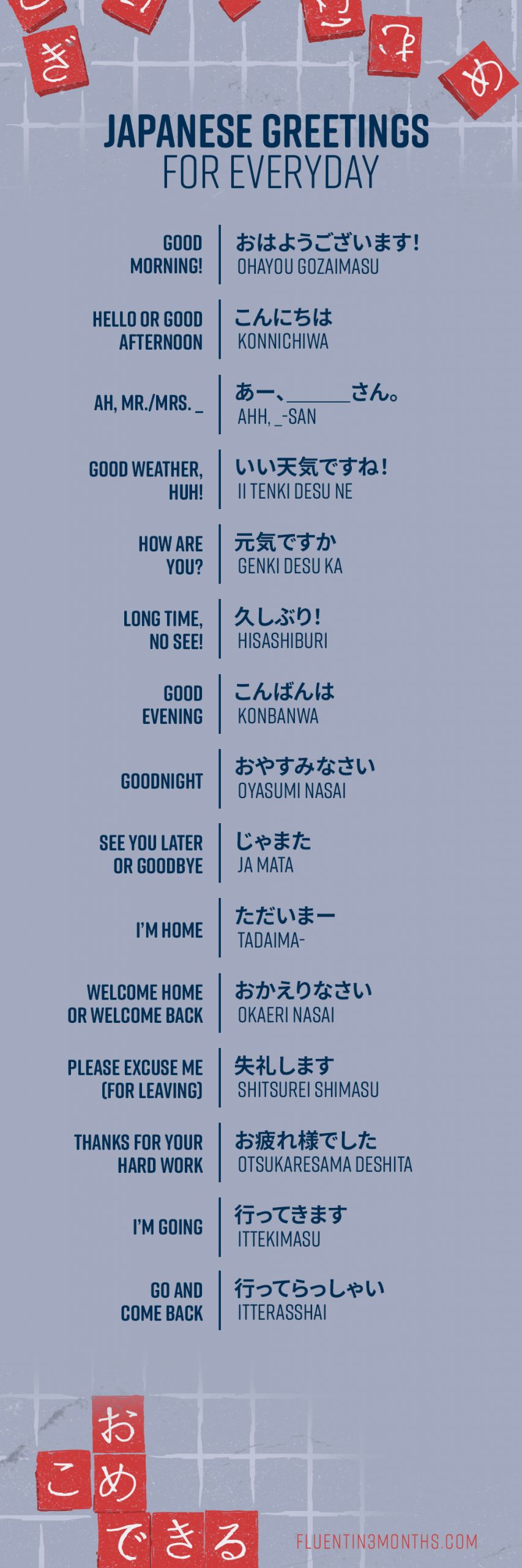
おはようございます! (Ohayou gozaimasu: “Good morning!”)
A formal way to greet someone in the morning, you’ll use this with co-workers, strangers, or superiors. With friends and family, you can shorten it by saying おはよう!(Ohayou, “‘Morning!”)
こんにちは (Konnichiwa: “Hello” or “Good afternoon”)
こんにちは is a standard polite daytime greeting. You can use it with strangers and acquaintances; close friends and family may prefer a more casual greeting.
あー、___さん。(Ahh, _-san: “Ah, Mr./Mrs. _”)
You may hear someone greet a person they recognise with “Ah!” followed by their name, rather than a set greeting.
Follow the name with an appropriate suffix: さん (san) is a useful polite default, regardless of gender or marital status. A question or a comment about the weather can follow.
Speaking of which…
いい天気ですね!(Ii tenki desu ne: “Good weather, huh!”)
いい (ii) means “good” and 天気 (tenki) means “weather”. Together, いい天気 means “good weather”; don’t assume any weather adjective can replace いい in exactly the same pattern.
元気ですか (Genki desu ka: “How are you?”)
Although it’s instinct to always greet everyone with “How are you?” in English, it’s not the case in Japanese.
You wouldn’t normally use this as an automatic hello every time you see a friend or family member. It asks about their wellbeing, so use it when you genuinely want to know how they’re doing rather than as a routine greeting to every stranger.
It’s particularly useful when you haven’t seen someone for a while, though you can also ask when you want to check how they’re feeling.
久しぶり!(Hisashiburi: “Long time, no see!”)
If you haven’t seen someone for a while, you may hear 久しぶり (hisashiburi)! There’s no fixed three-week threshold. You can follow it with 元気ですか (genki desu ka); お久しぶりです is the polite form of the reunion greeting.
こんばんは (Konbanwa: “Good evening”)
This is a polite evening greeting; you don’t need to tie it to a particular dinner time.
おやすみなさい (Oyasumi nasai: “Goodnight”)
When you say goodnight to someone you’re close to, you can shorten it by saying おやすみ (oyasumi: “‘night!”)
じゃまた (Ja Mata: “See you later” or “Goodbye”)
You probably know さようなら (sayounara) as “goodbye”. It can sound final in some situations, but it’s also a normal farewell between students and teachers at school, so it doesn’t always mean you won’t meet again.
So it’s often better to say じゃまた (ja mata).
Other variations are じゃね (ja ne: “see you”), バイバイ (baibai: “bye-bye”), and お元気で (o-genki de: “take care”).
Other Aisatsu (Greetings) in Daily Life
ただいまー (Tadaima-: “I’m home”)
When you arrive home, you announce it with this phrase. The person already at home replies with the greeting below.
おかえりなさい (Okaeri nasai: “Welcome home” or “Welcome back”)
These phrases can also be used at work: a coworker returning from a business meeting or trip may say ただいま, and someone welcoming them back can say おかえりなさい.
お先に失礼します (Osaki ni shitsurei shimasu: “Please excuse me for leaving before you”)
When you leave ahead of someone else, you say お先に失礼します as a polite acknowledgement that you are leaving first.
At work, this is a common way to acknowledge coworkers who are still there when you leave.
お疲れ様でした (Otsukaresama deshita: “Thanks for your hard work”)
You say this in reply to 失礼します (“please excuse me for leaving”) as a thank you for their hard work that day, but it can be used in many other situations.
Any time anyone works hard, you can say this to acknowledge their hard work, like a child who did well and finished their homework. You can also use it as a greeting when someone returns from a hard task.
行ってきます (Ittekimasu: “I’m going”)
Say this to family at home, friends, or co-workers to announce you’re heading out.
行ってらっしゃい (Itterasshai: “Go and come back”)
In reply to 行ってきます (ittekimasu, “I’m going”), you say this; it’s kind of like saying “Be careful!” or “Okay, take care” and lets them know you’ll see them when they get back.
Basic Japanese Words and Phrases for All Situations
- ありがとうございます (arigatou gozaimasu): “Thank you”
- ごめんなさい (gomen nasai): “I’m sorry”
- はい or うん (hai or un): “Yes” (formal and informal)
- いいえ or ううん (iie or uun): “No” (formal and informal)
- 私の名前は_です (watashi no namae wa _ desu): “My name is _”
- _ です。(desu): “I am” (See note below.)
- いいですよ。(ii desu yo): “It’s good.”
- だめです。(dame desu): “It’s no good / not allowed.”
- もう一度お願いします。(mou ichido onegai shimasu): “Again, please.”
- ゆっくりお願いします (yukkuri onegai shimasu): “More slowly, please”
- わかりません (wakarimasen): “I don’t understand”
- 良かった (yokatta): “Great!” or “I’m glad!”
- すみません (sumimasen): “Excuse me”
- どういたしまして (Dou itashimashite): “You’re welcome”
- 少し日本語を話します (Sukoshi nihongo wo hanashimasu): “I speak a little Japanese”
- また会いましょう (Mata aimashou): “Let’s meet again!”
Please in Japanese: どうぞ、お願いします、ください (Douzo, Onegai Shimasu, Kudasai)
The word for “please” changes with intent.
どうぞ (douzo) is straightforward. You use this word when you are offering something to someone else. Like, “お先にどうぞ” (osaki ni douzo: “Please, you first” or “Please, after you”).
お願いします (onegai shimasu) and ください (kudasai) can both follow a noun when ordering or asking for an item, with お願いします generally more polite; they are not interchangeable in every request pattern.
お願いします is used for requests and for asking for goods or services; its use is not based on treating service staff as socially higher. For a substantial request to a superior, a more indirect form such as 〜ていただけますか may be appropriate.
After a noun, ください asks for an item, as in restaurant orders. After a verb’s て-form, 〜てください makes a request or instruction; appropriateness depends on the situation, not simply whether the listener is a close friend.
You also use ください after a verb in its て-form, as in ちょっと待ってください (chotto matte kudasai: “please wait”), while keeping the social context and degree of directness in mind.
About Desu in Japanese
If you’ve listened to Japanese, you’ve probably wondered what desu means, because you hear it so often.
です (desu) is the polite copular form used after nouns and な-adjectives, often corresponding to English “am,” “is,” or “are” in context; it is not a general infinitive “to be.”
You can place a noun or な-adjective predicate before です to describe yourself. You can also add です after an い-adjective to make it polite, as in せまいです (semai desu: “It’s small”). Ordinary verb predicates instead take polite ます forms.
You could say 二十七歳です (ni juu nana sai desu: “I am 27 years old”), アメリカ人です (amerikajin desu: “I am American”), or 作家です (sakka desu: “I am a writer”).
You could also use it to describe other things, like いいほんです (ii hon desu: “A good book”).
Japanese Questions to Boost Your Conversation
In polite Japanese, add the question particle か to the end of a polite predicate, as in ですか or ますか. Casual questions may use rising intonation, but ですか is not a Japanese ‘question mark.’
Let’s start with the basics:
- 誰 (dare): “Who?”
- 何 (nani or nan): “What?”
- いつ (itsu): “When?”
- どこ (doko): “Where?”
- どうして (doushite): “Why?”
- どう (dou): “How?”
- どちら? (dochira): “Which?”
Learn more: Japanese Question Words: “What”, “Where”, “When”, “Who”, “How” and “Why” in Japanese
And more helpful Japanese questions:
- お名前は何ですか (o-namae wa nan desu ka): “What’s your name?”
- いくらですか (ikura desu ka): “How much is it?”
- わかりますか (wakarimasu ka): “Do you understand?”
- _はどこですか (_ wa doko desu ka): “Where is the _?”
- これは何ですか (kore wa nan desu ka): “What’s this?”
- これはどういう意味ですか? (kore wa dou iu imi desu ka): “What does this mean?”
- _は日本語で何と言いますか (_ wa nihongo de nan to iimasu ka): “How do you say _ in Japanese?”
- 英語を話せますか (eigo wo hanasemasu ka): “Can you speak English?”
- 何って言ったの (nani tte itta no): “What did you say?”
- _ がありますか (_ ga arimasu ka): “Do you have __?”
- 大丈夫ですか (daijoubu desu ka): “Are you okay?”
- どうしたんだ (doushitanda): “What happened?”
- E-メール/電話番号を教えてもらえますか (e-meru/denwa bango wo oshiete moraemasu ka): “Could I have your email address/phone number?”
- _ を利用しますか (_ wo riyou shimasu ka): “Do you use _?”
- いつ会えますか? (itsu aemasu ka): “When can we meet?”
Bonus: Some Cute and Cool Japanese Words to Level Up Your Speech
What are some cool Japanese words? I’m glad you asked! Use these Japanese slang words to sound cool in Japanese.
かわいい (Kawaii: “Cute”)
You probably know this one, as it’s become a staple of otaku in America, but it’s very common in Japan too. Everything is “kawaii.”
かっこいい (Kakkoii: “Cool”)
Also, “handsome.” It’s mostly used to describe dreamy guys or cool objects.
すごい!(Sugoi: “Wow!” or “Amazing!”)
すごい (sugoi) is a common positive reaction, but using it for everything can sound automatic. Mix it with reactions such as なるほど (naruhodo: ‘I see’), そうなんだ (sou nan da: ‘Oh, really?’) and 確かに (tashika ni: ‘That’s true’).
やばい (Yabai: ‘Crazy’, ‘Amazing’ or ‘Terrible’)
やばい is flexible slang. Depending on context and tone, it can mean something is amazing, delicious, dangerous, awful or simply intense.
超(ちょう)、めっちゃ、とっても (Chō, meccha, tottemo: “Very,” “Super”)
These differ more by register and history than by a simple dialect split. 超 (chou) is casual slang; めっちゃ (meccha) began in Kansai and is now casual nationwide; とても (totemo) is standard. とっても (tottemo) is an emphatic version and can sound playful.
マジで (Maji de: “Seriously,” “Really”)
マジ (maji) is casual, gender-neutral slang for ‘seriously’ or ‘really’.
うそ! (Uso!: “No way!”)
It actually means “a lie,” but it’s used as “no way!” in casual conversation when you hear something unbelievable.
ばか! (Baka!: “Idiot!”)
Context matters with ばか (baka). It can be a harsh insult to a stranger or a light ‘dummy’ between close friends and family.
あほ (aho) also means ‘idiot’, but its force varies by region. In Kansai it can be affectionate, while ばか may land harder; elsewhere, あほ can sound more insulting. Neither word automatically means ‘asshole’.
下衆野郎 (gesu yarou) is a much harsher insult, closer to ‘scumbag’ or ‘lowlife’.
よし (Yoshi: “OK!”)
A common question is: “What is OK in Japanese?” Because there are a few versions, and it’s a bit confusing!
First, there’s よし (yoshi), pronounced more like “yosh” than “Yoshi” the video game character.
It’s used as an exclamation, like “Okay, let’s do this!”
Then there’s オーケー (o-ke-). It’s used to respond to someone, just like in English. You’ll often hear “オーケーです” (o-ke- desu), which means “OK / Got it / It’s okay.”
Last, there’s まあまあ (maamaa). This means “okay” but in the sense that you’re “so-so.”
Learn more: 63 Must-Know Japanese Slang Words (to Sound like a Local)
Japanese Words and Phrases to Speak NOW!
How will you use these phrases to start speaking Japanese now? If you’re looking for a Japanese language exchange partner, learn how you can find one in your area or check out italki (our review is here) or Teacher AI.

Social