



111 Core Korean Words — Basic Korean Words You Need to Learn First

Full disclosure: This post contains affiliate links. ?
A compact set of useful Korean words gives you building blocks for greetings, questions and everyday conversations.
No list lets you understand half of every conversation on its own, because coverage depends on the source, topic and how words are counted.
This guide groups 111 useful words by topic, then shows you how to make them relevant to the Korean you actually want to speak.
A note from the Fluent in 3 Months team before we get started: You can chat away in Korean for at least 15 minutes with the “Fluent in 3 Months” method. All it takes is 90 days. Tap this link to find out more.
Table of contents
- 10 Must-Know Basic Korean Words
- 10 Useful Korean Reference Words and Address Forms
- 42 Basic Korean Nouns
- 25 Common Korean Verbs
- 19 Simple Korean Adjectives and Adverbs
- 5 Useful Korean Connectors and Time Expressions
- Bonus: 10 Cool Korean Words and Slang to Boost your Korean Vocabulary
- How to Learn These Korean Words
- Big Gains for Your Korean Language Learning Muscles
I’ll be writing using 한글 (hangeul), the Korean writing system. It’s helpful to learn Hangul first because it helps with pronunciation. And, while the writing system may look complex…
Hangul was made to be easy to learn! In fact, you could learn it in only an hour or two. So brush up on your Hangul first, then start working on the list below!
If you already feel confident reading Hangul, let’s get started.
Before we get into the article, if you are interested in learning Korean yourself, you should check out my absolute favourite resource for learning Korean, Koreanclass101.

During my own Korean learning project, this was by far my favourite resource, since it was a podcast style learning resource that covered many aspects of the language much better than traditional courses do.
It also tackled the issue of listening comprehension better than literally anything else out there, since its catalogue of lessons eases you in with simple lessons at first that get progressively harder, and you can listen to them for a huge range of topics better suited to your hobbies and interests.
They have a free option for anyone who wants to test them out, based on just their limited recent episodes, but exclusively for Fi3M readers, you can get 20% off if you sign-up for any of their subscriptions, which allow you to access their full catalog of many hundreds of lessons, using the code FLUENT3.
I highly recommend this to all Korean learners!!
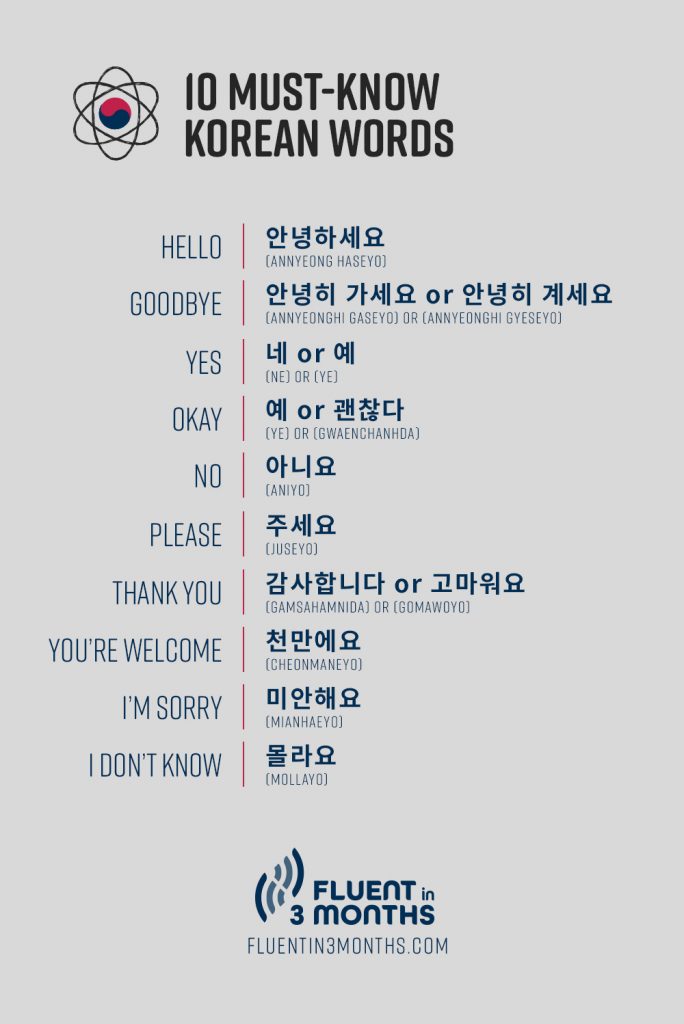
10 Must-Know Basic Korean Words
If you’re only going to learn 10 Korean words, these are the must-knows!
- 안녕하세요 (annyeong haseyo) – “Hello”
- 안녕히 가세요 (annyeonghi gaseyo) or 안녕히 계세요 (annyeonghi gyeseyo) – “Goodbye”
- 네 (ne) or 예 (ye) – “Yes”
- 괜찮아요 (gwaenchanh-ayo) – “Okay”
- 아니요 (aniyo) – “No”
- 주세요 (juseyo) – “Please”
- 감사합니다 (gamsahamnida) or 고마워요 (gomawoyo) – “Thank you”
- 천만에요 (cheonmaneyo) – “You’re welcome”
- 미안해요 (mianhaeyo) – “I’m sorry”
- 몰라요 (mollayo) – “I don’t know”
Related learning: Find 57 more must-know Korean words and phrases in this article.
10 Useful Korean Reference Words and Address Forms
Korean often omits pronouns when the meaning is clear from context.
The list below mixes pronouns with demonstratives, nouns and an address suffix, so don’t treat all ten as direct substitutes for English pronouns.
Pay attention to the notes, especially for forms that are more common in writing than conversation.
- -씨 (-ssi) – a polite suffix used after a person’s name
- 나 (na) – “I” in informal speech
- 여자 (yeoja) – “woman”
- 그 (geu) – “he” mainly in writing; often omitted in speech
- 그들 (geudeul) – “they”, more common in writing than everyday speech
- 우리 (uri) – “we” or “our”
- 이 (i) – “this” before a noun
- 그 (geu) – “that” before a noun
- 저거 (jeogeo) – “that thing over there”
- 그것 (geugeot) – “that thing” or “it”
당신 (dangsin) isn’t a neutral default for English “you”. Depending on context, it can sound intimate, confrontational or unusually formal.
In conversation, use the person’s name or title when needed, and omit “you” when the context already makes it clear.
If you need more information about Korean address forms, head to this guide I wrote.
42 Basic Korean Nouns
If you’re familiar with Fluent in 3 Months founder Benny Lewis’ Language Hacking method, then you know he suggests learning words based on what you personally say in everyday life. These would be the most helpful nouns and verbs to learn to start speaking fast.
And the best way to practice is by creating Korean scripts with words you use a lot.
I use that method, too. Especially after I learn the 100 most common words in a language. So I still suggest you do that, too.
The words below cover useful topics such as time, places, getting around and people. If a word doesn’t fit your life, replace it with one you’ll have more reason to use.
Korean Words for Time
- 일 (il) – “Day”
- 주 (ju) – “Week”
- 달 (dal) – “Month”
- 년 (nyeon) – “Year”
- 오늘 (oneul) – “Today”
- 어제 (eoje) – “Yesterday”
- 내일 (naeil) – “Tomorrow”
- 시 (si) – “Hour”
- 분 (bun) – “Minute”
- 시간 (sigan) – “Time”
- 전에 (jeon-e) – “Before”
- 후 (hu) – “After”
- 지금 (jigeum) – “Now”
Korean Words for Places
- 여기 (yeogi) – “Here”
- 거기 (geogi) – “There”
- 장소 (jangso) – “Place”
- 학교 (haggyo) – “School”
- 가게 (gage) – “Shop”
- 직장 (jikjang) – “Workplace”
- 화장실 (hwajangsil) – “Bathroom”
- 도시 (dosi) – “City”
- 나라 (nara) – “Country”
- 기차역 (gichayeog) – “Train station”
- 방 (bang) – “Room”
- 대한민국 (daehanmingug) – “South Korea”
Korean Words for Things
- 것 (geos) – “Thing”
- 아무것도 (amugeosdo) – “Nothing”
- 뭔가 (mwonga) – “Something”
- 집 (jib)- “House”
- 차 (cha) – “Car”
- 말 (mal) – “Words”
- 언어 (eon-eo) – “Language”
- 물 (mul) – “Water”
- 영화 (yeonghwa) – “Movie”
Korean Words for People
- 여자 (yeoja) – “Woman”
- 남자 (namja) – “Man”
- 소녀 (sonyeo) – “Girl”
- 소년 (sonyeon) – “Boy”
- 친구 (chingu) – “Friend”
- 사람 (saram) – “Person”
- 가족 (gajok) – “Family”
- 이름 (ileum) – “Name”
Related learning: “Family” in Korean: Talking About Your Family in Korean
25 Common Korean Verbs
These are the 25 most common Korean verbs you need to know. You can say a lot with only these 25, especially with verbs like 하다 and 있다 which combine with other words and nouns to form new verbs.
- 하다 (hada) – “To do”
- 있다 (issda) – “To be, there is”
- 지다 (jida) – “To become”
- 말하다 (malhada) – “To say”
- 오다 (oda) – “To come”
- 가다 (gada) – “To go”
- 할 수 있다 (hal su issda) – “To be able to do”
- 보다 (boda) – “To see”
- 보내다 (bonaeda) – “To send”
- 가지다 (gajida) – “To have”
- 기다리다 (gidalida) – “To wait”
- 만나다 (mannada) – “To meet”
- 살다 (salda) – “To live”
- 생각하다 (saeng-gaghada) – “To think”
- 주다 (juda) – “To give”
- 받다 (badda) – “To receive”
- 알다 (alda) – “To know”
- 만들다 (mandeulda) – “To make”
- 사용하다 (sayonghada) – “To use”
- 배우다 (baeuda) – “To learn”
- 먹다 (meokda) – “To eat”
- 마시다 (masida) – “To drink”
- 웃다 (udda) – “To laugh”
- 읽다 (ilgda) – “To read”
- 쓰다 (sseuda) – “To write”
19 Simple Korean Adjectives and Adverbs
There are so many adjectives you could use to add color to your Korean. But these are some of the basic Korean words to get started with.
They’re super helpful as descriptive words, especially if you don’t know the right one for what you’re describing.
- 많은 (manh-eun) – “Many, lots of”
- 조금 (jogeum) – “A little, a bit”
- 큰 (keun) – “Big”
- 작은 (jageun) – “Small”
- 긴 (gin) – “Long”
- 짧은 (jjalb-eun) – “Short”
- 가까이에 (gakkaie) – “Near”
- 멀리 (meolli) – “Far”
- 좋은 (joeun) – “Good, nice”
- 나쁜 (nappeun) – “Bad”
- 쉬운 (swiun) – “Easy”
- 어려운 (eoryeoun) – “Difficult”
- 아름다운 (aleumdaun) – “Beautiful”
- 못생긴 (mossaenggin) – “Ugly”
- 맛있는 (masissneun) – “Delicious”
- 뜨거운 (tteugeoun) – “Hot”
- 춥다 (chubda) – “Cold”
- 매우 (maeu) – “Very”
- 재미있는 (jaemiinneun) – “Fun, interesting”
5 Useful Korean Connectors and Time Expressions
Conversation connectors help you link ideas, while time expressions show when something happened. The right choice depends on the sentence and speech level.
- 그러나 (geuleona) – “But, however”
- 또한 (ttohan) – “Also”
- 예를 들어 (yeleul deul-eo) – “For example”
- 그래서 (geulaeseo) – “So”
- 그때 (geuttae) – “At that time, then”
Bonus: 10 Cool Korean Words and Slang to Boost your Korean Vocabulary
You always need some cool Korean slang words to add to your memory bank! These ten slang terms are a good place to start so you sound more natural in Korean.
- 대박 (daebak) – “Amazing, great”, or “that’s crazy”
- 짱 (jjang) – “The best, awesome”
- 꿀잼 (kkuljaem) – “Fun, interesting, or funny”
- 닭살 (dalgsal) – “Cheesy”
- 극혐 (geughyeom) – “Totally disgusting/repulsive”
- 불금 (bulgeum) – “TGIF” or “Burning Friday”
- 행쇼 (haengsyo) – “Be happy” (a trendy phrase made popular by K-Pop idol, G-Dragon)
- 헐 (heol) – “OMG, no way”
- ㅋㅋ (kk) – “Haha” or “lol” (Only used in text)
- 만렙 (mallaep) – “Max level, maxed out” (or as I like to think of it… “It’s over 9,000!”)

If you’d like to learn more Korean slang, I’ve got exactly what you need: Korean Slang: 80+ Everyday Words and Phrases to Sound Like a Native.
How to Learn These Korean Words
Word-frequency lists can help you prioritise vocabulary in a new target language, though the result depends on the corpus behind the list.
I’ve used this approach with core Japanese words and basic Spanish words as well, then added the words I needed for my own conversations.
The useful part is deciding what deserves your attention first.
I like to think of this method like a beginner’s approach to fitness: start with compound exercises that build several muscles at once, so you get the most out of it, fast.
These words do the same thing for your Korean language muscles. They strengthen your core and work your brain in the best way possible. You’ll see gains fast!
Rather than learn a “beginner’s Korean vocab list,” which often focuses on classroom or workplace vocab first, you’re learning Korean words used in everyday life. If you pair that with Korean greetings and phrases, you’ll see a lot of progress!
I use a general list to get started, then move on to the words that matter for me specifically, such as job vocabulary or words related to my favourite hobbies.
Frequency lists usually give you diminishing returns: the earliest words recur often, while each later batch covers a smaller share of a particular corpus. That still doesn’t translate into a percentage of fluency, because knowing a word is only one part of understanding and using Korean.
Keep expanding your vocabulary, but divide your study time between words, grammar, listening and speaking.
One thing to note about the list above: it isn’t a strict corpus-frequency ranking. I’ve skipped Korean particles and repeated conjugated forms, including the topic marker 는 (neun) and variations such as “see/saw” or “go/went”.
Learn those through grammar and complete sentences, where you can see what each particle or conjugation is doing.
You’ll come across many of these words repeatedly, and that repeated context will help them stick.
Big Gains for Your Korean Language Learning Muscles
Flex those Korean skills and show off your swole vocabulary! Because now that you’ve gotten through this list, you can move on to more complex Korean language topics.
You could find a Korean language exchange partner to practice with, or start immersing yourself in Korean at home with Korean dramas and TV shows.
Btw, if you want the best Korean language course to level up your Korean, check out my review of 90 Day Korean. It’s what helped me learn Korean and Hangul in the easiest way possible, and it’s honestly my very favorite language learning course I’ve used to date.

Social