


Communicating without words – my fun non-spoken train ride in India

Full disclosure: This post contains affiliate links. ?
Words. Who needs them?
Of course, if you want a really high academic level in a language then learning vocabulary, by whatever way you do it, will get you there. Most exams will test you on your memory capacity for even some obscure words that you'll never actually need in real life. And some people rely on systems that show off the exact number of words they ‘know'.
Such high numbers may sound impressive, (Hey baby, check me out! I know 30,000 words of your language!) but usually these same people are such perfectionists that they may never actually even bother to go out for a drink with a native or other learner and just socialise in the language.
Their understanding of efficiency is flawed in my opinion. Practice in real-world situations is one of the best ways to improve your language skills. I tell people all the time to communicate from day one, and it's the premise of my book. But people often ask me the same question:
How do I communicate from day one if I don't have any words??
I do this using a combination of extrapolation (as explained in my first week of trying to speak German), social dynamics, body language and psychology.
But for the moment, I'd like to share a story with you that shows how far I took this. Reading non-verbal cues is such a powerful tool to language learners that I managed to spend a whole day communicating with people who spoke no English and whose language I didn't even know the name of.
A note from the Fluent in 3 Months team before we get started: You can chat away with a native speaker for at least 15 minutes with the “Fluent in 3 Months” method. All it takes is 90 days. Tap this link to find out more.
Travel in India
Two years ago (before I had this blog) I went to India for two months. It was the only time I was ever in a country (for longer than a few days) with no intention to learn a new language. I actually went to find a nice beach to work on.
My strange “balance” of working half-time for one month and then working like a dog (if dogs do 75-hour work-weeks) for the other month was not a particularly clever idea, but it's how I did it as a freelance translator. After a full month in Palolem in the south of Goa, my laptop actually melted (it was over 40ºC many days and I was using the hell out of it) so I didn't have much of a choice but to use my final weeks to get to know at least one corner of India a little better.
I decided to check out Hampi, the incredible ruins of a former empire. I took the bus to get there from Goa and the “roads” there made the trip feel like my bus was bunny humping another bus all the way. Not pleasant at all. So after a few days checking out some breathtaking sites, I'd head back to Goa and do it by train this time.
Hampi to Margao train ride
Hampi isn't that far away from über-touristy Goa, but it's far enough that Indian tourists at the site would constantly ask to take photos with me, since it seemed white ‘goras‘ were quite the novelty.
So when I took the train ride, and didn't opt for first class (where the few other European tourists were travelling), I had a wonderful day with the Indian passengers around me. We didn't share a spoken language, so it was time for me to break out some non-verbal communication!
The train would stop at random stations for just a couple of minutes and there would be a few people walking around selling random items. I saw the perfect ice-breaker item: A Rubik's cube! I used to be able to solve it myself following some basic tactics, but I wanted to try out an app I had recently installed on my jailbroken iPhone. (I bought the iPhone just before my computer melted when money seemed plentiful. The combination of not being able to work, needing to buy a new laptop and this new expensive purchase meant that I'd be in credit card debt for a while. Yet another reason I don't like Apple 😛 haha).
Anyway, I got back on the train and handed my Rubik's cube to someone and gestured for him to shake it up for me. He understood immediately what I meant and turned it several times. I handed it to another guy and indicated the same. Soon, it was passed all over the carriage and then I asked for it back. I was saying the words, but the gestures were way more important here. Anything I said without gestures was lost entirely on my fellow passengers.
Finally I got it back, took out my iPhone, which really got their attention, opened up the Rubik's solver app and showed them how I took a photo of each face. Then in about 20 moves, following the app's instructions, I solved it! I gave it back to someone and asked him to turn it again. This time everyone was talking and it took a whole five minutes before I saw the cube again. I had an audience of dozens of people watching me take the photos, and then solve the 3-D instructions.
I had the attention of the entire carriage without needing to say a word.
My new friends
They saw that I had a camera with me and called for my attention when something noteworthy was passing by. It's thanks to them that I got a glimpse of several monkeys that took over some train stations and saw the spectacular waterfall that the train ride is famous for. I would have seen it as we passed under it, but they called me over to look at precisely when the view of it was best.
When I showed them the output on my camera's LCD screen, their reactions made it clear that they liked the shot. We didn't need a shared word for that moment.
I loved the inexpensive food that came through every few hours. For the equivalent of just a few cents I ate some spectacular samosas and had some great tea, Aloo Gobi and rice. India of course is so easy for vegetarians. Those selling the food actually did speak English, but once they were gone the others had a great laugh at my pathetic attempts to eat it all with my hands. Usually I get around the issue with Indian food by wrapping it up in a Naan, but I was doing an OK job of getting it down the hatch despite some bumps and turns the train was making.
Without me needing to say anything, the guy in the next seat offered me a napkin. It was kind of obvious I needed it!
The singing girl
And then came my favourite part of the trip!
A young girl and her mother were going through the train singing for some loose change. Probably because I looked like I had the most of that, they came and sat down in front of me. I took out my video camera and started recording. The still below comes from that clip:

You can see the little girl grin after I rotated the viewfinder so she could see herself in the shot. She tried to avoid looking at it to stay focused on the music 😛 I loved the moment and am happy to share this still.
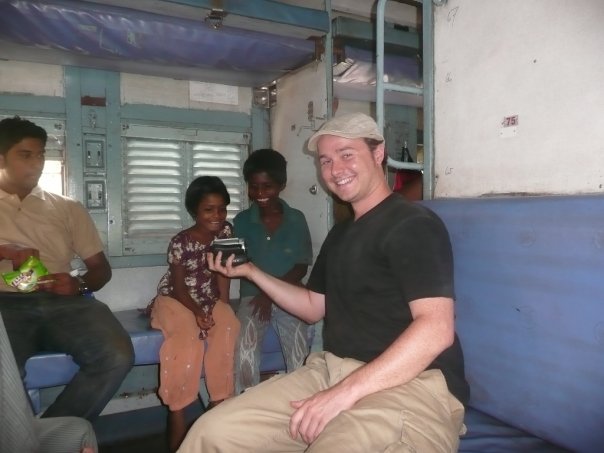
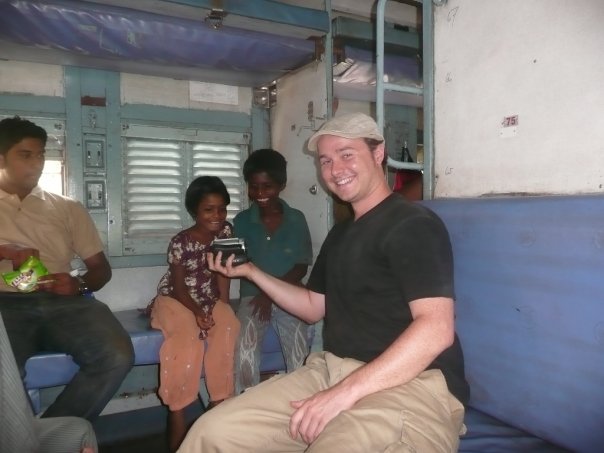
When they were done I handed her the camera to show her the video replay. I don't think I've seen anyone's face ever light up so quickly! (See the main photo of the post as she watches it for the first time.) She looked at me and said something whose meaning seemed clear from the context.
Can I show this to my friends/family real quick??
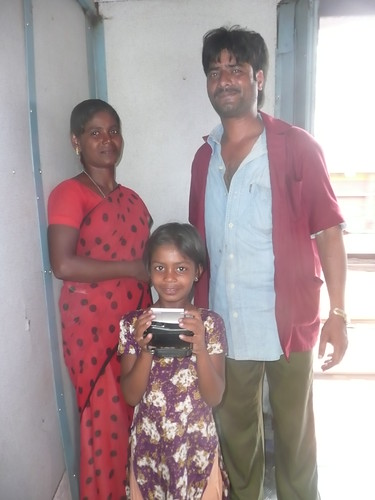
I didn't understand the words, of course, but I was sure she said this. I used a local head gesture I understood as “yes”, and she scurried off. The camera was worth several hundred euro, but I didn't worry about it. A few minutes later she was back, and her father seemed pleased to see me and how happy I had made her.
I generally avoided taking pictures of people since it can be disrespectful, but the mother and daughter team and the father absolutely insisted that I get a shot of them! She was still holding on to the camera, distracted by her own little tiny-TV appearance.
The international language of context
Keep in mind that whatever they were speaking (Hindi? Marathi? Kannada?) I didn't understand a single word of it. But the context gave me confidence that the girl would bring the camera back, and that the family wanted me to take a photo of them. Most importantly, I felt welcome on that train and found my fellow passengers generous, kind and friendly.
People can underestimate their ability to communicate across cultures. Learning the language is a crucial way to do this, but when you are starting off you can still get by if you pay attention to people and context. Gestures differ between cultures, including head movements for “yes” and “no”, but some non-verbal cues can still help human beings understand one another.
Travel is all about discovering the differences, many of them truly beautiful, between cultures. But it has also shown me the vast amount that we all have in common.
We know when others are happy, we can “feel” it in the air that we are welcome or not-welcome, and we can read so much about the situation from non-verbal cues. A typical English-speaking tourist may go for the strategy of just shouting what they are trying to say, but apart from being quite rude and inappropriate, that achieves nothing. It's all about reading people, and trying your best to be understood and get your point across by whatever means necessary.
It's not all about waving your arms frantically or playing charades. Pay attention to expression, posture, gestures and the situation around you, remembering that their meanings can vary by culture. Sometimes the context tells enough of a story to help you connect and even make new friends.
I wasn't learning a new language in India, but when I am learning a new language, I throw myself into using it right from the start. Even if I have just freshly learned only 10 words, I cannot possibly say that I'm “starting from scratch”. I've got almost 3 decades of experience in communicating with human beings, both verbally and non-verbally and that certainly counts for quite a lot.
So please stop worrying about how many words you don't know. In many cases your ability to communicate may be more full than you actually realised.
What do you think? Can the words you fill your language with be less important than you previously thought? Of course, you can't explain very complex concepts without complex language, and I never plan on debating Kantian philosophy by reading context and body language. But sometimes you can manage simple parts of daily life in another culture, even when you are just starting to learn its language.
This is an excellent tool for “filling in the gaps” as you are starting off with a language.

Social